

STM Blog
The fate of Lucky Supermarkets in SoCal

Last Updated on November 26, 2025 by Daily News Staff

Lucky Supermarket located in Lynwood, California 1985. Image Credit: H. Washington
Lucky Supermarkets’ Closure: A Blow to Southern California Communities
Lucky Supermarkets, a beloved chain of supermarkets situated in Southern California, recently declared bankruptcy and shuttered all of its stores. This unfortunate event has had a devastating impact on many local communities, leaving them without a dependable source of groceries and other essential items.
Founded in 1926, Lucky Supermarkets had been a staple in the region for nearly a century. Its stores were often the go-to destination for many Angelenos on their way to work or school, cementing its place as a cherished part of the community. Known for its competitive prices and extensive selection of fresh produce, canned goods, and other products, Lucky Supermarkets offered a shopping experience that was both convenient and budget-friendly.
However, in recent years, the company faced mounting challenges. Fierce competition from larger grocery chains such as Ralphs and Vons began to take its toll. These competitors, with their expansive resources and modernized operations, drew customers away from the more traditional Lucky Supermarkets. Additionally, Lucky Supermarkets struggled to keep pace with evolving technology and industry trends. While other chains embraced online ordering, delivery services, and advanced inventory management systems, Lucky Supermarkets lagged behind, gradually losing its competitive edge.
The onset of the coronavirus pandemic in 2020 further exacerbated the company’s troubles. Public health measures and social distancing led to a significant decline in in-store customer traffic. With revenues dwindling and operational costs remaining fixed, the already-precarious financial situation of Lucky Supermarkets worsened. Despite efforts to adapt, the company could not weather the storm and was ultimately forced to file for bankruptcy in June 2020. Subsequently, all its stores were permanently closed.
The closure of Lucky Supermarkets has had far-reaching ramifications for the communities it served. Residents who once relied on the convenience of nearby stores are now compelled to travel greater distances to access comparable grocery products. This is particularly challenging for vulnerable populations such as the elderly or those without reliable transportation. The loss of the supermarkets also means the loss of hundreds of jobs, leaving former employees grappling with sudden unemployment and uncertainty.
Moreover, the impact of Lucky Supermarkets’ closure extends beyond immediate convenience and employment. For nearly a century, Lucky Supermarkets had been woven into the fabric of community life in Southern California. Its absence represents not just the end of a business, but the end of a cultural touchstone that had played a significant role in the daily lives of many.
This unfortunate development serves as a stark reminder of the importance of innovation and adaptability in the retail industry. While the closure of Lucky Supermarkets is a poignant loss, it underscores the necessity for businesses to evolve in response to changing market dynamics and consumer behaviors.
The bankruptcy and closure of Lucky Supermarkets have left a void in Southern California communities, disrupting daily routines and displacing loyal patrons. The chain’s downfall highlights the critical need for continuous improvement and adaptation to sustain longevity in a competitive market. As communities strive to fill the gap left by Lucky Supermarkets, the legacy of the once-iconic chain will serve as a valuable lesson for businesses in the ever-evolving landscape of retail.
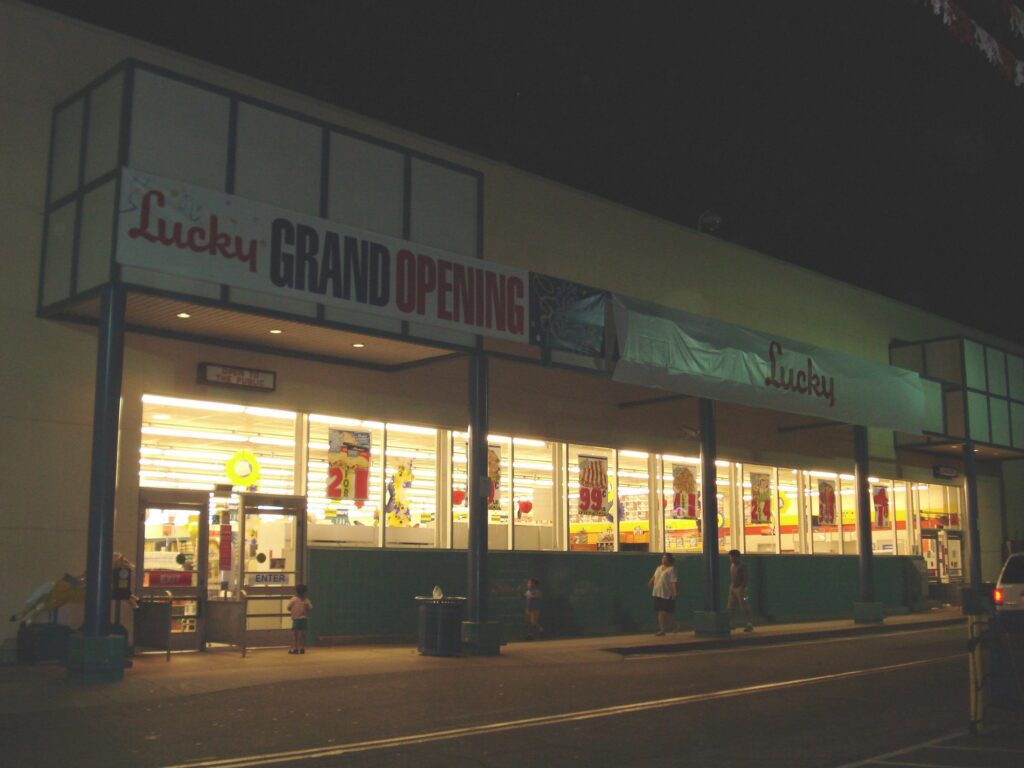
A 2006 rebranded Lucky store (since closed as of February 2010) (Supervalu-owned) at 1000 E. Valley Blvd. in Alhambra, California 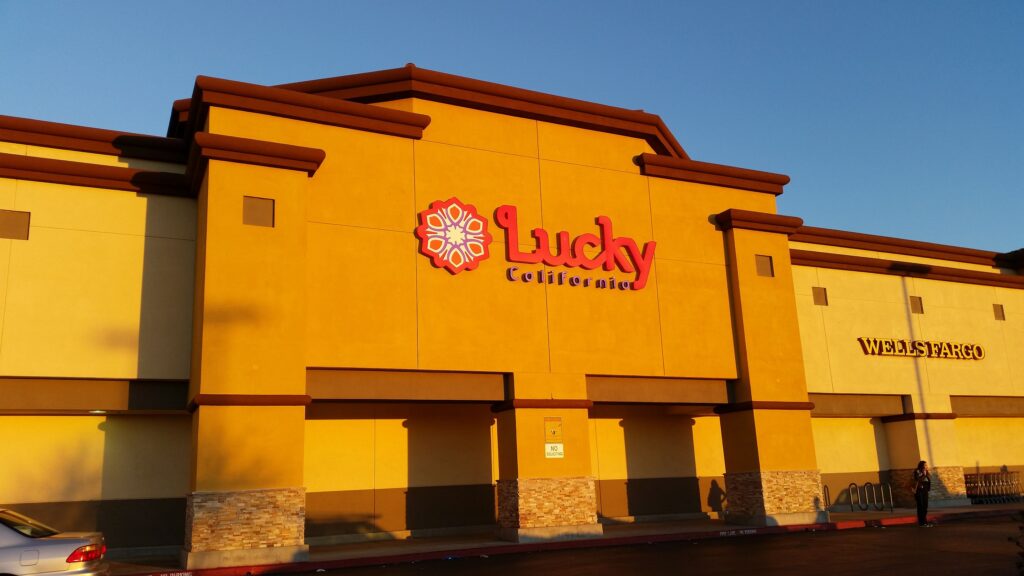
A 2015 rebranded Lucky California concept store in Daly City, California 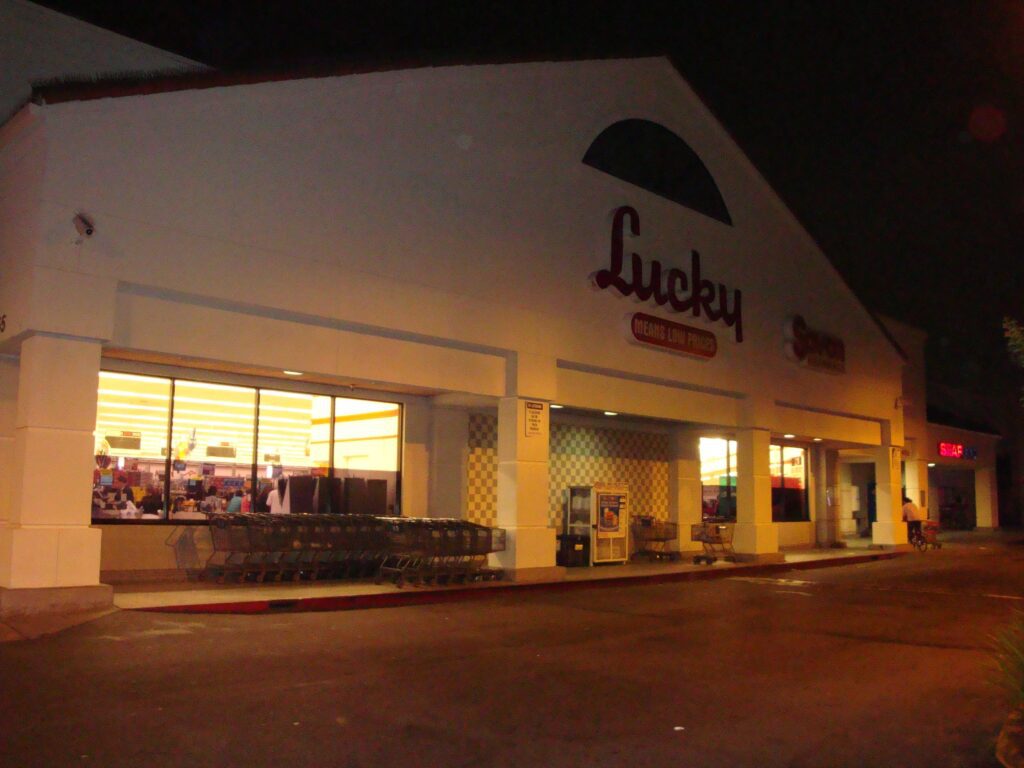
A 2009 rebranded Lucky store (Albertsons-owned) at 4155 Tweedy Blvd in South Gate, California (now closed as of 2020)
Lucky Stores: A Historical Overview
Lucky Stores is an American supermarket chain that originated in San Leandro, California in 1935. Over the decades, Lucky has become a recognizable name in the grocery industry, especially in Northern California. Today, Lucky is operated by Albertsons in Utah and Save Mart Supermarkets in Northern California, including a specific version branded as Lucky California.
Key Milestones in Lucky’s History
- 1935: Lucky Stores is founded in San Leandro, California.
- 1998: Lucky’s parent company, American Stores, is acquired by Albertsons.
- 1999: The Lucky brand is phased out following the acquisition.
- 2006: Albertsons is divided between SuperValu, CVS Pharmacy, and a Cerberus Capital Management-led investment group in a $17.4 billion deal. The Cerberus-acquired stores are re-branded as Albertsons, which then sells its Northern California and Northern Nevada stores to Save Mart Supermarkets.
The Return of Lucky Stores
In 2006, both SuperValu and Save Mart took steps to revive the Lucky brand by re-branding some Albertsons locations as Lucky stores, using the classic logo. This re-branding was designed to capitalize on Lucky’s nostalgic value and strong brand recognition among consumers.
Trademark Controversy
During the same year, Grocery Outlet, an unrelated retailer in Northern California, also began branding some of its stores as Lucky. They argued that Albertsons had forfeited rights to the Lucky trademark after retiring the brand in 1999. However, a legal battle ensued, and on January 4, 2009, a federal judge ruled against Grocery Outlet, determining that Albertsons had maintained continuous use of the Lucky name through various re-branding efforts.
Market Position
SuperValu positioned Lucky as “true neighborhood stores,” aiming to meet the unique needs of individual communities by offering the right products and assortment at competitive prices. This approach has allowed Lucky to maintain its appeal and relevance in a highly competitive market.
Lucky California
In Northern California, Save Mart Supermarkets introduced the Lucky California brand, an iteration created to appeal specifically to the region’s diverse and dynamic consumer base. This version of the retail chain focuses on offering fresh, locally-sourced products and unique culinary experiences, reflecting the rich cultural tapestry of Northern California.
Lucky Stores has weathered numerous changes and challenges, but its commitment to community-focused retailing and quality products has ensured its lasting presence in the American supermarket landscape.
Image Credit:
By JasVe3 at Wikipedia – Self-photographed, CC BY-SA 3.0, https://commons.wikimedia.org/w/index.php?curid=49836380
By JasVe3 – Own work, CC BY-SA 3.0, https://commons.wikimedia.org/w/index.php?curid=7157015
By Dryedmangoez – Own work, CC BY-SA 3.0, https://commons.wikimedia.org/w/index.php?curid=46643056
https://stmdailynews.com/stm-daily-news-vlog


For generations, the Santa Monica Pier sign has marked the start of a day at the beach. Now, the familiar blue neon landmark is preparing for a journey of its own.
Santa Monica scheduled removal of the 1941 sign for October 20–22, with shipment to Las Vegas anticipated October 26. The timetable is subject to change, according to the city’s October 19 announcement.
The temporary removal accompanies replacement of the aging bridge connecting Ocean Avenue to the pier. It also creates an opportunity to preserve the historic sign.
YESCO will restore it at its Las Vegas facility. The company’s experience includes work on the “Welcome to Fabulous Las Vegas” sign.
Crews will repair neon tubing, treat rust, repaint components and address structural needs while retaining historic features. The sign will remain in secure storage during bridge construction.
Once the project is finished, it will return above the new bridge at a slightly greater height for visibility and vehicle clearance. The city’s latest announcement targets project completion by 2028, ahead of the Los Angeles Olympics and Paralympics.
Meanwhile, visitors can photograph a lighted, half-scale replica near Pier Burger.
For anyone who associates that glowing arch with Southern California memories, its absence will be noticeable. The restoration is intended to ensure future generations can make memories beneath it, too.
Source: City of Santa Monica — October 19, 2026 announcement
Related Links
- City of Santa Monica: Official sign restoration announcement — October 19, 2026. Primary source for removal dates, shipment to Las Vegas, YESCO’s restoration work and the sign’s planned return.
- Santa Monica Daily Press: Sign restoration during bridge rebuild — October 20, 2026. Additional local reporting on the project and visitor access.
- LAist: Sign removal and how to watch — Reporting on the removal schedule and public viewing opportunities.
Follow more Southern California stories at STM Daily News.

STM Blog | Commentary | October 14, 2026
The viral allegations involving Texas Roadhouse and the treatment of Black customers raised an understandably disturbing question: Could diners trust that they were being served safely and respectfully?
After reviewing available coverage again on October 14, STM Daily News did not locate new verified evidence establishing that the alleged food tampering occurred. We also did not locate a publicly released final report from the outside firm the company said it hired.
The central distinction remains unchanged: the allegations have not been substantiated in the reporting reviewed, while Texas Roadhouse says its investigation points to a hoax.
What the available reporting says
In August, social media posts alleged that restaurant workers deliberately tampered with food served to Black customers. The claims circulated widely and prompted calls for a boycott. Texas Roadhouse said it had not identified current or former employees connected to the accusations.
In reporting updated August 26, KTXS noted that the viral post did not identify a particular restaurant location and that there was no verified evidence connecting the claims to a Texas Roadhouse employee.
The company told the outlet it had found no credible evidence of food tampering. It also said the original Facebook post had been deleted, some users had retracted posts amplifying the claims, and an outside firm had been engaged to investigate the accusations’ source and motives. These details come from August coverage, rather than a new October announcement.
What remains unresolved publicly
Our latest review did not locate a final outside investigation report that readers could examine. We therefore cannot describe that investigation as complete or independently assess its findings.
The company’s description of the claims as a hoax should continue to be attributed to Texas Roadhouse. Likewise, the allegations should not be repeated as though they describe a confirmed incident.
Not locating a new public report does not establish whether investigative work has continued privately. It means the public information we found does not support a stronger conclusion.
Why careful wording still matters
For Black diners, allegations of racist mistreatment can strike a painful nerve. Everyone deserves to sit down for a meal without worrying that their race could make them a target.
Taking that concern seriously requires credible complaints to be investigated thoroughly. It also requires care before assigning blame to a restaurant, a location, or its workers.
Social media can spread a warning far beyond its original audience before anyone verifies the underlying claim. Once that happens, a correction or clarification may never reach everyone who saw the accusation.
That makes transparency essential. Restaurants should explain what they have investigated and what they can substantiate. Those sharing accusations should be equally willing to share corrections and acknowledge uncertainty.
For now, the responsible position is to keep the evidence and the allegations separate. If new, verifiable findings become public, they should be assessed on their merits.
Join the conversation: What do you look for before trusting a viral warning about a business? Share your thoughts in the comments, and keep the conversation respectful.
Editor’s note: This is an October 14 status review of previously reported allegations. It does not announce a new investigative finding.
Sources
- KTXS: Viral post alleges Texas Roadhouse mistreated Black customers; company responds — Includes the company’s statement and explains the lack of verified evidence connecting the allegations to an employee or location.
- Houston Chronicle: Texas Roadhouse investigates Facebook hoax alleging racist food tampering — Covers the company’s denial and its decision to hire an outside investigative firm.
- MySA: Texas Roadhouse faces social media backlash over viral allegations — Details how the claims spread and the restaurant chain’s response.
Related reading
- Snopes: Posts claim Texas Roadhouse servers contaminated Black customers’ food — Examines the viral allegations.
- Restaurant Business: Texas Roadhouse says post alleging racist practices was a hoax — Restaurant industry coverage of the controversy.
- Texas Roadhouse official website — Company information and customer contact options.
College Life
Is College Worth It? New U.S. News Rankings Put More Weight on What Graduates Earn
Is college worth it? MIT has taken the No. 1 spot in the 2027 U.S. News Best Colleges rankings, ending Princeton’s 15-year run. But a new Earnings by Major metric could be even more important for families asking whether college is worth the investment.
For millions of students and families, choosing a college increasingly comes down to a basic question: Is college worth it?
The latest U.S. News & World Report Best Colleges rankings are attempting to provide another piece of information to help answer that question.
The 2027 rankings place the Massachusetts Institute of Technology (MIT) at No. 1 among National Universities, ending Princeton University’s 15-year run at the top. But perhaps the bigger story for prospective students isn’t which university occupies the No. 1 position.
It’s a significant change in how U.S. News measures the value of attending college.
For the first time, the rankings include an Earnings by Major factor designed to examine what graduates earn after leaving school — and to compare those earnings with graduates who studied the same subjects elsewhere.
Is College Worth It? U.S. News Looks Beyond Graduation
College has traditionally been promoted as an investment in a person’s future. But as families confront tuition, housing expenses and the possibility of student debt, simply earning a degree may no longer be enough information when deciding where — or whether — to attend.
Students increasingly want to know what happens after graduation.
The new U.S. News Earnings by Major metric examines graduate earnings four years after graduation using data from the U.S. Department of Education’s College Scorecard.
Importantly, the system doesn’t simply compare the average salary of graduates from one university with another.
Instead, earnings are compared within specific academic disciplines.
That distinction matters.
A university graduating large numbers of engineers, computer scientists or students entering other relatively high-paying occupations could otherwise appear to produce stronger financial outcomes simply because of the subjects its students choose to study.
Comparing graduates within similar fields is intended to provide a clearer picture of how graduates from different institutions fare financially.
From Student Debt to Graduate Earnings
The new Earnings by Major metric replaces the Graduate Indebtedness factor previously used by U.S. News.
That represents an important shift in perspective.
Instead of focusing primarily on how much debt students accumulate, the new measure looks at one aspect of what students may receive financially from their education after entering the workforce.
The metric examines employed federal financial aid recipients whose highest degree is a bachelor’s degree.
According to U.S. News, the approach is intended to reduce the influence of family financial advantages and provide a better indication of the economic value institutions may contribute to graduates.
That doesn’t mean earnings alone determine whether a college education is worthwhile.
But for a student potentially investing tens of thousands of dollars — and several years of their life — knowing how graduates in a particular major perform economically can be an important part of the decision.
MIT Takes the No. 1 Spot
Against that changing methodology, MIT moved into the No. 1 position among National Universities in the 2027 rankings.
The top three are:
- Massachusetts Institute of Technology
- Princeton University
- Harvard University
Princeton’s move to second place ends a run at No. 1 that began with the 2012 edition of the rankings.
Among National Liberal Arts Colleges, Williams College remained No. 1, followed by Amherst College at No. 2. Bowdoin College, Claremont McKenna College, Pomona College and Swarthmore College tied for third.
Nearly 1,700 institutions were evaluated in the 2027 edition.
Outcomes Are Becoming a Bigger Part of the Equation
The addition of graduate earnings is part of a broader emphasis on student outcomes in the U.S. News methodology.
U.S. News says outcomes now account for more than half of a school’s total score.
Institutions can be evaluated using as many as 17 weighted measures, including graduation and retention rates, social mobility for lower-income students, post-graduate earnings, faculty resources and academic peer assessments.
The shift reflects a changing conversation surrounding higher education.
For generations, students were often encouraged to focus heavily on getting into the most prestigious college possible. Today’s students may also be asking more practical questions:
How much will it cost?
How much financial aid will I receive?
How much debt might I have when I graduate?
What do graduates in my intended major earn?
And perhaps most importantly:
Will the investment pay off for me?
College Value Isn’t Just About Salary
Graduate earnings can provide useful information, but salary shouldn’t be treated as the sole measurement of the value of higher education.
Different careers have dramatically different compensation structures.
A graduate pursuing teaching, public service, social work, the arts or nonprofit work may earn less than someone entering engineering, finance or technology while still considering their education worthwhile.
There are also benefits of higher education that are difficult to capture in a salary statistic.
That’s why students comparing schools may want to look beyond an institution’s overall ranking and examine factors such as net price after financial aid, scholarships, graduation rates, student debt, internship opportunities, career placement, location and the strength of the program they actually intend to study.
The best-known university isn’t automatically the best financial or educational choice for every student.
Economic Diversity Also Gets Attention
The 2027 rankings also highlight economic diversity among highly ranked institutions.
According to U.S. News, MIT and Princeton rank third and fourth, respectively, among the top 25 National Universities in the percentage of students receiving federal Pell Grants.
Pell Grants generally assist undergraduate students with significant financial need and typically do not have to be repaid.
Among the top 25 National Liberal Arts Colleges, Amherst College ranked highest for economic diversity under the U.S. News measure.
A New Ranking Looks at In-State Value
U.S. News is also placing additional attention on affordability for students considering public universities.
The 2027 edition introduces a Best Value Schools for In-State Students ranking, which evaluates public universities based on academic quality and affordability for residents.
The University of North Carolina at Chapel Hill took the No. 1 position in the inaugural ranking.
That category could be particularly relevant to families deciding whether the prestige associated with attending a private or out-of-state university justifies potentially higher costs compared with attending a public institution in their home state.
The Rankings Look Different This Year
There is another important caveat when comparing the 2027 results with previous years.
Changes to the Carnegie Classification framework resulted in approximately 20% of previously ranked institutions moving into different U.S. News categories.
Because some colleges are now being compared against different groups of institutions, their 2027 rankings may not be directly comparable with previous years.
The changes also expanded eligibility, allowing additional institutions specializing in areas such as engineering, business and health to enter the rankings.
U.S. News also introduced an undergraduate economics specialty ranking while continuing rankings covering areas such as social mobility, innovation, historically Black colleges and universities, artificial intelligence programs, internships, undergraduate research and study-abroad opportunities.
Public Universities, HBCUs and Social Mobility
Among public National Universities, the University of California, Berkeley and UCLA tied for the No. 1 position, followed by the University of Michigan–Ann Arbor.
The top three Historically Black Colleges and Universities were:
- Spelman College
- Howard University
- Tuskegee University
For social mobility among National Universities, Florida International University and the University of California, Riverside tied for No. 1, with Oakland City University ranked third.
These categories illustrate another reason students may want to look deeper than a school’s overall national position. Different rankings can reveal institutions performing particularly well in areas that may matter more to an individual student.
So, Is College Worth It?
There isn’t one answer that applies to every student.
The cost of attending, financial aid, chosen major, career goals, likelihood of graduating and potential debt can dramatically change the financial equation.
A college with a famous name and high national ranking could be a poor financial choice for one student while a less prominent public university with generous financial aid could be an excellent investment for another.
That’s what makes the addition of Earnings by Major noteworthy.
Instead of asking only “Which college ranks highest?”, prospective students now have another reason to ask a much more personal question:
“What am I paying for — and what could I realistically get in return?”
MIT replacing Princeton at No. 1 makes the headline.
But for students and parents trying to decide whether college is worth the cost, the growing emphasis on outcomes, affordability and post-graduation earnings may ultimately be the more important story.
Source: U.S. News & World Report, 2027 Best Colleges rankings, released September 22, 2026.
U.S. News & World Report press release:
MIT Claims No. 1 Spot in U.S. News 2027 Best Colleges Rankings PR Newswire
Stay Informed with STM Daily News
From education and personal finance to technology, lifestyle, transportation and the stories shaping our everyday lives, STM Daily News keeps you informed about what matters — and why it matters. Get more news, useful insights and the latest updates by visiting STM Daily News and subscribe to stay connected to the stories worth knowing.




