damircudic/E+ via Getty Images
Erika Squires, Wayne State University and Lucy (Kathleen) McGoron, Wayne State University
Screen time permeates the lives of toddlers and preschoolers. For many young children, their exposure includes both direct viewing, such as watching a TV show, and indirect viewing, such as when media is on in the background during other daily activities.
As many parents will know, research points to several negative effects of screen time. As scholars who specialize in speech pathology and early childhood development, we are particularly interested in the recent finding that too much screen time is associated with less parent-child talk, such as fewer conversational turns between parents and children.
As a result, the American Academy of Pediatrics and World Health Organization suggest limiting screen time for children.
Beyond quantity, they also emphasize the quality of a child’s engagement with digital media. Used in moderation, certain kinds of media can have educational and social benefits for children – and even contribute to language development.
These tips may help parents structure and manage screen time more effectively.
No. 1: Choose high-quality content
Parents can enhance their children’s screen-time value by choosing high-quality media – that is, content with educational benefit. PBS Kids has many popular shows, from “Nature Cat” to “Sid the Science Kid,” that would qualify as educational.
Two other elements contribute to the quality of screen time.
First, screen content should be age-appropriate – that is, parents should choose shows, apps and games that are specifically designed for young children. Using a resource such as Common Sense Media allows parents to check recommended ages for television shows, movies and apps.
Second, parents can look for shows that use evidence-based educational techniques, such as participatory cues. That’s when characters in shows break the “fourth wall” by directly talking to their young audience to prompt reflection, action or response. Research shows that children learn new words better when a show has participatory cues – perhaps because it encourages active engagement rather than passive viewing.
Many classic, high-quality television shows for young children feature participatory cues, including “Mickey Mouse Clubhouse,” “Dora the Explorer,” “Go Diego Go!” and “Daniel Tiger’s Neighborhood.”
No. 2: Join in on screen time
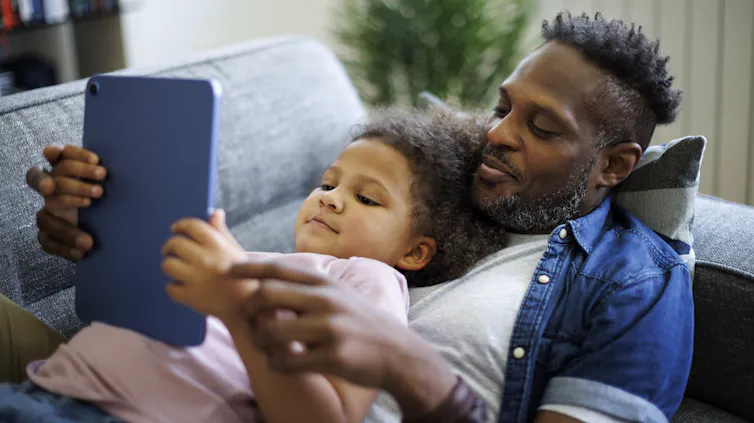
The American Academy of Pediatrics recommends that parents and children watch media together whenever possible.
kbeis/DigitalVision Vectors via Getty Images
This recommendation is based on the evidence that increased screen media use can reduce parent-child conversation. This, in turn, can affect language development. Intentionally discussing media content with children increases language exposure during screen time.
Parents may find the following joint media engagement strategies useful:
- Press pause and ask questions.
- Point out basic concepts, such as letters and colors.
- Model more advanced language using a “think aloud” approach, such as, “That surprised me! I wonder what will happen next?”
No. 3: Connect what’s on screen to real life
Learning from media is challenging for young children because their brains struggle to transfer information and ideas from screens to the real world. Children learn more from screen media, research shows, when the content connects to their real-life experiences.
To maximize the benefits of screen time, parents can help children connect what they are viewing with experiences they’ve had. For example, while watching content together, a parent might say, “They’re going to the zoo. Do you remember what we saw when we went to the zoo?”
This approach promotes language development and cognitive skills, including attention and memory. Children learn better with repeated exposure to words, so selecting media that relates to a child’s real-life experiences can help reinforce new vocabulary.
No. 4: Enjoy screen-free times
Ensuring that a child’s day is filled with varied experiences, including periods that don’t involve screens, increases language exposure in children’s daily routines.
Two ideal screen-free times are mealtimes and bedtime. Mealtimes present opportunities for back-and-forth conversation with children, exposing them to a lot of language. Additionally, bedtime should be screen-free, as using screens near bedtime or having a TV in children’s bedrooms disrupts sleep.
Alternatively, devoting bedtime to reading children’s books accomplishes the dual goals of helping children wind down and creating a language-rich routine.
Having additional screen-free, one-on-one, parent-child play for at least 10 minutes at some other point in the day is good for young children. Parents can maximize the benefits of one-on-one play by letting their children decide what and how to play.
Vera Livchak/Moment via Getty Images
A parent’s role here is to follow their child’s lead, play along, give their child their full attention – so no phones for mom or dad, either – and provide language enrichment. They can do this by labeling toys, pointing out shapes, colors and sizes. It can also be done by describing activities – “You’re rolling the car across the floor” – and responding when their child speaks.
Parent-child playtime is also a great opportunity to extend interests from screen time. Including toys of your child’s favorite characters from the shows or movies they love in playtime transforms that enjoyment from screen time into learning.
Erika Squires, Assistant Professor, Wayne State University and Lucy (Kathleen) McGoron, Assistant Professor of Child and Family Development, Wayne State University
This article is republished from The Conversation under a Creative Commons license. Read the original article.



 Brunching with Bunnies
 SOURCE: