

Economy
Trump’s ‘golden age’ economic message undercut by his desire for much lower interest rates – which typically signal a weak jobs market

Joshua Stillwagon, Babson College
President Donald Trump seems to want to have it both ways on the U.S. economy.
On the one hand, he recently said the economy is in its “golden age” and referred to the U.S. as the “hottest country anywhere in the world.”
Yet at the same time, he has outright demanded that the Federal Reserve sharply slash interest rates to fuel economic activity. And his recently handpicked governor, Stephen Miran, has led the charge in pushing for a bigger cut than preferred by his new colleagues at the Fed.
When an economy is strong, central banks typically don’t cut interest rates and may even raise them to avoid spurring inflation. And so to support his argument for large cuts, Miran has played up “downside risks” to the economy and a weakening labor market, contrasting with Trump’s talk of a “golden age.”
Trump and Miran also seem to be ignoring the problem of inflation, which the president has said “has been defeated” and Miran considers close enough to the Fed’s target of 2%. Yet, inflation remains high and has been picking back up in recent months – one of the core reasons the Fed has taken a gradual approach to lowering interest rates.
I’m a macroeconomist, which means I study big-picture factors affecting an economy, such as interest rates.
It’s well known that lower rates spur faster growth, and of course all presidents want a stronger economy on their watch. But the Fed’s job when it sets interest rates is to deal with whatever reality the data shows – and make decisions accordingly.
Is the economy hot or not?
In the simplest terms, the Fed raises interest rates when the economy is “hot,” or inflation is above the Fed’s 2% target, and lowers them when there are concerns about unemployment.
At its most recent meeting, in September, the Fed lowered rates a quarter of a point, citing slowing jobs growth, and increased economic uncertainty. Trump nominee Miran was the only one of the 12 members of the Fed’s policy-setting committee to instead vote for a more aggressive half-point cut.
The only credible rationale for that large of an interest rate cut, in the face of still-high inflation, is by believing the labor market is incredibly weak. According to the Fed’s preferred measure, the personal consumption expenditures index, inflation has been accelerating all summer and was 2.7% at the end of August, well above the Fed’s 2% target.
There’s no doubt jobs growth has slowed considerably in recent months, but enough to completely ignore the risk of driving inflation higher? At this point at least, the Fed doesn’t think so.
And if the economy were in fact running hot, as the president claims, the Fed would have little choice but to keep rates flat or raise them, especially given elevated inflation.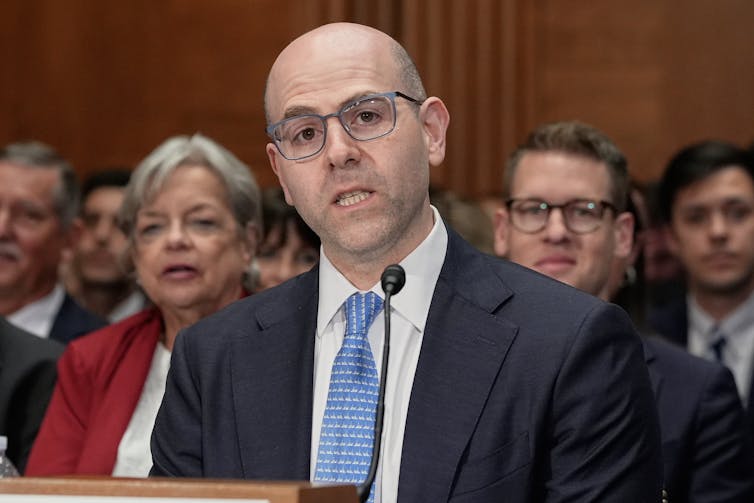
Risks of following political whims
This situation gets at the heart of why central bank independence matters.
Trump’s efforts to influence the Federal Reserve have not been subtle and break with Congress’ intention to insulate the Fed from political manipulation. Besides pressing for big rate cuts, he has tried to fire a member of the Board of Governors over questionable allegations and mused about removing Fed Chair Jerome Powell.
The risks of following the wishes of a president in the face of what the data shows were starkly demonstrated in 2021, when Turkey’s president, Recep Tayyip Erdogan, fired the head of the country’s central bank. The central banker was pushing rates higher to tame inflation, which was at about 20%, but Erdogan demanded they be lowered. In response, Turkey’s lira plunged to record lows and inflation soared to over 70% in 2022.
Something similar could happen in the U.S. if Trump continues down the same path of meddling with the Fed. As a sign of how much Wall Street worries about this risk, a recent study estimated that if Trump followed through on his threat to fire Powell, the stock market could lose an estimated US$1 trillion as a result.
That’s because the Fed’s credibility rests on its ability to make decisions driven by economic evidence, not political expedience. That independence means policymakers must weigh data on inflation, jobs and growth rather than election cycles or partisan demands.
Justifying deeper rate cuts
Looking ahead to the Fed’s next meeting Oct. 28-29, policymakers face a delicate balancing act. With inflation still running above target and signs of slowing jobs growth, it needs to lower rates enough to prevent a downturn but not so low that inflation spirals out of control.
Traders are putting near-100% odds of two more quarter-point cuts this year, one on Oct. 29 and another in December. This would bring the Fed’s benchmark interest rate to a range of 3.5%-3.75% by the end of 2025, down from 4%-4.25% now.
Based on Miran’s own interest rate projections, he’s likely to again push for a larger cut of a half-point or more at both meetings, as he believes the Fed’s benchmark rate should be below 3% by the end of the year.
To me, as an economist, the only way a Fed acting independently could reasonably justify such a significant cut in rates in the next few months is if the unemployment rate begins rising steadily, with the economy clearly at risk of slipping into a recession.
Joshua Stillwagon, Associate Professor of Economics, Babson College
This article is republished from The Conversation under a Creative Commons license. Read the original article.


The Knowledge
Where Does Federal Money Go? The Biggest Costs Behind the Budget
Where does federal money go? Part two of our National Debt Explained series examines the biggest expenses in the 2025 budget and how spending connects to government borrowing.

Last Updated on October 13, 2026 by Daily News Staff
The Knowledge | National Debt Explained, Part 2
When discussing debt, ask: Who borrowed the money? That question helps distinguish a family’s finances from the federal budget. Our first episode explained why your credit card balance is separate from the national debt. Now comes the next question: What does the federal government spend money on?
Much of it pays for retirement benefits, health coverage, national defense, public services, and interest on previous borrowing.
Social Security was the largest individual program in fiscal year 2025, costing approximately $1.6 trillion. But combine the major health care programs—including Medicare, Medicaid, and health insurance subsidies—and their spending reached about $1.8 trillion, exceeding Social Security alone. cbo.gov
The figures below cover October 1, 2024, through September 30, 2025.Major expense FY 2025 spending What it supports Social Security About $1.6 trillion Retirement, survivor, and disability benefits Medicare, net $988 billion Health coverage for older adults and certain people with disabilities Net interest $970 billion Cost of servicing publicly held federal debt, after subtracting interest income Discretionary defense $893 billion Military personnel, operations, equipment, and research Medicaid $668 billion Federal contribution toward health coverage and care for eligible people
These are selected expenses, not the entire budget. Medicare spending is shown after premiums and other offsetting receipts. The combined health care total already includes Medicare and Medicaid, so it should not be added to those rows. cbo.gov
The government also supports veterans’ health care, transportation, education, housing assistance, courts, law enforcement, scientific research, disaster response, and environmental protection. Nondefense discretionary spending totaled approximately $980 billion in 2025, covering many of these services. Some funding for these areas falls elsewhere in the budget. cbo.gov
Federal spending falls into three broad groups:
- Mandatory spending: Payments governed by existing eligibility rules and benefit formulas, including Social Security and major health programs.
- Discretionary spending: Funding lawmakers control through appropriations legislation, including most defense spending and many public services.
- Net interest: The expense of servicing publicly held federal debt, minus government interest income. cbo.gov
Interest deserves attention because it pays for borrowing already undertaken. In 2025, net interest exceeded discretionary defense spending. Congressional Budget Office
A program’s cost does not automatically translate into an equal increase in national debt. Taxes and other receipts finance much of federal spending. Social Security and Medicare’s hospital insurance program receive dedicated payroll taxes, while Medicare also collects premiums.
In 2025, federal spending totaled approximately $7 trillion, compared with $5.2 trillion in revenue. The roughly $1.8 trillion shortfall was the deficit, requiring borrowing. Understanding national debt therefore means examining both what government spends and what it collects. cbo.gov
Explore more explanations behind the headlines at STM Daily News, home of The Knowledge.
Sources for this episode
- CBO: The Federal Budget in Fiscal Year 2025 — Overview of spending, revenue, deficits, and debt interest.
- CBO: Mandatory Spending in Fiscal Year 2025 — Breakdown of Social Security, Medicare, Medicaid, and other benefit programs.
- CBO: Discretionary Spending in Fiscal Year 2025 — Defense spending and services including transportation, education, and veterans’ health care.
- CBO: Overview of the FY 2025 Budget Infographics — Highlights the largest expenses and broader budget trends.
Related reading
- U.S. Treasury: Understanding the National Debt — What federal debt represents and how borrowing works.
- U.S. Treasury: Understanding the National Deficit — Explains the difference between an annual deficit and accumulated debt.
- U.S. Treasury: Federal Spending — Additional context about where federal money goes.

Daily News
Whose Debt Is the National Debt?
The national debt isn’t Americans’ credit card balances added together. This simple explainer separates federal borrowing from household debt and explains the difference between debt and a deficit.
Last Updated on October 11, 2026 by Daily News Staff
The Knowledge | STM Daily News
When you hear “national debt,” do you picture everyone’s credit card balances added together? The name can create that impression, but the national debt and household debt measure different borrowing.
The U.S. national debt is money the federal government owes. Your personal credit card balance is not included.
Federal debt versus household debt
The Treasury defines national debt as the federal government’s total outstanding borrowing accumulated over the country’s history. Household debt covers borrowing by individuals and families, including mortgages, credit cards, auto loans, and student loans.
|Type of debt |Who borrowed? |Examples |
|————–|————————|————————————————–|
|National debt |Federal government |Outstanding Treasury securities |
|Household debt|Individuals and families|Credit cards, mortgages, auto loans, student loans|
Putting a $500 purchase on your credit card increases your personal balance. It does not add $500 to the national debt.
How does the national debt grow?
When federal spending exceeds tax collections and other revenue, the government runs a budget deficit. Treasury sells securities to borrow money to cover the gap.
Consider a simplified, hypothetical example: the government collects $5 trillion and spends $6 trillion in one year. That leaves a $1 trillion deficit requiring financing.
A deficit measures a shortfall over a period, usually a year. Debt measures outstanding borrowing accumulated over time. Repeated deficits generally increase that debt. Interest on existing borrowing is also a federal expense.
Does paying off your credit card reduce the national debt?
Paying off a card reduces what you owe your lender. It does not directly repay Treasury borrowing. Household debt and government debt can influence the same economy, but they remain separate obligations.
When discussing debt, ask: Who borrowed the money? That one question helps distinguish a family’s finances from the federal budget.
Find more explanations of the ideas behind the headlines at STM Daily News, home of The Knowledge.
Sources
● U.S. Treasury: Understanding the National Debt
● U.S. Treasury: Understanding the National Deficit
● Federal Reserve Bank of New York: Household Debt and Credit Report
Last Updated on September 17, 2026 by Daily News Staff
HOLLYWOOD, Calif. — Paramount’s century-long connection to Hollywood could be facing one of its biggest challenges yet, as the entertainment giant reportedly prepares for the possibility of moving major operations out of California amid an escalating legal battle over its proposed acquisition of Warner Bros. Discovery.
Paramount has informed the offices of Los Angeles Mayor Karen Bass and California Attorney General Rob Bonta that it is prepared to formally announce plans to leave California, according to reporting Wednesday from TheWrap. Paramount has not formally announced a relocation, and a company spokesperson declined to comment to the publication.
The potential move centers on Paramount Skydance’s proposed approximately $110 billion acquisition of Warner Bros. Discovery, a deal being challenged on antitrust grounds by California and a coalition of 11 other states, along with a separate challenge from the Writers Guild of America. California Attorney General Rob Bonta argues that combining the two entertainment companies could reduce competition, potentially leading to higher prices and fewer choices for consumers.
A court agreement currently prevents Paramount and Warner Bros. Discovery from completing the merger until June 1, 2027, or until after a court decision on the states’ claims, whichever comes first. The antitrust case is scheduled for trial in March 2027.
Paramount’s Hollywood Future
At the center of the controversy is Paramount’s historic studio complex at 5555 Melrose Avenue in Hollywood, one of the entertainment industry’s most recognizable properties.
The Los Angeles Times reported that Paramount CEO David Ellison has told associates that he would prefer to remain in Los Angeles. However, Paramount’s board has reportedly approved a contingency plan that could move the company’s headquarters out of Hollywood, and Ellison has indicated that the company is prepared to sell its historic studio properties and relocate operations if the merger remains stalled.
Tennessee, Texas and Georgia have emerged in reports as potential destinations should Paramount ultimately decide to relocate.
The financial pressure is significant. Beginning October 1, Paramount faces a roughly $7 million-per-day additional payment obligation tied to delays in completing the Warner Bros. Discovery transaction. Paramount has asked the federal court to require the states and the Writers Guild of America to post a $1.88 billion bond to cover potential costs associated with the delay.
What’s at Stake for Los Angeles?
A Paramount departure could extend far beyond the loss of a famous Hollywood address.
An economic analysis cited by TheWrap estimates that a large-scale Paramount departure could put as many as 57,980 full-time jobs, $21.2 billion in annual economic output and approximately $1.17 billion in state and local tax revenue at risk. Those figures represent an economic-impact scenario rather than a prediction that all of those losses would necessarily occur.
There are competing concerns about the merger itself. Los Angeles County analysis has estimated that completing the Paramount-Warner Bros. combination could also eliminate thousands of entertainment and related jobs because of consolidation. Opponents of the merger, including entertainment unions, have raised concerns about reduced competition and employment, while supporters argue that reaching a settlement could help prevent Paramount from moving operations out of California.
Mayor Bass has said she remains focused on protecting Los Angeles entertainment jobs and keeping Hollywood’s entertainment industry centered in the city. Bonta’s office, meanwhile, has maintained that California will continue enforcing its antitrust laws while remaining open to good-faith discussions. There is still an opportunity for the dispute to be resolved before Paramount makes a final decision about its California operations. Paramount Skydance and representatives for California Attorney General Rob Bonta are scheduled to participate in court-ordered settlement talks on October 14 and 15. The discussions could potentially resolve the antitrust dispute and clear a path for Paramount’s proposed Warner Bros. Discovery acquisition. For now, Paramount has made no official announcement that it is leaving California. The company declined to comment on reports Wednesday that it was preparing to announce a departure. That leaves the future of Paramount’s Hollywood operations — including its historic Melrose Avenue studio — uncertain as the legal and financial pressure surrounding the merger continues to build. Settlement Talks Scheduled
For now, the gates at Paramount remain firmly planted on Melrose Avenue.
Settlement Talks Scheduled
There is still an opportunity for the dispute to be resolved before Paramount makes a final decision about its California operations.
Paramount Skydance and representatives for California Attorney General Rob Bonta are scheduled to participate in court-ordered settlement talks on October 14 and 15. The discussions could potentially resolve the antitrust dispute and clear a path for Paramount’s proposed Warner Bros. Discovery acquisition.
For now, Paramount has made no official announcement that it is leaving California. The company declined to comment on reports Wednesday that it was preparing to announce a departure.
That leaves the future of Paramount’s Hollywood operations — including its historic Melrose Avenue studio — uncertain as the legal and financial pressure surrounding the merger continues to build.uilding around the Warner Bros. Discovery deal, the question of whether one of Hollywood’s most historic studios will continue calling California home has moved from speculation to a potentially consequential decision for Los Angeles and its entertainment industry.
STM Daily News will continue monitoring the Paramount-Warner Bros. Discovery dispute and what it could mean for Hollywood, entertainment workers and the future of film and television production in California.
Source and Related Reading
- California Attorney General — Agreement Halting Paramount/Warner Bros. Merger — Primary source explaining the states’ antitrust challenge and agreement delaying completion of the merger.
- Los Angeles Times — Paramount and Bonta Ordered Into Settlement Talks — Reports the October 14–15 settlement meetings and current state of the dispute.
- Los Angeles Times — Paramount’s Possible Hollywood Exit — Detailed reporting on the relocation contingency, potential destinations and implications for Los Angeles.
- Reuters — DOJ Backs Bond Demand in Paramount-Warner Fight — Covers the $1.88 billion bond dispute, $7 million daily fee and March trial.
- TheWrap — Paramount Preps California Exit — Reports the latest developments surrounding Paramount’s potential departure.




