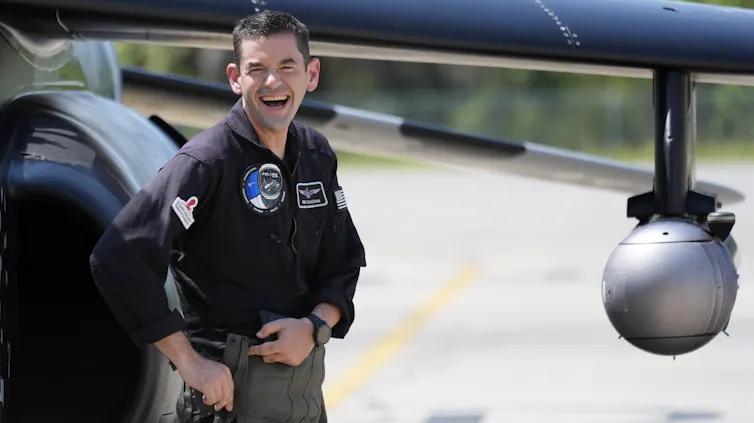
Jared Isaacman, the nominee for next NASA administrator, has traveled to orbit on two commercial space missions. AP Photo/John RaouxWendy Whitman Cobb, Air University Jared Isaacman, billionaire, CEO and nominee to become the next NASA administrator, faced questions on April 9, 2025, from members of the Senate Committee on Commerce, Science, and Transportation during his confirmation hearing for the position. Should the Senate confirm him, Isaacman will be the first billionaire – but not the first astronaut – to head NASA. Perhaps even more significant, he will be the first NASA administrator with significant ties to the commercial space industry. As a space policy expert, I know that NASA leadership matters. The head of the agency can significantly shape the missions it pursues, the science it undertakes and, ultimately, the outcome of America’s space exploration.Jared Isaacman speaks at a news conference in 2024, before his Polaris Dawn mission.AP Photo/John Raoux, File
An unconventional background
At 16 years old, Isaacman dropped out of high school to start a payment processing company in his basement. The endeavor succeeded and eventually became known as Shift4. Though he found early success in business, Isaacman also had a love for aviation. In 2009, he set a record for flying around the Earth in a light jet, beating the previous record by more than 20 hours. While remaining CEO of Shift4, Isaacman founded another company, Draken International. The company eventually assembled the world’s largest fleet of privately owned fighter jets. It now helps to train U.S. Air Force pilots. In 2019, Isaacman sold his stake in Draken International. In 2020, he took Shift4 public, making him a billionaire. Isaacman continued to branch out into aerospace, working with SpaceX beginning in 2021. He purchased a crewed flight on the Falcon 9 rocket, a mission that eventually was called Inspiration4. The mission, which he led, represented the first private astronaut flight for SpaceX. It sent four civilians with no previous formal space experience into orbit. Following the success of Inspiration4, Isaacman worked with SpaceX to develop the Polaris Program, a series of three missions to help build SpaceX’s human spaceflight capabilities. In fall 2024, the first of these missions, Polaris Dawn, launched. Polaris Dawn added more accomplishments to Isaacman’s resume. Isaacman, along with his crewmate Sarah Gillis, completed the first private spacewalk. Polaris Dawn’s SpaceX Dragon capsule traveled more than 850 miles (1,367 kilometers) from Earth, the farthest distance humans had been since the Apollo missions.The Polaris Dawn mission launched on a SpaceX Falcon 9 rocket in September 2024.AP Photo/John Raoux
The next adventure: NASA
In December 2024, the incoming Trump administration announced its intention to nominate Isaacman for the post of NASA administrator. As NASA administrator, Isaacman would oversee all NASA activities at a critical moment in its history. The Artemis program, which has been in progress since 2017, has several missions planned for the next few years. This includes 2026’s Artemis II mission, which will send four astronauts to orbit the Moon. Then, in 2027, Artemis III will aim to land on it.If the mission proceeds as planned, the Artemis II crew will fly in an Orion crew capsule, pictured behind them, around the Moon in 2026.Kim Shiflett/NASA via AP, File But, if Isaacman is confirmed, his tenure would come at a time when there are significant questions about the Artemis program, as well as the extent to which NASA should use commercial space companies like SpaceX. The agency is also potentially facing funding cuts. Some in the space industry have proposed scrapping the Artemis program altogether in favor of preparing to go to Mars. Among this group is the founder of SpaceX, Elon Musk. Others have suggested canceling NASA’s Space Launch System, the massive rocket that is being used for Artemis. Instead, they argue that NASA could use commercial systems, like SpaceX’s Starship or Blue Origin’s New Glenn. Isaacman has also dealt with accusations that he is too close to the commercial space industry, and SpaceX in particular, to lead NASA. This has become a larger concern given Musk’s involvement in the Trump administration and its cost-cutting efforts. Some critics are worried that Musk would have an even greater say in NASA if Isaacman is confirmed. Since his nomination, Isaacman has stopped working with SpaceX on the Polaris Program. He has also made several supportive comments toward other commercial companies. But the success of any of NASA’s plans depends on having the money and resources necessary to carry them out. While NASA has been spared major cuts up to this point, it, like many other government agencies, is planning for budget cuts and mass firings. These potential cuts are similar to what other agencies such as the Department of Health and Human Services have recently made. During his confirmation hearing, Isaacman committed to keeping the Artemis program, as well as the Space Launch System, in the short term. He also insisted that NASA could both return to the Moon and prepare for Mars at the same time. Although Isaacman stated that he believed NASA had the resources to do both at the same time, the agency is still in a time of budget uncertainty, so that may not be possible. About his relationship with Musk, Isaacman stated that he had not talked to Musk since his nomination in November, and his relationship with SpaceX would not influence his decisions. Additionally, he committed to carrying out space science missions, specifically to “launch more telescopes, more probes, more rovers.” But since NASA is preparing for significant cuts to its science budget, there is some speculation that the agency may need to end some science programs, like the Hubble space telescope, altogether.
Isaacman’s future
Isaacman has received support from the larger space community. Nearly 30 astronauts signed a letter in support of his nomination. Former NASA administrators, as well as major industry groups, have signaled their desire for Isaacman’s confirmation. He also received the support of Senator Ted Cruz, the committee chair. Barring any major development, Isaacman will likely be confirmed as NASA administrator by the Senate in the coming weeks. The Committee on Commerce, Science, and Transportation could approve his nomination once it returns from a two-week break at the end of April. A full vote from the Senate would follow. If the Senate does confirm him, Isaacman will have several major issues to confront at NASA, all in a very uncertain political environment.Wendy Whitman Cobb, Professor of Strategy and Security Studies, Air University This article is republished from The Conversation under a Creative Commons license. Read the original article.
Most of us still call them UFOs – unidentified flying objects. NASA recently adopted the term “unidentified anomalous phenomena,” or UAP. Either way, every few years popular claims resurface that these things are not of our world, or that the U.S. government has some stored away.
I’m a sociologist who focuses on the interplay between individuals and groups, especially concerning shared beliefs and misconceptions. As for why UFOs and their alleged occupants enthrall the public, I’ve found that normal human perceptual and social processes explain UFO buzz as much as anything up in the sky.
Historical context
Like political scandals and high-waisted jeans, UFOs trend in and out of collective awareness but never fully disappear. Thirty years of polling find that 25%-50% of surveyed Americans believe at least some UFOs are alien spacecraft. Today in the U.S., over 100 million adults think our galactic neighbors pay us visits.
It wasn’t always so. Linking objects in the sky with visiting extraterrestrials has risen in popularity only in the past 75 years. Some of this is probably market-driven. Early UFO stories boosted newspaper and magazine sales, and today they are reliable clickbait online.
In 1980, a popular book called “The Roswell Incident” by Charles Berlitz and William L. Moore described an alleged flying saucer crash and government cover-up 33 years prior near Roswell, New Mexico. The only evidence ever to emerge from this story was a small string of downed weather balloons. Nevertheless, the book coincided with a resurgence of interest in UFOs. From there, a steady stream of UFO-themed TV shows, films, and pseudo-documentaries has fueled public interest. Perhaps inevitably, conspiracy theories about government cover-ups have risen in parallel.
Some UFO cases inevitably remain unresolved. But despite the growing interest, multiple investigations have found no evidence that UFOs are of extraterrestrial origin – other than the occasional meteor or misidentification of Venus.
But the U.S. Navy’s 2017 Gimbal video continues to appear in the media. It shows strange objects filmed by fighter jets, often interpreted as evidence of alien spacecraft. And in June 2023, an otherwise credible Air Force veteran and former intelligence officer made the stunning claim that the U.S. government is storing numerous downed alien spacecraft and their dead occupants. https://www.youtube.com/embed/2TumprpOwHY?wmode=transparent&start=0 UFO videos released by the U.S. Navy, often taken as evidence of alien spaceships.
Human factors contributing to UFO beliefs
Only a small percentage of UFO believers are eyewitnesses. The rest base their opinions on eerie images and videos strewn across both social media and traditional mass media. There are astronomical and biological reasons to be skeptical of UFO claims. But less often discussed are the psychological and social factors that bring them to the popular forefront.
Many people would love to know whether or not we’re alone in the universe. But so far, the evidence on UFO origins is ambiguous at best. Being averse to ambiguity, people want answers. However, being highly motivated to find those answers can bias judgments. People are more likely to accept weak evidence or fall prey to optical illusions if they support preexisting beliefs.
Advertisement
For example, in the 2017 Navy video, the UFO appears as a cylindrical aircraft moving rapidly over the background, rotating and darting in a manner unlike any terrestrial machine. Science writer Mick West’s analysis challenged this interpretation using data displayed on the tracking screen and some basic geometry. He explained how the movements attributed to the blurry UFO are an illusion. They stem from the plane’s trajectory relative to the object, the quick adjustments of the belly-mounted camera, and misperceptions based on our tendency to assume cameras and backgrounds are stationary.
West found the UFO’s flight characteristics were more like a bird’s or a weather balloon’s than an acrobatic interstellar spacecraft. But the illusion is compelling, especially with the Navy’s still deeming the object unidentified.
Anyone, including pilots and intelligence officers, can be socially influenced to see things that aren’t there. Research shows that hearing from others who claim to have seen something extraordinary is enough to induce similar judgments. The effect is heightened when the influencers are numerous or higher in status. Even recognized experts aren’t immune from misjudging unfamiliar images obtained under unusual conditions.
Group factors contributing to UFO beliefs
“Pics or it didn’t happen” is a popular expression on social media. True to form, users are posting countless shaky images and videos of UFOs. Usually they’re nondescript lights in the sky captured on cellphone cameras. But they can go viral on social media and reach millions of users. With no higher authority or organization propelling the content, social scientists call this a bottom-up social diffusion process.
In contrast, top-down diffusion occurs when information emanates from centralized agents or organizations. In the case of UFOs, sources have included social institutions like the military, individuals with large public platforms like U.S. senators, and major media outlets like CBS.The left image shows bottom-up diffusion, in which information spreads from person to person. The right shows top-down, in which information spreads from one authority. Barry Markovsky
Amateur organizations also promote active personal involvement for many thousands of members, the Mutual UFO Network being among the oldest and largest. But as Sharon A. Hill points out in her book “Scientifical Americans,” these groups apply questionable standards, spread misinformation and garner little respect within mainstream scientific communities.
Top-down and bottom-up diffusion processes can combine into self-reinforcing loops. Mass media spreads UFO content and piques worldwide interest in UFOs. More people aim their cameras at the skies, creating more opportunities to capture and share odd-looking content. Poorly documented UFO pics and videos spread on social media, leading media outlets to grab and republish the most intriguing. Whistleblowers emerge periodically, fanning the flames with claims of secret evidence.
The science section of our news blog STM Daily News provides readers with captivating and up-to-date information on the latest scientific discoveries, breakthroughs, and innovations across various fields. We offer engaging and accessible content, ensuring that readers with different levels of scientific knowledge can stay informed. Whether it’s exploring advancements in medicine, astronomy, technology, or environmental sciences, our science section strives to shed light on the intriguing world of scientific exploration and its profound impact on our daily lives. From thought-provoking articles to informative interviews with experts in the field, STM Daily News Science offers a harmonious blend of factual reporting, analysis, and exploration, making it a go-to source for science enthusiasts and curious minds alike. https://stmdailynews.com/category/science/
Why can’t it always be summer? It’s all about the Earth’s tilt
Earth’s axial tilt causes the seasons. As Earth orbits the Sun, different hemispheres tilt toward or away, creating summer and winter depending on location.
Why can’t it always be summer? – Amanda, age 5, Chile
With its long days just itching to be spent by water doing nothing, summer really can be an enchanting season. As Jenny Han wrote in the young adult novel “The Summer I Turned Pretty”: “Everything good, everything magical happens between the months of June and August.”
But all good things must come to an end, and summer cannot last forever. There’s both a simple reason and a more complicated one. The simple reason is that it can’t always be summer because the Earth is tilted. The more complicated answer requires some geometry.
I’m a professor of geography and the environment who has studied seasonal changes on the landscape. Here’s what seasons have to do with our planet’s position as it moves through the solar system.
This animation shows why the Earth has seasons.
Closeness to the Sun doesn’t explain seasons
First, you need to know that the Earth is a sphere – technically, an oblatespheroid. That means Earth has a round shape a little wider than it is tall.
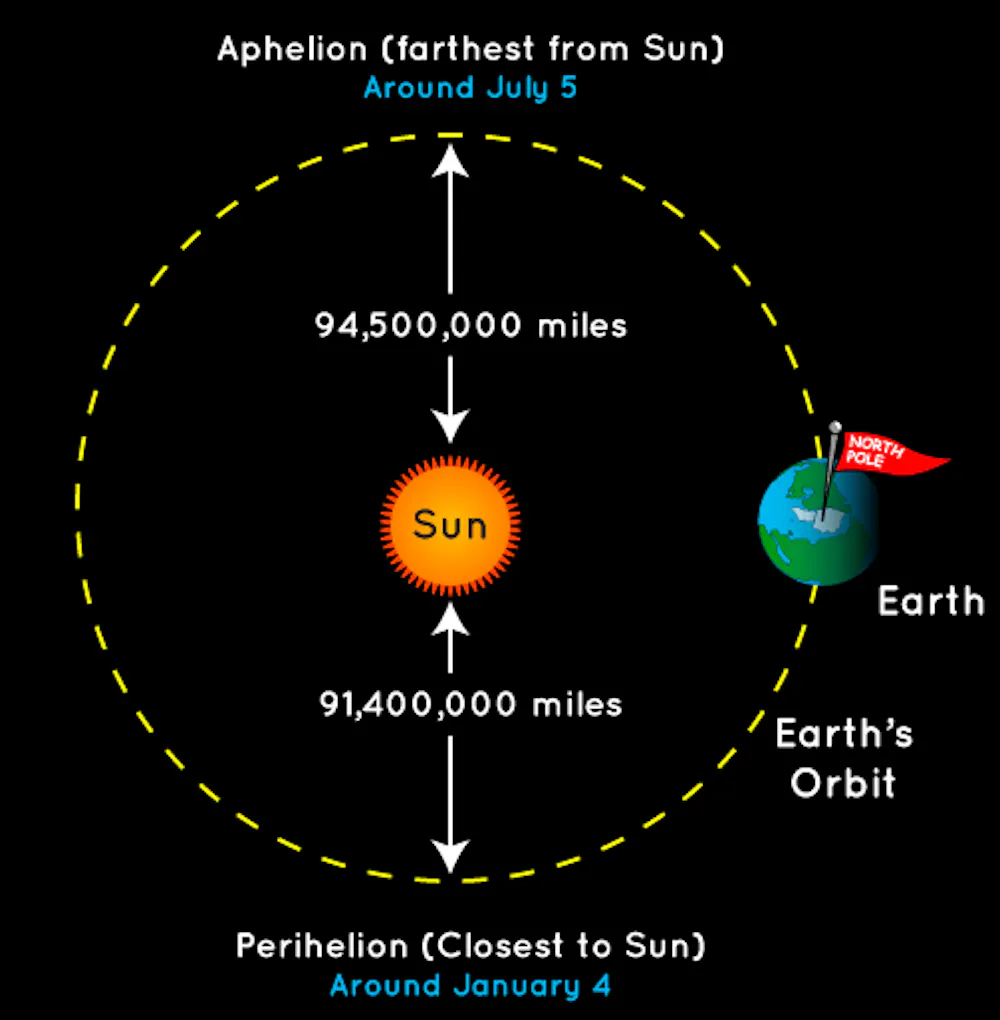
Every year, Earth travels in its orbit to make one revolution around the Sun. The Earth’s orbit is an ellipse, which is more like an oval than a circle. So there are times when Earth is closer to the Sun and times when it’s farther away.
A lot of people assume this distance is why we have seasons. But these people would be wrong. In the United States, the Earth is 3 million miles closer to the Sun during winter than in the summer.Our distance from the Sun is not why we have seasons. NASA
Spinning like a top
Now picture an imaginary line across Earth, right in the middle, at 0° latitude. This line is called the equator. If you drew it on a globe, the equator would pass through countries including Brazil, Kenya, Indonesia and Ecuador.
Everything north of the equator, including the United States, is considered the Northern Hemisphere, and everything south of the equator is the Southern Hemisphere.
Now think of the Earth’s axis as another imaginary line that runs vertically through the middle of the Earth, going from the North Pole to the South Pole.
Advertisement
As it orbits, or revolves, around the Sun, the Earth also rotates. That means it spins on its axis, like a top. The Earth takes one full year to revolve around the Sun and takes 24 hours, or one day, to do one full rotation on its axis.
This axis is why we have day and night; during the day, we’re facing the Sun, and at night, we’re facing away.
But the Earth’s axis does not go directly up and down. Instead, its axis is always tilted at 23.5 degrees in the exact same direction, toward the North Star.
The Earth’s axis is tilted due to a giant object – perhaps an ancient planet – smashing into it billions of years ago. And it’s this tilt that causes seasons.Because of the tilt of the Earth, we are able to experience the seasons. Stephanie Spera
It’s all about the tilt
So that means in June, the Northern Hemisphere is tilted toward the Sun. That tilt means more sunlight, more solar energy, longer days – all the things that make summer, well, summer.
At the same time, the Southern Hemisphere is tilted away from the Sun. So countries such as Australia, Chile and Argentina are experiencing winter then.
To say it another way: As the Earth moves around the Sun throughout the year, the parts of the Earth getting the most sunlight are always changing.
Fast-forward to December, and Earth is on the exact opposite side of its orbit as where it was in June. It’s the Southern Hemisphere’s turn to be tilted toward the Sun, which means its summer happens in December, January and February.
If Earth were not tilted at all, there would be no seasons. If it were tilted more than it is, there would be even more extreme seasons and drastic swings in temperature. Summers would be hotter and winters would be colder.The Earth’s axis is always tilted at 23.5 degrees. Stephanie Spera
Defining summer
Talk to a meteorologist, climate scientist or author Jenny Han, and they’ll tell you that for those of us in the Northern Hemisphere, summer is June, July and August, the warmest months of the year.
But there’s another way to define summer. Talk to astronomers, and they’ll tell you the first day of summer is the summer solstice – the day of the year with the longest amount of daylight and shortest amount of darkness.
The summer solstice occurs every year sometime between June 20 and June 22. And every day after, until the winter solstice in December, the Northern Hemisphere receives a little less daylight.
Advertisement
Summer officially ends on the autumnal equinox, the fall day when everywhere on Earth has an equal amount of daylight and night. The autumnal equinox happens every year on either September 22 or 23.
But whether you view summer like Jenny Han or like an astronomer, one thing is certain: Either way, summer must come to an end. But the season and the magic it brings with it will be back before you know it.
Hello, curious kids! Do you have a question you’d like an expert to answer? Ask an adult to send your question to CuriousKidsUS@theconversation.com. Please tell us your name, age and the city where you live.
And since curiosity has no age limit – adults, let us know what you’re wondering, too. We won’t be able to answer every question, but we will do our best.
The science section of our news blog STM Daily News provides readers with captivating and up-to-date information on the latest scientific discoveries, breakthroughs, and innovations across various fields. We offer engaging and accessible content, ensuring that readers with different levels of scientific knowledge can stay informed. Whether it’s exploring advancements in medicine, astronomy, technology, or environmental sciences, our science section strives to shed light on the intriguing world of scientific exploration and its profound impact on our daily lives. From thought-provoking articles to informative interviews with experts in the field, STM Daily News Science offers a harmonious blend of factual reporting, analysis, and exploration, making it a go-to source for science enthusiasts and curious minds alike. https://stmdailynews.com/category/science/
Dive into “The Knowledge,” where curiosity meets clarity. This playlist, in collaboration with STMDailyNews.com, is designed for viewers who value historical accuracy and insightful learning. Our short videos, ranging from 30 seconds to a minute and a half, make complex subjects easy to grasp in no time. Covering everything from historical events to contemporary processes and entertainment, “The Knowledge” bridges the past with the present. In a world where information is abundant yet often misused, our series aims to guide you through the noise, preserving vital knowledge and truths that shape our lives today. Perfect for curious minds eager to discover the ‘why’ and ‘how’ of everything around us. Subscribe and join in as we explore the facts that matter. https://stmdailynews.com/the-knowledge/
Arizona scholarships 2026: Arizona scholarships are open through ACF: one application for 160+ awards, plus ARAC’s $1,500 Ashby-Herring scholarships due April 6, 2026.
Scholarship season moves fast, and for a lot of Arizona families, the hardest part isn’t writing the essay or gathering transcripts—it’s simply finding the right opportunities in time.
The Archer Ragsdale Arizona Chapter (ARAC), Tuskegee Airmen, Inc. is encouraging students and the community to take advantage of scholarship resources through the Arizona Community Foundation (ACF), including an easy online application that can match applicants with 160+ scholarships—plus virtual workshops where students can get help directly from ACF’s scholarship team.
Whether you’re a high school senior, a current college student, or an adult re-entry student, ACF’s scholarship portal is designed to meet people where they are.
The Big Picture: One Application, 160+ Scholarships
According to the flyer, ACF awarded $6.3 million in scholarships last year, with over 160 scholarships available through a single, easy application.
What to watch for: Even if a student is only targeting one scholarship, completing the ACF application can surface additional matches they didn’t know existed.
ARAC (Tuskegee Airmen, Inc.) awards two or more scholarships to deserving Arizona students who are college-bound. The flyer highlights the Ashby-Herring scholarships, named in honor of late founding ARAC members who were original Tuskegee Airmen.
Free Virtual Workshops (Zoom): Get Help With Your Application
If you’ve ever watched a student stall out halfway through an application, these workshops are a smart fix: they’re designed so applicants can work on their scholarship application with support from ACF’s scholarship team.
Workshop dates (Zoom):
February 12, 2026 — 4:00 to 5:00 p.m.
March 5, 2026 — 4:00 to 5:00 p.m.
March 26 — 4:00 to 5:00 p.m. (date listed on flyer; confirm year when registering)
What to watch for: Register for the dates you can attend and come prepared with what you already have (basic info, activities list, questions). One hour of guided progress can save days of procrastination.
Why This Matters (and Why Sharing Helps)
The Tuskegee Airmen legacy is rooted in excellence, discipline, and breaking barriers—and scholarships tied to that legacy are meant to elevate futures for the next generation.
If you’re a parent, teacher, coach, mentor, or neighbor, consider this your nudge: forward the link, post it in a group chat, or share it with a student who might qualify. Deadlines hit quickly, and the easiest scholarship to win is often the one you actually apply for.
College isn’t just classes and credits — it’s learning how to manage your time, money, health, and relationships while you build a future that actually fits. In our College Life coverage, STM Daily News shares practical, real-world guides for students and families: campus living tips, study and productivity habits, career prep, budgeting basics, mental wellness check-ins, and smart ways to make the most of college in Arizona and beyond.
Expect quick reads, useful takeaways, and “what to do next” advice — whether you’re a first-year student, a transfer, or heading back to school.




 Wendy Whitman Cobb, Professor of Strategy and Security Studies, Air University This article is republished from The Conversation under a Creative Commons license. Read the original article.