Connect with us

Food and Beverage

Would you eat a grasshopper? In Oaxaca, it’s been a tasty tradition for thousands of years

Published

on

Would you eat a grasshopper?

Thai traditional street food grasshoppers,larvae ,market counter ,the concept of the traditional exotic food

Would you eat a grasshopper? In Oaxaca, it’s been a tasty tradition for thousands of years

Jeffrey H. Cohen, The Ohio State University

Billions of people regularly eat insects. In the southern Mexican state of Oaxaca, chapulines – toasted grasshoppers – stand out as a beloved seasonal treat that follows the start of the rainy season, a period that runs from late May through September.

My new book, “Eating Grasshoppers: Chapulines and the Women who Sell Them,” dives into the history and cultural significance of entomophagy (eating insects) and this unique snack.

Chapulineras – the women who sell chapulines – often learn their craft from their mothers and grandmothers. Most will use nets or mesh bags to capture grasshoppers in their “milpa” – alfalfa and maize fields – during the cool, early morning hours.

Teresa Silva, whom I spoke with at her home in Zimatlán, Oaxaca, shared some of her experience:

“I began with my husband’s family, following their traditions after we married. My husband would bring me chapulines in large quantities, and with him and my in-laws’ support, I started to cook and sell [them]. It wasn’t easy at first … but I liked the money I made. Now, I have been selling chapulines for 23 years.”

Prepping chapulines isn’t hard. A dip in boiling water turns the grasshoppers a rich, deep red. Then you toss them on the “comal” – a ceramic or metal cooking surface – with a little garlic, lemon, chile and “sal de gusano,” a mixture of ground agave worms, salt and other seasonings. In a few minutes, the grasshoppers are ready to eat.

Culture and cuisine in Oaxaca

Chapulines have been a staple food for thousands of years. Like other insects and their by-products – including honey – grasshoppers are easily digestible, high in protein and an excellent source of vitamins and minerals.

They are also plentiful. Archaeologist Jeffrey Parsons estimates that harvests before the arrival of European settlers might have included 3,900 metric tons of insects and their eggs, if not more, annually.

One of the earliest references to chapulines appears in Franciscan Friar Bernardino de Sahagún’s 1577 “General History of the Things of New Spain.” Sometimes called the “first anthropologist,” Sahagún describes their importance as a beloved seasonal food in the local diet.

A drawing of seven grasshoppers of various colors and sizes. Would you eat a grasshopper?
An illustration of grasshoppers from Bernardino de Sahagún’s ‘General History of the Things of New Spain.’
Mexicolore

High praise. But perhaps it isn’t surprising that Spanish colonists largely ignored grasshoppers and other Indigenous foods while introducing new crops, animals and unique ways of eating. The Spanish also reorganized life according to the casta system – a racially based hierarchy that restricted the rights and opportunities of Indigenous people.

While chapulines and other insects remained critical to the local diet, the Spanish preferred eating dishes made from the animals and crops they’d brought with them, including wheat and cattle.

Nor were these new foods readily adopted by locals. Indigenous cuisine lacked Spanish parallels. Grains and livestock were not suited to local dishes; furthermore, even as the Spanish colonists had locals grow these new crops, they usually prohibited them from keeping any of the harvest.

Advertisement
Get More From A Face Cleanser And Spa-like Massage

An old reliable

Of course, with time, the introduced crops and livestock took hold, and local cuisine incorporated these foods into many of the dishes the world knows today as Mexican.

However, whenever there’s not enough to eat – whether due to discrimination, a natural disaster or a human-made crisis – Mexicans often fall back on edible insects. They were critical following floods and famines in the 18th and 19th centuries. And when Oaxacans fled their homes and farmland during the Mexican Revolution, they turned to chapulines as a replacement for more typical proteins like chicken, turkey, beef tripe and pork.
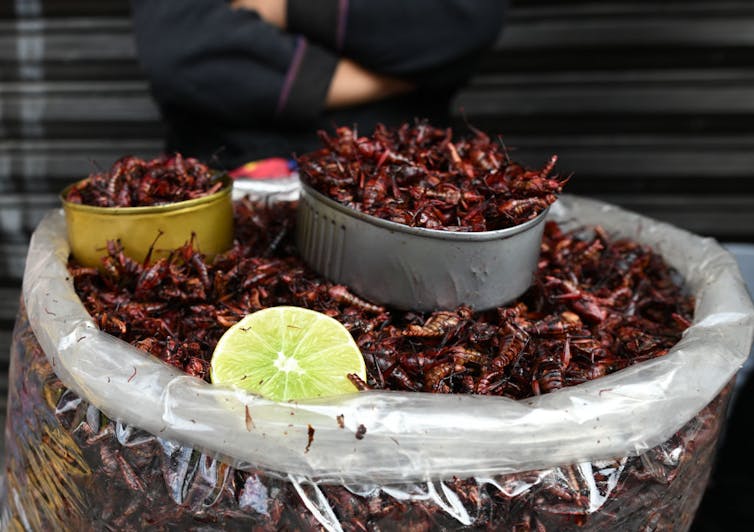
A basket of toasted bugs with half of a lime sitting atop the pile.
Boiling chapulines gives them their rich, red color.
Artur Widak/NurPhoto via Getty Images

Most recently, when the COVID-19 lockdowns made it nearly impossible to shop for foods, chapulineras created a touchless economy that connected vendors and customers through messaging services like WhatsApp. Some chapulineras also provided no-interest loans to people who could not cover the costs of their orders.

Carmen Mendoza, whom I interviewed at Mercado Benito Juárez in Oaxaca City, described her experience of the lockdown:

“When the pandemic hit, I said to myself, ‘Look, you need to keep selling, but from home.’ I know where I am, and I know my clients. I also know how much people want, how many kilos of chapulines they will buy. So people came to my house. Sometimes they would bring me their harvest, other times they would call and ask for two or three kilos. I could do that.”

The meaning, use and value of chapulines are changing, as Oaxaca has become a popular tourist destination and has been commemorated as a UNESCO heritage site. For foodies and tourists, tasting chapulines is a way to consume and experience the past.

Chapulineras will happily sell to foodies who want to “eat bugs.” But they also know tourists cannot support their market. Visitors usually swoop in for a few days, buy a small handful of chapulines and leave. Most will never return.

And so chapulineras continue to depend on locals whose families have been eating the insects for generations. Many chapulineras have achieved financial security through their efforts, earning incomes that exceed that of most rural women in Oaxaca.

In Oaxaca, just as it was 3,000 years ago, chapulines are “what’s for dinner.”

Jeffrey H. Cohen, Professor of Anthropology, The Ohio State University

This article is republished from The Conversation under a Creative Commons license. Read the original article.

Advertisement
Get More From A Face Cleanser And Spa-like Massage

At our core, we at STM Daily News, strive to keep you informed and inspired with the freshest content on all things food and beverage. From mouthwatering recipes to intriguing articles, we’re here to satisfy your appetite for culinary knowledge.

Visit our Food & Drink section to get the latest on Foodie News and recipes, offering a delightful blend of culinary inspiration and gastronomic trends to elevate your dining experience.

https://stmdailynews.com/food-and-drink/

Continue Reading
Advertisement SodaStream USA, inc

Foodie News

JOEY La Jolla Opening at Westfield UTC Brings Upscale Dining to San Diego

Published

on

Last Updated on April 22, 2026 by Daily News Staff

SAN DIEGO, CA — The award-winning JOEY Restaurant Group is continuing its U.S. expansion with the debut of its first San Diego location, JOEY La Jolla, opening April 23, 2026. The new restaurant will be located at Westfield UTC, one of Southern California’s premier retail and lifestyle destinations.

Modern restaurant entrance with outdoor seating. JOEY La Jolla Opening at Westfield UTC Brings Upscale Dining to San Diego
JOEY Restaurant Group to Open First San Diego Location at Westfield UTC

A New Dining Destination for La Jolla

Set in the heart of La Jolla, the 10,600-square-foot restaurant is designed to deliver a vibrant, upscale-yet-approachable experience. Guests can expect a seamless blend of indoor and outdoor dining, complete with a welcoming fire feature, lush landscaping, and a covered patio that opens into an expansive, modern interior.

Inside, the space features a lively bar and lounge area, complete with a DJ booth for select evenings, a curated wine wall, and contemporary art installations. The dining room centers around a striking olive tree beneath a wood canopy, creating a warm and immersive atmosphere ideal for everything from casual lunches to late-night gatherings.

Elevated Cuisine Meets Global Inspiration

JOEY Restaurants has built its reputation on globally inspired dishes and high-quality ingredients—and JOEY La Jolla is no exception.

The menu will showcase a wide range of offerings, including:

  • Premium steak cuts like Bone-In Prime Ribeye and Tomahawk
  • Fire-torched sushi and fresh seafood
  • Shareable plates and handcrafted bowls
  • Signature creations like Truffle Udon Carbonara

The beverage program is equally robust, featuring a curated wine selection and handcrafted cocktails such as the Good Life Margarita and Woodsmoked Old Fashioned. Guests can also explore “JOEY Supers,” a creative take on the classic highball with a refreshing twist.

Leadership Behind the Experience

The culinary and beverage program is led by an award-winning team, including:

  • Matthew Stowe, Executive Chef and Top Chef alumnus
  • Jay Jones, Bar Development Leader and Hall of Fame inductee
  • Jason Yamasaki, Group Sommelier

Their combined expertise is expected to elevate JOEY La Jolla into one of San Diego’s standout dining destinations.

Soft Opening and Reservations

Diners eager to get an early look can reserve a table during the restaurant’s limited preview period from April 18–22, ahead of its official grand opening on April 23. Once open, JOEY La Jolla will offer full-service dining daily, including lunch, happy hour, dinner, and late-night service.

Hours of Operation:

  • Sunday–Thursday: 11 AM – 12 AM
  • Friday–Saturday: 11 AM – 1 AM

Location:
4489 La Jolla Village Drive, Suite 1600
San Diego, CA 92122

A Strategic Expansion into Southern California

According to company leadership, the move into San Diego marks a significant milestone in JOEY’s broader growth strategy. With its strong culinary culture and coastal lifestyle, La Jolla provides an ideal backdrop for the brand’s signature blend of hospitality, design, and globally influenced cuisine.

As San Diego’s dining scene continues to evolve, JOEY La Jolla is positioned to become a go-to destination for locals and visitors seeking a dynamic and elevated dining experience.

Advertisement
Get More From A Face Cleanser And Spa-like Massage

At our core, we at STM Daily News, strive to keep you informed and inspired with the freshest content on all things food and beverage. From mouthwatering recipes to intriguing articles, we’re here to satisfy your appetite for culinary knowledge.

Visit our Food & Drink section to get the latest on Foodie News and recipes, offering a delightful blend of culinary inspiration and gastronomic trends to elevate your dining experience. https://stmdailynews.com/food-and-drink/


Author

Continue Reading

Festivals

Presqu’ile Winery Partners With LAND to Bring Contemporary Art to Santa Maria Valley

Presqu’ile Winery and LAND are partnering to bring free, site-responsive contemporary art to the Santa Maria Valley estate in Santa Barbara Wine Country.

Published

on

glass of wine
Photo by Arthur Brognoli on Pexels.com

Santa Barbara Wine Country is about to get a fresh reason to linger a little longer. Presqu’ile Winery has announced a new collaboration with Los Angeles Nomadic Division (LAND), the nationally recognized nonprofit known for taking contemporary art out of traditional museums and galleries and placing it directly into the environments that shape it. The result: curated, site-responsive works—some created specifically for the property—installed across Presqu’ile’s Santa Maria Valley estate.

A winery becomes an open-air gallery—at no cost

Under the partnership, Presqu’ile will serve as a host site for LAND programming, opening its estate to the public for free. Visitors can expect contemporary art integrated into the vineyard setting, with select installations shaped by the landscape itself. The goal is simple and ambitious at the same time: expand no-cost access to contemporary art along California’s Central Coast while creating a cultural experience that feels inseparable from the place it inhabits.

LAND’s approach is rooted in the belief that art should be experienced where people actually live, work, and gather. Rather than building exhibitions around white walls and controlled lighting, LAND supports projects driven by place—work that engages the environment, the community, and the lived experience of the artists creating it.

“Nourishing reciprocity” between art, landscape, and community

Laura Hyatt, Director of LAND, emphasized how the Central Coast setting opens new creative possibilities for artists.

Hyatt noted that collaborating with Presqu’ile gives artists the opportunity to engage with the region’s natural beauty and unique ecology—placing artworks in what she described as “nourishing reciprocity” with the landscape and the visitors moving through it. She also highlighted the long-term potential of the partnership, which allows for deeper exploration over time, expands LAND’s geographic reach, and strengthens connections between Southern and Central California.

For Hyatt, the collaboration is personal as well: her family has roots in the area going back five generations, adding another layer of community connection to the work LAND hopes to cultivate.

A shared mindset: tradition, experimentation, and a sense of place

Presqu’ile framed the partnership as a natural extension of what the winery already does—balancing tradition with experimentation. In the same way winemaking can honor time-tested methods while still pushing toward new expressions, contemporary art can offer new ways of seeing familiar processes and landscapes.

Matt Murphy, co-founder of Presqu’ile Winery, said the family’s appreciation for the visual arts made the collaboration an easy “yes.” He pointed to the opportunity to create “fun, compelling and unexpected” ways for the community to engage with both the installations and the estate itself—and to experience Presqu’ile through each artist’s creative lens.

PQLAND
Presqu’ile Winery x LAND

What happens next

In the near term, LAND will install artworks developed through its programming on the Presqu’ile property, with public access remaining free. The collaboration is designed with community benefit at its center, positioning the estate as a cultural and agricultural destination—not just a tasting room.

Looking ahead, Presqu’ile has submitted plans for approval to develop expanded spaces intended to support free public art, cultural programming, and community gathering. If approved, those improvements would signal a long-term commitment to integrating arts and culture into the estate experience and welcoming future partners whose work aligns with Presqu’ile’s values of openness, creativity, and place-based expression.

Additional details—including participating artists and installation timelines—will be announced as the collaboration progresses.

About the partners

Presqu’ile Winery

Presqu’ile (pronounced press-keel) is a family-owned estate winery in Santa Maria Valley on California’s Central Coast. Founded in 2007, the winery produces cool-climate wines from its sustainably farmed estate vineyard and from a select group of growers across Santa Barbara County. The name—French Creole for “almost an island”—reflects the Murphy family’s Gulf Coast heritage and the winery’s deep emphasis on place.

Advertisement
Get More From A Face Cleanser And Spa-like Massage

Los Angeles Nomadic Division (LAND)

Founded in 2009, LAND is a nonprofit arts organization dedicated to connecting people and places through site-responsive public art and programs. Over 15 years, LAND has presented more than 500 artists across 300+ programs and exhibitions, ranging from large-scale sculptural commissions to billboards, roadside screenings, workshops, and city-wide video presentations—reaching millions of people.

Why it matters

This collaboration isn’t just about adding art to a winery—it’s about rethinking where art belongs, who gets to access it, and how landscape can become part of the creative process. For the Central Coast, Presqu’ile and LAND are setting the stage for a new kind of cultural destination: one where a walk through the vines can also be a walk through contemporary ideas, made visible in the open air.

Source: Presqu’ile Winery

Organization: Los Angeles Nomadic Division (LAND)

Our Lifestyle section on STM Daily News is a hub of inspiration and practical information, offering a range of articles that touch on various aspects of daily life. From tips on family finances to guides for maintaining health and wellness, we strive to empower our readers with knowledge and resources to enhance their lifestyles. Whether you’re seeking outdoor activity ideas, fashion trends, or travel recommendations, our lifestyle section has got you covered. Visit us today at https://stmdailynews.com/category/lifestyle/ and embark on a journey of discovery and self-improvement.

Author

Continue Reading

Food and Beverage

Casamigos Introduces New Pre-Mixed Margaritas (Classic Lime + Spicy) Ahead of FIFA World Cup 2026

Published

on

Casamigos kicks off its FIFA World Cup 2026 moment with Gabrielle Union and Keegan-Michael Key and introduces new pre-mixed margaritas in Classic Lime and Spicy, designed for easy match-day hosting.

Casamigos is getting an early start on FIFA World Cup 2026™ watch-party season—and it’s doing it with a little friendly rivalry. The tequila brand announced a new World Cup campaign starring Gabrielle Union and Keegan-Michael Key, pairing the two as playful “hosts” who go head-to-head over a simple match-day question: are you Team Classic or Team Spicy?

The campaign tagline says it all: “Rivals at the game, Casamigos at the Bar.” The idea is less about picking sides forever and more about leaning into the competitive energy of the tournament—then coming together once the final whistle blows.

Team Classic vs. Team Spicy: the new bottled margaritas

Alongside the celebrity-led campaign, Casamigos introduced new pre-mixed margaritas in two flavors:

  • Classic Lime
  • Spicy

Both are designed for “pour, serve, and get back to the game” hosting—no extra ingredients, no shaking, no measuring. According to the brand, each pre-mixed margarita is 20.5% ABV and made with Casamigos Tequila, orange liqueur, lime juice, and natural flavors.

Casamigos says the bottles are meant to keep hosting simple during the tournament’s full 90 minutes (plus stoppage time), whether fans are gathering at home, meeting up at the bar, or celebrating in host cities.

Casamigos kicks off its FIFA World Cup 2026 moment with Gabrielle Union and Keegan-Michael Key and introduces new pre-mixed margaritas in Classic Lime and Spicy, designed for easy match-day hosting.
Casamigos, an Official Tequila Supporter of the FIFA World Cup 2026™.

What Gabrielle Union and Keegan-Michael Key are bringing to the campaign

Casamigos is leaning into Union and Key’s chemistry to capture what makes World Cup fandom so fun: the passion, the pride, and the rivalries that can get loud—without getting personal.

Union, who said she grew up playing soccer, is firmly Team Spicy, noting she loves “a little heat,” and that the best part of the sport is how it brings people together.

Key, a longtime World Cup viewer, is Team Classic, saying the “classic rivalries” already provide all the spice he needs.

World Cup activations and limited-time packaging

Casamigos is an Official Tequila Supporter of the FIFA World Cup 2026™ and plans to activate in host cities throughout the tournament with fan-first experiences. The brand also noted that its pre-mixed margaritas will feature limited-time FIFA World Cup 2026™ packaging.

For shoppers, the new pre-mixed margaritas are available in:

  • 750ml bottles (about 10 cocktails)
  • 375ml bottles (about 5 cocktails)

Casamigos lists 110 calories per serving and a suggested retail price of $21.99 MSRP, with both flavors best served chilled.

What to watch for

The World Cup is still months away, but brands are already battling for a spot on your watch-party table. Casamigos’ move is a clear bet on convenience: bottled margaritas that keep the vibe high without turning the host into the bartender.

And if you’re the type who treats every match like a personal derby, Casamigos’ message is basically this: talk your trash during the game—then toast like friends afterward.


Source:
Casamigos Spirits Company (PRNewswire), March 19, 2026.

Advertisement
Get More From A Face Cleanser And Spa-like Massage

Related Links:

Enjoy responsibly.

Hungry for what’s next? STM Daily News’ Food and Drink section dishes up the latest in restaurant news, beverage trends, seasonal recipes, culinary events, and food culture stories readers love to share.

Continue Reading

Trending