

News
3D printing will help space pioneers make homes, tools and other stuff they need to colonize the Moon and Mars

Last Updated on April 12, 2025 by Daily News Staff
3D printing will help space pioneers make homes, tools and other stuff they need to colonize the Moon and Mars
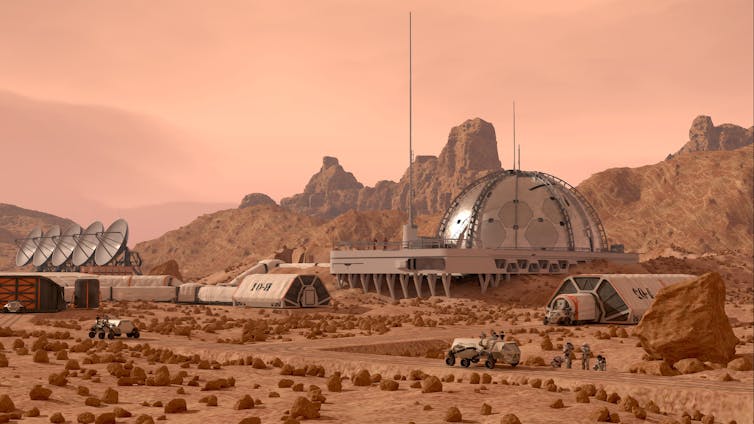
Throughout history, when pioneers set out across uncharted territory to settle in distant lands, they carried with them only the essentials: tools, seeds and clothing. Anything else would have to come from their new environment.
So they built shelter from local timber, rocks and sod; foraged for food and cultivated the soil beneath their feet; and fabricated tools from whatever they could scrounge up. It was difficult, but ultimately the successful ones made everything they needed to survive.
Something similar will take place when humanity leaves Earth for destinations such as the Moon and Mars – although astronauts will face even greater challenges than, for example, the Vikings did when they reached Greenland and Newfoundland. Not only will the astronauts have limited supplies and the need to live off the land; they won’t even be able to breathe the air.
Instead of axes and plows, however, today’s space pioneers will bring 3D printers. As an engineer and professor who is developing technologies to extend the human presence beyond Earth, I focus my work and research on these remarkable machines.
3D printers will make the tools, structures and habitats space pioneers need to survive in a hostile alien environment. They will enable long-term human presence on the Moon and Mars.
From hammers to habitats
On Earth, 3D printing can fabricate, layer by layer, thousands of things, from replacement hips to hammers to homes. These devices take raw materials, such as plastic, concrete or metal, and deposit it on a computerized programmed path to build a part. It’s often called “additive manufacturing,” because you keep adding material to make the part, rather than removing material, as is done in conventional machining.
Already, 3D printing in space is underway. On the International Space Station, astronauts use 3D printers to make tools and spare parts, such as ratchet wrenches, clamps and brackets. Depending on the part, printing time can take from around 30 minutes to several hours.
For now, the print materials are mostly hauled up from Earth. But NASA has also begun recycling some of those materials, such as waste plastic, to make new parts with the Refabricator, an advanced 3D printer installed in 2019.
Manufacturing in space
You may be wondering why space explorers can’t simply bring everything they need with them. After all, that’s how the International Space Station was built decades ago – by hauling tons of prefabricated components from Earth.
But that’s impractical for building habitats on other worlds. Launching materials into space is incredibly expensive. Right now, every pound launched aboard a rocket just to get to low Earth orbit costs thousands of dollars. To get materials to the Moon, NASA estimates the initial cost at around US$500,000 per pound.
Still, manufacturing things in space is a challenge. In the microgravity of space, or the reduced gravity of the Moon or Mars, materials behave differently than they do on Earth. Decrease or remove gravity, and materials cool and recrystallize differently. The Moon has one-sixth the gravity of Earth; Mars, about two-fifths. Engineers and scientists are working now to adapt 3D printers to function in these conditions.
Using otherworldly soil
On alien worlds, rather than plastic or metal, 3D printers will use the natural resources found in these environments. But finding the right raw materials is not easy. Habitats on the Moon and Mars must protect astronauts from the lack of air, extreme temperatures, micrometeorite impacts and radiation.
Regolith, the fine, dusty, sandlike particles that cover both the lunar and Martian surfaces, could be a primary ingredient to make these dwellings. Think of the regolith on both worlds as alien dirt – unlike Earth soil, it contains few nutrients, and as far as we know, no living organisms. But it might be a good raw material for 3D printing.
My colleagues began researching this possibility by first examining how regular cement behaves in space. I am now joining them to develop techniques for turning regolith into a printable material and to eventually test these on the Moon.
But obtaining otherworldly regolith is a problem. The regolith samples returned from the Moon during the Apollo missions in the 1960s and 70s are precious, difficult if not impossible to access for research purposes. So scientists are using regolith simulants to test ideas. Actual regolith may react quite differently than our simulants. We just don’t know.
What’s more, the regolith on the Moon is very different from what’s found on Mars. Martian regolith contains iron oxide –that’s what gives it a reddish color – but Moon regolith is mostly silicates; it’s much finer and more angular. Researchers will need to learn how to use both types in a 3D printer. https://www.youtube.com/embed/J1TWlNWHrsw?wmode=transparent&start=0 See models of otherworldly habitats.
Applications on Earth
NASA’s Moon-to-Mars Planetary Autonomous Construction Technology program, also known as MMPACT, is advancing the technology needed to print these habitats on alien worlds.
Among the approaches scientists are now exploring: a regolith-based concrete made in part from surface ice; melting the regolith at high temperatures, and then using molds to form it while it’s a liquid; and sintering, which means heating the regolith with concentrated sunlight, lasers or microwaves to fuse particles together without the need for binders.
Along those lines, my colleagues and I developed a Martian concrete we call MarsCrete, a material we used to 3D-print a small test structure for NASA in 2017.
Then, in May 2019, using another type of special concrete, we 3D-printed a one-third scale prototype Mars habitat that could support everything astronauts would need for long-term survival, including living, sleeping, research and food-production modules.
That prototype showcased the potential, and the challenges, of building housing on the red planet. But many of these technologies will benefit people on Earth too.
In the same way astronauts will make sustainable products from natural resources, homebuilders could make concretes from binders and aggregates found locally, and maybe even from recycled construction debris. Engineers are already adapting the techniques that could print Martian habitats to address housing shortages here at home. Indeed, 3D-printed homes are already on the market.
Meanwhile, the move continues toward establishing a human presence outside the Earth. Artemis III, now scheduled for liftoff in 2027, will be the first human Moon landing since 1972. A NASA trip to Mars could happen as early as 2035.
But wherever people go, and whenever they get there, I’m certain that 3D printers will be one of the primary tools to let human beings live off alien land.
Sven Bilén, Professor of Engineering Design, Electrical Engineering and Aerospace Engineering, Penn State
This article is republished from The Conversation under a Creative Commons license. Read the original article.


Last Updated on April 2, 2026 by Daily News Staff
🕒 [UPDATE] Orion Performs Translunar Injection Burn
The spacecraft has completed its critical engine burn, sending Artemis II on a trajectory toward the Moon. This marks the official start of its deep space journey.

Artemis II Successfully Launches
CAPE CANAVERAL, Fla. — NASA has successfully launched its Artemis II mission, marking the first crewed journey toward the Moon in more than 50 years.
The powerful Space Launch System (SLS) rocket lifted off from Kennedy Space Center on April 1, carrying four astronauts on a 10-day mission around the Moon and back.
On board are Commander Reid Wiseman, Pilot Victor Glover, Mission Specialist Christina Koch, and Canadian astronaut Jeremy Hansen. The mission is already being hailed as a major milestone in NASA’s effort to return humans to deep space.
Shortly after liftoff, the Orion spacecraft successfully reached orbit and deployed its solar arrays, beginning its journey that will eventually send the crew on a translunar trajectory toward the Moon. 
Artemis II is a lunar flyby mission, meaning astronauts will not land but will travel farther from Earth than any human mission in decades while testing critical systems needed for future landings.
The mission also marks several historic firsts, including the first woman and the first person of color—Victor Glover—to travel into lunar space.
NASA says the mission is a key step toward future lunar landings and long-term plans to establish a human presence on the Moon later this decade.
🛰️ Artemis II Mission Timeline
The 10-day Artemis II mission follows a carefully planned trajectory from Earth to the Moon and back:
- Day 1: Launch and Earth orbit
- Day 1–2: Translunar injection burn
- Days 2–4: Deep space travel
- Days 4–5: Lunar flyby
- Days 5–8: Return to Earth
- Days 9–10: Reentry and splashdown
For official updates and in-depth mission details, visit the following trusted sources:
- NASA: Artemis II Mission Overview
- NASA Artemis Program (Return to the Moon)
- Orion Spacecraft – Mission Details
- Space Launch System (SLS) Rocket Overview
- Kennedy Space Center – Launch Operations
- Watch NASA Live Coverage and Replays
🧾 Sources
- NASA official launch coverage and mission updates
- NASA Artemis II press materials and briefings
- NASA Kennedy Space Center launch operations updates
Stay with STM Daily News for live updates on Artemis II.
Travel Advisory
Traveling to Mexico this spring? Here’s what to know about current advisories
Traveling to Mexico this spring? Visitors should be aware of state-specific travel advisories, as safety concerns in one region do not affect major resort areas like Cancun and Los Cabos, currently rated Level 2, which encourages increased caution. Monitoring official updates is essential for informed travel decisions amidst evolving conditions.

Last Updated on March 30, 2026 by Daily News Staff
Traveling to Mexico this spring? Here’s what to know about current advisories
(Tiffany Miller for ALG Vacations) For some travelers counting down to spring break, recent headlines about violence in parts of Mexico have sparked a new question: Should I cancel my trip? Travel advisors say they are seeing a surge in calls and emails from clients trying to determine whether developments in one region affect major resort areas elsewhere.
The questions follow several days of unrest in parts of Mexico after security operations targeting organized crime leaders prompted temporary flight disruptions and shelter-in-place guidance for U.S. government personnel in areas including Puerto Vallarta and Guadalajara. In this article, ALG Vacations explains what current travel advisories mean for spring break travelers heading to Mexico.
The U.S. State Department evaluates Mexico state by state, not as a single destination, and advisory levels vary by region. Many major beach destinations, including Cancun, Riviera Maya, Tulum and Los Cabos, are currently under a Level 2 advisory, which encourages travelers to exercise increased caution. It does not discourage travel.
Part of the confusion stems from geography. Puerto Vallarta, on the Pacific coast, is roughly 1,300 miles from Cancun and the Riviera Maya on the Caribbean side, about the distance between New York and Miami. Because advisories are assigned state by state, developments in one region do not automatically alter another.
In recent days, that uncertainty has translated into additional inquiries about whether specific resort areas are experiencing disruptions. U.S. Embassy security alerts issued this week indicate that temporary shelter-in-place guidance affecting Puerto Vallarta was lifted and that flight operations resumed. The advisory level for the Mexican state of Quintana Roo remains unchanged.
Some clients are asking about alternatives, advisors say, but many are continuing with their plans after reviewing official updates. Travel patterns often shift in response to breaking headlines, they add, before stabilizing as clearer information becomes available.
The State Department assigns travel advisories on a four-tier scale ranging from Level 1, exercise normal precautions, to Level 4, do not travel. While Level 2 encourages increased awareness, Level 3 and Level 4 carry stronger language discouraging or restricting travel.
Advisories are reviewed regularly and can be updated as conditions evolve. The State Department’s Mexico advisory page breaks down conditions by state, reflecting the country’s federal structure rather than issuing a single national designation. Travelers can also enroll in the State Department’s Smart Traveler Enrollment Program, which provides real-time security updates and allows U.S. officials to contact citizens in an emergency.
Embassy notices state that airports, hotels and tourism services in Quintana Roo are operating normally. Security conditions across Mexico vary widely by state, with some regions carrying higher advisories and others designated Level 1. Most destinations popular with U.S. travelers are currently classified as Level 2.
As spring break approaches, advisors say informed decision-making depends on reviewing the advisories assigned to a specific destination and monitoring official updates, rather than reacting to national headlines alone. Travel decisions ultimately depend on individual comfort levels, they add, but advisory levels are assigned regionally and should be evaluated accordingly.
Photo courtesy of Shutterstock

SOURCE:
Welcome to the Consumer Corner section of STM Daily News, your ultimate destination for savvy shopping and informed decision-making! Dive into a treasure trove of insights and reviews covering everything from the hottest toys that spark joy in your little ones to the latest electronic gadgets that simplify your life. Explore our comprehensive guides on stylish home furnishings, discover smart tips for buying a home or enhancing your living space with creative improvement ideas, and get the lowdown on the best cars through our detailed auto reviews. Whether you’re making a major purchase or simply seeking inspiration, the Consumer Corner is here to empower you every step of the way—unlock the keys to becoming a smarter consumer today!
Community
McDonald’s First Job Confessional Turns Career Stories Into Free Meal Opportunity
McDonald’s is launching First Job Confessional, a campaign inviting fans to share first job stories for a chance to receive a $15 gift card in select cities.


First Job Confessional
McDonald’s is putting first jobs in the spotlight with a new campaign that asks fans to share the real-world skills they gained early in their working lives. Launched on National Employee Appreciation Day, the brand’s First Job Confessional invites people to reflect on how those first roles helped shape their careers — and, in some cases, earn a free meal in the process.
The campaign is built around a simple idea: first jobs often teach lasting skills that deserve more recognition. Whether someone learned problem-solving while babysitting, communication during a lunch rush, or teamwork behind a counter, McDonald’s is framing those experiences as valuable career foundations. The company says those are the same kinds of skills employers continue to prioritize as workplace demands evolve.

How the First Job Confessional Works
In select cities, McDonald’s is setting up confessional booths designed to look like ordering kiosks. But instead of placing a meal order, participants can record a story about their first job and the skills they picked up along the way. Those who take part in person will have the opportunity to receive a $15 McDonald’s gift card, while supplies last.
Fans who cannot attend in person can still join online by posting their stories using #FirstJobConfessional. McDonald’s says selected videos may also be featured on its YouTube channel, extending the campaign beyond the live events.
External Related Links
- McDonald’s corporate article: McDonald’s is Asking Fans to Get Real About Their First Job Skills in Exchange for Free Meals
- McDonald’s 1 in 8: First Job Confessional
- McDonald’s 1 in 8 home page
- Marketing Dive coverage of the campaign
- Parade coverage of the First Job Confessional tour
Source Links
- Original PRNewswire press release from McDonald’s USA, LLC
- McDonald’s official corporate story
- McDonald’s 1 in 8 First Job Confessional page
- McDonald’s 1 in 8 official website
The Bridge is a section of the STM Daily News Blog meant for diversity, offering real news stories about bona fide community efforts to perpetuate a greater good. The purpose of The Bridge is to connect the divides that separate us, fostering understanding and empathy among different groups. By highlighting positive initiatives and inspirational actions, The Bridge aims to create a sense of unity and shared purpose. This section brings to light stories of individuals and organizations working tirelessly to promote inclusivity, equality, and mutual respect. Through these narratives, readers are encouraged to appreciate the richness of diverse perspectives and to participate actively in building stronger, more cohesive communities.
https://stmdailynews.com/the-bridge





