

Business and Finance
6 Success Tips for Young Professionals

Last Updated on September 6, 2025 by Daily News Staff
(Family Features) Starting your career can be both an exciting time and a daunting experience. While there’s no secret formula to becoming successful in the workplace, there are steps you can take and skills you can build during the early stages of your career that can help you move toward your long-term goals.
Many young professionals face unique challenges, but with the right guidance and advice those obstacles may lead to opportunities for personal and professional development. Passionate about mentoring young professionals and sharing her methods for success, Morgan DeBaun, founder and CEO of digital media and technology company Blavity, partnered with Sharpie – makers of a wide selection of permanent markers, pens, highlighters and more for the classroom, office and home – to share these tips.
Be proactive: Take initiative and identify areas you can contribute beyond your assigned tasks. Instead of waiting to be asked to do something, draft an email, spreadsheet or project board that could benefit the team. Showing a willingness to go above and beyond may lead to additional projects or responsibilities being sent your way in the future.
Write everything down: Putting your dreams and goals to paper can help you commit to them, track progress and stay on course to achieve them. Additionally, particularly in meetings, your brain is processing new information, ways of thinking and operational systems all while you are trying to come across as engaged and personable. Jotting down key action items and learnings along the way can save you later. Being an active listener and note-taker can increase your ability to retain information and contribute to your team.
Featuring no-smear, no-bleed technology with best-in-class ink, an option like the Sharpie S•Gel pen promises exceptionally smooth writing experiences. To put her best work forward, DeBaun uses the Medium Point (.7mm) White Barrel. The high-performance gel pen enhances handwriting with its sleek, professional look and offers a variety of ink colors, barrel styles and points to choose from, making it a must-have for professionals looking to make a statement.
Identify useful productivity tools: Look for tools and programs that can help make you more productive and successful then leverage them in your personal workflow. Whether it’s an email scheduling tool, calendar software or favorite writing utensil, ensure you are taking advantage of things that can help you succeed.
Develop and strengthen your organizational skills: Regardless of what role you are in, being systemized and structured in the way you work can help keep you on track as you grow in your career. Whether it’s a smartphone app, old-fashioned to-do lists on paper or desktop reminders on your computer, find a system that works for you and stick with it – refining the approach as you go – for best results. For example, with a variety of available ink colors, the Sharpie S•Gel can make it simple to color code calendars and to-do lists, which can make prioritizing tasks a cinch.
Embrace teamwork and learn from your peers: Across your company, you are likely working with bright, talented people who may have completely different skill sets and ways of working and thinking than you. Set up 15-20-minute virtual coffee chats to meet people not on your team during your first 90 days as a way to connect with your coworkers and learn more about not only them but the company and its environment as a whole.
Say yes to opportunities: Whether it is a work event, new project, meeting or class, take advantage of prospects presented to you. Taking advantage of opportunities to network, learn and grow in your career can help lead you on the trajectory you are aiming for.
Find the must-have tools to set your career on the right path at Sharpie.com.
SOURCE:
Sharpie


Consumer Corner
3 Practical Ways to Build Financial Confidence
Financial Confidence: Economic uncertainty, fueled by persistent inflation, stagnant wages and a cooling job market, has led many Americans to feel like they’re falling behind, even when they’re doing many of the “right” things financially. This expert guidance can help you be more intentional with the choices you make so your spending reflects your priorities.

Building Financial Confidence
(Feature Impact) Nearly everyone is carrying some level of insecurity about their financial future, even those who are trying to plan ahead. Economic uncertainty, fueled by persistent inflation, stagnant wages and a cooling job market, has led many Americans to feel like they’re falling behind, even when they’re doing many of the “right” things financially.
Though many are paying down debt, saving for retirement and building an emergency fund, they’re still asking, “Am I doing enough?” In fact, only 21% of Americans are financially prepared and assured in their ability to protect their futures, according to Mutual of Omaha’s 2026 Protection Index Survey – a proprietary research study conducted with quantilope – which shows overall financial confidence has declined.
“Many people believe they need to wait until they have more money, more certainty or the perfect plan before taking action,” said Nate Hobson, vice president of sales, Advisor Network at Mutual of Omaha. “But financial confidence is usually built through consistency rather than perfect timing. Even small steps today can make a meaningful difference over time.”
While being financially secure means different things to different people, according to the survey – such as having little or no debt (34%), owning a home (29%), maintaining emergency savings (27%), saving for retirement (26%) or having insurance coverage (26%) – building financial confidence doesn’t have to translate to cutting out everything you enjoy. Instead, this expert guidance can help you be more intentional with the choices you make so your spending reflects your priorities.
Create a Financial Cushion
Whether it’s a car repair, medical bill or temporary loss of income, unexpected expenses happen.
Having even a modest emergency fund can reduce financial stress and reliance on credit cards or loans. If saving several months of expenses feels overwhelming, start with a smaller milestone. Consistency matters more than the starting amount.
 Put Good Financial Habits on Autopilot
One of the easiest ways to make progress is removing the need to make the same decision every month. Consider setting up automatic contributions to savings and retirement accounts, regular investment deposits and automatic bill payments, which can help you build financial security even during busy or uncertain times.
Taking a look at everyday spending habits can also make a difference. The survey showed small, everyday choices add up over time, such as cutting non-essential spending (57%), using rewards programs (54%), comparing prices or switching providers (39%) and following a monthly budget (38%). That could mean bringing your lunch to work instead of grabbing takeout, taking a few extra minutes to compare prices at the grocery store or using rewards to get more value from the purchases you’re already making.
Protect What You’re Building
Saving and investing are important pieces of financial protection, but they’re only part of the equation. Protecting income, loved ones and other financial assets is equally important.
For families, life insurance can provide financial protection during key earning and caregiving years, helping replace income if the unexpected happens. For those focused on covering final expenses, guaranteed whole life insurance can help cover funeral and other end-of-life costs. If you’re approaching or living in retirement, an annuity may provide a reliable stream of income that can complement other retirement resources and reduce uncertainty.
A financial professional can help determine which options best fit your goals and circumstances. To see how much coverage is right for your situation, Mutual of Omaha’s Life Insurance Calculator can provide a personalized estimate based on your income, financial obligations and long-term goals.
For more practical advice to build financial confidence, visit MutualofOmaha.com.
Taking Action with an Extra $1,000
If you unexpectedly received $1,000, your response with the extra cash may reveal your financial priorities and where additional planning could strengthen financial resilience.
Providing a window into Americans’ financial priorities, respondents in Mutual of Omaha’s 2026 Protection Index Report said they would:
- Pay down debt (25%)
- Add it to savings (21%)
- Use it for everyday expenses (14%)
- Invest it (9%)
Photos courtesy of Shutterstock

SOURCE:
💰 Live well and make your money work smarter! Explore the latest lifestyle tips, personal finance insights, saving strategies, and financial wellness stories on STM Daily News. Share your thoughts in the comments and subscribe to our newsletter for fresh ideas delivered straight to your inbox.
financial wellness
Survey: Credit isn’t a backup plan. For millions of Americans, it’s how they buy groceries.
Credit isn’t a backup plan. Credit cards were once reserved for expensive purchases or for added security in buying online. For households managing debt, they have become a way to cover everyday purchases like groceries.

Survey: Credit isn’t a backup plan. For millions of Americans, it’s how they buy groceries.
(Sheeka Sanahori) Sixty-six percent of Americans carrying at least $10,000 in unsecured debt used a credit card to buy groceries in the last year, more than any other essential expense, according to a new survey. Credit cards were once reserved for expensive purchases or for added security in buying online. For households managing debt, they have become a way to cover everyday purchases like groceries.
Accredited Debt Relief, a company specializing in debt relief, commissioned Atomik Research in May 2026 to survey 2,000 U.S. adults with at least $10,000 in unsecured debt. Along with groceries, 47% say they’ve used credit for gas or transportation, 45% for utilities and 33% for rent or housing costs.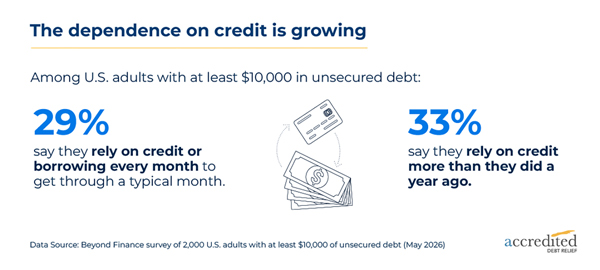
For people struggling with cost-of-living pressures, using unsecured debt can begin as a quick solution to cover household needs for the moment. At first, it’s just milk and eggs. But then an unexpected expense happens: a flat tire, an unusually high electricity bill, a medical cost that was not in the budget. The balance adds up and, according to the survey data, this also creates stress for consumers.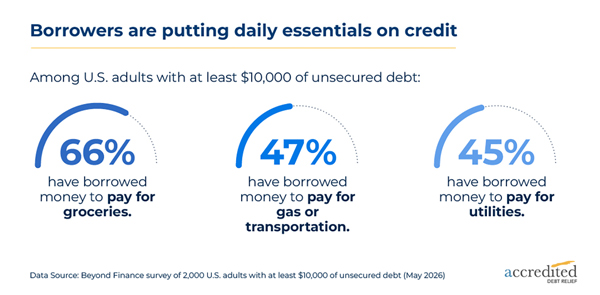
This isn’t discretionary spending. The data reflects a growing reliance on consumer debt to cover basic cost-of-living needs. However, relying on borrowed money without an executable plan for repaying it could mean that one day, the runway for taking care of such expenses runs out.
A significant share of respondents report relying on credit as a routine part of managing their personal finances. This routine could become a long-term debt cycle for many households. Nearly three in ten say that they rely on credit or borrowing to get through a typical month. This reliance appears to be growing, with a third saying they depend on credit more than they did a year ago. For those consumers, what may have once been a stopgap has become an increasingly common and ongoing financial strategy.
The growing debt cycle by unsecured borrowing is taking an emotional toll on these consumers, too. A quarter of respondents are concerned about their financial future and 12% feel a stronger concern that they’re at risk of long-term financial instability.
A lack of savings makes the cycle harder to break. Only 28% of respondents say they can both cover expenses and save. When there is little room between income and expenses, every disruption becomes harder to absorb.
Unexpected expenses, such as medical bills or car repairs, lead 19% of respondents to take on additional debt every time, and 27% most of the time. These are the kinds of costs households are often told to prepare for, but preparation requires room. For many consumers, that room does not exist.
Debt builds over time when credit becomes part of monthly operations. Some of these consumers say they don’t earn enough to make meaningful changes to their current financial situation. Among those surveyed, 45% report that their income is enough to get by but not get ahead. Many report that their financial situation has caused them to put off taking a vacation or begin building savings.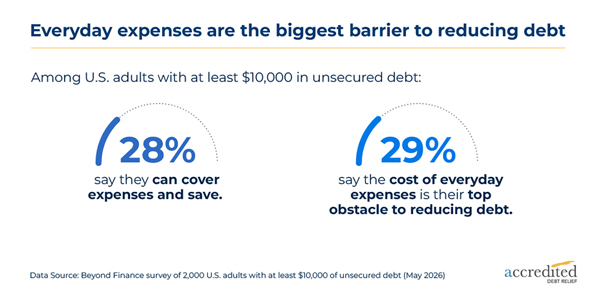
When asked about the biggest barrier to reducing debt, 29% of respondents listed the same obstacle: the cost of everyday expenses. That number connects how debt builds with why it persists.
When everyday expenses become part of ongoing credit card debt, the balance can grow without notice. Even when a consumer gets their next paycheck, if it’s already accounted for, they may not be able to make much progress in paying down their debts. A few recurring costs, spread across months, can become a greater financial weight. The result is debt that builds, because it’s tied to the basic cost of living. It also can create a stressful way to live; more than three in ten people say their current debt situation has affected their mental well-being.
Without meaningful changes, whether through increased income, debt relief or other financial support, these households may continue to rely on consumer debt and unsecured credit as a daily necessity rather than a strategic financial tool or occasional supplement. The risk is that life’s most basic needs become harder to maintain in the long run.
Methodology
Accredited Debt Relief commissioned Atomik Research to conduct an online survey of 2,000 U.S. adults with at least $10,000 in unsecured debt. The margin of error is plus or minus 2 percentage points at a 95 percent confidence level. Fieldwork was conducted between May 11-14, 2026. Atomik Research, part of 4media group, is a creative market research agency.
Photo courtesy of Shutterstock (tap to pay)

SOURCE:
💰 Live well and make your money work smarter! Explore the latest lifestyle tips, personal finance insights, saving strategies, and financial wellness stories on STM Daily News. Share your thoughts in the comments and subscribe to our newsletter for fresh ideas delivered straight to your inbox.
College Life
The Princeton Review’s “Best Colleges for 2027” Rankings Are Out: 50 Student-Driven Lists Spotlight Campus Life, Aid, and Fit
The Princeton Review’s Best Colleges for 2027 rankings are out, based on surveys of 172,000 students across 392 schools in 50 categories.
The Princeton Review has released its “Best Colleges for 2027” rankings, a set of 50 category-based lists built entirely from student feedback—an approach designed to help applicants and families focus less on prestige and more on campus fit.
The rankings are now searchable for free on PrincetonReview.com and are also published in a dedicated chapter of The Best 392 Colleges: 2027 Edition (Penguin Random House, $26.99), which went on sale August 18.
A rankings system built on student experience
Unlike lists that attempt to name a single “best” college overall, The Princeton Review’s project breaks the undergraduate experience into categories that mirror real questions students and parents ask: How good are the professors? Is financial aid strong? What’s campus food like? Do students feel supported?
This year’s rankings are based on surveys of 172,000 students at the 392 colleges featured in the book—about 439 students per school on average. Students completed a 98-question survey rating academics, administrative services, financial aid, campus amenities, and social dynamics, including topics like political leanings, race/class interaction, and LGBTQ acceptance.
Each ranking list names the top 25 schools in a specific category, using data drawn from one or more survey questions. The Princeton Review also posts information online about how each list is calculated.
Rob Franek, Editor-in-Chief at The Princeton Review and lead author of the guide, emphasized that the schools profiled vary widely by “type, size, locale, and campus culture,” but each offers an academically strong undergraduate education. He also reiterated a key point behind the project: there is no single “best” college—only the best fit for a given student.
Notable #1 schools across the 2027 lists
The 2027 rankings highlight how different “best” can look depending on what matters most to a student.
For academics and campus operations, several schools earned top spots:
- Professors Get High Marks: Franklin W. Olin College of Engineering (Massachusetts)
- Best Classroom Experience: Reed College (Oregon)
- Best-Run Colleges: Claremont McKenna College (California)
- Great Financial Aid: Washington and Lee University (Virginia)
- Best Career Services: Bentley University (Massachusetts)
- Best Health Services: The University of Chicago (Illinois)
- Best Student Support and Counseling Services: Macalester College (Minnesota)
Campus life categories also drew attention:
- Best Campus Food: University of Massachusetts—Amherst
- Best College Dorms: Bowdoin College (Maine)
- Most Beautiful Campus: University of San Diego (California)
The lists also capture student-reported culture and community dynamics:
- Most Politically Conservative Students: Texas Christian University
- Most Politically Liberal Students: Bennington College (Vermont)
- Most Politically Moderate Students: Manhattan University (New York)
- Most Religious Students: Brigham Young University (Utah)
- LGBTQ-Friendly: University of Vermont
- Lots of Race/Class Interaction: Rice University (Texas)
- Friendliest Students: William & Mary (Virginia)
- Happiest Students: Vanderbilt University (Tennessee)
One new addition in the 2027 edition is “Great Outdoors: Students Get Outside,” with The University of the South (Tennessee) ranked #1.
“Statistical Stand-Out Schools” adds a data lens
In addition to student rankings, The Best 392 Colleges includes a feature called “Statistical Stand-Out Schools for 2027,” based on surveys of college administrators. A few of the standout distinctions include:
- Lowest Tuition & Fees (In-State) / Public College: University of Central Florida ($5,954)
- Highest Average Need-Based Scholarships: Princeton University ($80,837)
- Lowest Student/Faculty Ratio: Caltech (3:1) and MIT (3:1)
- Lowest Average Undergraduate Debt: CUNY: City College ($7,849)
- Most Applications / Public College: UCLA (145,086)
- Most Applications / Private College: NYU (114,125)
For families weighing cost, support, and outcomes, these stats can provide a useful counterpoint to reputation-driven decision-making.
How to use the rankings
The Princeton Review’s 2027 lists are best used as a starting point for research: identify what you value most—teaching quality, career preparation, affordability, student support, or campus culture—then compare schools through that lens.
The full rankings hub is available at: www.princetonreview.com/college-rankings/best-colleges





