Connect with us

News

Educators Are Being Priced Out of Their Communities—These Cities Are Building Subsidized Teacher Housing to Bring Them Back

Teacher Housing: As housing costs rise and teacher pay stagnates, cities and school districts are building education workforce housing to attract and retain educators—cutting commutes and strengthening community ties.

Published

on

As housing costs rise and teacher pay stagnates, cities and school districts are building education workforce housing to attract and retain educators—cutting commutes and strengthening community ties.
Developers of Wendy’s Village, an affordable housing complex planned for teachers in Colorado Springs, Colo., completed their first homes in July 2025.
WeFortify

America’s educators are being priced out of their communities − these cities are building subsidized teacher housing to lure them back

Jeff Kruth, Miami University and Tammy Schwartz, Miami University

For much of the 20th century, teaching was a stable, middle-class job in the U.S. Now it’s becoming a lot harder to survive on a teacher’s salary: Wages have been stagnant for decades, according to a study from the Economic Policy Institute, and teachers earn 5% less than they did a decade ago when adjusting for inflation.

That’s one reason why there’s a widespread teacher shortage, with tens of thousands of positions going unfilled. At the same time, according to a 2022 report from the Annenberg Institute at Brown University, there are more than 160,000 underqualified teachers in the classroom, meaning they don’t meet full certification or credentialing standards.

This issue has become particularly acute as housing costs have risen sharply across the country over the past decade. Why become a teacher if it means you’ll struggle to put a roof over your head?

In response, many states and cities, from California to Cincinnati, are exploring ways to attract and retain teachers by developing education workforce housing – affordable housing built specifically for public school teachers and staff to make it easier for them to live near where they work. In doing so, they seek to address aspects of both the teacher shortage and housing crisis.

Fertile land for housing

As professors of architecture and education and as directors of an urban teaching program at Miami University in Ohio, we work to make it easier for students to pursue teaching careers – and that includes addressing affordable housing issues in communities where they work.

A key element of this work involves collaborating with local education agencies to either build, subsidize or find housing for teachers.

Local education agencies are tasked with the administrative functions of a school district, and they often own large tracts of land.

This land can be used to build new school buildings or community health clinics. But it can also be used to build housing – a particularly attractive option in cities where land can be scarce and expensive.

California has been at the forefront of these efforts. The state’s school districts own more than 75,000 acres of potentially developable land. Meanwhile, more than one-third of the state’s public school employees are rent-burdened, meaning they spend more than 30% of their income on housing costs.

California’s Teacher Housing Act of 2016 set up a framework for local education agencies to build and develop housing on their land. Since then, education workforce housing complexes have been developed across the state, ranging from San Francisco’s Shirley Chisolm Village to 705 Serramonte in Daly City, California.

Advertisement
Get More From A Face Cleanser And Spa-like Massage
The San Francisco Unified School District celebrated the opening of Shirley Chisolm Village, the city’s first educator housing development, in September 2025.

The nuts and bolts of education workforce housing vary.

It can be financed by traditional sources, such as private philanthropy and government funds. But it can also be funded through financial tools such as certificates of participation, which allow outside investors to provide funding up front and later receive a return on their investment through rental income.

In some cases, teachers are offered reduced rents for just a few years as they start their careers. In others, they’re given the opportunity to purchase their home.

Third party management companies often oversee the projects, since local education agencies usually aren’t interested in property management. This also reduces the potential for any direct disputes between employer and employee. Many programs require only that residents be employees of the school district when they enter the program, meaning if someone leaves their job, they will not be displaced.

In April 2025, UCLA’s CITYLab and the Center for Cities and Schools published a study highlighting some of the benefits and challenges of nine educator workforce housing projects built in California.

The complexes ranged in size, from 18 to 141 dwelling units, with heights that ranged from two to six stories. The researchers found that tenants were largely satisfied with their living situations: They paid rents at far below market rate, and they praised the apartment design. They also highlighted their shorter commutes.

From tiny homes to factory conversions

Since 2020, educator housing has been proposed or developed in Arkansas, Colorado, Florida, Nevada and South Carolina.

In Fort Stockton, a small, rural town in West Texas, the school district bought a motel in 2022 and converted it into teacher housing. In Arizona, the Chino Valley Unified School District built tiny homes for its teachers in 2023, renting them at US$550 per month.

The Chino Valley Unified School District built tiny homes for its workers in 2023.

In Baltimore, more than 775 teachers have recently been housed thanks to initiatives such as the Union Mill project, an 86,000-square-foot historic building converted into teacher apartments that range in price from $700 to $1200 per month.

Teacher housing does more than give educators an affordable place to live. It can forge lasting relationships. A recent assessment of teacher housing in Los Angeles found that the community spaces and programs offered on site strengthened bonds among the residents, leading to friendships and working relationships that lasted for years.

Advertisement
Get More From A Face Cleanser And Spa-like Massage
A spacious living space featuring a billiards table, chairs, tables and a large, built-in bookcase filled with books.
A community room in Norwood Learning Village, a 29-unit affordable housing development for Los Angeles Unified School District employees.
© Alexander Vertikoff for Thomas Saffron and Associates and Norwood Learning Village

Building community in and out of the classroom

Here in Cincinnati, our own graduates now working in schools also benefit from affordable housing options.

Through a partnership between Miami University and St. Francis Seraph, early career teachers from our TEACh and Urban Cohort programs have access to affordable housing.

In 2024, the Archdiocese of Cincinnati converted an old church property in Cincinnati’s Over-the-Rhine neighborhood into teacher apartments, which recent graduates can rent at a reduced rate. Most young teachers otherwise wouldn’t be able to afford living in this area.

A group of people smile as two women cut a red ribbon.
In 2024, the Archdiocese of Cincinnati collaborated with Miami University to convert the St. Francis Seraph Church building in the city’s Over-the-Rhine neighborhood into affordable housing for recent teaching graduates.
Photo: Je’Von Calhoun, CC BY-SA

“I wouldn’t be able to spend my beginning years as an educator in the community without access to affordable housing,” Nicholas Detzel, a graduate teacher now living in the converted space, told us in an interview.

“Living in the community has been an amazing experience and helps you know your students on a completely different level,” he added. “It has also helped me relate to students about knowing what is going on in our community.”

Teachers like Detzel who live in Over-the-Rhine can walk or take public transportation to the local schools where they work.

Perhaps more importantly, they can better understand the world of their students. They can learn the streets that students avoid, the parks and community spaces that become popular after-school hangouts, and what community organizations offer summer programming. Ultimately, teachers grounded in the life of the community can build relationships outside of the walls of school that contribute to more trust in the classroom.

Providing affordable housing for teachers and staff also helps retention rates, particularly as many younger teachers leave the profession due to low pay and burnout.

Teacher housing programs are still in their infancy. There are roughly 3.2 million public school teachers nationwide, and there are probably fewer than 100 of these developments completed or in progress.

Yet more and more districts are expressing interest, because they help alleviate two major concerns affecting so many American communities: affordable housing and a quality education.

While the need for affordable housing spans both lower- and middle-class families, teachers or not, forging alliances between schools and affordable housing providers can serve as one path forward – and possibly serve as a model for other trades and professions.The Conversation

Jeff Kruth, Assistant Professor of Architecture, Miami University and Tammy Schwartz, Director of the Urban Cohort, Miami University

This article is republished from The Conversation under a Creative Commons license. Read the original article.

Advertisement
Get More From A Face Cleanser And Spa-like Massage


Discover more from Daily News

Subscribe to get the latest posts sent to your email.

Continue Reading
Advertisement Winter Super Sale – Enjoy 25% Off Your Entire Purchase + Free Shipping. Use Code: BPWARM25
Click to comment

Leave a Reply

Your email address will not be published. Required fields are marked *

News

Children can be systematic problem-solvers at younger ages than psychologists had thought – new research

Child psychologists: Celeste Kidd’s research challenges long-standing ideas from Jean Piaget about children’s problem-solving abilities. Her findings show that children as young as four can independently utilize algorithmic strategies to solve complex tasks, contradicting the belief that systematic logical thinking develops only after age seven. This insight highlights the importance of nurturing algorithmic thinking in early education.

Published

on

Children can be systematic problem-solvers at younger ages than psychologists had thought – new research
How do kids figure out how to sort things by order? Celeste Kidd

Celeste Kidd, University of California, Berkeley

I’m in a coffee shop when a young child dumps out his mother’s bag in search of fruit snacks. The contents spill onto the table, bench and floor. It’s a chaotic – but functional – solution to the problem.

Children have a penchant for unconventional thinking that, at first glance, can look disordered. This kind of apparently chaotic behavior served as the inspiration for developmental psychologist Jean Piaget’s best-known theory: that children construct their knowledge through experience and must pass through four sequential stages, the first two of which lack the ability to use structured logic.

Piaget remains the GOAT of developmental psychology. He fundamentally and forever changed the world’s view of children by showing that kids do not enter the world with the same conceptual building blocks as adults, but must construct them through experience. No one before or since has amassed such a catalog of quirky child behaviors that researchers even today can replicate within individual children.

While Piaget was certainly correct in observing that children engage in a host of unusual behaviors, my lab recently uncovered evidence that upends some long-standing assumptions about the limits of children’s logical capabilities that originated with his work. Our new paper in the journal Nature Human Behaviour describes how young children are capable of finding systematic solutions to complex problems without any instruction. https://www.youtube.com/embed/Qb4TPj1pxzQ?wmode=transparent&start=0 Jean Piaget describes how children of different ages tackle a sorting task, with varying success.

Putting things in order

Throughout the 1960s, Piaget observed that young children rely on clunky trial-and-error methods rather than systematic strategies when attempting to order objects according to some continuous quantitative dimension, like length. For instance, a 4-year-old child asked to organize sticks from shortest to longest will move them around randomly and usually not achieve the desired final order.

Psychologists have interpreted young children’s inefficient behavior in this kind of ordering task – what we call a seriation task – as an indicator that kids can’t use systematic strategies in problem-solving until at least age 7.

Somewhat counterintuitively, my colleagues and I found that increasing the difficulty and cognitive demands of the seriation task actually prompted young children to discover and use algorithmic solutions to solve it.

Piaget’s classic study asked children to put some visible items like wooden sticks in order by height. Huiwen Alex Yang, a psychology Ph.D. candidate who works on computational models of learning in my lab, cranked up the difficulty for our version of the task. With advice from our collaborator Bill Thompson, Yang designed a computer game that required children to use feedback clues to infer the height order of items hidden behind a wall, .

The game asked children to order bunnylike creatures from shortest to tallest by clicking on their sneakers to swap their places. The creatures only changed places if they were in the wrong order; otherwise they stayed put. Because they could only see the bunnies’ shoes and not their heights, children had to rely on logical inference rather than direct observation to solve the task. Yang tested 123 children between the ages of 4 and 10. https://www.youtube.com/embed/GlsbcE6nOxk?wmode=transparent&start=0 Researcher Huiwen Alex Yang tests 8-year-old Miro on the bunny sorting task. The bunnies are hidden behind a wall with only their sneakers visible. Miro’s selections exemplify use of selection sort, a classic efficient sorting algorithm from computer science. Kidd Lab at UC Berkeley.

Figuring out a strategy

We found that children independently discovered and applied at least two well-known sorting algorithms. These strategies – called selection sort and shaker sort – are typically studied in computer science.

Advertisement
Get More From A Face Cleanser And Spa-like Massage

More than half the children we tested demonstrated evidence of structured algorithmic thinking, and at ages as young as 4 years old. While older kids were more likely to use algorithmic strategies, our finding contrasts with Piaget’s belief that children were incapable of this kind of systematic strategizing before 7 years of age. He thought kids needed to reach what he called the concrete operational stage of development first.

Our results suggest that children are actually capable of spontaneous logical strategy discovery much earlier when circumstances require it. In our task, a trial-and-error strategy could not work because the objects to be ordered were not directly observable; children could not rely on perceptual feedback.

Explaining our results requires a more nuanced interpretation of Piaget’s original data. While children may still favor apparently less logical solutions to problems during the first two Piagetian stages, it’s not because they are incapable of doing otherwise if the situation requires it.

A systematic approach to life

Algorithmic thinking is crucial not only in high-level math classes, but also in everyday life. Imagine that you need to bake two dozen cookies, but your go-to recipe yields only one. You could go through all the steps of making the recipe twice, washing the bowl in between, but you’d never do that because you know that would be inefficient. Instead, you’d double the ingredients and perform each step only once. Algorithmic thinking allows you to identify a systematic way of approaching the need for twice as many cookies that improves the efficiency of your baking.

Algorithmic thinking is an important capacity that’s useful to children as they learn to move and operate in the world – and we now know they have access to these abilities far earlier than psychologists had believed.

That children can engage with algorithmic thinking before formal instruction has important implications for STEM – science, technology, engineering and math –education. Caregivers and educators now need to reconsider when and how they give children the opportunity to tackle more abstract problems and concepts. Knowing that children’s minds are ready for structured problems as early as preschool means we can nurture these abilities earlier in support of stronger math and computational skills.

And have some patience next time you encounter children interacting with the world in ways that are perhaps not super convenient. As you pick up your belongings from a café floor, remember that it’s all part of how children construct their knowledge. Those seemingly chaotic kids are on their way to more obviously logical behavior soon.

Celeste Kidd, Professor of Psychology, University of California, Berkeley

This article is republished from The Conversation under a Creative Commons license. Read the original article.

Advertisement
Get More From A Face Cleanser And Spa-like Massage


Dive into “The Knowledge,” where curiosity meets clarity. This playlist, in collaboration with STMDailyNews.com, is designed for viewers who value historical accuracy and insightful learning. Our short videos, ranging from 30 seconds to a minute and a half, make complex subjects easy to grasp in no time. Covering everything from historical events to contemporary processes and entertainment, “The Knowledge” bridges the past with the present. In a world where information is abundant yet often misused, our series aims to guide you through the noise, preserving vital knowledge and truths that shape our lives today. Perfect for curious minds eager to discover the ‘why’ and ‘how’ of everything around us. Subscribe and join in as we explore the facts that matter.  https://stmdailynews.com/the-knowledge/

View recent photos

Unlock fun facts & lost history—get The Knowledge in your inbox!

We don’t spam! Read our privacy policy for more info.


Discover more from Daily News

Subscribe to get the latest posts sent to your email.

Continue Reading

News

Valley Metro to Exit CAPEX Capitol Extension After Phoenix Council Shifts Focus to Indian School Road Corridor

Valley Metro is shifting its focus on high-capacity transit planning in west Phoenix following a City Council vote, prioritizing a new corridor along Indian School Road while exiting the Capitol Extension project, CAPEX, and seeking community engagement.

Published

on

Valley Metro is officially shifting gears on high-capacity transit planning in west Phoenix following a Phoenix City Council vote earlier this year.

In a message to the public, Valley Metro said that after the Jan. 27, 2026 City Council decision to re-evaluate high-capacity transit options and prioritize a proposed West Phoenix corridor along Indian School Road, the agency will exit project development and the Federal Transit Administration Capital Investment Grant (CIG) process for the Capitol Extension (CAPEX) project.

alley Metro will exit the Capitol Extension (CAPEX) project development and federal grant process after Phoenix City Council voted to re-evaluate west Phoenix transit and prioritize a new corridor study along Indian School Road.

What the City Council voted to do

According to Valley Metro, the Phoenix City Council voted to take another look at high-capacity transit options for west Phoenix and to prioritize studying a new corridor alignment along Indian School Road.

What Valley Metro is doing next

Valley Metro emphasized it still supports expanding high-capacity transit in west Phoenix, citing demand and mobility needs in the corridor. But the agency says it will now pivot away from CAPEX and toward the new study effort.

Key next steps Valley Metro outlined include:

  • Exiting the CAPEX project development process and the federal CIG pipeline
  • Advancing planning for the West Phoenix study along Indian School Road
  • Centering comprehensive community engagement, including outreach to residents, business owners, and stakeholders along the corridor
  • Working closely with the City of Phoenix on project development
  • Coordinating with the Federal Transit Administration to explore funding opportunities

How to stay engaged

Valley Metro is encouraging residents to sign up for updates as the next phase moves forward at valleymetro.org/notices.

Dive into “The Knowledge,” where curiosity meets clarity. This playlist, in collaboration with STMDailyNews.com, is designed for viewers who value historical accuracy and insightful learning. Our short videos, ranging from 30 seconds to a minute and a half, make complex subjects easy to grasp in no time. Covering everything from historical events to contemporary processes and entertainment, “The Knowledge” bridges the past with the present. In a world where information is abundant yet often misused, our series aims to guide you through the noise, preserving vital knowledge and truths that shape our lives today. Perfect for curious minds eager to discover the ‘why’ and ‘how’ of everything around us. Subscribe and join in as we explore the facts that matter.  https://stmdailynews.com/the-knowledge/

Author


Discover more from Daily News

Subscribe to get the latest posts sent to your email.

Continue Reading

News

In World War II’s dog-eat-dog struggle for resources, a Greenland mine launched a new world order

Greenland’s cryolite mine, vital for U.S. airplane production during World War II, became strategically important after Nazi invasions of Europe. President Roosevelt emphasized its significance in national security, advocating for its protection. This shifted U.S. resource access policies and shaped post-war international relations, prioritizing strategic minerals and military bases.

Published

on

In World War II’s dog-eat-dog struggle for resources, a Greenland mine launched a new world order
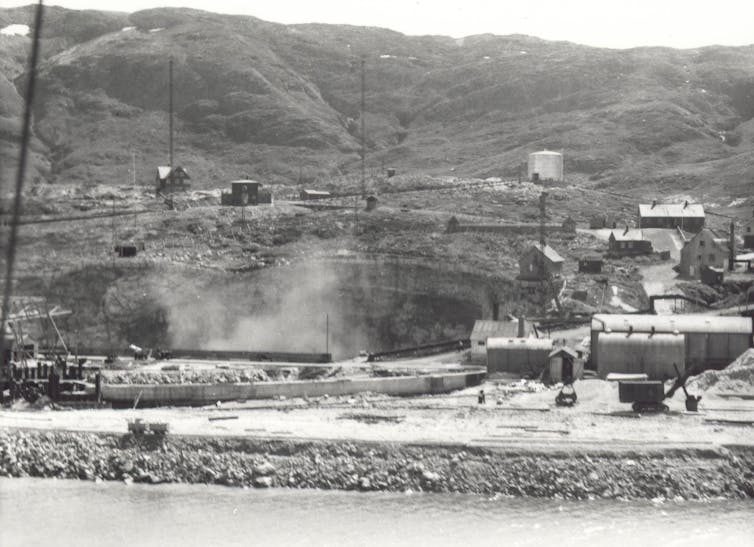
Greenland’s cryolite mine, essential for U.S. airplane production, was below sea level and vulnerable to Nazi sabotage. Reginald Wilcox, ca. 1941. Peary–MacMillan Arctic Museum, Bowdoin College

Thomas Robertson, Macalester College

On April 9, 1940, Nazi tanks stormed into Denmark. A month later, they blitzed into Belgium, Holland and France. As Americans grew increasingly rattled by the spreading threat, a surprising place became crucial to U.S. national security: the vast, ice-capped island of Greenland.

The island, a colony of Denmark’s at the time, was rich in mineral resources. The Nazi invasions left it and several other European colonies as international orphans.

Greenland was essential for air bases as U.S. planes flew to Europe, and also for strategic minerals. Greenland’s Ivittuut (formerly Ivigtut) mine contained the world’s only reliable supply of the most important material you’ve probably never heard of: cryolite, a frosty white mineral that the U.S. and Canadian industries relied upon to refine bauxite into aluminum, and thus essential to assembling a modern air force.

A month after the Nazis seized Denmark, five American Coast Guard cutters set sail for Greenland, in part to protect the Ivittuut mine from the Nazis.

An illustration of Uncle Sam pounding a sign into Greenland labeled 'Keep Out!' with a tiny drawing of Adolf Hitler on the horizon.
This April 1941 drawing by famous political cartoonist Herbert L. Block, known as Herblock, was published shortly after Greenland became a de facto protectorate of the U.S. A Herblock Cartoon, © The Herb Block Foundation

People sometimes forget that World War II was a dog-eat-dog struggle for resources – oil and uranium but also dozens of other materials, everything from rubber to copper. Without these strategic materials, no modern military could produce crucial new weapons such as tanks and airplanes. The resource struggle often started before actual fighting.

Foreign materials fueled American global power, but also raised tricky questions about access to resources and about sovereignty, just as the old European imperial order was being rethought. As in 2026, U.S. presidents had to skillfully balance force and diplomacy.

Two people look over a production line with dozens of military aircraft in a large building.
Walter H. Beech and Olive Ann Beech view wartime production lines at Beech Aircraft Corp. in Wichita, Kan., in 1942. Courtesy of Wichita State University Libraries, Special Collections and University Archives. Walter H. and Olive Ann Beech Collection, wsu_ms97-02.3.9.1

As a historian at Macalester College, I research how Americans shape environments around the world through their purchasing and national security needs, and how foreign landscapes enable and constrain American actions. Today, control of Greenland’s natural resources is again on an American president’s radar as demand for critical minerals rises and supply tightens.

During the spring of 1940, America and its European allies mapped out patterns of resource use and ideas of global interconnection that would shape the international order for decades. Greenland helped give birth to this new order.

Rethinking American vulnerability

On May 16, 1940, President Franklin Roosevelt addressed a joint session of Congress, including many “American first” isolationists wary of European entanglements. Roosevelt implored Americans to wake up to new threats in the world – to, in his words, “recast their thinking about national protection.”

New weapons, he warned, had shrunk the world, and oceans could no longer shield the United States. The nation’s fate was inextricably tied to Europe’s. Nothing showed this better than Greenland: “From the fiords of Greenland,” FDR warned, “it is four hours by air to Newfoundland; five hours to Nova Scotia, New Brunswick and to the province of Quebec; and only six hours to New England.”

A 1942 map of the world at war and which countries were on which side.
Richard Edes Harrison’s famous WWII maps in Fortune magazine, including this one from 1942, changed American understandings of vulnerability by highlighting short aerial routes. Dark areas are considered Axis, dotted areas pro-Axis neutral or Axis-occupied, red areas Allies and yellow areas neutral. Pink areas, including Greenland, were considered Allies-occupied. Cornell University – PJ Mode Collection of Persuasive Cartography

But Greenland set off alarm bells for another reason. To protect itself in a dangerous world, Roosevelt famously called for the U.S. to hammer out 50,000 planes a year. But in 1938, America had produced only 1,800 planes.

To meet this ambitious goal, Roosevelt and his advisers knew that little could be done without Greenland. No Greenland, no cryolite. No cryolite, no massive American air force. Without cryolite, making 50,000 planes would be infinitely more difficult.

The age of alloys

Americans, National Geographic explained in 1942, lived in an “age of alloys.” Without aluminum alloys and other metallic mixtures, assembly lines churning out modern tanks, trucks and airplanes would grind to a halt. “More than any other struggle in history, this is a war of many metals, and the lack of a single one may be a blow far worse than the loss of a battle.”

Advertisement
Get More From A Face Cleanser And Spa-like Massage
Two military mechanics work on the propeller engine of an aircraft.
Aluminum was crucial for modern militaries. Mechanics check an airplane engine at Naval Air Station Corpus Christi, Texas, in November 1942. Fenno Jacobs/Department of Defense

Few materials mattered more than aluminum. Light yet strong, aluminum formed 60% of a heavy bomber’s engines, 90% of its wings and fuselage, and all of its propellers.

But there was a problem: Refining aluminum from bauxite ore required working with dangerously hot metallic mixtures, over 2,000 degrees Fahrenheit (1,100 degrees Celsius). Cryolite solved the problem by reducing the temperature to a more manageable 900 F (480 C).

The Nazis’ chemical industry had found a substitute for cryolite using fluorspar, but the U.S. preferred the more resource-efficient cryolite and wanted to prevent the Germans from having it.

After the Nazis seized Denmark

Just days after German tanks rolled into Denmark in April 1940, Allied officials huddled to devise ways to protect Ivittuut’s magical mineral. On May 3, Danish Ambassador to the U.S. Henrik de Kauffmann, risking trial for treason, requested American assistance. On May 10, the U.S. Coast Guard Cutter Comanche departed New England for Ivittuut. Four others soon followed, one with guns for the mine’s defenders.

A Coast Guard cutter and Army freighter off Greenland.
The U.S. Coast Guard Cutter Comanche played a role in protecting Greenland mining operations starting long before the U.S. officially entered World War II. Thomas B. MacMillan, Courtesy of Peary-MacMillan Arctic Museum, Bowdoin College

That very week in Washington, at a meeting of the Pan American Union, Roosevelt and his advisers spoke with hundreds of geologists and other representatives from Latin America — a resource-rich region that the U.S. saw as an answer to its strategic materials shortages.

Nervous about the history of U.S. imperial high-handedness in the region, some Latin Americans thought that their countries should seal off their resources to outside control, as Mexico had in nationalizing U.S. and European oil holdings in 1938.

A post reading: America needs your scrap rubber and noting uses, such as a heavy bomber needs 1,825 pounds of rubber.
Japan’s advances in Southeast Asia after Pearl Harbor cut off rubber from the Dutch East Indies and Malaysia, prompting a rush for rubber in the Amazon and the development of synthetics. World War II posters urged Americans to conserve rubber for the war effort. U.S. Government Printing Office, Courtesy of Northwestern University Libraries

With European empires crumbling, Roosevelt faced a delicate diplomatic dance with Greenland. He wanted to maintain the appearance of neutrality, keep skeptical isolationists in Congress from revolting and give no provocations to Latin American anti-imperialists to cut off resources. Crucially, he also needed to avoid giving the resource-starved Japanese a legal justification to seize the oil-rich Dutch East Indies, now Indonesia – another European colony orphaned by the Nazi invasion.

Roosevelt’s solution: enlist Coast Guard “volunteers” to guard Ivittuut. By the end of the summer, long before the U.S. officially entered the war, 15 sailors resigned from their ships and took up residence near the mine.

Seeing Greenland as crucial to US security

Roosevelt also got creative with geography.

In an April 12, 1940, press conference, just days after the Nazi invasion, he began to emphasize Greenland as part of the Western Hemisphere, more American than European, and thus falling under Monroe Doctrine protections. To calm fears in Latin America, U.S. officials recast the doctrine as development-oriented hemispheric solidarity.

Maj. William S. Culbertson, a former U.S. trade official speaking before the Army Industrial College in fall 1940, noted how the scramble for resources pulled the U.S. into a form of nonmilitary warfare: “We are engaged at the present time in economic warfare with the totalitarian powers. Publicly, our politicians don’t state it quite as bluntly as that, but it is a fact.” For the rest of the century, the front line was just as likely a far-off mine as an actual battlefield.

On April 9, 1941, exactly a year after the Nazis seized Denmark, Kauffmann met with U.S. Secretary of State Cordell Hull to sign an agreement “on behalf of the King of Denmark” placing Greenland and its mines under the U.S. security blanket. At Narsarsuaq, on the island’s southern tip, the U.S. began constructing an airbase named “Bluie West One.”

A photo from a plane of an airbase surrounded by mountains with glaciers above – in June.
An aerial view shows Bluie West One, a U.S. air base at Narsarsuaq, Greenland, in June 1942. Later, during the Cold War, the U.S. used Thule Air Base, now called Pituffik Space Base, in northwest Greenland as a key missile defense site because of its proximity to the USSR. USAF Historical Research Agency

During the rest of World War II and throughout the Cold War, Greenland would house several important U.S. military installations, including some that forced Inuit families to relocate.

Critical minerals today

What transpired in Greenland in the 18 months before Pearl Harbor fit into a larger emerging pattern.

Advertisement
Get More From A Face Cleanser And Spa-like Massage

As the U.S. ascended to global leadership and realized that it couldn’t maintain military dominance without wide access to foreign materials, it began to redesign the global system of resource flows and the rules for this new international order.

A chart showing costs significantly higher for steel, aluminum and copper in the 1950s compared with the early 1940s.
A 1952 chart from the President’s Materials Policy Commission, established by President Harry Truman to study the security of U.S. raw materials during the Cold War. The group was commonly known as the Paley Commission. Resources for Freedom: A Report to the President

It rejected the Axis’ “might makes right” territorial conquest for resources, but found other ways to guarantee American access to critical resources, including loosening trade restrictions in European colonies.

The U.S. provided a lifeline to the British with the destroyers-for-bases deal in September 1940 and the Lend-Lease Act in March 1941, but it also gained strategic military bases around the world. It used aid as leverage to also pry open the British Empire’s markets.

The result was a postwar world interconnected by trade and low tariffs, but also a global network of U.S. bases and alliances of sometimes questionable legitimacy designed in part to protect U.S. access to strategic resources.

Two men, one in military uniform, stand in front of a White House door talking.
President John F Kennedy meets with Mobutu Sese Seko of the former Belgian Congo, now the Democratic Republic of Congo, at the White House in 1963. Starting in the 1940s, the African country provided the U.S. with cobalt and uranium, including for the Hiroshima bomb. CIA-supported coups in 1960 and 1965 helped put Mobutu, known for corruption, in power. Keystone/Getty Images

During the Cold War, these global resources helped defeat the Soviet Union. However, these security imperatives also gave the U.S. license for support of authoritarian regimes in places like Iran, Congo and Indonesia.

America’s voracious appetite for resources also often displaced local populations and Indigenous communities, justified by the old claim that they misused the resources around them. It left environmental damage from the Arctic to the Amazon.

Five white men standing on snow smile for the cameras with a Greenland village behind them.
Donald Trump’s son visited Greenland in 2025, shortly after the U.S. president began talking about wanting to control the island and its resources. The people with Donald Trump Jr., second from right, are wearing jackets reading ‘Trump Force One.’ Emil Stach/Ritzau Scanpix/AFP via Getty Images

Strategic resources have been at the center of the American-led global system for decades. But U.S. actions today are different. The cryolite mine was a working mine, rarer than today’s proposed critical mineral mines in Greenland, and the Nazi threat was imminent. Most important, Roosevelt knew how to gain what the U.S. needed without a “damn-what-the world-thinks” military takeover.

Thomas Robertson, Visiting Associate Professor of Environmental Studies, Macalester College

This article is republished from The Conversation under a Creative Commons license. Read the original article.

Dive into “The Knowledge,” where curiosity meets clarity. This playlist, in collaboration with STMDailyNews.com, is designed for viewers who value historical accuracy and insightful learning. Our short videos, ranging from 30 seconds to a minute and a half, make complex subjects easy to grasp in no time. Covering everything from historical events to contemporary processes and entertainment, “The Knowledge” bridges the past with the present. In a world where information is abundant yet often misused, our series aims to guide you through the noise, preserving vital knowledge and truths that shape our lives today. Perfect for curious minds eager to discover the ‘why’ and ‘how’ of everything around us. Subscribe and join in as we explore the facts that matter.  https://stmdailynews.com/the-knowledge/

Advertisement
Get More From A Face Cleanser And Spa-like Massage

Discover more from Daily News

Subscribe to get the latest posts sent to your email.

Continue Reading

Trending