

Lifestyle
Some people love to scare themselves in an already scary world − here’s the psychology of why
Experiencing controlled fear can enhance social bonds, increase resilience, and offer psychological benefits, making horror entertainment a healthy distraction from scary real-life terrors.

Last Updated on March 11, 2026 by Daily News Staff

Fall for me as a teenager meant football games, homecoming dresses – and haunted houses. My friends organized group trips to the local fairground, where barn sheds were turned into halls of horror, and masked men nipped at our ankles with (chainless) chain saws as we waited in line, anticipating deeper frights to come once we were inside.
I’m not the only one who loves a good scare. Halloween attractions company America Haunts estimates Americans are spending upward of US$500 million annually on haunted house entrance fees simply for the privilege of being frightened. And lots of fright fans don’t limit their horror entertainment to spooky season, gorging horror movies, shows and books all year long.
To some people, this preoccupation with horror can seem tone deaf. School shootings, child abuse, war – the list of real-life horrors is endless. Why seek manufactured fear for entertainment when the world offers real terror in such large quantities?
As a developmental psychologist who writes dark thrillers on the side, I find the intersection of psychology and fear intriguing. To explain what drives this fascination with fear, I point to the theory that emotions evolved as a universal experience in humans because they help us survive. Creating fear in otherwise safe lives can be enjoyable – and is a way for people to practice and prepare for real-life dangers.
Fear can feel good
Controlled fear experiences – where you can click your remote, close the book, or walk out of the haunted house whenever you want – offer the physiological high that fear triggers, without any real risk.
When you perceive yourself under threat, adrenaline surges in your body and the evolutionary fight-or-flight response is activated. Your heart rate increases, you breathe deeper and faster, and your blood pressure goes up. Your body is preparing to defend itself against the danger or get away as fast as possible.
This physical reaction is crucial when facing a real threat. When experiencing controlled fear – like jump scares in a zombie TV show – you get to enjoy this energized sensation, similar to a runner’s high, without any risks. And then, once the threat is dealt with, your body releases the neurotransmitter dopamine, which provides sensations of pleasure and relief.
In one study, researchers found that people who visited a high-intensity haunted house as a controlled fear experience displayed less brain activity in response to stimuli and less anxiety post-exposure. This finding suggests that exposing yourself to horror films, scary stories or suspenseful video games can actually calm you afterward. The effect might also explain why my husband and I choose to relax by watching zombie shows after a busy day at work.
The ties that bind
An essential motivation for human beings is the sense of belonging to a social group. According to the surgeon general, Americans who miss those connections are caught up in an epidemic of loneliness, which leaves people at risk for mental and physical health issues.
Going through intense fear experiences together strengthens the bonds between individuals. Good examples include veterans who served together in combat, survivors of natural disasters, and the “families” created in groups of first responders.
I’m a volunteer firefighter, and the unique connection created through sharing intense threats, such as entering a burning building together, manifests in deep emotional bonds with my colleagues. After a significant fire call, we often note the improved morale and camaraderie of the firehouse. I feel a flood of positive emotions anytime I think of my firefighting partners, even when the events occurred months or years ago.
Controlled fear experiences artificially create similar opportunities for bonding. Exposure to stress triggers not only the fight-or-flight response, but in many situations it also initiates what psychologists call the “tend-and-befriend” system. A perceived threat prompts humans to tend to offspring and create social-emotional bonds for protection and comfort. This system is largely regulated by the so-called “love hormone” oxytocin.
The tend-and-befriend reaction is particularly likely when you experience stress around others with whom you have already established positive social connections. When you encounter stressors within your social network, your oxytocin levels rise to initiate social coping strategies. As a result, when you navigate a recreational fear experience like a haunted house with friends, you are setting the emotional stage to feel bonded with the people beside you.
Sitting in the dark with friends while you watch a scary movie or navigating a haunted corn maze with a date is good for your health, in that it helps you strengthen those social connections.
An ounce of prevention = a pound of cure
Controlled fear experiences can also be a way for you to prepare for the worst. Think of the early days of the COVID-19 pandemic, when the films “Contagion” and “Outbreak” trended on streaming platforms as people around the world sheltered at home. By watching threat scenarios play out in controlled ways through media, you can learn about your fears and emotionally prepare for future threats.
For example, researchers at Aarhus University’s Recreational Fear Lab in Denmark demonstrated in one study that people who regularly consumed horror media were more psychologically resilient during the COVID-19 pandemic than nonhorror fans. The scientists suggest that this resilience might be a result of a kind of training these fans went through – they practiced coping with the fear and anxiety provoked by their preferred form of entertainment. As a result, they were better prepared to manage the real fear triggered by the pandemic.
When I’m not teaching, I’m an avid reader of crime fiction. I also write psychological thrillers under the pen name Sarah K. Stephens. As both a reader and writer, I notice similar themes in the books I am drawn to, all of which tie into my own deep-rooted fears: mothers who fail their children somehow, women manipulated into subservience, lots of misogynist antagonists.
I enjoy writing and reading about my fears – and seeing the bad guys get their just desserts in the end – because it offers a way for me to control the story. Consuming these narratives lets me mentally rehearse how I would handle these kinds of circumstances if any were to manifest in my real life.
Survive and thrive
In the case of controlled fear experiences, scaring yourself is a pivotal technique to help you survive and adapt in a frightening world. By eliciting powerful, positive emotions, strengthening social networks and preparing you for your worst fears, you’re better able to embrace each day to its fullest.
So the next time you’re choosing between an upbeat comedy and a creepy thriller for your movie night, pick the dark side – it’s good for your health.
Sarah Kollat, Teaching Professor of Psychology, Penn State
This article is republished from The Conversation under a Creative Commons license. Read the original article.
Our Lifestyle section on STM Daily News is a hub of inspiration and practical information, offering a range of articles that touch on various aspects of daily life. From tips on family finances to guides for maintaining health and wellness, we strive to empower our readers with knowledge and resources to enhance their lifestyles. Whether you’re seeking outdoor activity ideas, fashion trends, or travel recommendations, our lifestyle section has got you covered. Visit us today at https://stmdailynews.com/category/lifestyle/ and embark on a journey of discovery and self-improvement.

Child Health
Changing the Landscape of Childhood Cancer Survivorship
Childhood Cancer: hile “cancer” is a term no family wants to hear, especially when it comes to their children, there is reason for hope. Today, 85% of children diagnosed with cancer survive at least five years. Survival is only part of the journey, however.


Changing the Landscape of Childhood Cancer Survivorship
(Feature Impact) While “cancer” is a term no family wants to hear, especially when it comes to their children, there is reason for hope. Today, 85% of children diagnosed with cancer survive at least five years, according to the National Cancer Institute, up from 75% three decades ago.
Watch this video to learn more
“This progress is driven in large part by dedicated research,” Hyundai Hope on Wheels Board Member Kevin Reilly said. “Over the last 28 years, Hyundai Hope on Wheels has committed over $300 million in pediatric cancer research and program grants, awarding more than 1,600 grants to 210 medical institutions nationwide, impacting thousands of young lives each year.”
Survival is only part of the journey, however. Nearly half (46%) of U.S. adults believe a child ringing the hospital bell after cancer treatment means the child is cancer-free and their medical journey is largely over, according to a survey conducted by Atomik Research on behalf of Hyundai Hope on Wheels. For the children and families living through a diagnosis, the reality is far more complex.
“The reality is that healing continues long after treatment, which is why sustained investment in survivorship care is a priority for us,” said John Guastaferro, executive director of Hyundai Hope on Wheels.
Isabella Franco-Capps, 11, understands that journey firsthand. Diagnosed with B-cell acute lymphoblastic leukemia at age 5, her journey took two years before she could say she’s “a cancer survivor.”
“I was diagnosed with b-cell acute lymphoblastic leukemia,” she said. “This began my two-year-long journey of scans, pokes, chemotherapy and hospital stays. And now I’m a cancer survivor.”
Fellow Hyundai Hope on Wheels National Youth Ambassador, Jackson Trihn, 12, is using his voice to call for continued research and to bring hope to others.
“The role … is being able to share my story,” he said. “Not just to spread awareness but to spread hope to kids that need it. And awareness is so important because people don’t understand how hard pediatric cancer can be.”
Continued progress can help ensure more children ring the bell and receive the care and support they need long after they’ve had the opportunity to do so. To learn more about these efforts and how you can help, visit HyundaiHopeOnWheels.org.

SOURCE:
💪 Your health journey starts here! Explore the latest health news, fitness tips, wellness trends, and healthy living advice. Share your thoughts in the comments and subscribe to the STM Daily News newsletter to stay informed and inspired every day.

(Feature Impact) Driven by rising rates of obesity, diabetes, high blood pressure and other risk factors,cardiovascular disease has surpassed cancer as the leading cause of death among Hispanic adults in the United States.
Hispanic people represent nearly 1 in 5 of the U.S. population and are the nation’s largest ethnic minority group, yet many continue to face barriers to achieving heart health and accessing high-quality healthcare. A new scientific statement published in the American Heart Association’s flagship journal, “Circulation,” revealed how social, economic, cultural and environmental factors contribute to persistent disparities in cardiovascular health, calling for culturally tailored prevention strategies, equitable access to care and greater representation of Hispanic populations in cardiovascular research.
“Hispanic populations in the U.S. are incredibly diverse even within their own communities with differences in genetic ancestry, language, cultural traditions and social experiences that can significantly influence cardiovascular health,” said Johanna Contreras, M.D., M.Sc., FAHA, director of the Division of Heart Failure and medical director of the Hispanic Heart Center within the Mount Sinai Health System. “Yet Hispanic people remain underrepresented overall in the research that guides prevention and treatment strategies… Without better representation and more detailed data, we risk overlooking important differences that can help us improve care and save lives.”
Hispanic Cardiovascular Health by the Numbers
Cardiovascular risk factors – obesity (nearly 46%), type 2 diabetes (15.5%) and high blood pressure (approximately 44%) – are prevalent among Hispanic adults and often emerge at younger ages and occur more frequently among Hispanic adults compared with white adults.
According to the report, only about 1 in 5 Hispanic adults achieves ideal cardiovascular health as defined by the American Heart Association’s original Life’s Simple 7 metrics. Updated analyses using the Life’s Essential 8 framework demonstrated persistent disparities for heart and brain health, as well as suboptimal dietary quality, sleep patterns and levels of physical activity.
Social and Economic Barriers Matter
Biology alone does not explain cardiovascular health disparities. The environments where people live, work and age, along with social and economic challenges, impact heart health. In fact, approximately 17% of Hispanics live below the federal poverty threshold, compared with 8.2% of white adults.
“Many Hispanic adults face obstacles that extend far beyond the doctor’s office,” Contreras said. “Limited health insurance coverage, language differences, food insecurity, environmental exposures and concerns related to immigration status can make it more difficult to prevent disease, manage chronic conditions and receive timely treatment.”
Contreras emphasized the cultural values and practices of Hispanic people also influence how they perceive their health and healthcare options.
“Family plays a central role in many Hispanic communities and can be an extraordinary source of strength, support and resilience,” Contreras said. “At the same time, family members are often called upon to translate medical information, navigate health systems and help make healthcare decisions for loved ones. Those responsibilities can shape how health information is understood and acted upon.”
An Action Plan for Improving Hispanic Health
There are practical opportunities to achieve equitable cardiovascular health and reduce disparities through community engagement, culturally responsive care, inclusive research and policies that address the underlying drivers of health.
“Reducing cardiovascular disease among Hispanic populations demands action at every level,” Contreras said, “from improving access to culturally responsive care and expanding research participation to addressing the social and environmental conditions that shape health.”
By addressing both medical risk factors and the social conditions that shape health, experts believe there is an important opportunity to reduce disparities and help more people live longer, healthier lives. Learn more at Heart.org.
Photo courtesy of Shutterstock

SOURCE:
Subscribe to our news letter STM Daily News


(Feature Impact) Every year, approximately 200,000 service men and women transition from military life to corporate America. Finding the right civilian career is a transition, but it’s an opportunity to leverage military leadership and mission-driven talent.
Traditional hiring processes often focus on conventional resumes, but forward-thinking organizations recognize military experience as a competitive advantage in today’s workforce. The resilience, integrity and adaptability of America’s veterans and military families make them uniquely positioned to drive growth and innovation in their communities.
“Veterans bring unmatched discipline, adaptability and a results-driven mindset that directly translates to high-impact corporate careers,” said Drew Matheson, senior director at Capital One’s Commercial Bank and retired U.S. Army infantry officer. “While military experience doesn’t always fit perfectly on a traditional paper resume, employers like Capital One who know how to decode these unique leadership skills are able to unlock an incredible pipeline of proven performers.”
To help transitioning service members successfully navigate this career pivot, military community leaders at Capital One offer these five essential tips for service members entering the civilian workforce: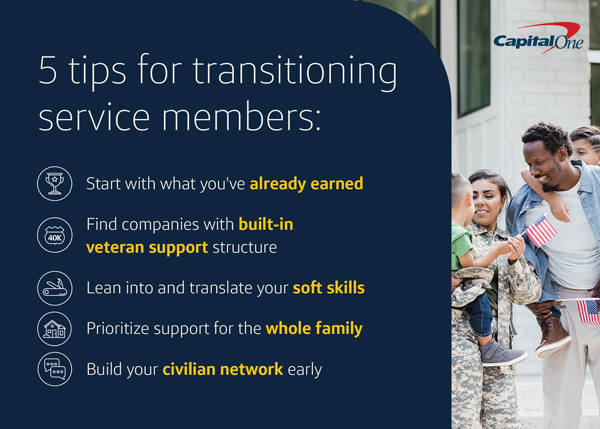
Start With What You’ve Already Earned
Opportunity starts with preparation. Beyond the well-known Post-9/11 GI Bill, which can cover tuition, housing and books, transitioning service members can look into vocational rehab or the SkillBridge program, which allows them to do civilian internships during the last 180 days of service. Many employers also offer internal tuition reimbursement programs. Taking the time to proactively map out these benefits ensures you aren’t leaving valuable opportunities or money on the table.
Find Employers with Veteran Support Structures
With almost half of veterans leaving their first post-military job within a year, according to research published by the Institute for Veterans and Military Families and VetAdvisor, finding the right culture and community is key to a successful transition. Look for employers with active veteran networks and dedicated mentorship.
For example, Capital One’s Salute Business Resource Group serves as a thriving internal community of more than 6,000 members, offering peer support, year-round professional development and mentorship for veterans, reservists and military spouses. Additionally, partner organizations like Hiring Our Heroes provide career workshops, fellowships and job fairs to ensure you’re employment-ready from day one.
Lean Into and Translate Your Soft Skills
Veterans bring a distinct competitive advantage to the applicant pool. You should confidently lean into the cross-functional “soft skills” learned in the line of duty such as risk management, crisis resolution and building trust under high-pressure scenarios.
The trick is translating these capabilities out of military jargon on your resume. Swap military terms like “NCOIC” for “Operations Manager” or “commanded” for “directed.” To make this easier, look for military-friendly employers that employ dedicated military recruiters who specialize in decoding military resumes to align skills with the right roles.
Prioritize Support for the Whole Family
Military service is a family commitment, and the transition out of uniform affects everyone. Military spouses often face unique career hurdles, including frequent relocations and employment gaps. When evaluating employers, look for companies that offer holistic benefits and flexible structures.
For example, Capital One, recognized by “U.S. Veterans Magazine” as a Top Veteran Employer and Top Military Spouse Employer, actively supports military spouses and families through dedicated spouse hiring initiatives and internal support mechanisms. Furthermore, look for organizations that support continued military training and active-duty leave, ensuring military associates never have to choose between their service and their careers.
Build Your Civilian Network Early
In the military, your network is built in. In the civilian world, you have to cultivate it. Long before your terminal leave begins, connect with veterans who work at companies you admire. Reach out for brief, 15-minute informational interviews to learn about their transition journeys rather than simply asking for a job. With more than 70% of civilian jobs filled through networking, according to estimates from Career Horizons, making organic connections early is a powerful tool for getting your foot in the door.
To find additional resources and learn more about how to support the hiring of veterans and military spouses, visit CapitalOneCareers.com/Military.
Photo courtesy of Shutterstock

SOURCE:





