

Consumer Corner
What are halal mortgages?


Shariq Siddiqui, Indiana University
The growth of “halal mortgages” over the past 20 years has expanded financial access to homeownership for many Muslims. Halal mortgages provide interest-free loans in keeping with Islamic beliefs.
These mortgages are available in over 80 countries that have a significant Muslim population, such as Saudi Arabia, Iran, Malaysia, United Arab Emirates, Kuwait, Qatar, Turkey, Bahrain, Indonesia and Pakistan, where they account for the vast majority of the global US$3.9 trillion Islamic finance economy.
Access to halal mortgages has been growing in the United States. Until 1997, no financial institution was willing to offer halal mortgages, but in 2024, over 25 banks had made them available.
The Conversation asked Shariq Siddiqui, assistant professor and director of the Muslim Philanthropy Initiative at Indiana University, to explain halal mortgages.
What are halal mortgages?
Halal mortgages are a tool of Islamic finance and offer an equitable way to gain homeownership. They emphasize risk-sharing and mutual cooperation with the aim of checking unfair exploitation and wealth accumulation in the hands of a few. In such a system, money is a means of exchange rather than a commodity that generates profit.
What are the religious roots of Islamic finance?
The Muslim holy book, the Quran, and the sayings of the Prophet Muhammad, the Sunnah, prohibit riba, (interest), maisir (speculation) and gharar (uncertainty or uneven risk).
For example, the Quran says, “O you who believe, do not eat up the amounts acquired through ribā (interest), doubled and multiplied. Fear Allah, so that you may be successful.”
Over time, Muslims have sought to develop systems that adhere to these rules. These include bonds that do not receive interest but are based on profit-sharing; socially responsible mutual funds that comply with ethical rules; and insurance that provide protection through a communal fund.
Since World War II, however, monetary policies in the global financial market are largely based upon interest.
How does Islamic financing work in modern context?

In the modern context, Muslims use contract law for economic activity and offer home mortgages without interest. For example, as an attorney, I would develop mortgage contracts that would allow buyers and sellers to transact without interest. This “mortgage” contract would be recorded with the county.
Traditionally, there are three kinds of halal mortgages. In the first, known as ijara, the bank purchases the property and leases it to the homeowner; the homeowner pays rent, principal payments and bank charges; the buyer’s share in the home remains the same until the entire loan is paid off.
Diminishing musharaka is another type of joint ownership plan between the bank and the buyer. The buyer makes principal monthly payments and pays bank charges rather than interest. With each principal payment, the ownership of the buyer increases and the bank’s ownership decreases.
In the third type, murabaha, the bank purchases the home and resells it immediately to the buyer at a higher price – termed as profit. The buyer typically pays a 20% down payment. Thereafter, the buyer makes fixed interest-free payments until the loan is paid off.
What is the availability of halal mortgages in the US?
In 2001 and 2003, respectively, Freddie Mac and Fannie Mae started buying Islamic mortgage products to provide extra liquidity in the U.S. Islamic finance market. These government-backed housing giants work under the conservatorship of the Federal Housing Finance Agency and are one of the principal means of bolstering homeownership in the United States.
These mortgage buyers have grown to become the main investors in Islamic mortgages. For example, Freddie Mac has invested in Guidance Residential, one of the largest halal mortgage companies in the U.S.
What are the advantages?
These systems ensure that there is mutual risk-taking between the bank and the homebuyer. For example, should the homebuyer be unable to keep up payments, their prior principal payments are protected and not consumed by the interest. Furthermore, if the home loses value, both homebuyer and bank proportionally lose out on the principal value of the home.
They require greater transparency on costs, fees and responsibilities; both parties are required to work together and fulfill their obligations.
This reduces the risk of failures like the subprime lending crisis, when banks overvalued homes and financed mortgages that buyers could not afford, leading to a global recession in 2008.
What are the downsides?
Halal mortgages are more expensive and more difficult to enter into, as they require a down payment of at least 20%. Furthermore, they are not available in every state in the United States.
Additionally, many Muslims are unwilling to deposit their money in banks, if those banks are required to pay interest or earn part of their revenue based upon interest.
Shariq Siddiqui, Assistant Professor & Director of the Muslim Philanthropy Initiative, Indiana University
This article is republished from The Conversation under a Creative Commons license. Read the original article.
Welcome to the Consumer Corner section of STM Daily News, your ultimate destination for savvy shopping and informed decision-making! Dive into a treasure trove of insights and reviews covering everything from the hottest toys that spark joy in your little ones to the latest electronic gadgets that simplify your life. Explore our comprehensive guides on stylish home furnishings, discover smart tips for buying a home or enhancing your living space with creative improvement ideas, and get the lowdown on the best cars through our detailed auto reviews. Whether you’re making a major purchase or simply seeking inspiration, the Consumer Corner is here to empower you every step of the way—unlock the keys to becoming a smarter consumer today!

Consumer Corner
3 Practical Ways to Build Financial Confidence
Financial Confidence: Economic uncertainty, fueled by persistent inflation, stagnant wages and a cooling job market, has led many Americans to feel like they’re falling behind, even when they’re doing many of the “right” things financially. This expert guidance can help you be more intentional with the choices you make so your spending reflects your priorities.


Building Financial Confidence
(Feature Impact) Nearly everyone is carrying some level of insecurity about their financial future, even those who are trying to plan ahead. Economic uncertainty, fueled by persistent inflation, stagnant wages and a cooling job market, has led many Americans to feel like they’re falling behind, even when they’re doing many of the “right” things financially.
Though many are paying down debt, saving for retirement and building an emergency fund, they’re still asking, “Am I doing enough?” In fact, only 21% of Americans are financially prepared and assured in their ability to protect their futures, according to Mutual of Omaha’s 2026 Protection Index Survey – a proprietary research study conducted with quantilope – which shows overall financial confidence has declined.
“Many people believe they need to wait until they have more money, more certainty or the perfect plan before taking action,” said Nate Hobson, vice president of sales, Advisor Network at Mutual of Omaha. “But financial confidence is usually built through consistency rather than perfect timing. Even small steps today can make a meaningful difference over time.”
While being financially secure means different things to different people, according to the survey – such as having little or no debt (34%), owning a home (29%), maintaining emergency savings (27%), saving for retirement (26%) or having insurance coverage (26%) – building financial confidence doesn’t have to translate to cutting out everything you enjoy. Instead, this expert guidance can help you be more intentional with the choices you make so your spending reflects your priorities.
Create a Financial Cushion
Whether it’s a car repair, medical bill or temporary loss of income, unexpected expenses happen.
Having even a modest emergency fund can reduce financial stress and reliance on credit cards or loans. If saving several months of expenses feels overwhelming, start with a smaller milestone. Consistency matters more than the starting amount.
 Put Good Financial Habits on Autopilot
One of the easiest ways to make progress is removing the need to make the same decision every month. Consider setting up automatic contributions to savings and retirement accounts, regular investment deposits and automatic bill payments, which can help you build financial security even during busy or uncertain times.
Taking a look at everyday spending habits can also make a difference. The survey showed small, everyday choices add up over time, such as cutting non-essential spending (57%), using rewards programs (54%), comparing prices or switching providers (39%) and following a monthly budget (38%). That could mean bringing your lunch to work instead of grabbing takeout, taking a few extra minutes to compare prices at the grocery store or using rewards to get more value from the purchases you’re already making.
Protect What You’re Building
Saving and investing are important pieces of financial protection, but they’re only part of the equation. Protecting income, loved ones and other financial assets is equally important.
For families, life insurance can provide financial protection during key earning and caregiving years, helping replace income if the unexpected happens. For those focused on covering final expenses, guaranteed whole life insurance can help cover funeral and other end-of-life costs. If you’re approaching or living in retirement, an annuity may provide a reliable stream of income that can complement other retirement resources and reduce uncertainty.
A financial professional can help determine which options best fit your goals and circumstances. To see how much coverage is right for your situation, Mutual of Omaha’s Life Insurance Calculator can provide a personalized estimate based on your income, financial obligations and long-term goals.
For more practical advice to build financial confidence, visit MutualofOmaha.com.
Taking Action with an Extra $1,000
If you unexpectedly received $1,000, your response with the extra cash may reveal your financial priorities and where additional planning could strengthen financial resilience.
Providing a window into Americans’ financial priorities, respondents in Mutual of Omaha’s 2026 Protection Index Report said they would:
- Pay down debt (25%)
- Add it to savings (21%)
- Use it for everyday expenses (14%)
- Invest it (9%)
Photos courtesy of Shutterstock

SOURCE:
💰 Live well and make your money work smarter! Explore the latest lifestyle tips, personal finance insights, saving strategies, and financial wellness stories on STM Daily News. Share your thoughts in the comments and subscribe to our newsletter for fresh ideas delivered straight to your inbox.
financial wellness
Survey: Credit isn’t a backup plan. For millions of Americans, it’s how they buy groceries.
Credit isn’t a backup plan. Credit cards were once reserved for expensive purchases or for added security in buying online. For households managing debt, they have become a way to cover everyday purchases like groceries.

Survey: Credit isn’t a backup plan. For millions of Americans, it’s how they buy groceries.
(Sheeka Sanahori) Sixty-six percent of Americans carrying at least $10,000 in unsecured debt used a credit card to buy groceries in the last year, more than any other essential expense, according to a new survey. Credit cards were once reserved for expensive purchases or for added security in buying online. For households managing debt, they have become a way to cover everyday purchases like groceries.
Accredited Debt Relief, a company specializing in debt relief, commissioned Atomik Research in May 2026 to survey 2,000 U.S. adults with at least $10,000 in unsecured debt. Along with groceries, 47% say they’ve used credit for gas or transportation, 45% for utilities and 33% for rent or housing costs.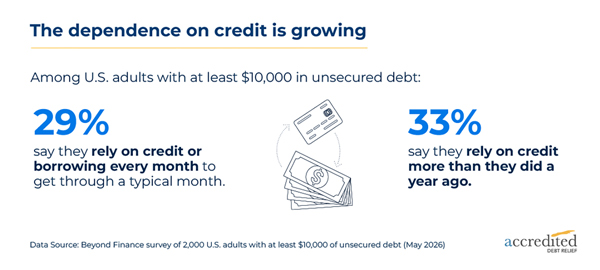
For people struggling with cost-of-living pressures, using unsecured debt can begin as a quick solution to cover household needs for the moment. At first, it’s just milk and eggs. But then an unexpected expense happens: a flat tire, an unusually high electricity bill, a medical cost that was not in the budget. The balance adds up and, according to the survey data, this also creates stress for consumers.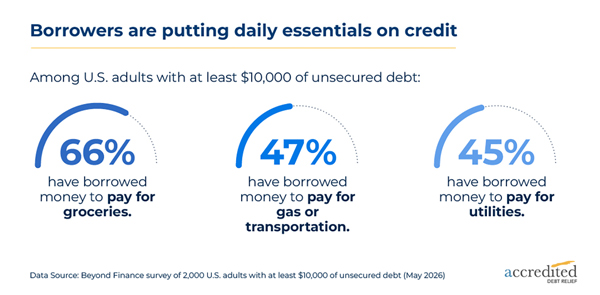
This isn’t discretionary spending. The data reflects a growing reliance on consumer debt to cover basic cost-of-living needs. However, relying on borrowed money without an executable plan for repaying it could mean that one day, the runway for taking care of such expenses runs out.
A significant share of respondents report relying on credit as a routine part of managing their personal finances. This routine could become a long-term debt cycle for many households. Nearly three in ten say that they rely on credit or borrowing to get through a typical month. This reliance appears to be growing, with a third saying they depend on credit more than they did a year ago. For those consumers, what may have once been a stopgap has become an increasingly common and ongoing financial strategy.
The growing debt cycle by unsecured borrowing is taking an emotional toll on these consumers, too. A quarter of respondents are concerned about their financial future and 12% feel a stronger concern that they’re at risk of long-term financial instability.
A lack of savings makes the cycle harder to break. Only 28% of respondents say they can both cover expenses and save. When there is little room between income and expenses, every disruption becomes harder to absorb.
Unexpected expenses, such as medical bills or car repairs, lead 19% of respondents to take on additional debt every time, and 27% most of the time. These are the kinds of costs households are often told to prepare for, but preparation requires room. For many consumers, that room does not exist.
Debt builds over time when credit becomes part of monthly operations. Some of these consumers say they don’t earn enough to make meaningful changes to their current financial situation. Among those surveyed, 45% report that their income is enough to get by but not get ahead. Many report that their financial situation has caused them to put off taking a vacation or begin building savings.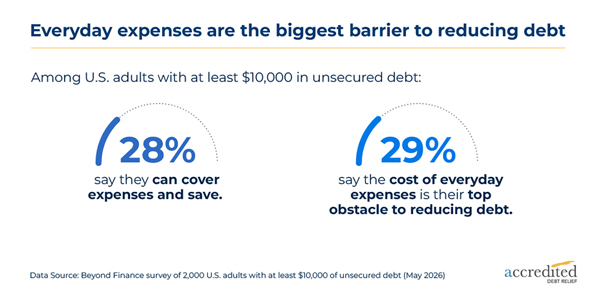
When asked about the biggest barrier to reducing debt, 29% of respondents listed the same obstacle: the cost of everyday expenses. That number connects how debt builds with why it persists.
When everyday expenses become part of ongoing credit card debt, the balance can grow without notice. Even when a consumer gets their next paycheck, if it’s already accounted for, they may not be able to make much progress in paying down their debts. A few recurring costs, spread across months, can become a greater financial weight. The result is debt that builds, because it’s tied to the basic cost of living. It also can create a stressful way to live; more than three in ten people say their current debt situation has affected their mental well-being.
Without meaningful changes, whether through increased income, debt relief or other financial support, these households may continue to rely on consumer debt and unsecured credit as a daily necessity rather than a strategic financial tool or occasional supplement. The risk is that life’s most basic needs become harder to maintain in the long run.
Methodology
Accredited Debt Relief commissioned Atomik Research to conduct an online survey of 2,000 U.S. adults with at least $10,000 in unsecured debt. The margin of error is plus or minus 2 percentage points at a 95 percent confidence level. Fieldwork was conducted between May 11-14, 2026. Atomik Research, part of 4media group, is a creative market research agency.
Photo courtesy of Shutterstock (tap to pay)

SOURCE:
💰 Live well and make your money work smarter! Explore the latest lifestyle tips, personal finance insights, saving strategies, and financial wellness stories on STM Daily News. Share your thoughts in the comments and subscribe to our newsletter for fresh ideas delivered straight to your inbox.
Automotive
Beyond the Sticker Price: Identifying the Most Affordable New Vehicles to Insure for 2026
For most households, buying a new vehicle is one of the largest financial decisions they’ll make. The purchase price is only the beginning, however. To help consumers make more informed purchasing decisions, consider these rankings of the most affordable new 2026 model year vehicles to insure.
Beyond the Sticker Price: Identifying the Most Affordable New Vehicles to Insure for 2026
(Feature Impact)For most households, buying a new vehicle is one of the largest financial decisions they’ll make. The purchase price is only the beginning, however. Fuel, maintenance, depreciation and insurance all contribute to the total cost of ownership, making affordability a consideration that extends well beyond the showroom.
To help consumers make more informed purchasing decisions, Mercury Insurance recently released its annual rankings of the most affordable new 2026 model year vehicles to insure, identifying the top-performing SUV, truck, sedan and electric or hybrid vehicles in four of today’s most popular categories.
“Consumers naturally compare purchase price, fuel economy, safety ratings and technology features before buying a vehicle,” said Chong Gao, director of research and development for Mercury Insurance. “Insurance is one of the few ownership costs drivers can estimate before making a purchase. Factoring it into the decision gives consumers a more complete picture of what that vehicle is likely to cost over the years they own it.”
While every driver’s premium is unique, this year’s rankings also revealed a broader trend: Practical, mainstream vehicles continue to offer some of the strongest long-term insurance value.
“Vehicles designed for everyday drivers often strike the best balance between safety, repairability and replacement costs,” Gao said. “That’s reflected in this year’s rankings, where familiar models from manufacturers like Hyundai, Chevrolet, Honda, Kia and Volkswagen rose to the top. It reinforces the idea that choosing a practical vehicle can pay dividends well beyond the purchase price.”
 A Cost You Can Plan For
Unlike unexpected repairs or fluctuating fuel prices, insurance is a predictable ownership expense consumers can research before purchasing a vehicle.
Comparing insurance costs alongside purchase price, fuel economy, maintenance expenses and expected repair costs can help shoppers better understand the long-term financial commitment of vehicle ownership.
Factors Influencing Insurance Costs
Insurance costs are influenced by many factors, but repair complexity, parts availability, vehicle safety systems and historical claims experience all contribute to how a vehicle is insured. While advanced safety technology can help reduce accidents, vehicles that are easier and less expensive to repair can also help improve long-term affordability. Among the considerations insurers evaluate are:
- Repair and replacement costs
- Historical claims experience
- Vehicle safety features and crash performance
- Theft frequency
- Availability and cost of replacement parts
- Vehicle performance characteristics
The Most Affordable Vehicles to Insure
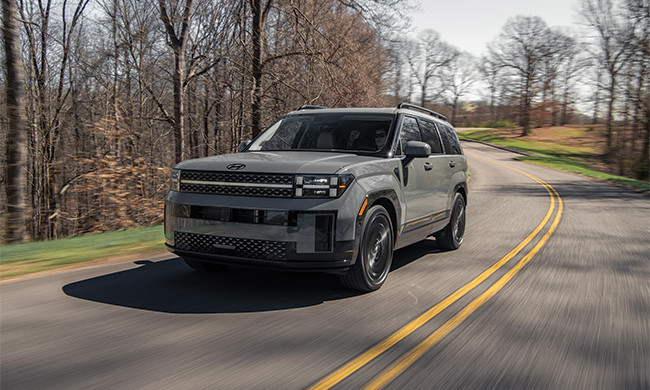
This year’s rankings show practical, mainstream vehicles continue to offer some of the strongest insurance value. The top spot in both the SUV and electric and hybrid categories was claimed by Hyundai while Chevrolet led the truck category and Volkswagen topped the sedan rankings. Rounding out Mercury’s rankings were several familiar nameplates recognized for balancing insurance affordability with everyday value.
SUVs:
- Hyundai Santa Fe
- Chevrolet Blazer
- Honda Pilot
- Kia Sportage
- Honda Passport
Trucks:
- Chevrolet Colorado LT
- Chevrolet Silverado C3500
- Ford Maverick and Ranger
- Hyundai Santa Cruz SE
- Toyota Tundra CrewMax
Sedans and Coupes:
- Volkswagen Golf R
- Acura Integra
- Honda Prelude
- Kia K4
- Mazda3
Electric and Hybrids:
- Hyundai Santa Fe Hybrid
- Chevrolet Blazer EV
- Kia Sportage Hybrid
- Ford Escape Hybrid
- Honda CR-V Hybrid
“The smartest vehicle purchase isn’t always the one with the lowest sticker price,” Gao said. “It’s the one that delivers the best overall value over time. Comparing insurance before buying gives consumers another tool to make a more informed decision.”
Visit MercuryInsurance.com to see the full rankings and request a quote to get a more complete understanding of long-term ownership costs.
Photo courtesy of Hyundai America (Hyundai Santa Fe)
Photo courtesy of Shutterstock (couple using laptop)

SOURCE:
📰 Enjoying STM Daily News? Join the conversation!
💬 Leave a comment, share your thoughts, and subscribe to our newsletter for the latest stories, updates, and “News You Can Use This Moment!” delivered to your inbox.
Stay connected with STM Daily News!





