Valerie Thomas is a true pioneer in the world of science and technology. A NASA engineer and physicist, she is best known for inventing the illusion transmitter, a groundbreaking device that creates 3D images using concave mirrors. This invention laid the foundation for modern 3D imaging and virtual reality technologies.
Beyond her inventions, Thomas broke barriers as an African American woman in STEM, mentoring countless young scientists and advocating for diversity in science and engineering. Her work at NASA’s Goddard Space Flight Center helped advance satellite technology and data visualization, making her contributions both innovative and enduring.
In our latest short video, we highlight Valerie Thomas’ remarkable journey—from her early passion for science to her groundbreaking work at NASA. Watch and be inspired by a true STEM pioneer whose legacy continues to shape the future of space and technology.
Dive into “The Knowledge,” where curiosity meets clarity. This playlist, in collaboration with STMDailyNews.com, is designed for viewers who value historical accuracy and insightful learning. Our short videos, ranging from 30 seconds to a minute and a half, make complex subjects easy to grasp in no time. Covering everything from historical events to contemporary processes and entertainment, “The Knowledge” bridges the past with the present. In a world where information is abundant yet often misused, our series aims to guide you through the noise, preserving vital knowledge and truths that shape our lives today. Perfect for curious minds eager to discover the ‘why’ and ‘how’ of everything around us. Subscribe and join in as we explore the facts that matter. https://stmdailynews.com/the-knowledge/
A Short-Form Series from The Knowledge by STM Daily News
Every Friday, STM Daily News shines a light on brilliant minds history overlooked.
Advertisement
Forgotten Genius Fridays is a weekly collection of short videos and articles dedicated to inventors, innovators, scientists, and creators whose impact changed the world—but whose names were often left out of the textbooks.
From life-saving inventions and cultural breakthroughs to game-changing ideas buried by bias, our series digs up the truth behind the minds that mattered.
Each episode of The Knowledge runs 30–90 seconds, designed for curious minds on the go—perfect for YouTube Shorts, TikTok, Reels, and quick reads.
Because remembering these stories isn’t just about the past—it’s about restoring credit where it’s long overdue.
Rod: A creative force, blending words, images, and flavors. Blogger, writer, filmmaker, and photographer. Cooking enthusiast with a sci-fi vision. Passionate about his upcoming series and dedicated to TNC Network. Partnered with Rebecca Washington for a shared journey of love and art. View all posts
Rod: A creative force, blending words, images, and flavors. Blogger, writer, filmmaker, and photographer. Cooking enthusiast with a sci-fi vision. Passionate about his upcoming series and dedicated to TNC Network. Partnered with Rebecca Washington for a shared journey of love and art.
The modern traffic light, largely attributed to Garrett Morgan’s 1923 invention, introduced a critical yellow warning light that improved public safety. Despite his significant impact on traffic systems, Morgan’s contributions have often been overlooked due to historical racism.
When you think about the traffic light, you probably picture green for go, red for stop, and maybe a frustrated glance at the yellow. But have you ever stopped to ask: Who actually invented this system we take for granted every day?
The story of the modern traffic light isn’t just about technology—it’s about innovation, public safety, and a Black inventor named Garrett Morgan who changed the way we move through the world.
🔦 Early Traffic Signals: A Dangerous Beginning
Before cars dominated streets, early attempts at traffic control involved manual policing and hand signals. In 1868, the first gas-powered traffic signal was installed in London outside the British Houses of Parliament. Designed by J.P. Knight, a railway engineer, this early signal exploded after just a month due to a gas leak—killing a police officer and abandoning the idea for years.
As cars became more common in the early 20th century, so did traffic jams—and accidents. Cities needed a safer, more efficient solution.
🛠️ Enter Garrett Morgan
In 1923, Garrett Morgan, an African-American inventor and entrepreneur from Cleveland, Ohio, received U.S. Patent No. 1,475,024 for a traffic control device that added a crucial feature: a “warning position” between stop and go. This idea is the basis for today’s yellow light.
His signal was:
Manually operated
T-shaped
Designed to be mounted on a post
And included a buffer phase to clear intersections before switching direction
This innovation was not only about traffic flow—it was about safety and preventing collisions at a time when automobile fatalities were rapidly increasing.
Morgan sold the rights to his invention to General Electric for $40,000 (equivalent to over $700,000 today), though his contributions were overlooked for decades.
No. Traffic signal history has multiple contributors:
Lester Wire, a Salt Lake City policeman, created an electric traffic light prototype in 1912.
William Ghiglieri patented an automatic signal in 1917.
Garrett Morgan’s version stood out for its practical innovation—the transitional phase—and for being one of the first widely adopted and commercially viable versions.
In other words, Morgan helped move the traffic light from an experimental device to a nationwide safety standard.
🎥 Watch the Story in 60 Seconds
We break this story down in our latest Forgotten Genius Fridays episode from The Knowledge series on STM Daily News.
Garrett Morgan’s impact goes far beyond traffic lights. He also invented a gas mask used by firefighters and soldiers, and he launched one of the first Black-owned newspapers in the U.S.
He was a true innovator, working in an era where his contributions were often ignored due to racism. Today, we honor his legacy by telling his story and recognizing how his vision saved countless lives.
🧠 Now you know.
— STM Daily News
Dive into “The Knowledge,” where curiosity meets clarity. This playlist, in collaboration with STMDailyNews.com, is designed for viewers who value historical accuracy and insightful learning. Our short videos, ranging from 30 seconds to a minute and a half, make complex subjects easy to grasp in no time. Covering everything from historical events to contemporary processes and entertainment, “The Knowledge” bridges the past with the present. In a world where information is abundant yet often misused, our series aims to guide you through the noise, preserving vital knowledge and truths that shape our lives today. Perfect for curious minds eager to discover the ‘why’ and ‘how’ of everything around us. Subscribe and join in as we explore the facts that matter. https://stmdailynews.com/the-knowledge/
Meet Irene Curie, the Nobel-winning atomic physicist who changed the course of modern cancer treatment
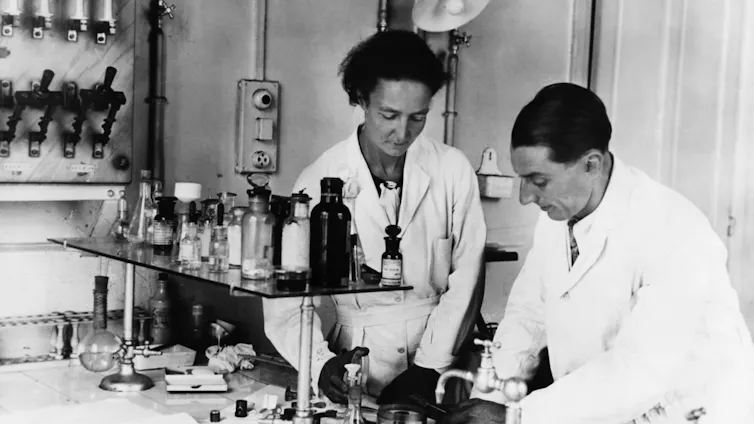
Artemis Spyrou, Michigan State University and Andrea Richard, Ohio University The adage goes “like mother like daughter,” and in the case of Irene Joliot-Curie, truer words were never spoken. She was the daughter of two Nobel Prize laureates, Marie Curie and Pierre Curie, and was herself awarded the Nobel Prize in chemistry in 1935 together with her husband, Frederic Joliot. While her parents received the prize for the discovery of natural radioactivity, Irene’s prize was for the synthesis of artificial radioactivity. This discovery changed many fields of science and many aspects of our everyday lives. Artificial radioactivity is used today in medicine, agriculture, energy production, food sterilization, industrial quality control and more.Frederic Joliot and Irene Joliot-Curie.Wellcome Collection, CC BY We are two nuclear physicistswho perform experiments at different accelerator facilities around the world. Irene’s discovery laid the foundation for our experimental studies, which use artificial radioactivity to understand questions related to astrophysics, energy, medicine and more.
Early years and battlefield training
Irene Curie was born in Paris, France, in 1897. In an unusual schooling setup, Irene was one of a group of children taught by their academic parents, including her own by then famous mother, Marie Curie.Marie Curie and her daughter Irene were both scientists studying radioactivity.Wellcome Collection, CC BY World War I started in 1914, when Irene was only 17, and she interrupted her studies to help her mother find fragments of bombs in wounded soldiers using portable X-ray machines. She soon became an expert in these wartime radiology techniques, and on top of performing the measurements herself, she also spent time training nurses to use the X-ray machines. After the war, Irene went back to her studies in her mother’s lab at the Radium Institute. This is where she met fellow researcher Frederic Joliot, whom she later married. The two worked together on many projects, which led them to their major breakthrough in 1934.
A radioactive discovery
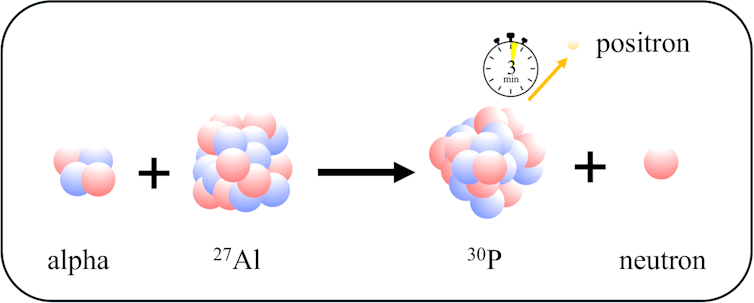
Isotopes are variations of a particular element that have the same number of protons – positively charged particles – and different numbers of neutrons, which are particles with no charge. While some isotopes are stable, the majority are radioactive and called radioisotopes. These radioisotopes spontaneously transform into different elements and release radiation – energetic particles or light – in a process called radioactive decay. At the time of Irene and Frederic’s discovery, the only known radioactive isotopes came from natural ores, through a costly and extremely time-consuming process. Marie and Pierre Curie had spent years studying the natural radioactivity in tons of uranium ores. In Irene and Frederic’s experiments, they bombarded aluminum samples with alpha particles, which consist of two protons and two neutrons bound together – they are atomic nuclei of the isotope helium-4. In previous studies, they had observed the different types of radiation their samples emitted while being bombarded. The radiation would cease when they took away the source of alpha particles. In the aluminum experiment, however, they noticed that even after they removed the alpha source, they could still detect radiation. The amount of radiation decreased by half every three minutes, and they concluded that the radiation came from the decay of a radioisotope of the element phosphorus. Phosphorus has two additional protons compared to aluminum and was formed when the alpha particles fused with the aluminum nuclei. This was the first identification of an artificially made radioisotope, phosphorus-30. Because phosphorus-30 was created after bombarding aluminum with alpha particles – rather than occurring in its natural state – Irene and Frederic induced the radioactivity. So, it is called artificial radioactivity.In Irene and Frederic’s experiments, an isotope of aluminum was hit with an alpha particle (two neutrons and two protons bound together). The collision resulted in two protons and a neutron from the alpha particle binding to the aluminum, making it an isotope of phosphorus, which decayed, releasing a particle called a positron.Artemis Spyrou After her major discovery, Irene stayed active not only in research but in activism and politics as well. In 1936, almost a decade before women gained the right to vote in France, she was appointed under secretary of state for scientific research. In this position, she laid the foundations for what would become the National Centre for Scientific Research, which is the French equivalent of the U.S. National Science Foundation or National Institutes of Health. She co-created the French Atomic Energy Commission in 1945 and held a six-year term, promoting nuclear research and development of the first French nuclear reactor. She later became director of the Curie Laboratory at the Radium Institute and a professor at the Faculty of Science in Paris.
Medical uses of artificial radioactivity
The Joliot-Curie discovery opened the road to the extensive use of radioisotopes in medical applications. Today, radioactive iodine is used regularly to treat thyroid diseases. Radioisotopes that emit positrons – the positive equivalent of the electron – are used in medical PET scans to image and diagnose cancer, and others are used for cancer therapy. To diagnose cancer, practitioners can inject a small amount of the radioisotope into the body, where it accumulates at specific organs. Specialized devices such as a PET scanner can then detect the radioactivity from the outside. This way, doctors can visualize how these organs are working without the need for surgery. To then treat cancer, practitioners use large amounts of radiation to kill the cancer cells. They try to localize the application of the radioisotope to just where the cancer is so that they’re only minimally affecting healthy tissue.
An enduring legacy
In the 90 years since the Joliot-Curie discovery of the first artificial radioisotope, the field of nuclear science has expanded its reach to roughly 3,000 artificial radioisotopes, from hydrogen to the heaviest known element, oganesson. However, nuclear theories predict that up to 7,000 artificial radioisotopes are possible. As physicists, we work with data from a new facility at Michigan State University, the Facility for Rare Isotope Beams, which is expected to discover up to 1,000 new radioisotopes.Scientists graph the known isotopes in the chart of nuclei. They have discovered roughly 3,000 radioisotopes (shown with cyan boxes) and predict the existence of another 4,000 radioisotopes (shown with gray boxes).Facility for Rare Isotope Beams While the Joliot-Curies were bombarding their samples with alpha particles at relatively low speeds, the Michigan State facility can accelerate stable isotopes up to half the speed of light and smash them on a target to produce new radioisotopes. Scientists using the facility have already discovered five new radioisotopes since it began operating in 2022, and the search continues. Each of the thousands of available radioisotopes has a different set of properties. They live for different amounts of time and emit different types of radiation and amounts of energy. This variability allows scientists to choose the right isotope for the right application. Iodine, for example, has more than 40 known radioisotopes. A main characteristic of radioisotopes is their half-life, meaning the amount of time it takes for half of the isotopes in the sample to transform into a new element. Iodine radioisotopes have half-lives that span from a tenth of a second to 16 million years. But not all of them are useful, practical or safe for thyroid treatment.The iodine radioisotope used in cancer therapy has a half-life of eight days. Eight days is long enough to kill cancer cells in the body, but not so long that the radioactivity poses a long-term threat to the patient and those around them.Artemis Spyrou Radioisotopes that live for a few seconds don’t exist long enough to perform medical procedures, and radioisotopes that live for years would harm the patient and their family. Because it lives for a few days, iodine-131 is the preferred medical radioisotope. Artificial radioactivity can also help scientists study the universe’s mysteries. For example, stars are fueled by nuclear reactions and radioactive decay in their cores. In violent stellar events, such as when a star explodes at the end of its life, they produce thousands of different radioisotopes that can drive the explosion. For this reason, scientists, including the two of us. produce and study in the lab the radioisotopes found in stars. With the advent of the Facility for Rare Isotope Beams and other accelerator facilities, the search for new radioisotopes will continue opening doors to a world of possibilities. Artemis Spyrou, Professor of Nuclear Physics, Michigan State University and Andrea Richard, Assistant Professor of Physics and Astronomy, Ohio University This article is republished from The Conversation under a Creative Commons license. Read the original article.
A Short-Form Series from The Knowledge by STM Daily News
Every Friday, STM Daily News shines a light on brilliant minds history overlooked.
Forgotten Genius Fridays is a weekly collection of short videos and articles dedicated to inventors, innovators, scientists, and creators whose impact changed the world—but whose names were often left out of the textbooks.
From life-saving inventions and cultural breakthroughs to game-changing ideas buried by bias, our series digs up the truth behind the minds that mattered.
Each episode of The Knowledge runs 30–90 seconds, designed for curious minds on the go—perfect for YouTube Shorts, TikTok, Reels, and quick reads.
Because remembering these stories isn’t just about the past—it’s about restoring credit where it’s long overdue.
In the 1930s and 40s, one man’s groundbreaking medical research transformed how we save lives — and his legacy still flows through hospitals around the world.
Dr. Charles R. Drew (1904–1950), an African American physician and surgeon, discovered a better way to store and transport blood plasma. Plasma, the liquid component of blood, can be preserved longer than whole blood and safely shipped over great distances — a game changer for emergency medicine.
He revolutionized how we store blood, saved thousands in WWII, and stood up to injustice. 🩸 Meet Dr. Charles R. Drew — the Father of the Blood Bank. History BlackHistory WWII MedicalBreakthrough STMDailyNews DidYouKnow ScienceHistory BloodBank InspiringStories LearnOnTikTok ♬ original sound – STMDailyNews – STMDailyNews
During World War II, Drew’s expertise powered the “Blood for Britain” program, which sent vital plasma to soldiers and civilians injured in the Blitz. Later, as the first director of the American Red Cross blood bank, he helped establish modern blood collection and distribution systems.
But Drew was more than a scientist — he was a man of principle. He resigned from the Red Cross in protest over its policy of segregating blood by race, a practice he condemned as scientifically baseless and morally wrong.
Known today as the “Father of the Blood Bank,” Dr. Drew’s innovations continue to save millions of lives every year. His story is a testament to the power of science, dedication, and courage to challenge injustice.
Rod: A creative force, blending words, images, and flavors. Blogger, writer, filmmaker, and photographer. Cooking enthusiast with a sci-fi vision. Passionate about his upcoming series and dedicated to TNC Network. Partnered with Rebecca Washington for a shared journey of love and art.