

News
Jugging: The New Crime Trend Targeting Bank and ATM Customers
Jugging is a rising crime trend where thieves follow victims from banks or ATMs to steal cash and valuables. Learn recent cases, safety tips, and how new laws are fighting back.

Last Updated on September 21, 2025 by Daily News Staff
What Is Jugging?
“Jugging” is a fast-growing crime trend sweeping across U.S. cities. It happens when criminals watch people leaving banks, ATMs, or high-value stores, then follow them to steal money or valuables.
The typical pattern looks like this:
Thieves stake out a bank or store parking lot. They spot someone carrying a bank envelope, ATM cash, or a shopping bag with electronics or jewelry. The suspects follow the victim, sometimes for miles, until they stop at another location. Once the victim is distracted or leaves their car, the thieves strike — breaking into the vehicle or committing a robbery.
Some cases involve property theft only, while others escalate into violent confrontations if the victim notices the suspects.
Why Is Jugging on the Rise?
Police in Texas, Florida, California, Georgia, and other states have reported a surge in jugging incidents between 2024 and 2025. Criminals are drawn to this method because:
They can easily identify victims carrying cash. The crimes are fast, often taking less than a minute. Offenders frequently work in organized crews, making it harder for victims to fight back.
Unfortunately, many jugging cases go unreported or are categorized under general theft/robbery, so exact statistics are difficult to track.
Recent Cases Across the U.S.
Austin, Texas (Dec 2024) – Two suspects followed a person from a bank, then stole an envelope containing cash, a bank card, and an ID from the victim’s car. Police recovered about $8,000 and made arrests.
Midlothian, Texas (July 2024, sentencing in 2025) – An ATM technician was ambushed and robbed of nearly $250,000 while making service rounds. A Houston man tied to the crime was sentenced to 10 years in federal prison.
Osceola County, Florida (2025) – The sheriff’s office reported at least seven jugging cases in the first half of the year, many tied to gang activity. Victims were followed from banks and robbed either at businesses or in parking lots.
Beaumont & Port Arthur, Texas (early 2025) – Police arrested suspects linked to multiple jugging incidents, including a case where a victim with a 5-month-old baby was targeted.
Houston & Montgomery Counties, Texas (mid-2025) – A joint task force arrested 21 suspects believed responsible for at least a dozen jugging incidents.
Law Enforcement & Legal Crackdowns
Task Forces: Police departments in Texas and Florida have dedicated jugging task forces, often working across multiple jurisdictions. Organized Crime Links: Many jugging suspects are part of organized groups, with coordinated surveillance and get-away drivers. New Laws: In 2025, Texas passed House Bill 1902, which takes effect on September 1, 2025. This law enhances penalties for jugging — making it a first-degree felony if violence or weapons are involved.
Safety Tips to Prevent Jugging
Authorities recommend several precautions:
Stay aware when leaving banks or ATMs — don’t assume you’re safe once you’re off the premises. Avoid carrying visible envelopes, cash, or store bags. Don’t leave bank envelopes or valuables in plain sight inside your vehicle. If you suspect you’re being followed, do not drive home — instead, head to a police station or busy public location. Consider conducting large cash transactions inside the bank with assistance instead of outside at ATMs.
Why It Matters
Jugging is no longer just a Texas problem — it’s spreading nationwide. From Houston to Orlando, law enforcement warns that thieves are targeting anyone carrying visible cash or valuables. While police are cracking down with arrests and tougher laws, prevention and awareness remain the best defense.
As jugging gains more attention, expect to see more states adopting stricter laws and banks possibly redesigning parking lots and surveillance systems to deter criminals.
👉 Related Reading: Click2Houston – New Texas law targets bank jugging crimes
STM Daily News is a vibrant news blog dedicated to sharing the brighter side of human experiences. Emphasizing positive, uplifting stories, the site focuses on delivering inspiring, informative, and well-researched content. With a commitment to accurate, fair, and responsible journalism, STM Daily News aims to foster a community of readers passionate about positive change and engaged in meaningful conversations. Join the movement and explore stories that celebrate the positive impacts shaping our world.
Author

Discover more from Daily News
Subscribe to get the latest posts sent to your email.


The Long Track Back
Why Downtown Los Angeles Feels Small Compared to Other Cities
Downtown Los Angeles often feels “small” compared to other U.S. cities, but that’s only part of the story. With some of the tallest buildings west of the Mississippi and skyline clusters spread across the region, LA’s downtown reflects the city’s unique polycentric identity—one that, if combined, could form a true mega downtown.
Last Updated on February 18, 2026 by Daily News Staff

Panorama of Los Angeles from Mount Hollywood – California, United States
When people think of major American cities, they often imagine a bustling, concentrated downtown core filled with skyscrapers. New York has Manhattan, Chicago has the Loop, San Francisco has its Financial District. Los Angeles, by contrast, often leaves visitors surprised: “Is this really downtown?”
The answer is yes—and no.
Downtown LA in Context
Compared to other major cities, Downtown Los Angeles (DTLA) is relatively small as a central business district. For much of the 20th century, strict height restrictions capped most buildings under 150 feet, while cities like Chicago and New York were erecting early skyscrapers. LA’s skyline didn’t really begin to climb until the late 1960s.
But history alone doesn’t explain why DTLA feels different. The real story lies in how Los Angeles grew: not as one unified city center, but as a collection of many hubs.

Downtown Los Angeles
A Polycentric City
Los Angeles is famously decentralized. Hollywood developed around the film industry. Century City rose on former studio land as a business hub. Burbank became a studio and aerospace center. Long Beach grew around the port. The Wilshire Corridor filled with office towers and condos.
Unlike other cities where downtown is the place for work, culture, and finance, Los Angeles spread its energy outward. Freeways and car culture made it easy for businesses and residents to operate outside of downtown. The result is a polycentric metropolis, with multiple “downtowns” rather than one dominant core.
A Resident’s Perspective
As someone who lived in Los Angeles for 28 years, I see DTLA differently. While some outsiders describe it as “small,” the reality is that Downtown Los Angeles is still significant. It has some of the tallest buildings west of the Mississippi River, including the Wilshire Grand Center and the U.S. Bank Tower. Over the last two decades, adaptive reuse projects have transformed old office buildings into lofts, while developments like LA Live, Crypto.com Arena, and the Broad Museum have revitalized the area.
In other words, DTLA is large enough—it just plays a different role than downtowns in other American cities.

View of Westwood, Century City, Beverly Hills, and the Wilshire Corridor.
The “Mega Downtown” That Isn’t
A friend once put it to me with a bit of imagination: “If you could magically pick up all of LA’s skyline clusters—Downtown, Century City, Hollywood, the Wilshire Corridor—and drop them together in one spot, you’d have a mega downtown.”
He’s right. Los Angeles doesn’t lack tall buildings or urban energy—it just spreads them out over a vast area, reflecting the city’s unique history, geography, and culture.
A Downtown That Fits Its City
So, is Downtown LA “small”? Compared to Manhattan or Chicago’s Loop, yes. But judged on its own terms, DTLA is a vibrant hub within a much larger, decentralized metropolis. It’s a downtown that reflects Los Angeles itself: sprawling, diverse, and impossible to fit neatly into the mold of other American cities.
🔗 Related Links
Dive into “The Knowledge,” where curiosity meets clarity. This playlist, in collaboration with STMDailyNews.com, is designed for viewers who value historical accuracy and insightful learning. Our short videos, ranging from 30 seconds to a minute and a half, make complex subjects easy to grasp in no time. Covering everything from historical events to contemporary processes and entertainment, “The Knowledge” bridges the past with the present. In a world where information is abundant yet often misused, our series aims to guide you through the noise, preserving vital knowledge and truths that shape our lives today. Perfect for curious minds eager to discover the ‘why’ and ‘how’ of everything around us. Subscribe and join in as we explore the facts that matter. https://stmdailynews.com/the-knowledge/
Author
Discover more from Daily News
Subscribe to get the latest posts sent to your email.
The Knowledge
Century City: From Hollywood Backlot to Business Hub
Century City, originally part of 20th Century Fox’s backlot, transformed into a prominent business district in Los Angeles during the 1950s amid the decline of cinema. Developer William Zeckendorf envisioned a mixed-use urban center, leading to iconic skyscrapers and establishing the area as a hub for law, finance, and media, blending Hollywood history with modern business.

Before Century City became one of Los Angeles’ premier business districts, it was part of 20th Century Fox’s sprawling backlot, used for filming movies and housing studio operations. By the 1950s, as television rose and movie attendance declined, 20th Century Fox faced financial challenges and decided to sell a portion of its land.

Developer William Zeckendorf envisioned a “city within a city”—a modern, mixed-use urban center with office towers, hotels, and entertainment facilities. Branded Century City, the name paid homage to its studio roots while symbolizing LA’s vision for the future.
The first skyscrapers, including the Gateway West Building, set the tone for the district’s sleek, futuristic skyline. Architects like Welton Becket and Minoru Yamasaki helped shape Century City’s iconic look. Over time, it evolved from Hollywood’s backlot to a corporate and legal hub, attracting law firms, financial institutions, and media companies.
Today, Century City stands as a testament to Los Angeles’ postwar optimism, westward expansion, and multi-centered urban growth—a unique blend of Hollywood history and modern business.
Related STM Daily News Links:
- The Evolution of Los Angeles Public Transportation
- Why Los Angeles Grew Into a Sprawling City
- Downtown Los Angeles: Past, Present, and Future
Dive into “The Knowledge,” where curiosity meets clarity. This playlist, in collaboration with STMDailyNews.com, is designed for viewers who value historical accuracy and insightful learning. Our short videos, ranging from 30 seconds to a minute and a half, make complex subjects easy to grasp in no time. Covering everything from historical events to contemporary processes and entertainment, “The Knowledge” bridges the past with the present. In a world where information is abundant yet often misused, our series aims to guide you through the noise, preserving vital knowledge and truths that shape our lives today. Perfect for curious minds eager to discover the ‘why’ and ‘how’ of everything around us. Subscribe and join in as we explore the facts that matter. https://stmdailynews.com/the-knowledge/
Discover more from Daily News
Subscribe to get the latest posts sent to your email.
Community
Local governments provide proof that polarization is not inevitable
Local politics help mitigate national polarization by focusing on concrete issues like infrastructure and community needs rather than divisive symbolic debates. A survey indicates that local officials experience less partisanship, as interpersonal connections foster recognition of shared interests. This suggests that reducing polarization is possible through collaboration and changes in election laws.


Lauren Hall, Rochester Institute of Technology
When it comes to national politics, Americans are fiercely divided across a range of issues, including gun control, election security and vaccines. It’s not new for Republicans and Democrats to be at odds over issues, but things have reached a point where even the idea of compromising appears to be anathema, making it more difficult to solve thorny problems.
But things are much less heated at the local level. A survey of more than 1,400 local officials by the Carnegie Corporation and CivicPulse found that local governments are “largely insulated from the harshest effects of polarization.” Communities with fewer than 50,000 residents proved especially resilient to partisan dysfunction.
Why this difference? As a political scientist, I believe that lessons from the local level not only open a window onto how polarization works but also the dynamics and tools that can help reduce it.
Problems are more concrete
Local governments deal with concrete issues – sometimes literally, when it comes to paving roads and fixing potholes. In general, cities and counties handle day-to-day functions, such as garbage pickup, running schools and enforcing zoning rules. Addressing tangible needs keeps local leaders’ attention fixed on specific problems that call out for specific solutions, not lengthy ideological debates.
By contrast, a lot of national political conflict in the U.S. involves symbolic issues, such as debates about identity and values on topics such as race, abortion and transgender rights. These battles are often divisive, even more so than purely ideological disagreements, because they can activate tribal differences and prove more resistant to compromise.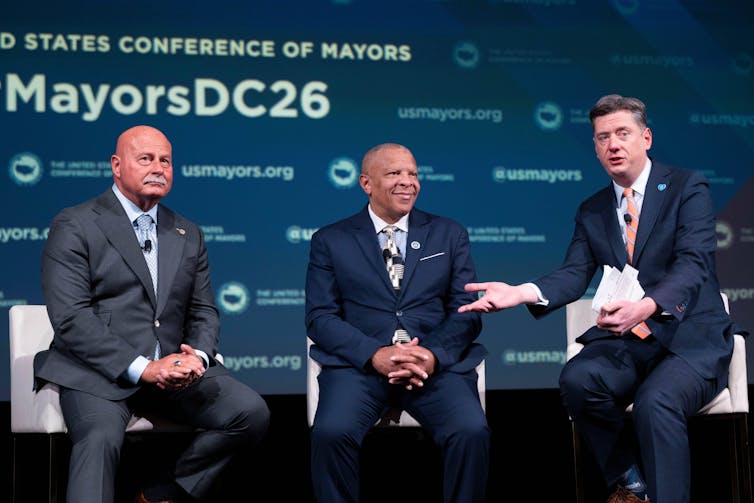
Such arguments at the national level, or on social media, can lead to wildly inaccurate stereotypes about people with opposing views. Today’s partisans often perceive their opponents as far more extreme than they actually are, or they may stereotype them – imagining that all Republicans are wealthy, evangelical culture warriors, for instance, or conversely being convinced that all Democrats are radical urban activists. In terms of ideology, the median members of both parties, in fact, look similar.
These kinds of misperceptions can fuel hostility.
Local officials, however, live among the human beings they represent, whose complexity defies caricature. Living and interacting in the same communities leads to greater recognition of shared interests and values, according to the Carnegie/CivicPulse survey.
Meaningful interaction with others, including partisans of the opposing party, reduces prejudice about them. Local government provides a natural space where identities overlap.
People are complicated
In national U.S. politics today, large groups of individuals are divided not only by party but a variety of other factors, including race, religion, geography and social networks. When these differences align with ideology, political disagreement can feel like an existential threat.
Such differences are not always as pronounced at the local level. A neighbor who disagrees about property taxes could be the coach of your child’s soccer team. Your fellow school board member might share your concerns about curriculum but vote differently in presidential elections.

These cross-cutting connections remind us that political opponents are not a monolithic enemy but complex individuals. When people discover they have commonalities outside of politics with others holding opposing views, polarization can decrease significantly.
Finally, most local elections are technically nonpartisan. Keeping party labels off ballots allows voters to judge candidates as individuals and not merely as Republicans or Democrats.
National implications
None of this means local politics are utopian.
Like water, polarization tends to run downhill, from the national level to local contests, particularly in major cities where candidates for mayor and other office are more likely to run as partisans. Local governments also see culture war debates, notably in the area of public school instruction.
Nevertheless, the relative partisan calm of local governance suggests that polarization is not inevitable. It emerges from specific conditions that can be altered.
Polarization might be reduced by creating more opportunities for cross-partisan collaboration around concrete problems. Philanthropists and even states might invest in local journalism that covers pragmatic governance rather than partisan conflict. More cities and counties could adopt changes in election law that would de-emphasize party labels where they add little information for voters.
Aside from structural changes, individual Americans can strive to recognize that their neighbors are not the cardboard cutouts they might imagine when thinking about “the other side.” Instead, Americans can recognize that even political opponents are navigating similar landscapes of community, personal challenges and time constraints, with often similar desires to see their roads paved and their children well educated.
The conditions shaping our interactions matter enormously. If conditions change, perhaps less partisan rancor will be the result.
Lauren Hall, Associate professor of Political Science, Rochester Institute of Technology
This article is republished from The Conversation under a Creative Commons license. Read the original article.
The Bridge is a section of the STM Daily News Blog meant for diversity, offering real news stories about bona fide community efforts to perpetuate a greater good. The purpose of The Bridge is to connect the divides that separate us, fostering understanding and empathy among different groups. By highlighting positive initiatives and inspirational actions, The Bridge aims to create a sense of unity and shared purpose. This section brings to light stories of individuals and organizations working tirelessly to promote inclusivity, equality, and mutual respect. Through these narratives, readers are encouraged to appreciate the richness of diverse perspectives and to participate actively in building stronger, more cohesive communities.
https://stmdailynews.com/the-bridge
Discover more from Daily News
Subscribe to get the latest posts sent to your email.





