

Science
NASA Sets Coverage for Agency’s SpaceX Crew-6 Events, Launch

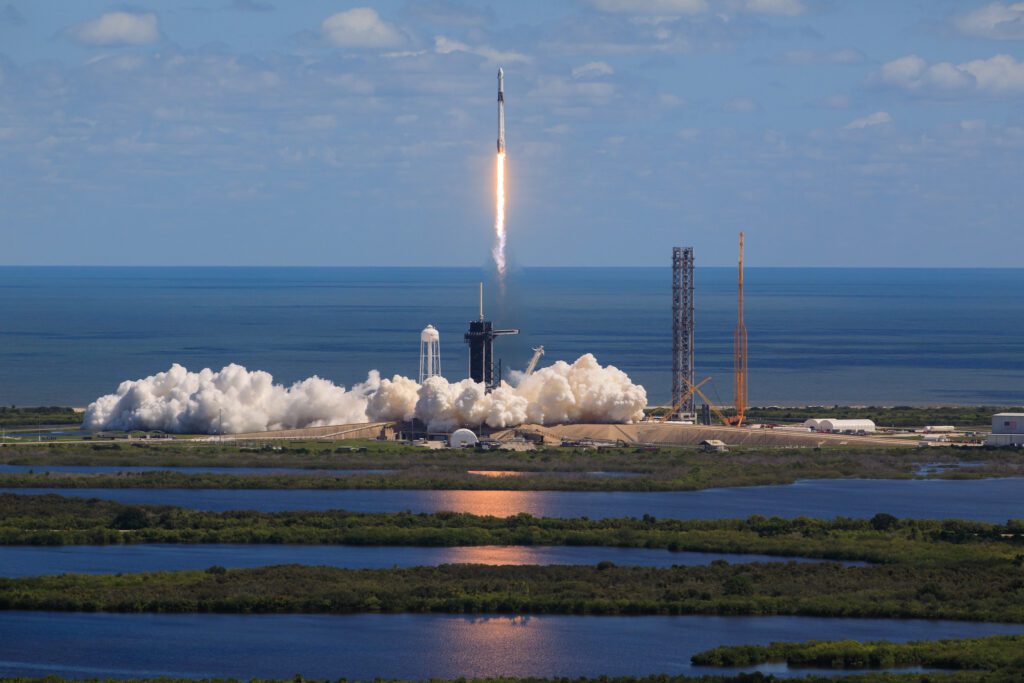
Credits: Kim Shiflett
NASA will provide coverage of the upcoming prelaunch and launch activities for the agency’s SpaceX Crew-6 mission with astronauts to the International Space Station.
Launch is targeted for 2:07 a.m. EST, Sunday, Feb. 26, from Launch Complex 39A at NASA’s Kennedy Space Center in Florida. The Dragon spacecraft is scheduled to dock to the space-facing port of the station’s Harmony module at 2:54 a.m., Monday, Feb. 27.
Crew arrival at Kennedy, launch, the postlaunch news conference, and docking coverage will air live on NASA Television, the NASA app, and the agency’s website. NASA also will host audio-only news teleconferences following the agency’s flight and launch readiness reviews. Follow all live events at:
The Crew-6 launch will carry two NASA astronauts, Mission Commander Stephen Bowen and Pilot Warren Hoburg, along with UAE (United Arab Emirates) astronaut Sultan Alneyadi, and Roscosmos cosmonaut Andrey Fedyaev, who will serve as mission specialists to the space station for a science expedition mission.
This is the sixth crew rotation mission with astronauts using the SpaceX Dragon spacecraft on a Falcon 9 rocket to the orbiting laboratory as part of the agency’s Commercial Crew Program. This Dragon is named Endeavour.
The deadline has passed for media accreditation for in-person coverage of this launch. NASA’s media accreditation policy is available online. More information about media accreditation is available by emailing: ksc-media-accreditat@mail.nasa.gov.
All media participation in the following news conferences will be remote except where specifically listed below.
NASA’s SpaceX Crew-6 mission coverage is as follows (all times Eastern and subject to change based on real-time operations):
Tuesday, Feb. 21
12:30 p.m. (approximately) – Crew arrival media event at Kennedy on NASA Television
- Kelvin Manning, deputy director, Kennedy
- Dana Hutcherson, deputy manager, NASA’s Commercial Crew Program
- Salem AlMarri, director general, Mohammed Bin Rashid Space Centre
- NASA astronaut Stephen Bowen
- NASA astronaut Warren Hoburg
- UAE astronaut Sultan Alneyadi
- Roscosmos cosmonaut Andrey Fedyaev
The event is limited to in-person media only. Follow Commercial Crew and Kennedy Space Center on Twitter for the latest arrival updates.
6 p.m. (approximately) – Flight Readiness Review media teleconference (no earlier than one hour after completion of the review) with the following participants:
- Ken Bowersox, deputy associate administrator, Space Operations Mission Directorate, NASA Headquarters in Washington
- Steve Stich, manager, Commercial Crew Program, Kennedy
- Dana Weigel, deputy manager, International Space Station Program, NASA’s Johnson Space Center in Houston
- Emily Nelson, chief flight director, Johnson
- Jared Metter, director, Flight Reliability, SpaceX
- Adnan AlRais, mission manager UAE Astronaut Mission 2, Mohammed Bin Rashid Space Centre
Media may ask questions via phone only. For the dial-in number and passcode, please contact the Kennedy newsroom no later than 4 p.m., Tuesday, Feb. 21 at: ksc-newsroom@mail.nasa.gov.
Friday, Feb. 24
10:30 p.m. (approximately) – Prelaunch News Teleconference at Kennedy (no earlier than one hour after completion of the Launch Readiness Review) with the following participants:
- Steve Stich, manager, Commercial Crew Program, Kennedy
- Dana Weigel, deputy manager, International Space Station Program, Johnson
- Emily Nelson, chief flight director, Johnson
- Kirt Costello, chief scientist, International Space Station Program, Johnson
- Sarah Walker, director, Dragon Mission Management, SpaceX
- Salem AlMarri, director general, Mohammed Bin Rashid Space Centre
- Mike McAleenan, launch weather officer, U.S. Space Force 45th Weather Squadron
Media may ask questions via phone only. For the dial-in number and passcode, please contact the Kennedy newsroom no later than 5:30 p.m., Friday, Feb. 24, at: ksc-newsroom@mail.nasa.gov.
Saturday, Feb. 25
10:30 p.m. – NASA TV launch coverage begins
Sunday, Feb. 26
2:07 a.m. – Launch
Following conclusion of launch and ascent coverage, NASA coverage of agency’s Crew-6 flight to the space station will continue with audio only, with full coverage resuming at the start of the arrival broadcast. Viewers can continue to listen to real-time audio between Crew-6 and flight controllers at NASA’s Mission Audio stream, which also includes conversations with astronauts aboard the space station and a live video feed from the orbiting laboratory.
4 a.m. (approximately) – Postlaunch news conference on NASA TV
- Ken Bowersox, deputy associate administrator, Space Operations Mission Directorate, NASA Headquarters
- Steve Stich, manager, Commercial Crew Program, Kennedy
- Dana Weigel, deputy manager, International Space Station Program, Johnson
- Sarah Walker, director, Dragon Mission Management, SpaceX
- Salem AlMarri, director general, Mohammed Bin Rashid Space Centre
Media may ask questions in-person and via phone. Limited auditorium space will be available for in-person participation. For the dial-in number and passcode, please contact the Kennedy newsroom no later than 1 a.m., Sunday, Feb. 26, at: ksc-newsroom@mail.nasa.gov.
Monday, Feb. 27
1 a.m. – NASA TV arrival coverage begins
2:54 a.m. – Docking to the space-facing port of the station’s Harmony module
4:35 a.m. – Hatch opening
5:20 a.m. – Welcome ceremony
NASA TV Launch Coverage
NASA TV live coverage will begin at 10:30 p.m., Saturday, Feb. 25. For NASA TV downlink information, schedules, and links to streaming video, visit:
Audio only of the news conferences and launch coverage will be carried on the NASA “V” circuits, which may be accessed by dialing 321-867-1220, -1240 or -7135. On launch day, “mission audio,” countdown activities without NASA TV launch commentary, will be carried on 321-867-7135.
NASA Website Launch Coverage
Launch day coverage of NASA’s SpaceX Crew-6 mission will be available on the agency’s website. Coverage will include live streaming and blog updates beginning no earlier than 10:30 p.m., Saturday, Feb. 25, as the countdown milestones occur. On-demand streaming video and photos of the launch will be available shortly after liftoff. For questions about countdown coverage, contact the Kennedy newsroom at 321-867-2468. Follow countdown coverage on our launch blog at:
https://blogs.nasa.gov/commercialcrew
Launch also will be available on local amateur VHF radio frequency 146.940 MHz and UHF radio frequency 444.925 MHz, FM mode, heard within Brevard County on the Space Coast.
Attend launch virtually
Members of the public can register to attend this launch virtually. NASA’s virtual guest program for this mission also includes curated launch resources, notifications about related opportunities or changes, and a stamp for the NASA virtual guest passport following a successful launch.
Watch, engage on social media
Let people know you’re following the mission on Twitter, Facebook, and Instagram by using the hashtags #Crew6 and #NASASocial. You can also stay connected by following and tagging these accounts:
Twitter: @NASA, @NASAKennedy, @NASASocial, @Space_Station, @ISS_Research, @ISS National Lab, @SpaceX, @Commercial_Crew
Facebook: NASA, NASAKennedy, ISS, ISS National Lab
Instagram: @NASA, @NASAKennedy, @ISS, @ISSNationalLab, @SpaceX
Did you know NASA has a Spanish section called NASA en Espanol? Make sure to check out NASA en Espanol on Twitter, Instagram, Facebook, and YouTube for more coverage on Crew-6.
Para obtener información sobre cobertura en español en el Centro Espacial Kennedy o si desea solicitar entrevistas en español, comuníquese con Antonia Jaramillo, 321-501-8425, antonia.jaramillobotero@nasa.gov.
NASA will provide a live video feed of Launch Complex 39A approximately 48 hours prior to the planned liftoff of the Crew-6 mission. Pending unlikely technical issues, the feed will be uninterrupted until the prelaunch broadcast begins on NASA TV, approximately four hours prior to launch.
Once the feed is live, you will find it here:
https://youtube.com/kscnewsroom
NASA’s Commercial Crew Program has delivered on its goal of safe, reliable, and cost-effective transportation to and from the International Space Station from the United States through a partnership with American private industry. This partnership is changing the arc of human spaceflight history by opening access to low-Earth orbit and the International Space Station to more people, more science, and more commercial opportunities. The space station remains the springboard to NASA’s next great leap in space exploration, including future missions to the Moon and, eventually, to Mars.
For NASA’s launch blog and more information about the mission, visit:
https://www.nasa.gov/commercialcrew
Source: NASA


Science
October Meteor Showers Give Phoenix Skywatchers a Reason to Look Up
Phoenix skywatchers have several chances to catch October’s meteor showers. Here’s when to watch the Taurids and Orionids—and how moonlight affects the view.
Last Updated on October 10, 2026 by Daily News Staff
PHOENIX — October is bringing several opportunities to spot shooting stars over the Valley, with the Draconids reaching their October 8–9 peak and more meteor activity ahead.
The Draconids remain active through October 10, although viewers should expect a light display as the peak passes. Under favorable conditions, the shower typically produces only a handful of meteors per hour. timeanddate.com
Next, the Southern Taurids have an annual activity peak around October 14. Known for occasional bright fireballs, the shower continues into November. The stronger Orionids peak on the night of October 21 into the morning of October 22, typically producing 10–20 meteors per hour under dark skies. A bright Moon will interfere with this year’s display. American Meteor Society
The Orionids originate from debris left by Halley’s Comet. For Phoenix viewers, the best opportunity will be after moonset and before dawn, weather permitting. City lights will further reduce the number visible. amsmeteors.org
NASA recommends finding a viewing area away from streetlights, allowing about 30 minutes for eyes to adjust, and watching a broad stretch of sky. No telescope is needed—just a comfortable chair and patience. NASA Science
ECurious about what’s happening above us? Explore more space stories and science explainers in The Knowledge at STM Daily News.xplore more space, science and everyday
unknown
Did Jackie Gleason See Aliens? Inside the Strange Nixon–UFO Legend
Jackie Gleason reportedly told his wife that President Richard Nixon arranged for him to view preserved extraterrestrial bodies at a Florida Air Force base. Here is what we know—and why the remarkable story remains unverified.

The beloved comedian reportedly told his wife that President Richard Nixon arranged for him to view preserved extraterrestrial bodies at a Florida Air Force base. Decades later, the extraordinary story remains fascinating—but unverified.
Jackie Gleason is remembered as “The Great One,” the larger-than-life entertainer who turned bus driver Ralph Kramden into one of television’s most enduring characters on The Honeymooners. Away from the cameras, however, Gleason had another consuming interest: UFOs, psychic phenomena and the possibility of extraterrestrial life.
That interest eventually became the foundation of one of the strangest stories ever associated with an American president and a Hollywood celebrity. According to Gleason’s second wife, Beverly McKittrick, her husband came home late one night in 1973 and claimed that President Richard Nixon had helped him see the preserved bodies of extraterrestrial beings at Homestead Air Force Base in Florida.
Did Jackie Gleason really see aliens?
The honest answer is that we do not know. The allegation is remarkable, but the available evidence never rises above an uncorroborated story attributed to Gleason years after the supposed event.
Gleason’s fascination with UFOs was real
There is little question that Gleason took the UFO subject seriously. He reportedly assembled a substantial personal library devoted to UFOs, the paranormal and related mysteries. His unusual circular home in New York—often nicknamed “The Mothership”—only strengthened his public association with flying saucers, although its distinctive architecture is not evidence of an extraterrestrial encounter.
Gleason also had a genuine social connection with Nixon. The two men shared an interest in golf and spent time together in Florida. That documented friendship is the factual starting point from which the more sensational story grew.
The alleged trip to Homestead Air Force Base
McKittrick said that Gleason returned to their Florida home at about 11:30 one evening looking disturbed. According to her account, he told her that Nixon had arrived without the usual presidential entourage and taken him to Homestead Air Force Base, south of Miami.
Once there, Gleason allegedly entered a secured building where he saw small humanoid bodies preserved inside glass-topped containers. Published versions differ over the number of bodies and some physical details, but they generally describe child-sized beings with oversized heads.
Importantly, McKittrick did not claim to have accompanied the men or witnessed anything at the base. Her account was based entirely on what she said Gleason told her after returning home.
The story became public in 1983, years after the alleged visit and after the couple had divorced. It circulated widely through tabloid reporting, UFO publications and later books, gradually becoming part of UFO folklore.
Why the story remains unverified
No authenticated photograph, visitor record, military document or firsthand statement from Nixon has emerged to confirm the alleged trip. Gleason also never provided investigators with a signed affidavit describing the experience.
UFO researcher Larry Bryant reportedly sought records from Homestead and tried to obtain a statement from Gleason, but those efforts produced no confirming documentation. Gleason’s refusal to address the account publicly has sometimes been portrayed as suspicious, but silence is not proof that an event occurred.
There is another important complication: McKittrick later expressed uncertainty about her former husband’s story.
During telephone interviews conducted by researcher Kenny Young in 2003, she stood by her recollection that Gleason told her he had seen “dead aliens.” She also acknowledged that, as the years passed, she wondered whether he might have invented the explanation because he had been out late. She declined to appear on camera and said the story should be authenticated first.
Her later comments do not establish that the account was false, but they considerably weaken any attempt to treat it as verified history.
Could a president have slipped away unnoticed?
Some versions of the legend emphasize that Nixon supposedly drove to Gleason’s house alone and then entered a military installation without his Secret Service detail. Presidents have occasionally sought privacy or slipped away from tightly managed schedules, but a secret nighttime excursion of this nature would have involved serious security and logistical obstacles.
The claim becomes even more difficult to accept when we consider what Nixon allegedly revealed. If the United States possessed extraterrestrial bodies, granting a comedian personal access to them would have represented an extraordinary breach of national security—with no apparent official purpose and no surviving documentation.
None of that makes the episode logically impossible. It does, however, mean that the story requires exceptionally strong evidence. That evidence has never appeared.
A compelling legend, not a confirmed encounter
The Jackie Gleason story endures because it combines three irresistible ingredients: a famous comedian fascinated by UFOs, a secretive American president and a nighttime visit to a military base containing an alleged government secret.
What can be established is that Gleason was deeply interested in UFOs, knew Nixon and was said by his former wife to have made an extraordinary claim. What cannot be established is that Nixon took him to Homestead Air Force Base or that preserved extraterrestrial bodies were ever stored there.
So, did Jackie Gleason see aliens?
Perhaps he believed that he did—or perhaps he simply told an unforgettable story. Until corroborating evidence emerges, the alleged encounter belongs in the intriguing borderland between celebrity history and American UFO mythology.
Sources and further reading
- The Black Vault: Jackie Gleason and the Pickled Alien
- University of Miami Libraries: The Jackie Gleason Collection
- U.S. Department of Defense: All-domain Anomaly Resolution Office
Step into The Unknown, where STM Daily News explores the strange phenomena, unexplained encounters and enduring mysteries that continue to challenge what we think we know. From UFO sightings and paranormal events to historical mysteries and unusual scientific discoveries, we examine the stories, evidence and competing explanations—without losing our sense of wonder. https://stmdailynews.com/science/unknown/
health and wellness
Lactose intolerance is actually the human norm – but racism, the US government and business interests have made it into a condition
Lactose intolerance is the global human norm, but Western dietary standards, government policies and commercial interests helped frame it as a medical deficiency.


Hilary Smith, University of Denver
Lactose intolerance makes drinking milk or eating ice cream a literal pain. For some people, eating a dairy treat can lead to bloating, nausea and diarrhea. You might’ve experienced its effects yourself. If so, you may think of lactose intolerance as a defect rather than the norm.
But did you know that most people in the world today are lactose intolerant – and that the condition itself was invented in the 1960s?
“Surely you mean discovered, not invented,” I hear you saying. I don’t. As a historian who has traced the origins of nutrition-science ideas, I have chosen the word “invented” on purpose.
Inventing lactose intolerance
Variations in people’s ability to digest lactose first came to scientists’ attention after American dairy producers found a way to rid themselves of a postwar milk surplus. To offload what they couldn’t sell, they looked to the government to intervene. And it did, buying the excess and embedding it in school lunches and other places with publicly funded meals.
Suddenly, many people who had not habitually drunk milk were consuming it regularly, including not only some Americans but also people overseas. Part of that same milk surplus found its way into school lunches in places such as Japan and Taiwan in the 1950s as the American government began to sell milk to allies during the Cold War.
Many of the groups drinking milk regularly for the first time did not like it. In fact, it made them feel sick. Intrigued, scientists set up experiments to figure out why. In a 1966 study comparing how Black and white people incarcerated in Baltimore metabolized lactose, researchers found that Black participants had lower levels of lactase – the enzyme that breaks down lactose – in their guts.
To the white scientists conducting this study, the trouble that the Black prisoners had digesting milk looked like an “inborn error of metabolism.” They assumed that the normal human state was lactose tolerance and that the lactose intolerant had inherited a genetic mutation.
It was only after years more work with research participants of many races that experts realized that, as one National Institutes of Health official put it in 1981, “lactose intolerance is a normal physiological condition, shared by every adult animal except for certain ethnic and racial groups in man.” People of northern European descent, it turned out, were the weird ones. It was their ancestors who had passed down a genetic mutation – one that made them able to digest milk after infancy.
In short, what scientists discovered in the 1960s was that different bodies process milk differently. What they invented was the idea that lactose intolerance is a defect. Accepting that framing would mean nearly two-thirds of the human population – the estimated prevalence of lactose intolerance worldwide – is defective.
Instead of acknowledging that dairy-free diets can be healthy, people innovated ways to overcome this supposed disability so everyone could consume more.
Nutritional imperialism
Lactose intolerance is one example of what I call nutritional imperialism: a way of thinking that treats white diets as the norm and everyone else’s as an aberration.
Nutritional imperialism was common in the 20th century, when scientists thought that not only milk-rich but also meat-heavy diets were best; they considered diets outside of the United States and Europe too vegetarian. Some also argued that wheat flour, not rice, ought to be the universal staple.
The same bias applied to bodies. Besides faulty lactose digestion, nonwhite bodies were accused of other failures, too, such as aldehyde dehydrogenase deficiency, an inability to digest alcohol quickly. The less technical term for this may be more familiar: Asian flush.
Such differences might have been thought of as variety, just another way of being human. Instead, each became a deficiency.
Many people today have inherited and perpetuated this way of thinking without knowing it, including those who are deemed deficient by it. In 1959, the director of Japan’s nutrition bureau declared that “rice-eating peoples” such as the Japanese were “resigned and passive” and could correct this by imitating Western diets and switching to wheat.
Today, the most prominent scientist promoting the idea that Asian flush is a disease is a geneticist of Taiwanese descent who started a research consortium to study “the most common human enzymopathy in the world.”
The Chinese Nutrition Society placed a tall glass of milk next to its 2022 Food Guide Plate – never mind estimates that the vast majority of Han Chinese, the largest ethnic group in China and worldwide, are lactose intolerant.
Turning sickness back into difference
Science that pathologizes difference helps racism persist.
In recent years, white supremacists have embraced the concept of lactose intolerance as a distinguishing debility of nonwhite people. Social media users have copied and pasted a map of the geographic distribution of lactose tolerance originally published in the scientific journal Nature into racist chat threads on the online discussion forum 4chan.
In 2017, internet trolls disrupted an anti-racist art installation with neo-Nazi chants and messily downed jugs of milk to accentuate their white identity.
Turning a lactose-digestion difference into a deficiency has done more to reinforce narratives of racial hierarchy than to improve public health. So here’s a suggestion: If you enjoy eating dairy, keep doing it; if you don’t, don’t – and know that there is nothing wrong with you.
Hilary Smith, Professor of History, University of Denver
This article is republished from The Conversation under a Creative Commons license. Read the original article.
📰 Enjoying STM Daily News? Join the conversation!
💬 Leave a comment, share your thoughts, and subscribe to our newsletter for the latest stories, updates, and “News You Can Use This Moment!” delivered to your inbox.
Stay connected with STM Daily News!





