

Lifestyle
A Legacy of Service: How family stories shape service
Legacy of Service: Discover how military service creates lasting family legacies across generations. Explore powerful veteran stories from the Veterans History Project, including Pearl Harbor survivors and Code Talkers, and learn how to preserve your family’s service history.

Last Updated on February 6, 2026 by Daily News Staff

A Legacy of Service: How family stories shape service
(Family Features) Major historical events like war or military service make a lasting impact on family identity, values and traditions, often reverberating across multiple generations.
Veterans frequently speak about their military units as if they were family, given the unbreakable bonds that develop between comrades. However, for some veterans, “brothers in arms” is more than a figurative turn of phrase.
Throughout the 20th century, entire families felt the firsthand effects of war, with multiple generations serving. Brothers enlisted together. A father’s military legacy inspired his children to join up. Sweethearts met and married while in uniform. These stories not only illustrate the experiences of individual veterans but also provide an intimate glimpse into family legacies of military service.
Consider the Veterans History Project, a program overseen by the Library of Congress, which collects and preserves the firsthand remembrances of U.S. military veterans and makes them accessible for future generations to better understand veterans’ service and sacrifice. These personal stories encompass original correspondence, memoirs, diaries, photographs and oral history interviews, all offering deeper insight into the long-term impact of military service.
Veterans’ narratives are collected by volunteers, and anyone who served from World War I to today can submit their personal story, regardless of whether or not they saw combat. The collections frequently shed light on the importance of family in military experiences. Whether expressed through heartfelt letters home, enduring family legacies of service or the experience of serving alongside loved ones, these stories reflect profound connections.
 Family Identity
During the Cold War, Jennifer McNeill rose from Army Dental Assistant to Command Sergeant Major at the Army Eisenhower Medical Center in Fort Gordon, Georgia. Her collection includes a poignant photograph of her mother sharing images of her four military daughters in uniform, underscoring how family identity and military service are closely connected.
Values
Military service makes a lasting impression on veterans, shaping the experiences and the values that guide them through life. Ray Chavez is one such example. He was the oldest known Pearl Harbor survivor before his passing in 2018. For most of his life, he remained silent about his experiences, but in 1991, his daughter, Kathleen Chavez, who served in the U.S. Navy during Desert Storm, convinced him to return to Pearl Harbor. That trip marked the first time he spoke openly about his service. Kathleen shared their family’s deep military legacy in her oral history for the Veterans History Project.
Traditions Across Generations
Serving in the military is a deeply personal journey, but for many veterans, it’s an experience that transcends generations. Bill Toledo enlisted in the Marine Corps in October 1942 at the age of 18. Along with his uncle, Frank Toledo, and cousin, Preston Toledo, he served as a Code Talker transmitting military messages through secret codes. In his oral history, Bill vividly recalled both the challenges of combat during the invasion of Iwo Jima in February 1945, and the treasured moments spent with his uncle.
These and many other family stories of military service and remembrance are available to the public at loc.gov/vets.
Photo courtesy of Shutterstock (men looking at scrapbook)
Photo courtesy of the Library of Congress (man and woman on park bench)
SOURCE:
Library of Congress
Author


health and wellness
Stacking Healthy Habits for Progress, Not Perfection
Healthy Habits: Many struggle with building healthier habits due to unrealistic expectations rather than lack of motivation. The American Heart Association’s My Life Check tool offers personalized heart health insights, helping to set attainable goals. Simple lifestyle changes—focused on nutrition, movement, sleep, and stress management—can gradually lead to significant health improvements.
Last Updated on April 10, 2026 by Daily News Staff
(Feature Impact) Despite the best of intentions, it’s common for plans to build healthier habits to fall flat. Often, the culprit isn’t a lack of motivation or discipline; rather, it’s unrealistic expectations.
Overhauling your lifestyle requires a level of commitment that isn’t always practical. Understanding your personal health needs and the challenges you need to overcome can help give you a more realistic roadmap toward better health.
Tools to Guide You
Every plan needs a starting point and there are many reputable sources that can help guide you toward a plan that addresses your personal health needs.
For example, the American Heart Association introduced My Life Check, a simple, free tool to help individuals understand their heart health and what’s driving it. Users answer simple questions about their daily habits and health factors to get a personalized Heart Health Score in minutes.
The results are private and downloadable, giving you full control of your information. The tool turns big goals into small, specific actions you can start right away. Knowing your numbers relative to your heart health (and where you are in comparison to target ranges for optimal health) can help you decide how to build a better map to get you where you want to be.
While the report is customized to each individual, no personal data is stored and answers are only used to calculate health scores and provide personalized recommendations and practical steps to improve your health, so you can use your results to focus on what matters most to you. Every small step you take, such as moving more, eating smarter, sleeping better or managing stress, can add up over time.
Finding Your Path
Once you’re armed with data and know where you stand on your heart health numbers, small steps become clearer and more manageable. That knowledge makes it easier to choose one area to focus on, such as getting more sleep, taking daily walks or adding more color to your meals.
Healthy changes don’t need to be expensive or complicated. The best habits are ones that fit real life when every action you take moves you closer to your goals.
Eat Smart
Choose foods that help you feel your best, one meal at a time. Add more color to your plate and focus on balance, not restriction. Simple, affordable swaps can make a real difference.
Move More
Find movement that fits your life, such as a walk, a stretch or dancing while you cook. Every bit of activity counts and it all supports your heart and mind. Move for joy, not just for results.
Sleep Well
Rest is a foundation of good health, not a reward. Protect your bedtime routine and give your body the recovery it deserves. Notice how good sleep makes everything else easier.
Manage Stress
Check in with yourself regularly, both mentally and emotionally. Create simple moments to pause, breathe, laugh or step outside. Connection, kindness and calm all support a healthy heart.
Staying motivated and on track is also easier when you can check back in, see your progress and realize the steps you’re taking are making an impact. Checking in every few months to see how you can grow gives you the chance to celebrate your progress, learn from challenges and keep building lasting habits that feel good.
To get started with personalized tips to set your own health goals, visit heart.org/mylifecheck.
Photos courtesy of Shutterstock
<img src="https://ssl.google-analytics.com/collect?v=1&tid=UA-482330-7&cid=1955551e-1975-5e52-0cdb-8516071094cd&sc=start&t=pageview&dl=http%3A%2F%2Ftrack.familyfeatures.com%2F17763%2F10236&dt=STACKING-HEALTHY-HABITS-FOR-PROGRESS-NOT-PERFECTION" />
https://erp.featureimpact.com/api/v1/tracking/17763/10236/track.js
<script type="text/javascript">
(function () {
var image = new Image(1, 1);
image.src = 'https://erp.featureimpact.com/api/v1/tracking/17763/10236/track.gif?referrer=' + window.location.href;
image.id = 'feature-impact-content-tracking-pixel';
image.style.position = 'absolute';
image.style.top = 0;
image.style.left = 0;
document.body.appendChild(image);
})();
</script>SOURCE:
home gardening
Grow Healthier Plants (and Use Less Water) by Improving Your Soil
Biochar enhances soil health by improving water retention and nutrient availability, supporting stronger plant growth. It offers a sustainable solution by sequestering carbon and can also be used for composting and livestock bedding.
Last Updated on April 10, 2026 by Daily News Staff
(Feature Impact) Almost every gardener knows the frustration: One corner of the garden bursts with life while another struggles to hang on. Flowers are slow to open, vegetables disappoint and the soil seems to drink up water and ask for more.
However, seasoned gardeners know the difference between a struggling garden and a thriving one almost always comes down to what’s beneath the surface.
Success Runs Soil Deep
The change in seasons can leave soil compacted and depleted, so spending some time giving it a boost can set the stage for strong, healthy plants. It may also be easier than many gardeners think to give soil the help it needs. Blending in amendments like biochar improves soil health, helps retain water and locks in nutrients.
An easy-to-use yet powerful conditioner that helps balance soil pH, Wakefield BioChar boosts soil fertility and supports stronger, healthier plant growth. Once it’s mixed into soil, biochar becomes a powerhouse worker. It holds onto water like a sponge, slowly releasing and making the water accessible, so plants continually receive moisture and gardeners need to water less. It also makes nutrients more available to plants, resulting in healthier gardens and greener lawns.
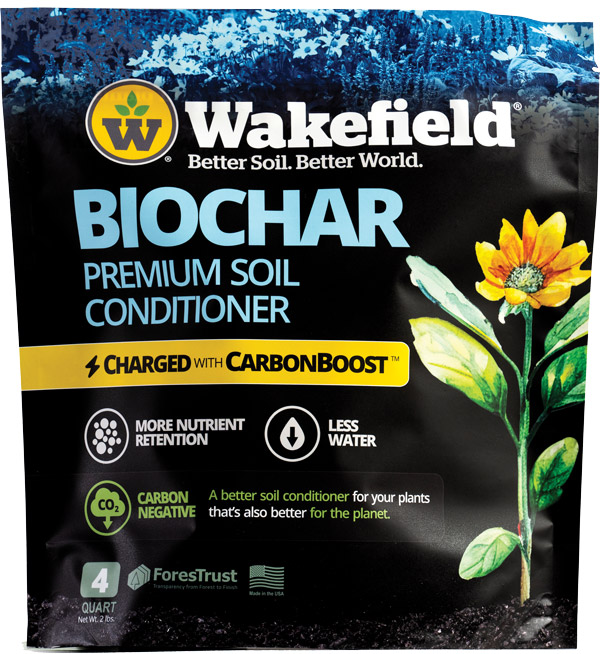 An Easy-to-Use Boost
When planting in the garden or pots, biochar should make up approximately 10% of the soil mix. If you’re setting up a garden bed, mix it into the soil to a depth of 4-6 inches (1 cubic foot is plenty for a 4-by-8-foot garden bed). For trees and shrubs, adding biochar directly to the roots helps them get off to a strong start and supports healthy growth.
It’s also a natural way to improve a lawn’s look and performance. To add biochar to your lawn to prepare for warm weather, spread it evenly across the grass, either by hand or with a broadcast spreader for larger areas. Aim for a thin, even layer to ensure all parts of your lawn benefit from its properties, improving long-term soil health. For newly planted lawns, mix 1 cubic foot of biochar into every 100 square feet of soil, making sure it penetrates 2-4 inches deep.
No matter where you use biochar, water regularly for the first week to activate its benefits. Watering helps biochar settle into the soil and start working, as its porous structure holds moisture, helping keep gardens and lawns hydrated.
Sustainable from the Ground Up
Not only does biochar deeply nourish your garden or lawn, it also helps create a more sustainable environment for years to come. It’s made by heating natural materials, such as organic wood waste, in a way that stores carbon rather than releasing it into the atmosphere as greenhouse gases.
The process – called pyrolysis – locks carbon into a stable form that doesn’t break down as quickly as mulch or compost and transforms into a light, porous material that stays active, season after season, to ensure nutrient-rich soil for years to come.
Beyond the Lawn
It isn’t just for providing plants with healthier soil. Bring biochar along on camping trips, as it also works wellfor composting toilets and has the added benefit of controlling odors and absorbing waste, making it a sustainable option that can be composted afterward.
It can also be used as livestock bedding as it absorbs liquids, neutralizes odors and can be mixed with manure to create a more nutrient-rich compost for plants and crops.
Learn more about planting healthy gardens and green spaces at WakefieldBiochar.com/grow.
Photo courtesy of Shutterstock (woman gardening)


SOURCE:
Wakefield BioChar
Travel
Travel Smarter for Spring’s Most Anticipated Moments
Travel Smarter: This spring, travelers are encouraged to embrace a “sportcation” by planning trips around their favorite games. Hyatt’s Bonus Journeys offer rewards for stays at participating hotels, enabling fans to experience live sports events while earning points for future stays. Various destinations cater to sports enthusiasts across multiple disciplines.
Last Updated on April 10, 2026 by Daily News Staff
Travel Smarter for Spring’s Most Anticipated Moments
(Feature Impact) Sports fandom is riding a fresh wave of energy, and travelers can turn that inspiration into trips built around the games they love most.
You’ve done the staycation. Maybe even the workcation. Now it’s time for the sportcation, where game day sets the schedule from tip-offs and first pitches to photo finishes.
This season, travelers can rally around championship matchups and legendary rivalries with the global Bonus Journeys offer from World of Hyatt. Through April 15, members who register for the offer can:
- Earn 3,000 Bonus Points for every three eligible nights – up to 21,000 Bonus Points – at participating hotels and resorts worldwide.
- Earn more rewards at Hyatt Place and Hyatt Select hotels and receive an additional 1,000 Bonus Points for every three eligible nights, up to 7,000 additional Bonus Points, for a total of up to 28,000 Bonus Points.
Regardless of the occasion, members can earn more points wherever they go next to redeem points for future free nights, room upgrades and curated experiences across the globe.
Turn Epic Live Experiences into Rewards
For those chasing courtside seats and stadium lights, spring offers the perfect excuse to plan a getaway around the action. Jump into the excitement at these hot spots:
- Set, Point, Match
Soak up the sun while enjoying tennis showdowns when you stay at Andaz Miami Beach Resort & Spa. Just steps from the beachfront, this hotel provides a refined take on the city’s vibrant spirit, while putting travelers close to the action as international tennis stars bring high-stakes rallies. - Access Basketball’s Biggest Matchups
At Hyatt Select St. Louis Airport, hoops fans can soak up the fun of collegiate basketball’s biggest moments. Less than a mile from St. Louis Lambert International Airport and within easy reach of the city’s top attractions, travelers can fly in, check in and let the madness begin.
Basketball in April just hits differently. Hyatt Place Indianapolis Airport puts fans near the biggest hardwood showdowns of the season, while also providing prime access to nearby attractions. - Batter Up This Spring
If baseball is your thing, check in at Hyatt Place Phoenix/Mesa, a valley escape that allows fans to get up close and personal with America’s pastime as the season warms up. After the final inning, unwind at the resort-style pool or practice your own short game on the nine-hole putting green.
For baseball junkies, stay just 3 miles from one of the most iconic baseball stadiums at Hyatt Place Chicago/Wicker Park. Savor game day festivities and enjoy panoramic views of the Chicago skyline from the historic Wicker Park neighborhood.
Earn Now, Play More Later 
Spring stays with World of Hyatt do double duty by turning this season’s thrills into future getaways, from summer trips to crisp fall weekends. Redeem points to get more out of iconic experiences around the world.
- Root for the Winning Horse
Make a toast in the bourbon capitol of the world as you check in at Hyatt Place Louisville – East. Located 20 minutes from the legendary horse racing track, you’ll feel right at home as you watch the thoroughbreds race for a place in the history books. - Plan a Football Escape
Make this fall’s football calendar your travel inspiration. Take college game day on the road with friends and family while staying at Hyatt Place Columbus/OSU, steps from one of football’s most iconic stadiums. - Experience the Fast Lane
Immerse yourself in one of the world’s premier motorsports race destinations from a sophisticated base at Hyatt Centric Gran Via Madrid. Minutes from the new 3.3-mile street circuit, guests can pair high-speed thrills with sweeping views of central Madrid and standout culinary offerings.
This season, don’t just watch the action; travel for it and let every stay bring you closer to what’s next. Learn more and plan your next vacation at hyatt.com/bonusjourneys.


SOURCE:
Hyatt
Our Lifestyle section on STM Daily News is a hub of inspiration and practical information, offering a range of articles that touch on various aspects of daily life. From tips on family finances to guides for maintaining health and wellness, we strive to empower our readers with knowledge and resources to enhance their lifestyles. Whether you’re seeking outdoor activity ideas, fashion trends, or travel recommendations, our lifestyle section has got you covered. Visit us today at https://stmdailynews.com/category/lifestyle/ and embark on a journey of discovery and self-improvement.





