

home improvement
Blavity Inc. Launches ‘Home & Texture,’ First-Ever Curated Home, Interior Design and Commerce Hub for Black and Multicultural Millennials

Home & Texture Roll Outs Editorial Storytelling, Shoppable Content, and Creator Partnerships to Best Reflect the Individuality, Lifestyle and Cultural Heritage of Consumers
LOS ANGELES (Newswire.com) – Blavity Inc. – the corporation that builds solutions for Black and multicultural audiences and enterprises who want to reach them and reaches more than 250 million monthly consumers across its media portfolio, including 21Ninety, Travel Noire, Shadow and Act, and Blavity.com – announces the launch of its newest lifestyle brand and commerce vertical Home & Texture. 
Home & Texture marks the first-ever curated home, interior design, and commerce hub dedicated to Black and multicultural consumers. While the home decor market is forecasted to hit $202 billion by the end of 2024, and this consumer segment makes up 60% of the growth in the home improvement category in the U.S., it is historically underserved with relevant home, DIY, and buying content and resources. Additionally, as more multicultural millennials are aging and buying homes, Home & Texture fills a current void in the publishing space by providing storytelling and shoppable content that reflects their individuality, lifestyle, and cultural heritage.
Merin Pasternak, the Senior Vice President of Commerce & Consumer Media, and Melody Bostic Brown, the Associate Vice President of Consumer Media at Blavity, will lead the home brand. The team will drive the content strategy for Blavity’s commerce-first lifestyle brands 21Ninety and Travel Noire, and will lead Home & Texture’s curated editorial storytelling and commerce to inspire and engage audiences in a way that consistently drives action. With millennials transitioning into home ownership and growing their families, Blavity Inc. will leverage its trust with consumers to drive inclusive change in media.
“Blavity was founded to fuel inclusivity across all business and lifestyle categories, specifically for Black and multicultural millennials. Home & Texture is a category disruptor – providing much-needed information and shoppable content that is curated to speak authentically to this underserved consumer segment, which is among the fastest growing in this category,” said Morgan DeBaun, CEO and Founder of Blavity Inc. “We’re excited to expand our growing media portfolio with this launch and guide readers as they put down their roots, raise families and turn houses into homes.”
Home & Texture launches with content franchises and key tentpoles featuring creators, entrepreneurs, and community-driven content, including:
- House Tours: House tours profile entrepreneurs, creators, and single parents, including Carmeon Hamilton, David Quarles IV, and Laquita Tate. The franchise looks at home designs and decor inspiration from the Black and multicultural community.
- My Homebuying Experience: This UGC and influencer-driven content discusses the joys and unexpected scenarios around becoming first-time homeowners, as well as design hacks and product reviews.
- Bad to Bougie: This franchise covers transforming old, unattractive pieces into fabulous accent pieces. It shows how to maximize your budget and reimagine furniture and decor sustainably.
- D-I-WHY: This tentpole explores the “why” vs. the “why not” approach to home renovations and refreshes. It provides insights and how-tos around specific home projects that are worth taking a hands-on approach and defines those that are best left to the professionals.
- Everything Must-Go…Into Your Home: This tentpole leverages an organic beginning-of-the-year refresh buzz with the best deals on home furnishings and appliances through “everything must go” clearance sales. In addition, we’ll highlight product reviews and listicles about home furnishings and appliances and offer UGC-driven contests.
- First Time Around: This tentpole touches a vital segment of the Home & Texture audience and buyers — first-time homeowners. For BIPOC millennials, creating a beautiful home is exciting, yet it also presents a lot of unknowns and discoveries. We offer them guidance.
For more, visit HomeandTexture.com.
ABOUT BLAVITY INC.
Blavity Inc. is a corporation that builds solutions for Black and multicultural audiences and enterprises who want to reach them. Founded in 2014, Blavity Inc. is home to the largest network of platforms and lifestyle brands serving millennials & Gen Z through original content, video, and unique experiences. The company has grown into a market leader for Black-owned media, reaching over 250 million millennials and Gen Z per month through its growing brand portfolio, including Blavity, 21Ninety, Home & Texture, Travel Noire, AfroTech, Shadow & Act, and Blavity TV.
Source: Blavity Inc.


Consumer Corner
5 Ways Homeowners Can Put Their Equity to Use
For many homeowners, their home represents their largest financial asset. When facing competing financial priorities, homeowners have several options for accessing equity and gaining financial flexibility. Consider these ways homeowners can then leverage that equity.

5 Ways Homeowners Can Put Their Equity to Use
(Feature Impact) For many homeowners, their home represents their largest financial asset. In fact, Americans are sitting on more than $35 trillion in total home equity – an average of $310,000 per mortgaged home – but many aren’t clear on how it could work for them to address today’s needs.
While 60% of homeowners in a survey conducted by Unlock said having the option to leverage home equity provides an extra level of financial security, nearly half (46%) don’t know how much equity they have. Equity can fluctuate over time, but you can calculate your current amount by determining your home’s worth and subtracting what you owe on your mortgage and any other loans. As your home’s value increases and you pay down your loans, equity rises.
When facing competing financial priorities, homeowners have several options for accessing equity and gaining financial flexibility – such as a home equity loan, home equity line of credit or cash-out refinance – each with different costs, requirements and trade-offs. A home equity agreement (HEA), sometimes referred to as a home equity investment, is an option that doesn’t require refinancing or giving up favorable interest rates – as is the case with the 57% of mortgaged U.S. homeowners who currently have a rate below 4%.
Offered by companies like Unlock, an HEA allows you to trade a portion of your home’s value at the end of the agreement in exchange for cash now. It lets you stay in your home, keep your current mortgage rate and have no monthly payments during the term. At the end of the term – which can last 10-30 years, depending on the provider – you’ll owe a single payment based on a percentage of your home’s value at that time, plus applicable fees and closing costs. Homeowners often settle by selling their home or using another form of financing to buy out the HEA provider’s share. The agreement is secured with a property lien, so a solid repayment plan can help minimize risks.
For homeowners who feel the squeeze of rising daily costs, an HEA allows them to use equity in smart, strategic ways by providing liquid funds for big expenses or everyday needs. Consider these ways homeowners can leverage their equity.
 Funding Home Improvements and Repairs
You can use the current value of your home to improve its future value. Whether you need a new roof, plumbing upgrades or a kitchen renovation, home improvements can be expensive. Receiving a lump sum from home equity can help you pay for important repairs, maintenance, upgrades and more.
Cover Unexpected Expenses
Life can be unpredictable. Cars break down, appliances go on the fritz, pets need a trip to the vet or family emergencies leave you wondering how you’ll afford the bill. If you have value tied up in your home, cashing in that equity can help provide a financial cushion.
Manage High-Interest Debt
If you’re caught in a cycle of debt where interest keeps piling up and you can barely make a dent in the original amount, your home’s equity could help you clear that slate. High-interest debt may include credit cards, payday loans, certain personal loans or other types of debt – especially any with double-digit interest rates. For homeowners who feel crushed by debt even though they have a positive net worth thanks to equity, tapping into home value can be a way to break that cycle.
Pay for Major Life Expenses
Some life expenses are unexpected, but there are others you can see coming in advance. Whether you’re planning a wedding, starting a business, paying college tuition or acquiring a rental property, home equity may enable you to cover the costs without stretching yourself thin.
Create Financial Flexibility
An HEA could make sense for homeowners who need extra financial flexibility. Since you don’t have to make monthly payments and have a decade or more to plan for settlement, this structure can free up cash flow for everyday essentials like daycare, insurance, groceries and more, along with future needs and goals.
Visit Unlock.com to learn more and find out how much equity you may have access to.
Photos courtesy of Shutterstock
SOURCE:
Unlock
home improvement
4 Ways to Make Room for Better Living
Make Room for Better Living: Oftentimes, making your home better suited for your needs starts with rethinking how the doors open. Whether you’re remodeling or building a new home, understanding the options can help you choose doors – and the installation hardware behind them – that make rooms more comfortable and convenient.
Last Updated on November 16, 2026 by Daily News Staff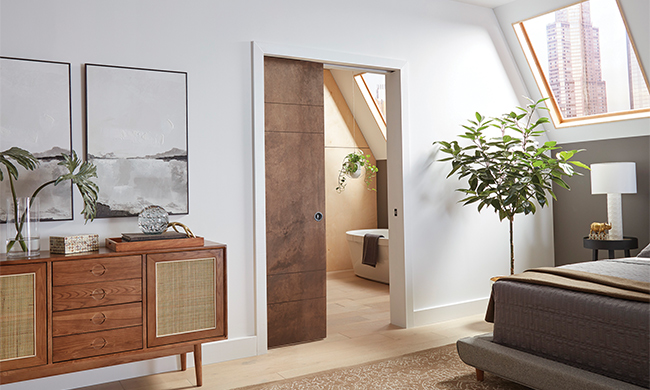
4 Ways to Make Room for Better Living
A bathroom door that bumps into the vanity. A closet interior that’s awkward to reach. A home office that needs a little separation from family activity. Oftentimes, making your home better suited for your needs starts with rethinking how the doors open.
Sliding, folding and pocket doors offer practical ways to improve everyday spaces without adding square footage. Whether you’re remodeling or building a new home, understanding the options can help you choose doors – and the installation hardware behind them – that make rooms more comfortable and convenient.
Consider these four ways to put your doors to work from the experts at Johnson Hardware, who make easy-to-install hardware systems in the U.S.:
Free Up Floor Space with Pocket Doors
In bathrooms, kitchen pantries and laundry rooms, a swinging door can compete with storage, taking up to 14 square feet of floor space and interrupting traffic flow. Pocket doors slide into the wall, freeing the area a hinged door needs to swing open.
Made for single pocket doors in compact rooms or two converging doors for larger openings between adjoining spaces, pocket door hardware with its soft-close feature helps doors glide gently into the open and closed positions, reducing slamming. Discuss pocket doors early in your project so your building professional can plan for the space needed inside the wall.
 Keep Essentials Handy with Bypass and Multi-Pass Doors
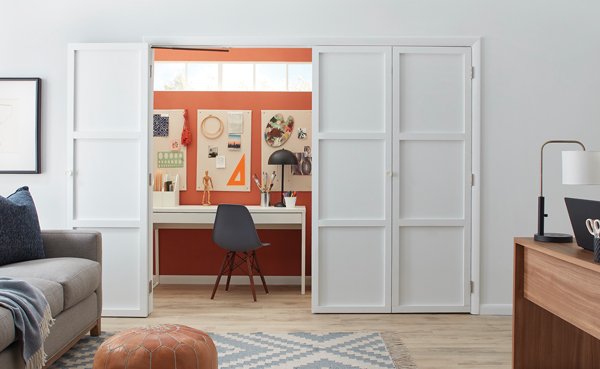
A frequently used mudroom, hallway or bedroom closet can look more organized with sliding bypass or multi-pass doors. The panels travel on separate tracks and slide past one another, letting you reach different sections without doors swinging into the room.
Options like Johnson’s bypass and multi-pass hardware systems help keep walkways clear while concealing storage or everyday clutter. Ask your designer or remodeler about panel arrangements and soft-close options that suit the opening based on how you’ll use the space.
Add Flexibility with Wall-Mount Sliding Doors
If you want the space-saving benefits of a sliding door but a pocket door isn’t practical, wall-mount doors travel along a track outside the wall. With easy-to-install hardware systems, making the switch from a swinging door can be a quick, practical room upgrade.
Often called barn doors, they can complement many decorating styles, from traditional painted wood to contemporary glass designs. Wall-mount sliding doors work well in home offices, bedrooms, laundry rooms and pantries, where soft-close and soft-open hardware can help reduce noise. Plan for clear wall space beside the opening so the door has room to slide.
Open Up Storage with Full-Access Bifold Doors
A closet can hold more than clothes. It might become a craft station, compact workspace or convenient place for laundry supplies.
Bifold doors use hinged panels that fold together as they open. Unique 1601 Full-Access Bifold Door Hardware goes a step further, allowing panels to fold flat against adjacent walls for full access across the opening. That makes it easier to reach shelves, organize supplies and use the space inside.
Thoughtful door hardware choices can make everyday routines easier, from reaching pantry shelves to creating a quiet place to work. As you plan your project, ask your designer, architect, remodeler or building contractor how pocket, sliding and folding door hardware systems can help make better use of your space.
For more ideas, visit johnsonhardware.com.
SOURCE:
Health
Radon is the second leading cause of lung cancer. 8 in 10 US adults have never tested their home for it
Decades of public health campaigns have reinforced the connection between smoking and lung cancer, helping people understand that their choices can influence their health. Despite radon being the second-leading cause of lung cancer, many have never tested their home for it.

Radon is the second leading cause of lung cancer. 8 in 10 US adults have never tested their home for it
(Sheeka Sanahori) Avoid tobacco products. Eat a healthy diet. Get recommended cancer screenings. Most U.S. adults recognize these behaviors as ways to lower their cancer risk or catch cancer early. Decades of public health campaigns have reinforced the connection between smoking and lung cancer, helping people understand that their choices can influence their health.
But U.S. adults are far less likely to recognize a risk factor they can’t control through daily habits. Radon – an odorless, invisible gas that forms naturally in the ground – is the second leading cause of lung cancer, but new research from the Prevent Cancer Foundation finds that 8 in 10 U.S. adults have never tested their home for radon. The findings are based on the Foundation’s annual Early Detection Survey of more than 7,000 U.S. adults, conducted in January 2026.
With recent high-profile lung cancer cases, such as the October diagnosis of Pope Leo XIV, who is not known to have a history of smoking cigarettes, more people are paying attention to other risk factors for lung cancer, especially for people who have never smoked.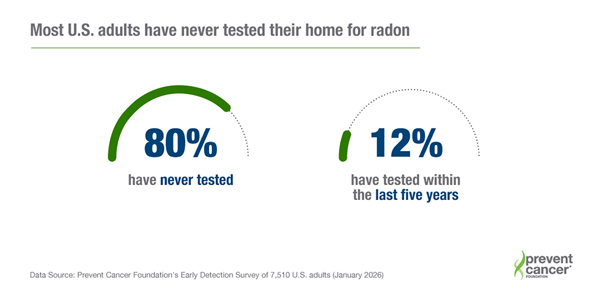
Testing for radon is last on the list
When asked about preventive behaviors, 77.5% say avoiding tobacco lowers their cancer risk. Three out of four say eating a healthy diet and getting routine cancer screenings make a difference, too. More than half also named regular exercise, limiting alcohol and protecting themselves from harmful UV rays.
Testing their home for radon ranked last on the list of preventive behaviors, with only 28% listing it as a way to reduce their cancer risk.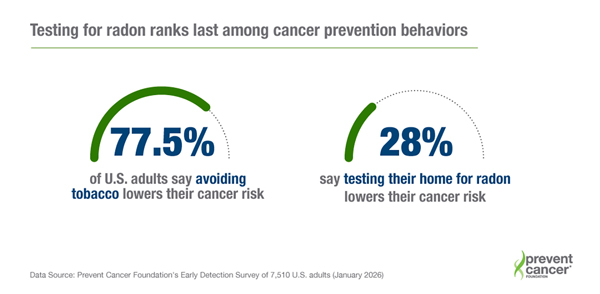
Most homes go untested in every region
Radon hasn’t reached the same level of public awareness as tobacco use, diet and exercise. U.S. adults appear to overlook an environmental risk that could be inside their own homes. Eighty percent of U.S. adults report never having their homes tested for radon, and only 12% have tested within the last five years. The U.S. Environmental Protection Agency (EPA) recommends testing every two years.
In the Northeast, about 7 in 10 people (72%) have never tested their home for radon. That percentage increases for the Midwest (79%), West (82%) and South (83%). Unlike cigarettes, radon does not produce smoke and is odorless, so a test is the only way to detect its presence.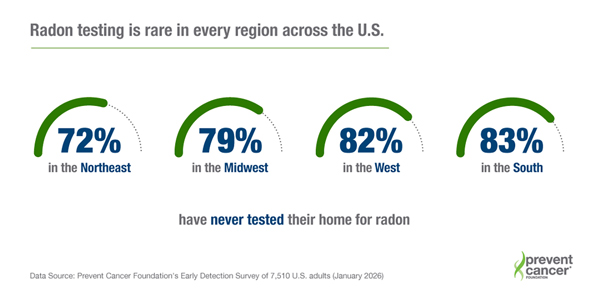
What it takes to find out
Radon can enter homes through the ground when uranium underneath decays. Once it’s inside, it gets trapped. People can live with high radon levels without knowing it, in older homes and new construction alike. Breaking ground on undisturbed land during construction can release more radon.
Renters can either test themselves or ask their landlord whether the home has been tested and request the results. Landlord requirements vary by state.
Test kits are inexpensive and available online and at home improvement stores. The EPA recommends taking action to reduce radon levels at 4 picocuries per liter (pCi/L) or higher, and notes that levels below that may still carry risk. If levels are high, a mitigation system can bring them down.
Beyond radon, the EPA and other health authorities cite avoiding tobacco and secondhand smoke as the most significant steps people can take to lower lung cancer risk, along with following screening guidelines based on personal risk factors.
Methodology
The Prevent Cancer Foundation commissioned Atomik Research to conduct the Foundation’s fourth annual Early Detection Survey of U.S. adults. The study consists of an online survey questionnaire, which includes several repeated measures from a previous year’s questionnaire and a primary data set gathered from a sample of 7,510 adults located throughout the United States. The sample consists of adults 21 years of age or older, and researchers implemented several demographic-based quotas in order to achieve sample characteristics similar to the overall U.S. population of adults 21 and older.
Researchers controlled for demographic variables such as biological sex, age group classification, race/ethnicity, parental status, geographic region, employment status and community classifications (e.g., urban or rural classification).
The margin of error of the overall sample is +/-1 percentage point with a confidence level of 95%. Fieldwork took place between Jan. 10 and Jan. 30, 2026. Atomik Research is an independent market research agency.
Percentages may not add up to 100% due to computer rounding, and/or the acceptance of multiple responses.
Photo courtesy of Shutterstock (family playing)
SOURCE:
Prevent Cancer Foundation




