
Connect with us

health and wellness

Do people really want to know their risk of getting Alzheimer’s?

Published

on

Alzheimer’s
Tricky Shark/Shutterstock.com

Claudia Cooper, Queen Mary University of London

A new study has highlighted the complex emotions and ethical dilemmas of learning your future risk of Alzheimer’s disease. Among 274 healthy research participants from the US aged 65 and over, 40% declined to receive their personal risk estimates – despite having initially expressed an interest in doing so.

These risk estimates were based on demographic data, brain imaging and blood biomarkers, offering an 82 to 84% accuracy in predicting the likelihood of developing Alzheimer’s disease within five years. By comparison, age alone can predict this risk with 79% accuracy.

So the value of these tests is modest in people without any cognitive symptoms, and there are potential risks to disclosing them. People told they are at increased risk of dementia describe how this can feel like an illness in itself – or being in limbo between health and disease – and cause distress.

Participants who did not want to be tested cited the uncertainty of the result, the burden of knowing, and their negative experiences of witnessing Alzheimer’s disease in others. Those with a family history of Alzheimer’s were less likely to want to know their results – perhaps because of greater exposure to these negative experiences.


Get your news from actual experts, straight to your inbox. Sign up to our daily newsletter to receive all The Conversation UK’s latest coverage of news and research, from politics and business to the arts and sciences.


Black participants were less likely to want to know, too, which the researchers suggest could relate to greater experiences of stress, stigma and discrimination, making the prospect of a positive test result feel more threatening.

Perhaps the question here is not why more people didn’t want to know the result, but whether researchers should routinely offer them at all, given the lack of certainty of the results and the potential for distress.

Another issue is their limited usefulness for people without symptoms. Addressing lifestyle risk factors, such as eating a healthy diet and getting regular exercise, can reduce cognitive decline, a message the public is increasingly aware of. But knowing your risk doesn’t change the advice.

In contrast to areas like breast cancer, where people at high risk of the disease can be offered preventative measures, such as drugs, surgery or enhanced screening, there are no comparable interventions to reduce dementia risk in people without symptoms.

Advertisement
Reveal Your Skin's Youthful Radiance with FOREO's LUNA 2 Facial Massager. Shop Now For $199

The authors of the new study explain that researchers used to be cautious about not sharing test results with participants in Alzheimer’s studies. But now there’s a growing expectation that people will be given their results. A proposed “bill of rights” for dementia research participants includes the right to get their results and have them clearly explained.

It’s hard to explain how uncertain these results can be. People often worry about getting dementia in general, not just Alzheimer’s, which makes up about two-thirds of all cases. Some people who are told they have a low risk of Alzheimer’s may still develop another form of dementia, such as vascular dementia.

The wider science that produced these future risk estimates has enabled the development of new diagnostic technologies unimaginable ten years ago. Similar blood tests can detect Alzheimer’s disease pathology in people with cognitive symptoms with over 90% accuracy, potentially enabling more accurate and timely dementia diagnoses.

Blood tests

Two major UK research programmes are piloting these blood tests in the NHS to support the more accurate diagnoses of some forms of dementia, including Alzheimer’s disease. Improved and earlier detection is needed: a third of people with dementia in England and Northern Ireland are never diagnosed.

The benefits of the first drugs to slow the progression of Alzheimer’s disease are modest. In the UK, the National Institute for Health and Care Excellence hasn’t yet been convinced that these drugs are worth the cost for the NHS.
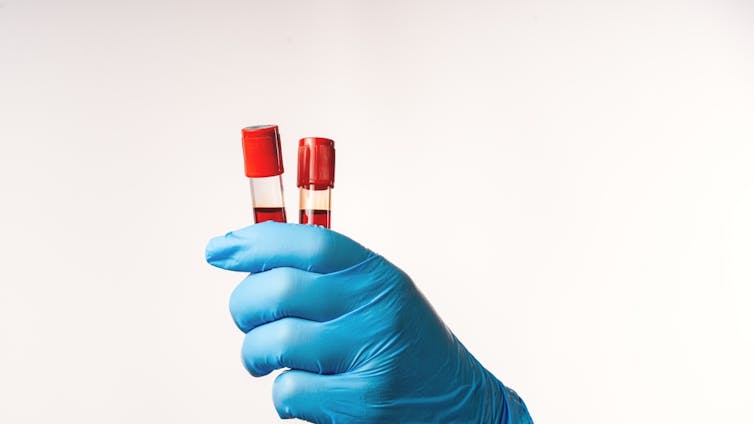
A hand in a blue latex glove holding two phials of blood.
The NHS is trialling blood tests to spot early signs of Alzheimer’s.
AntonSAN/Shutterstock.com

Some might question a focus on identifying future risks for dementia before we have good treatments. But developing better treatments depends on the new scientific discoveries that are helping us detect Alzheimer’s earlier. Finding a treatment for an illness requires a detailed understanding of how that illness develops.

We are closer to delivering accurate detection of Alzheimer’s disease than curative treatment. This presents a dilemma of how much to know about personal risk. Rights-based approaches situate this dilemma with the participant, to decide whether to know rather than researchers to decide whether to tell.

For researchers, disclosing results compassionately and clearly is difficult and for some, the knowledge will cause distress, however well it is conveyed. The option to receive results should come with warnings.The Conversation

Claudia Cooper, Professor of Psychological Medicine, Queen Mary University of London

This article is republished from The Conversation under a Creative Commons license. Read the original article.

Author

  • Rod Washington

    Rod: A creative force, blending words, images, and flavors. Blogger, writer, filmmaker, and photographer. Cooking enthusiast with a sci-fi vision. Passionate about his upcoming series and dedicated to TNC Network. Partnered with Rebecca Washington for a shared journey of love and art.

    View all posts
Advertisement
Reveal Your Skin's Youthful Radiance with FOREO's LUNA 2 Facial Massager. Shop Now For $199

Rod: A creative force, blending words, images, and flavors. Blogger, writer, filmmaker, and photographer. Cooking enthusiast with a sci-fi vision. Passionate about his upcoming series and dedicated to TNC Network. Partnered with Rebecca Washington for a shared journey of love and art.

Continue Reading
Advertisement Simply Wholesale

health and wellness

Stacking Healthy Habits for Progress, Not Perfection

Healthy Habits: Many struggle with building healthier habits due to unrealistic expectations rather than lack of motivation. The American Heart Association’s My Life Check tool offers personalized heart health insights, helping to set attainable goals. Simple lifestyle changes—focused on nutrition, movement, sleep, and stress management—can gradually lead to significant health improvements.

Published

on

Last Updated on April 10, 2026 by Daily News Staff

Despite the best of intentions, it’s common for plans to build healthy habits to fall flat. Often, the culprit isn’t a lack of motivation or discipline; rather, it’s unrealistic expectations. Understanding your personal health needs and the challenges you need to overcome can help give you a more realistic roadmap toward better health.

(Feature Impact) Despite the best of intentions, it’s common for plans to build healthier habits to fall flat. Often, the culprit isn’t a lack of motivation or discipline; rather, it’s unrealistic expectations.

Overhauling your lifestyle requires a level of commitment that isn’t always practical. Understanding your personal health needs and the challenges you need to overcome can help give you a more realistic roadmap toward better health.

Tools to Guide You
Every plan needs a starting point and there are many reputable sources that can help guide you toward a plan that addresses your personal health needs.

For example, the American Heart Association introduced My Life Check, a simple, free tool to help individuals understand their heart health and what’s driving it. Users answer simple questions about their daily habits and health factors to get a personalized Heart Health Score in minutes.

The results are private and downloadable, giving you full control of your information. The tool turns big goals into small, specific actions you can start right away. Knowing your numbers relative to your heart health (and where you are in comparison to target ranges for optimal health) can help you decide how to build a better map to get you where you want to be.

While the report is customized to each individual, no personal data is stored and answers are only used to calculate health scores and provide personalized recommendations and practical steps to improve your health, so you can use your results to focus on what matters most to you. Every small step you take, such as moving more, eating smarter, sleeping better or managing stress, can add up over time.

17763 A detail embed1

Finding Your Path
Once you’re armed with data and know where you stand on your heart health numbers, small steps become clearer and more manageable. That knowledge makes it easier to choose one area to focus on, such as getting more sleep, taking daily walks or adding more color to your meals.

Healthy changes don’t need to be expensive or complicated. The best habits are ones that fit real life when every action you take moves you closer to your goals.

Eat Smart
Choose foods that help you feel your best, one meal at a time. Add more color to your plate and focus on balance, not restriction. Simple, affordable swaps can make a real difference.

Move More
Find movement that fits your life, such as a walk, a stretch or dancing while you cook. Every bit of activity counts and it all supports your heart and mind. Move for joy, not just for results.

Sleep Well
Rest is a foundation of good health, not a reward. Protect your bedtime routine and give your body the recovery it deserves. Notice how good sleep makes everything else easier.

Advertisement
Reveal Your Skin's Youthful Radiance with FOREO's LUNA 2 Facial Massager. Shop Now For $199

Manage Stress
Check in with yourself regularly, both mentally and emotionally. Create simple moments to pause, breathe, laugh or step outside. Connection, kindness and calm all support a healthy heart.

Staying motivated and on track is also easier when you can check back in, see your progress and realize the steps you’re taking are making an impact. Checking in every few months to see how you can grow gives you the chance to celebrate your progress, learn from challenges and keep building lasting habits that feel good.

To get started with personalized tips to set your own health goals, visit heart.org/mylifecheck.

Photos courtesy of Shutterstock

    <img src="https://ssl.google-analytics.com/collect?v=1&amp;tid=UA-482330-7&amp;cid=1955551e-1975-5e52-0cdb-8516071094cd&amp;sc=start&amp;t=pageview&amp;dl=http%3A%2F%2Ftrack.familyfeatures.com%2F17763%2F10236&amp;dt=STACKING-HEALTHY-HABITS-FOR-PROGRESS-NOT-PERFECTION" />
    https://erp.featureimpact.com/api/v1/tracking/17763/10236/track.js
    <script type="text/javascript">
        (function () {
            var image = new Image(1, 1);
            image.src = 'https://erp.featureimpact.com/api/v1/tracking/17763/10236/track.gif?referrer=' + window.location.href;
            image.id = 'feature-impact-content-tracking-pixel';
            image.style.position = 'absolute';
            image.style.top = 0;
            image.style.left = 0;
            document.body.appendChild(image);
        })();
    </script>

SOURCE:

American Heart Association

Continue Reading

Entertainment

Come Talk to ME Selected for Minneapolis–Saint Paul International Film Festival

Published

on

MINNEAPOLIS — The powerful new documentary Come Talk to ME is set to make its big-screen debut at the Minneapolis–Saint Paul International Film Festival (MSPIFF), marking a significant milestone for the independently produced film centered on Parkinson’s disease, communication, and human connection.

A scene from the documentary Come Talk to ME showing Parkinson’s advocate Jackie Hunt Christensen and Alexa Jarombek engaged in conversation, highlighting themes of communication, connection, and living with Parkinson’s disease.
Alexa Jarombek and Jackie Hunt Christensen in a scene from the 2026 documentary, “Come Talk to ME”, a film about Parkinson’s, communication, and relationships.

The 2026 festival, running April 8–19, will feature more than 200 films from around the world. Come Talk to ME is scheduled for two screenings, including a meaningful premiere on April 11—World Parkinson’s Day—followed by a second showing on April 14. Both screenings will take place at the Main Cinema at Saint Anthony Main in Minneapolis.


A Story About Communication and Connection

Directed by Deacon Warner and produced by Jackie Hunt Christensen, the documentary follows Christensen, her husband Paul, and a close-knit group of friends living with Parkinson’s disease.

The film explores how communication evolves as the disease progresses, highlighting the creative and deeply human ways individuals maintain relationships—with family, friends, and healthcare providers—even as traditional speech becomes more challenging.

Christensen, diagnosed with Parkinson’s at just 34, emphasizes that the film is ultimately about preserving connection:

“Having Parkinson’s does not mean that you stop loving, caring, and feeling… communication is everything.”


Innovative Use of AI Voice Technology

One of the film’s most groundbreaking elements is its use of AI-generated narration powered by ElevenLabs.

The filmmakers recreated Christensen’s voice using archival audio recorded shortly after her diagnosis in 2000. This AI-generated voice—nicknamed “JHC2K”—serves as the primary narrator, allowing Christensen to “speak” throughout the film in a way that would otherwise be difficult due to the progression of Parkinson’s.

Director Warner called the experience both innovative and deeply personal:

“To be part of [MSPIFF’s] rich history… while also utilizing cutting-edge AI technology to set us apart from other films is incredible.”


Festival Screenings and Accessibility

Come Talk to ME will screen twice during the festival:

  • Saturday, April 11 (World Parkinson’s Day) – Early afternoon (time TBD)
  • Tuesday, April 14 – Late afternoon (time TBD)

Ticket pricing:

  • MSP Film Society Members: $11
  • General Admission: $17 (+ online fee)
  • Students: $10 (with ID)

In a move aligned with the film’s mission, the April 11 screening will offer free admission (donation-based) for individuals affected by Parkinson’s disease.

The venue also provides limited wheelchair seating on a first-come, first-served basis.


A Film Seeking Broader Impact

Beyond its festival debut, Come Talk to ME is actively seeking sponsors to expand its reach and impact. The filmmakers hope to bring the documentary to wider audiences, particularly within communities affected by Parkinson’s disease.

Advertisement
Reveal Your Skin's Youthful Radiance with FOREO's LUNA 2 Facial Massager. Shop Now For $199

At its core, the film delivers a powerful message: even as physical abilities change, the need for connection—and the human drive to communicate—remains constant.


Why This Film Matters

As awareness of Parkinson’s disease continues to grow, Come Talk to ME stands out as both an emotional narrative and a technological milestone. By combining personal storytelling with AI innovation, the film offers a new way to understand life with Parkinson’s—and the enduring importance of being heard.


Source and Related Links

STM Daily News’ Entertainment section delivers the latest on movies, television, music, pop culture, events, and industry buzz. From breaking news and trending stories to feature coverage and community-centered entertainment reporting, it keeps readers connected to what’s happening on screen, on stage, and beyond.

Want more stories 👋
“Your morning jolt of Inspiring & Interesting Stories!”

Sign up to receive awesome articles directly to your inbox.

STM Coffee Newsletter 1

We don’t spam! Read our privacy policy for more info.

Continue Reading

health and wellness

Heart Risks Go Beyond the Heart: Don’t Forget to Check Blood Sugar and Kidney Health

Published

on

Heart Risks Go Beyond the Heart: Don't Forget to Check Blood Sugar and Kidney Health

Heart Risks Go Beyond the Heart: Don’t Forget to Check Blood Sugar and Kidney Health

(Feature Impact) Diabetes and kidney disease are major risk factors for heart disease, yet many cases are undiagnosed. In fact, most people don’t realize their heart, kidney and metabolic health – how the body creates, uses and stores energy – are connected. Understanding these connections can help you take steps toward protecting your long-term health.

Cardiovascular-kidney-metabolic (CKM) syndrome is a health condition that includes heart disease, kidney disease, diabetes and obesity. Many people don’t realize they’re at risk, though, because they aren’t aware of health risks beyond the heart. Almost 1 in 4 U.S. adults with diabetes are unaware they have it, according to a 2026 statistics update from the American Heart Association. In addition, data from the Centers for Disease Control and Prevention shows that as many as 9 in 10 adults with chronic kidney disease don’t know they’re living with the condition.

Learning about CKM syndrome can be a helpful step in understanding your overall health picture.

How are CKM conditions connected?

Heart disease, kidney disease and diabetes have shared risk factors – including high blood pressure, cholesterol and blood sugar; excess weight; and reduced kidney function – and they’re closely linked. Having one condition often increases the likelihood of developing the others.

“We are encouraging people to become aware of the connection between conditions so they and their health care team can think about their overall health beyond individual conditions,” said Stacey E. Rosen, M.D., FAHA, volunteer president of the American Heart Association, executive director of the Katz Institute for Women’s Health and senior vice president of women’s health at Northwell Health. “Understanding the connection helps you better prevent complications through lifestyle changes and appropriate treatment.”

The biggest health threats from CKM syndrome are disability and death from heart disease and stroke, which make up the “cardiovascular” part of CKM. The “metabolic” part includes diabetes and obesity. Kidney disease is closely linked with both metabolic and cardiovascular diseases.

17848 B detail embed2How common is CKM syndrome?

CKM-related risks are common. Nearly 90% of U.S. adults have at least one risk factor for CKM syndrome. The 2026 statistics report showed about half of all U.S. adults have high blood pressure, about 1 in 3 has high total cholesterol, more than half have prediabetes or diabetes, about 1 in 7 has kidney disease and more than half have a high waist circumference.

These risks often develop slowly, with few or no symptoms at first, but you can stay informed. Rosen emphasizes regular screening of your cardiovascular, kidney and metabolic health, which can catch problems early.

“Due to the current risk factor rates, everyone could benefit from being screened this way,” she said.

Regular check-ins with your health care team can offer a clearer picture of your CKM health. They can check your:

  • Blood pressure
  • Cholesterol panel (total cholesterol, LDL (bad) cholesterol, HDL (good) cholesterol and triglycerides)
  • Blood glucose (blood sugar), measured in either the short term as fasting glucose or long term as A1C
  • Body weight and size, measured by body mass index and waist circumference
  • Kidney function, using both UACR and eGFR

These results can be used in the PREVENT online calculator to estimate your risk for cardiovascular disease over the next 10 or 30 years. CKM syndrome can often be prevented and improved with healthy daily habits like those in Life’s Essential 8 and science-based treatments.

The CKM Health Initiative was introduced by the American Heart Association to raise awareness of the connections between CKM syndrome conditions and improve diagnosis rates. It’s supported by founding sponsors Novo Nordisk and Boehringer Ingelheim, supporting sponsors Novartis Pharmaceuticals Corporation and Bayer, and champion sponsor DaVita.

Advertisement
Reveal Your Skin's Youthful Radiance with FOREO's LUNA 2 Facial Massager. Shop Now For $199

Visit Heart.org/myCKMhealth to learn more about CKM health, including screening and treatment options.

    collect?v=1&tid=UA 482330 7&cid=1955551e 1975 5e52 0cdb 8516071094cd&sc=start&t=pageview&dl=http%3A%2F%2Ftrack.familyfeatures
track

SOURCE:

American Heart Association

Our Lifestyle section on STM Daily News is a hub of inspiration and practical information, offering a range of articles that touch on various aspects of daily life. From tips on family finances to guides for maintaining health and wellness, we strive to empower our readers with knowledge and resources to enhance their lifestyles. Whether you’re seeking outdoor activity ideas, fashion trends, or travel recommendations, our lifestyle section has got you covered. Visit us today at https://stmdailynews.com/category/lifestyle/ and embark on a journey of discovery and self-improvement.

Continue Reading

Trending