Connect with us

The Knowledge

Even before they can read, young children are visualizing letters and other objects with the same strategies adults use

Published

on

young children are visualizing letters and other objects
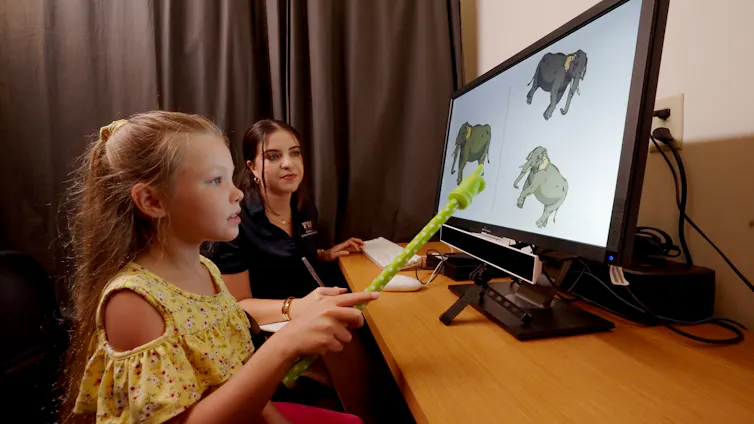
A student looks at different images, as eye-tracking technology monitors how she is visualizing the objects.
Chris Necuze/FIU, CC BY

Even before they can read, young children are visualizing letters and other objects with the same strategies adults use

Shannon Pruden, Florida International University and Karinna Rodriguez, Florida International University

What do puzzles, gymnastics, writing and using maps all have in common?

They all rely on people’s ability to visualize objects as they spin, flip or turn in space, without physically moving them. This is a spatial skill that developmental psychologists call mental rotation.

Whether a person is navigating a new city or doing a cartwheel, they must use mental rotation skills to move shapes or objects in their mind and make sense of where their bodies are going and what surrounds them.

When children play with puzzles, building blocks or pattern games, they are also practicing mental rotation.

Over time, these skills support learning in math, science and reading. This can look like visualizing pulley systems in physics or seeing the differences between similar-looking letters such as b and d, which young children often confuse.

Strong mental rotation skills also lay the foundation for doing well in school and developing interest in careers in science, technology, engineering and math.

Most preschool-age children are not yet learning to read – but it turns out they are still using some of these same spatial reasoning skills as they think about the world around them.

We are scholars of, developmental science and were curious to find out how children as young as 3 years old mentally rotate objects.

While there is research on the age at which children can mentally rotate objects, less is understood about how children are solving mental rotation problems. We found in our research, conducted from 2022 to 2023, that young children are using the same problem-solving strategies as adults when they solve a mental rotation task.

Children think visually, just like adults

We used eye-tracking technology to understand how a sample of 148 children, all between 3 and 7 years old, solved different mental rotation problems. Eye-trackers use harmless infrared light to capture eye movements. This technology lets us observe how children solve these problems in real time.

Advertisement
Get More From A Face Cleanser And Spa-like Massage

As part of our study, we showed each child a large picture of items such as a fire truck, as well as two smaller pictures of the same truck, one placed above the other and positioned slightly differently.

Children were asked to say which small picture on the right matched the large one on the left. In this example, the correct answer is the top picture, because that top fire truck can be rotated to match the large fire truck. The bottom fire truck was a mirrored image, and no matter how much you rotate it, it will never match the large fire truck.

file 20250925 64 xywaer.png?ixlib=rb 4.1
Children looked at pictures of fire trucks as part of a research study to assess how they manipulated the object in their heads.
Karinna Rodriguez

While the children thought about their response, the eye-tracker, mounted right below the computer screen, recorded their eye movements.

By looking at where and for how long children looked at each image, we figured out what kind of strategy they were using.

Some children focused on fewer parts of the object and spent less time studying its details. This suggests they used a holistic strategy, meaning they took in the whole image at once, instead of breaking it into pieces. These children mentally rotated the entire object to solve the task.

Other children focused on parts of the object and spent more time studying its details. This suggests they broke the image down into pieces instead of visualizing the image as a whole, known as a piecemeal strategy. Our findings support prior work showing that children generally use these two visual approaches to solve mental rotation problems.

This study helped us learn where children look while solving puzzles and identify how they solve these problems – without ever having to ask the child, who might be too young to explain, about their process.

Children were more likely to turn the whole image instead of breaking it down into pieces, a pattern of problem solving adults typically also use. This means that even very young children are already thinking about how objects move and turn in space in ways that are more advanced than expected.
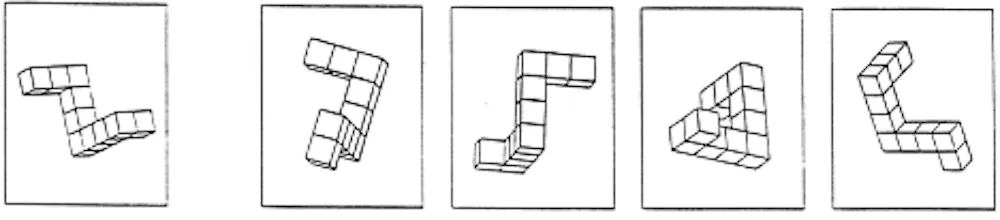
White blocks are seen in different configurations in a drawing.
An example of a mental rotation task that can show how people are visually moving objects in their minds.
Angie Mackewn, CC BY

Supporting children’s visual skills

Knowing how young children mentally rotate objects may help researchers, teachers and parents understand why some children struggle with learning to read.

Children who break an image down into pieces, instead of visualizing it as a whole, to solve mental rotation problems may be the very same children who struggle with discriminating similar-looking letters such as p and q and may later be diagnosed with dyslexia.

Parents can play an important role in building their child’s mental rotation skills. Parents can help children by offering them opportunities to practice rotating real objects with toys such as three-dimensional puzzles or building blocks. Tangrams – flat, colorful puzzles that come in different shapes – can be used to practice breaking down shapes of animals into pieces. Parents can encourage their child to look for shapes that match parts of the animal or object they are building.

Nov. 8 is International STEM Day, a celebration of all things science, technology, engineering and mathematics.

Advertisement
Get More From A Face Cleanser And Spa-like Massage

Research like ours provides valuable guidance for designing early STEM activities and educational tools. By directly observing children’s problem solving in real time, we can develop better ways for educators and toy makers to support strong spatial thinking from an early age. To celebrate, we encourage people to engage in activities that test their spatial skills, such as ditching the GPS for the day or playing a game of Tetris.

Mental rotation is a powerful skill that helps us understand and interact with the surrounding physical world. From solving puzzles to reading maps, mental rotation plays a role in many everyday activities. Building mental rotation abilities can improve children’s performance in subjects such as reading, math and science and may inspire future careers in STEM fields.

Shannon Pruden, Professor of psychology, Florida International University and Karinna Rodriguez, PhD candidate in psychology, Florida International University

This article is republished from The Conversation under a Creative Commons license. Read the original article.

Dive into “The Knowledge,” where curiosity meets clarity. This playlist, in collaboration with STMDailyNews.com, is designed for viewers who value historical accuracy and insightful learning. Our short videos, ranging from 30 seconds to a minute and a half, make complex subjects easy to grasp in no time. Covering everything from historical events to contemporary processes and entertainment, “The Knowledge” bridges the past with the present. In a world where information is abundant yet often misused, our series aims to guide you through the noise, preserving vital knowledge and truths that shape our lives today. Perfect for curious minds eager to discover the ‘why’ and ‘how’ of everything around us. Subscribe and join in as we explore the facts that matter.  https://stmdailynews.com/the-knowledge/

Author

Continue Reading
Advertisement SodaStream USA, inc

The Knowledge

Artemis II crew brought a human eye and storytelling vision to the photos they took on their mission

Artemis II crew: Artemis II’s astronaut photos show how human perspective and storytelling make space imagery feel authentic—especially in an era of AI-generated visuals.

Published

on

file 20260410 57 xmsmko.jpg?ixlib=rb 4.1
Astronaut Jeremy Hansen takes a picture through the camera shroud covering a window on the Orion spacecraft. NASA

Christye Sisson, Rochester Institute of Technology

In early April 2026, the Artemis II mission captivated me and millions of people watching from across the world. The crew’s courage, skill and infectious wonder served as tangible proof of human persistence and technological achievement, all against the mysterious backdrop of space.

People back on Earth got to witness the mission through remarkable photos of space captured by astronauts. Images created and shared by astronauts underscore how photography builds a powerful, authentic connection that goes beyond what technology alone can capture.

As a photographer and the director of the Rochester Institute of Technology’s School of Photographic Arts and Sciences, I am especially drawn to how these photographs have been at the center of the public’s collective experience of this mission.

In an era when image authenticity is often questioned and with the capabilities of autonomous, AI-driven imaging, NASA’s choice to train astronauts in photography has placed meaning over convenience and prioritized their human perspectives and creativity.

Capturing space from the crew’s perspective

Photography was not originally placed as a high priority in NASA’s Apollo era. The astronauts only took photographs if they had the chance and all their other tasks were complete.

An image of the entire Earth from space.
‘The Blue Marble’ view of the Earth as seen by the Apollo 17 crew in 1972. NASA

Thanks largely in part to public response to those images from Apollo, including “Earthrise” and the “Blue Marble” being widely credited for helping catalyze the modern environmental movement, NASA shifted its approach to utilize photography to help capture the public’s imagination by training their astronauts in photographic practices.

The Artemis II mission’s photographs have helped cut through the increasing volume of artificially generated images circulating on social media. NASA’s social media releases of the crew’s photographs have garnered thousands of shares and comments.

This excitement could be explained by the novelty of photos from space, but these images also distinguish themselves as products of astronauts experiencing these sights and interpreting them through their photographs. These differences require an important distinction around where technology ends and humanity begins.

An astronaut looking out the window of the Orion spacecraft, where the full moon is visible in space.
NASA astronaut Reid Wiseman watches the Moon from one of the Orion spacecraft’s windows. NASA

Human perspective versus AI tools

Photography has long integrated AI-powered software and data-driven tools in a variety of ways: to process raw images, fill in missing color information, drive precise focus and guide image editing, among others. These modern technological assists help human photographers realize their vision.

Artificial intelligence is also increasingly capable of operating machinery competently and autonomously, from cars to drones and cameras.

And AI can generate convincing, realistic images and videos from nothing more than a text prompt, using readily available tools.

Researchers train AI to mimic patterns informed by millions of sample images, and the algorithm can then either take or create a photograph based on what it predicts would be the most likely version of a successful, believable image.

Advertisement
Get More From A Face Cleanser And Spa-like Massage

Human-created photos are rooted in direct observation, intent and lived experience, while AI images – or choices made by AI-driven tools – are not. While both can produce compelling and believable visuals, the human photographs carry emotional power because the photographer is drawing from their experiences and perspective in that moment to tell an authentic story.

Artemis II photographs resonate, not only because they are historic, but because they reflect the deliberate choices and intent of a human being in that specific moment and context. The exposure, camera setting, lens choice and composition are all dictated by the astronaut’s vision, skill, perspective and experience. Each image is unique in comparison with the others. These choices give the images narrative power, anchoring them in human perspective.

The Earth shown partially shadowed beyond the Moon in space
NASA’s ‘Earthset’ photo captured by the Artemis II crew. NASA

Images to tell a story

Photographers choose what to include in the final version of their image to tell a story. In the Artemis II images, this human perspective comes out. In the “Earthset” photo, you see a striking juxtaposition of the Moon’s monochromatic, textured surface in the foreground against a slivered, bright Earth.

The choice to include both in the frame contrasts these objects literally and figuratively, inviting comparison. It creates a narrative where Earth is contrasted against the Moon – life is contrasted against the absence of it.

Another photo shows the nightside of the whole Earth, featuring the Sun’s halo, auroras and city lights. The choice to include the subtle framing of the window of the capsule in the lower left corner reminds the viewer where and how this image was captured: by a human, inside a capsule, hurtling through space. That detail grounds the photograph in the human perspective.

Both photos are reminiscent of Earthrise and the Blue Marble. These past images hold a place in the global collective consciousness, shaped by a shared historical moment.

The Artemis II photographs are anchored in this collective moment of lived human experience, yet also shaped by each astronaut’s viewpoint. The crew’s unique perspectives exemplify photography’s transformative power by inviting viewers to engage emotionally and intellectually with their journey. These photographs share the astronauts’ awe and wonder and affirm the value of human creativity and its ability to connect us in a captured moment.

Christye Sisson, Professor of Photographic Sciences, Rochester Institute of Technology

This article is republished from The Conversation under a Creative Commons license. Read the original article.

Dive into “The Knowledge,” where curiosity meets clarity. This playlist, in collaboration with STMDailyNews.com, is designed for viewers who value historical accuracy and insightful learning. Our short videos, ranging from 30 seconds to a minute and a half, make complex subjects easy to grasp in no time. Covering everything from historical events to contemporary processes and entertainment, “The Knowledge” bridges the past with the present. In a world where information is abundant yet often misused, our series aims to guide you through the noise, preserving vital knowledge and truths that shape our lives today. Perfect for curious minds eager to discover the ‘why’ and ‘how’ of everything around us. Subscribe and join in as we explore the facts that matter.  https://stmdailynews.com/the-knowledge/

Author

Continue Reading

Forgotten Genius Fridays

Forgotten Genius Friday: The Enduring Legacy of Elijah McCoy — Is he the Man Behind “The Real McCoy?”

Discover how Elijah McCoy’s automatic lubrication system revolutionized steam engines and inspired the phrase “the real McCoy,” symbolizing quality and authenticity.

Published

on

In the age of steam power, efficiency wasn’t just a luxury—it was a necessity. Trains, factories, and ships depended on complex machinery that required constant maintenance to function properly. Into this industrial challenge stepped Elijah McCoy, an innovator whose work would quietly transform mechanical engineering—and leave a lasting mark on American language.

Elijah McCoy

From Skilled Engineer to Overlooked Worker

Born in 1844 in Colchester to formerly enslaved parents who had escaped via the Underground Railroad, McCoy showed early aptitude for mechanics. He later trained as an engineer in Scotland, gaining formal technical education that was rare for Black men of his time.

Despite his qualifications, racial discrimination limited his career opportunities when he moved to the United States. McCoy found work as a fireman and oiler on steam locomotives—positions far below his level of expertise.

But it was in this role that he identified a critical problem.


Solving a Costly Industrial Problem

Steam engines required frequent lubrication to prevent overheating and mechanical failure. At the time, trains had to stop regularly so workers could manually oil moving parts—wasting time, reducing efficiency, and increasing costs.

McCoy saw a better way.

He developed an automatic lubrication system that continuously applied oil to engine components while they were in motion. This innovation eliminated the need for constant stops and significantly improved performance across railroads and industrial machinery.

His invention quickly became indispensable.


“The Real McCoy”

As McCoy’s devices gained widespread use, imitations inevitably followed. But engineers and operators who valued reliability sought out his original designs—giving rise to the now-famous phrase “the real McCoy,” a term synonymous with authenticity and superior quality.

While the exact origin of the phrase is debated, McCoy’s reputation for precision engineering made the association both logical and enduring.

While Elijah McCoy is often credited with inspiring the phrase “the real McCoy,” many historians and linguists dispute this connection. Evidence suggests the expression existed in various forms before McCoy’s inventions gained widespread recognition, and no definitive historical record links railroad engineers using the term specifically in reference to his lubrication systems. As a result, some scholars view the association as a compelling but likely apocryphal origin story—one that reflects cultural admiration more than documented linguistic history.Wikipedia

A Legacy of Innovation

Over the course of his career, Elijah McCoy secured dozens of patents, primarily focused on lubrication technology. His work extended beyond locomotives to ships, factories, and other machinery critical to the industrial economy.

Advertisement
Get More From A Face Cleanser And Spa-like Massage

His contributions helped:

  • Increase efficiency in steam-powered transportation
  • Reduce wear and tear on machinery
  • Lower operational costs across industries
  • Set new standards for mechanical reliability

Why Elijah McCoy Still Matters

McCoy’s story reflects both brilliance and resilience. Despite systemic barriers that limited recognition and opportunity, he produced innovations that became foundational to industrial progress.

His legacy is a reminder that transformative ideas often come from those closest to the problem—and that true quality stands the test of time.


The Spotlight on the Innovators

As part of STM Daily News’ Forgotten Genius Friday series, the story of Elijah McCoy highlights a powerful truth: innovation doesn’t always come from the spotlight—but its impact can echo for generations.

The next time you hear someone refer to “the real McCoy,” remember the engineer whose work kept the world moving.


Sources & Further Reading

Primary Sources

Related External Articles

Explore More on STM Daily News

Continue Reading

The Knowledge

AI data center boom is leaving consumer electronics short of chips − even though they don’t use the same kinds

Published

on

It takes a huge investment to be able to manufacture computer chips like these. Data center
It takes a huge investment to be able to manufacture computer chips like these. Annabelle Chih/Getty Images

Vidya Mani, University of Virginia; Cornell University

The boom in data center construction is taking up much of the supply of high-tech components, especially processor and memory chips. This demand is squeezing consumer device makers, which are having trouble acquiring enough chips.

This is happening even though data center servers and smartphones use different types of chips. The key distinction between consumer electronics and data centers is what they need chips to be optimized for. Smartphones and PCs require low power use, thermal efficiency and tight integration. Data centers that run AI systems such as large language models, or LLMs, require maximum compute power, memory bandwidth and storage throughput.

To meet these needs, consumer devices tend to rely on systems-on-a-chip – chips that combine processing and storage – with dynamic random access memory, or DRAM, and NAND, a type of nonvolatile memory. In contrast, AI servers rely on graphics processing units, or GPUs, or other accelerator processors combined with high-bandwidth memory chips.

I study global supply chains and how businesses respond to market constraints within these supply chains. The reason for the consumer electronics supply crunch has to do with the nature of the chip market: its concentration and high costs and how it responds to boom-and-bust cycles.

AI is not replacing consumer electronics; it is reorganizing the chip market around new priorities for specific chip characteristics. Data centers are pulling capital and scarce memory capacity toward the production of accelerator processors and high-bandwidth memory and the data handling and electronics equipment that surround them. https://www.youtube.com/embed/IkRXpFIRUl4?wmode=transparent&start=0 Chipmaking explained.

A winner-takes-most industry

Chip manufacturing behaves less like a competitive commodity market and more like a layered oligopoly. Scale matters because the leading firms can reinvest in research, improve yields, secure equipment and deepen customer relationships. In the case of graphics processor chips, designers such as NVIDIA, which has 85% market share, depend on advanced semiconductor foundries such as TSMC, which has more than 70% market share, to manufacture chips using extreme ultraviolet lithography machines from ASML, a monopoly.

A small number of producers both design and manufacture memory chips. Currently, three companies – Samsung, Micron and SK Hynix – hold a majority market share in the memory chips market. Long development cycles, extremely high fixed costs and the need for technological leadership reinforce concentration over time.

Consumer electronics firms such as Apple, along with other technology firms such as Amazon, Google, Microsoft and Xiaomi, increasingly design their own processor chips, because these chips shape the user experience, AI performance, power efficiency and system-level differentiation. Manufacturing memory chips, by contrast, is extraordinarily capital-intensive; requires high precision, efficiency and production line utilization; and is dominated by a few incumbent suppliers.

Since 2000, the memory chip industry has moved through repeated cycles of overcapacity and undersupply: the post-dot-com collapse, the 2007-09 glut, the tighter 2010s after consolidation, the severe 2022-23 downturn, and the AI-driven tightness of 2024-25. This has led to high levels of concentration in the industry and chipmakers that are hesitant to add capacity. Producers often operate chip fabrication plants, or fabs, at or near capacity due to high fixed costs. The risk of having expensive facilities go underused keeps chipmakers from bringing new fabs online in lockstep with demand increases.

Consolidation has reduced the number of major suppliers, who now increasingly direct investment toward higher-margin products rather than broadly adding capacity. That shift is important for understanding why AI demand is tightening chip supplies even as demand for consumer electronics continues to grow. https://www.youtube.com/embed/1JkzrR-hznE?wmode=transparent&start=0 The most advanced computer chips are made with a machine manufactured by one Dutch company.

Advertisement
Get More From A Face Cleanser And Spa-like Massage

How the AI data center boom redirects capacity

The AI boom has changed memory demand from a broad consumer cycle into a more segmented market centered on high-bandwidth memory chips. In 2023, Micron cut capital spending and the company’s fabs operated below levels needed to justify their cost. By 2026, however, Micron was reporting strong AI demand, record data center DRAM revenue and rapidly rising high-bandwidth memory sales.

This shift matters because the market for supplying memory cannot respond quickly. Opening new fabs requires years of planning, large capital commitments and investments in advanced process equipment and skills. Memory chip manufacturers are likely to remain cautious about expanding capacity even as their profitability improves, with 2026 spending focused more on technology upgrades and high-value products than on large increases in chip supply.

In practical terms, AI is not simply lifting all memory demand equally; it is redirecting scarce capacity toward massive, or hyperscale, data centers and server markets first.

Can consumer electronics catch up?

Consumer electronics can catch up, assuming the manufacturers can weather the cost increases from tariffs and geopolitical pressures. One way they could is by making investments to enable small AI language models to run on consumer devices, a move analysts expect the companies to attempt.

Apple shifted a growing share of U.S.-bound iPhone production out of China to India and moved much of its iPad, Mac, Apple Watch and AirPods assembly for the U.S. market to Vietnam to lower the company’s tariff burden. Yet relocation does not eliminate cost pressure. Manufacturing iPhones in India still costs roughly 5% to 8% more than in China, and in some cases closer to 10%, because supplier ecosystems, logistics and production efficiency remain stronger in China.

Rising geopolitical tensions between the United States and China led to supply constraints and export controls on critical minerals and chip components, raising input costs for consumer electronics manufacturers. This led to higher total import costs and reduced margins for firms unable to pass costs fully to consumers, leading to further consolidation in supply.

Consumer devices do not need to replicate data center infrastructure to offer AI on their products. Their opportunity lies in running small language models on-device for summarization, rewriting, search, assistance and lightweight reasoning. Doing so, however, creates a distinct hardware requirement. Phones and laptops need to incorporate multiple functions on the same chip, combining processing capability with fast local memory and enough storage to keep on-device AI responsive. Apple’s current device requirements for the company’s AI, Apple Intelligence, also show that older phones often lack the compute power and memory needed for useful on-device AI.

To adopt AI, device makers need to redesign their products with higher-end chips – both processors and memory – that can piggyback on the AI model-oriented growth in the chips market driven by the data center boom. Such a shift by the device makers could also provide a useful backstop for the memory chipmakers in case the projected AI and data center growth does not materialize in the medium to long term, a boom-and-bust cycle that memory chipmakers have had to endure many times in the past.

aerial view of a pair of sprawling industrial buildings
Chipmakers have been devoting much of their precious manufacturing capacity to lucrative AI chips that are filling new data centers, like this Meta facility in Stanton Springs, Ga. AP Photo/Mike Stewart

What this means for the wider economy

The AI and data center boom is redistributing capital, supplier attention and pricing power across the broader economy. Sectors with limited purchasing leverage are especially vulnerable when chip supplies tighten. For example, medical technology accounts for less than 1% of the overall chip market, leaving essential equipment manufacturers exposed during shortages.

In contrast, sectors linked to power delivery and digital infrastructure may benefit from the boom because they try to keep up with demand for cloud services and electrification. The International Energy Agency estimates that data centers consumed about 415 TWh of electricity in 2024 and notes that AI is accelerating the deployment of high-performance servers, which implies stronger demand for the grid, storage, cooling and networking equipment around them.

For the consumer electronics industry, the strategic task is not to try to match the AI data centers chip for chip but to build differentiated, energy-efficient, on-device AI services while managing higher supply chain and tariff risks.

Advertisement
Get More From A Face Cleanser And Spa-like Massage

And for consumers looking to buy phones, games and laptops, because of high demand from data centers, the next few years are likely to bring higher prices, shortages and delayed product releases.

Vidya Mani, Associate Professor of Business Administration, University of Virginia; Cornell University

This article is republished from The Conversation under a Creative Commons license. Read the original article.

Dive into “The Knowledge,” where curiosity meets clarity. This playlist, in collaboration with STMDailyNews.com, is designed for viewers who value historical accuracy and insightful learning. Our short videos, ranging from 30 seconds to a minute and a half, make complex subjects easy to grasp in no time. Covering everything from historical events to contemporary processes and entertainment, “The Knowledge” bridges the past with the present. In a world where information is abundant yet often misused, our series aims to guide you through the noise, preserving vital knowledge and truths that shape our lives today. Perfect for curious minds eager to discover the ‘why’ and ‘how’ of everything around us. Subscribe and join in as we explore the facts that matter.  https://stmdailynews.com/the-knowledge/

Continue Reading

Trending

