Connect with us

News

Girls and boys solve math problems differently – with similar short-term results but different long-term outcomes

Girls and Boys: New research finds girls and women more often use step-by-step algorithms, while boys and men use shortcuts. Accuracy is similar short-term, but algorithm use links to weaker performance on complex problems and may help explain gaps on high-stakes tests and in math-intensive careers.

Published

on

file 20251104 56 f7pa3s.jpg?ixlib=rb 4.1
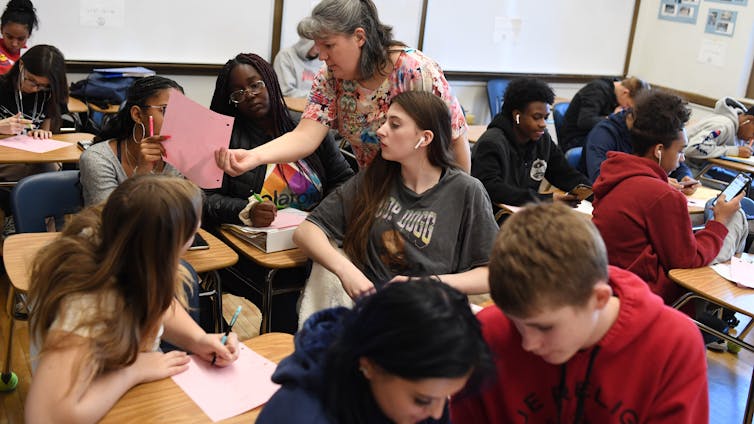
Math teachers have to accommodate high school students’ different approaches to problem-solving.
RJ Sangosti/MediaNews Group/The Denver Post via Getty Images

Girls and boys solve math problems differently – with similar short-term results but different long-term outcomes

Sarah Lubienski, Indiana University; Colleen Ganley, Florida State University, and Martha Makowski, University of Alabama

Among high school students and adults, girls and women are much more likely to use traditional, step-by-step algorithms to solve basic math problems – such as lining up numbers to add, starting with the ones place, and “carrying over” a number when needed. Boys and men are more likely to use alternative shortcuts, such as rounding both numbers, adding the rounded figures, and then adjusting to remove the rounding.

But those who use traditional methods on basic problems are less likely to solve more complex math problems correctly. These are the main findings of two studies our research team published in November 2025.

This new evidence may help explain an apparent contradiction in the existing research – girls do better at math in school, but boys do better on high-stakes math tests and are more likely to pursue math-intensive careers. Our research focuses not just on getting correct answers, but on the methods students use to arrive at them. We find that boys and girls approach math problems differently, in ways that persist into adulthood.

A possible paradox

In a 2016 study of U.S. elementary students, boys outnumbered girls 4 to 1 among the top 1% of scorers on a national math test. And over many decades, boys have been about twice as likely as girls to be among the top scorers on the SAT and AP math exams.

However, girls tend to be more diligent in elementary school and get better grades in math class throughout their schooling. And girls and boys across the grades tend to score similarly on state math tests, which tend to be more aligned with the school curriculum and have more familiar problems than the SAT or other national tests.

Beyond grades and test scores, the skills and confidence acquired in school carry far beyond, into the workforce. In lucrative STEM occupations, such as computer science and engineering, men outnumber women 3 to 1. Researchers have considered several explanations for this disparity, including differences in math confidence and occupational values, such as prioritizing helping others or making money. Our study suggests an additional factor to consider: gender differences in approaches to math problems.

When older adults think of math, they may recall memorizing times tables or doing the tedious, long-division algorithm. Memorization and rule-following can pay off on math tests focused on procedures taught in school. But rule-following has its limits and seems to provide more payoff among low-achieving than high-achieving students in classrooms.

More advanced math involves solving new, perplexing problems rather than following rules.

A teacher shows students a math lesson.
Math can be creative, not rote.
AP Photo/Jacquelyn Martin

Differing strategies

In looking at earlier studies of young children, our research team was struck by findings that young boys use more inventive strategies on computation problems, whereas girls more often use standard algorithms or counting. We wondered whether these differences disappear after elementary school, or whether they persist and relate to gender disparities in more advanced math outcomes.

In an earlier study, we surveyed students from two high schools with different demographic characteristics to see whether they were what we called bold problem-solvers. We asked them to rate how much they agreed or disagreed with specific statements, such as “I like to think outside the box when I solve math problems.” Boys reported bolder problem-solving tendencies than girls did. Importantly, students who reported bolder problem-solving tendencies scored higher on a math problem-solving test we administered.

Our newer studies echo those earlier results but reveal more specifics about how boys and girls, and men and women, approach basic math problems.

Advertisement
Get More From A Face Cleanser And Spa-like Massage

Algorithms and teacher-pleasing

In the first study, we gave three questions to more than 200 high school students: “25 x 9 = ___,” “600 – 498 = ___,” and “19 + 47 + 31 = ___.” Each question could be solved with a traditional algorithm or with a mental shortcut, such as solving 25 x 9 by first multiplying 25 x 8 to get 200 and then adding the final 25 to get 225.

Regardless of their gender, students were equally likely to solve these basic computation items correctly. But there was a striking gender difference in how they arrived at that answer. Girls were almost three times as likely as boys – 52% versus 18% – to use a standard algorithm on all three items. Boys were far more likely than girls – 51% versus 15% – to never use an algorithm on the questions.

We suspected that girls’ tendency to use algorithms might stem from greater social pressure toward compliance, including complying with traditional teacher expectations.

So, we also asked all the students eight questions to probe how much they try to please their teachers. We also wanted to see whether algorithm use might relate to gender differences in more advanced problem-solving, so we gave students several complex math problems from national tests, including the SAT.

As we suspected, we found that girls were more likely to report a desire to please teachers, such as by completing work as directed. Those who said they did have that desire used the standard algorithm more often.

Also, the boys in our sample scored higher than the girls on the complex math problems. Importantly, even though students who used algorithms on the basic computation items were just as likely to compute these items correctly, algorithm users did worse on the more complex math problems.

Continuing into adulthood

In our second study, we gave 810 adults just one problem: “125 + 238 = ___.” We asked them to add mentally, which we expected would discourage them from using an algorithm. Again, there was no gender difference in answering correctly.

But 69% of women, compared to 46% of men, reported using the standard algorithm for their mental calculation, rather than using another strategy entirely.

We also gave the adults a more advanced problem-solving test, this time focused on probability-related reasoning, such as the chances that rolling a seven-sided die would result in an even number. Similar to our first study, women and those who used the standard algorithm on the computation problem performed worse on the reasoning test.

Advertisement
Get More From A Face Cleanser And Spa-like Massage

The importance of inventiveness

We identified some factors that may play a role in these gender differences, including spatial-thinking skills, which may help people develop alternate calculation approaches. Anxiety about taking tests and perfectionism, both more prevalent among women, may also be a factor.

We are also interested in the power of gender-specific social pressures on girls. National data has shown that young girls exhibit more studious behavior than do boys. And the high school girls we studied were more likely than boys to report they made a specific effort to meet teachers’ expectations.

More research definitely is needed to better understand this dynamic, but we hypothesize that the expectation some girls feel to be compliant and please others may drive teacher-pleasing tendencies that result in girls using algorithms more frequently than boys, who are more socialized to be risk-takers.

While compliant behavior and standard math methods often lead to correct answers and good grades in school, we believe schools should prepare all students – regardless of gender – for when they face unfamiliar problems that require inventive problem-solving skills, whether in daily life, on high-stakes tests or in math-intensive professions.The Conversation

Sarah Lubienski, Professor of Mathematics Education, Indiana University; Colleen Ganley, Professor of Developmental Psychology, Florida State University, and Martha Makowski, Assistant Professor of Mathematics, University of Alabama

This article is republished from The Conversation under a Creative Commons license. Read the original article.

Hollywood vs. Reality: How LA’s Wilshire Subway Was Really Built

Link: https://stmdailynews.com/wilshire-subway-tunneling-hollywood-vs-reality/

Author

View recent photos

Unlock fun facts & lost history—get The Knowledge in your inbox!

We don’t spam! Read our privacy policy for more info.

Advertisement
Get More From A Face Cleanser And Spa-like Massage

Discover more from Daily News

Subscribe to get the latest posts sent to your email.

Continue Reading
Advertisement Tool Tickets
Click to comment

Leave a Reply

Your email address will not be published. Required fields are marked *

News

From ‘mail-order brides’ to ‘passport bros,’ the international dating industry often sells traditional gender roles

A sociologist traces how the international dating industry evolved from “mail-order brides” to “passport bros,” and why economic anxiety and shifting gender norms keep traditional roles in demand.

Published

on

A traveler in an airport looks at a phone, illustrating modern international dating and the passport bros trend.
For many American men, the draw of the international dating industry is the idea of ‘more traditional’ women. Kurgenc/iStock via Getty Images Plus

From ‘mail-order brides’ to ‘passport bros,’ the international dating industry often sells traditional gender roles

Julia Meszaros, Texas A&M University-Commerce
Fifteen years ago, when I started studying the international dating industry, few people took the subject seriously. The term “mail-order bride” was treated as a punch line – something outdated, associated with lonely men and poor women who migrated from Eastern Europe, Asia or other places to meet their new husbands in the United States. But I’ve seen firsthand how ideas about gender, intimacy and global mobility have shifted. In 2025, a man going abroad to look for love might call himself a “passport bro” – and celebrate his lifestyle on TikTok. This new generation of young men may have rebranded international dating, but they reflect an age-old theme. Social and economic changes shape how people negotiate love and labor across borders, as I explore in my 2025 book, “Economies of Gender.” In a chaotic world, some men and women turn to traditional gender roles as a source of seeming stability – and that often leads them abroad.

Old industry, new look

The term “mail-order bride” dates back to the 19th century, when so-called frontier brides advertised themselves in newspapers to single men in the American West. After the Civil War, when large numbers of men had died on the East Coast, some women saw migrating to the frontier to marry someone sight unseen as a way to secure stability. That narrative still lingers today in Western novels and films. The modern international matchmaking industry, however, took shape in the 1970s, when catalogs of mostly Filipino women’s photos and addresses were sold to American men. After being pen pals, men would travel to the Philippines to meet and decide whether they wanted to get married. Some scholars consider this a form of human trafficking, but that has been challenged by other scholarship. These catalogs emerged as more U.S. women were entering the workforce and earning their own money. Some men sought wives abroad who they believed would embody more traditional values – prioritizing domestic work and devoting themselves to men and children. Over the next few decades, large numbers of stable, well-paying factory jobs disappeared, further challenging some men’s view of themselves as breadwinners. By 2010, the catalog system had moved online and expanded into a global industry that generated US$2 billion dollars per year. Today, it takes many forms. Most of the industry is online, with email and chat correspondence that charges men but not women. Some agencies provide in-person tours for male clients, and there are higher-end, more personalized matchmaking services as well.

From taboo to televised

What was once stigmatized has become more normalized through reality TV. TLC’s hit series “90 Day Fiance,” which came on air in 2014, has transformed international dating into a lucrative entertainment franchise.
A brunette woman with curly hair, wearing a pink sleeveless shirt, embraces a dark-haired man in a white t-shirt, with two suitcases in the corner.
The stresses of the K-1 visa process have become fodder for reality TV. AMR Image/iStock via Getty Images Plus
The show and its numerous spin-offs show couples navigating the K-1 visa process, which gives 90 days to marry after a partner enters the country. If the wedding is called off, the foreign fiance or fiancee must return to their country of origin. Many of the featured couples met randomly, in person. A significant number, however, connected through online dating or language-learning sites. Numerous couples’ storylines highlight family and friends of the American partner who question the girlfriend’s or boyfriend’s motives, accusing them of faking love for financial gain and access to a green card. Audiences might watch the show for drama or love stories, but the underlying themes mirror what I’ve seen in the field: relationships shaped by economic inequality and migration, with women often exchanging emotional, domestic and sexual labor in return for financial stability.

Rise of the ‘passport bros’

In recent years, the mail-order bride industry has gotten a cultural revamp, with younger and more diverse men who identify as “passport bros.” This crowd is typically younger than men participating in the commercial international dating industry and more likely to identify as men of color. These men are less likely to pay for formal dating and introduction services. They travel on their own, using free dating apps such as Tinder to meet local women – mostly in Colombia, Brazil and the Dominican Republic. Passport bros say they travel abroad to meet women who are more traditional than the ones they meet at home. Many of the American men I interviewed between 2010 and 2022 talked about Western women as too focused on career, which challenged their idea of themselves as financial providers.
A man in a black t-shirt and gray button-up rests his arm on the bar as he tries to talk to a woman in a pink top.
‘Passport bros’ fly solo rather than paying for international dating services. Stanislav Smoliakov/iStock via Getty Images Plus
Similarly, my research in Ukraine, Colombia and the Philippines shows that many men using international dating services are motivated by more than just love or cultural curiosity. They are responding to a changing world in which women’s financial independence has challenged traditional male roles. For some, traveling abroad is a way to reassert control and to find relationships that reaffirm a sense of masculine identity. In my interviews, American men looking abroad talked about feeling empowered and having choices, while being ignored in the U.S. dating market. Some recognized that their relative wealth is the cause of this. As one man on a romance tour in Ukraine told me in 2012, “I am here to exchange my financial stability for some Ukrainian woman’s youth and beauty, and I am OK with that.”

Appeal of ‘tradition’

Together, many of these daters illustrate the global pattern I’ve seen across my years of fieldwork: anxiety fuels a longing for traditionalism. What appears to be a return to the past is, in reality, an adaptation to the present. The romance tours, the “90 Day Fiance” phenomenon and the passport bros speak to how people use relationships to navigate the economic instability of the modern world. Gender roles become a way to reestablish order and identity. In the past two decades, rising inflation, stagnant wages and housing shortages have left many people, especially younger generations, feeling economically trapped. The COVID-19 pandemic deepened these inequalities, forcing millions out of the workforce and amplifying the strain of unpaid caregiving, particularly for women. In times of uncertainty, societies often retreat to familiar narratives. Traditional gender roles offer an illusion of stability and order, even if they reinforce inequality. The fantasy of the dependable male provider and the nurturing homemaker resurfaces because it seems to resolve anxieties that the modern economy has made harder to bear. As a sociologist, I study these dynamics not just to understand dating trends but to trace how societies reproduce inequality through intimacy. Until our society addresses stagnant wages, rising costs and the erosion of social safety nets, I believe nostalgia for a clear, gendered hierarchy will continue. In this hierarchy, men are guaranteed women’s labor, and women hold out hope for economic security – which is often seen as romance. Julia Meszaros, Associate Professor of Sociology, Texas A&M University-Commerce This article is republished from The Conversation under a Creative Commons license. Read the original article.
High Demand Marks “Veggies for Veterans” Event Amid SNAP Delays
Links: https://stmdailynews.com/high-demand-marks-veggies-for-veterans-event-amid-snap-delays/

Discover more from Daily News

Subscribe to get the latest posts sent to your email.

Continue Reading

actors & performers

Hollywood Legend Rob Reiner and Wife Found Dead; Son in Custody

Renowned filmmaker Rob Reiner and his wife, Michele Singer Reiner, were found dead in their Los Angeles home in a reported homicide. Police have arrested their son in connection with the case, and tributes are pouring in.

Published

on

Last Updated on December 16, 2025 by Daily News Staff

Portrait of filmmaker Rob Reiner

Director Rob Reiner participates in a discussion following a screening of the film LBJ at the LBJ Presidential Library in Austin, Texas on Saturday October 22, 2016
On Saturday evening October 22, 2016, the LBJ Presidential Library held a sneak peek of Rob Reiner’s new filmÊLBJ, starring Woody Harrelson as the 36th president. The film, which premiered at the Toronto International Film Festival in September, chronicles the life and times of Lyndon Johnson who would inherit the presidency at one of the most fraught moments in American history.
Following the screening, director Rob Reiner, actor Woody Harrelson, and writer Joey Hartstone joined LBJ Library Director Mark Updegrove on stage for a conversation about the film.
LBJ Library photo by Jay Godwin
10/22/2016

Hollywood Legend Rob Reiner and Wife Found Dead; Son in Custody

December 15, 2025

Renowned filmmaker and actor Rob Reiner, 78, and his wife Michele Singer Reiner, 68, were found dead in their Brentwood, Los Angeles home on Sunday, authorities say. Emergency responders were called to the residence Sunday afternoon, where both were discovered with fatal wounds consistent with a stabbing. Police are treating the case as a double homicide. 

Los Angeles police arrested the couple’s 32-year-old son, Nick Reiner, in connection with the deaths. He is being held in custody as investigators continue to piece together the circumstances surrounding the incident. 

Nick Reiner and Rob Reiner at the 2016 Substance Abuse and Mental Health Services Administrations 2016 SAMHSA Voice Awards cropped

2016 SAMHSA Voice Awards

Reiner was one of Hollywood’s most influential figures, known for his work as a director, producer and actor. His career spanned decades, from early television fame to directing beloved films that shaped American cinema. 

Friends, colleagues and public figures have begun sharing tributes and reactions to the news as the investigation is ongoing. 

More details will be updated as they become available.

The Inspiring Legacy of Raymond E. Fowler: A Journey into the Unknown
Link: https://stmdailynews.com/the-inspiring-legacy-of-raymond-e-fowler-a-journey-into-the-unknown/

Discover more from Daily News

Subscribe to get the latest posts sent to your email.

Continue Reading

Health

FDA’s COVID-19 Vaccine Safety Claims Lack Solid Evidence—Why Overreaction Could Harm Public Health

COVID-19 vaccine safety: The FDA’s claims about COVID-19 vaccine deaths in children lack strong evidence and could restrict vaccine access. Learn why experts say VAERS reports aren’t proof, and how overreacting may harm public health and trust in vaccines.

Published

on

FDA’s COVID-19 Vaccine Safety Claims Lack Solid Evidence—Why Overreaction Could Harm Public Health
The FDA has provided no evidence that children died because of receiving a COVID-19 vaccine. Anchiy/E+ via Getty Images

FDA claims on COVID-19 vaccine safety are unsupported by reliable data – and could severely hinder vaccine access

Frank Han, University of Illinois Chicago The Food and Drug Administration is seeking to drastically change procedures for testing vaccine safety and approving vaccines, based on unproven claims that mRNA-based COVID-19 vaccines caused the death of at least 10 children. The agency detailed its plans in a memo released to staff on Nov. 28, 2025, which was obtained by several news outlets and published by The Washington Post. Citing an internal, unpublished review, the memo, written by the agency’s top vaccine regulator, Vinay Prasad, attributes the children’s deaths to myocarditis, an inflammation of the heart muscle. And it says the deaths were reported to the Vaccine Adverse Event Reporting System, or VAERS, but provides no evidence that the vaccines caused the deaths.  

COVID-19 vaccine safety

The death of children due to an unsafe vaccine is a serious allegation. I am a pediatric cardiologist who has studied the link between COVID-19 vaccines and heart-related side effects such as myocarditis in children. To my knowledge, studies to date have shown such side effects are rare, and severe outcomes even more so. However, I am open to new evidence that could change my mind. But without sufficient justification and solid evidence, restricting access to an approved vaccine and changing well-established procedures for testing vaccines would carry serious consequences. These moves would limit access for patients, create roadblocks for companies and worsen distrust in vaccines and public health. In my view, it’s important for people reading about these FDA actions to understand how the evidence on a vaccine’s safety is generally assessed.

Determining cause of death

The FDA memo claims that the deaths of these children were directly related to receiving a COVID-19 immunization. From my perspective as a clinician, it is awful that any child should die from a routine vaccination. However, health professionals like me owe it to the public to uphold the highest possible standards in investigating why these deaths occurred. If the FDA has evidence demonstrating something that national health agencies worldwide have missed – widespread child deaths due to myocarditis caused by the COVID-19 vaccine – I don’t doubt that even the most pro-vaccine physician will listen. So far, however, no such evidence has been presented. While a death logged in VAERS is a starting point, on its own it is insufficient to conclude whether a vaccine caused the death or other medical causes were to blame. To demonstrate a causal link, FDA staff and physicians must align the VAERS report with physicians’ assessments of the patient, as well as data from other sources for monitoring vaccine safety. These include PRISM, which logs insurance claims data, and the Vaccine Safety Datalink, which tracks safety signals in electronic medical records. It’s known that most deaths logged only in VAERS of children who recently received vaccines have been incorrectly attributed to the vaccines – either by accident or in some cases on purpose by anti-vaccine activists.

Heart-related side effects of COVID-19 vaccines

In his Substack and Twitter accounts, Prasad has said that he believes the rate of severe cardiac side effects after COVID-19 vaccination is severely underestimated and that the vaccines should be restricted far more than they currently are. In a July 2025 presentation, Prasad quoted a risk of 27 cases per million of myocarditis in young men who received the COVID-19 vaccine. A 2024 review suggested that number was a bit lower – about 20 cases out of 1 million people. But that same study found that unvaccinated people had greater risk of heart problems after a COVID-19 infection than vaccinated people. In a different study, people who got myocarditis after a COVID-19 vaccination developed fewer complications than people who got myocarditis after a COVID-19 infection. Existing vaccine safety infrastructure in the U.S. successfully identifies dangers posed by vaccines – and did so during the COVID-19 pandemic. Today, most COVID-19 vaccines in the U.S. rely on mRNA technology. But as vaccines were first emerging during the COVID-19 pandemic, two pharmaceutical companies, Janssen and AstraZeneca, rolled out a vaccine that used a different technology, called a viral vector. This type of vaccine had a very rare but genuine safety problem that was detected.
A report in VAERS is at most a first step to determining whether a vaccine caused harm.
VAERS, the Vaccine Safety Datalink, clinical investigators in the U.S. and their European counterparts detected that these vaccines did turn out to cause blood clotting. In April 2021, the FDA formally recommended pausing their use, and they were later pulled from the market. Death due to myocarditis from COVID-19 vaccination is exceedingly rare. Demonstrating that it occurred requires proof that the person had myocarditis, evidence that no other reasonable cause of death was present, and the absence of any additional cause of myocarditis. These factors cannot be determined from VAERS data, however – and to date, the FDA has presented no other relevant data.

A problematic vision for future vaccine approvals

Currently, vaccines are tested both by seeing how well they prevent disease and by how well they generate antibodies, which are the molecules that help your body fight viruses and bacteria. Some vaccines, such as the COVID-19 vaccine and the influenza vaccine, need to be updated based on new strains. The FDA generally approves these updates based on how well the new versions generate antibodies. Since the previous generation of vaccines was already shown to prevent infection, if the new version can generate antibodies like the previous one, researchers assume its ability to prevent infection is comparable too. Later studies can then test how well the vaccines prevent severe disease and hospitalization. The FDA memo says this approach is insufficient and instead argues for replacing such studies with many more placebo-controlled trials – not just for COVID-19 vaccines but also for widely used influenza and pneumonia vaccines. That may seem reasonable theoretically. In practice, however, it is not realistic. Today’s influenza vaccines must be changed every season to reflect mutations to the virus. If the FDA were to require new placebo-controlled trials every year, the vaccine being tested would become obsolete by the time it is approved. This would be a massive waste of time and resources.
A pharmacy with a sign advertising flu shots
Influenza vaccines must be updated for every flu season. Jacob Wackerhausen/iStock via Getty Images Plus
Also, detecting vaccine-related myocarditis at the low rate at which it occurs would have required clinical trials many times larger than the ones that were done to approve COVID-19 mRNA vaccines. This would have cost at least millions of dollars more, and the delay in rolling out vaccines would have also cost lives. Placebo-controlled trials would require comparing people who receive the updated vaccine with people who remain unvaccinated. When an older version of the vaccine is already available, this means purposefully asking people to forgo that vaccine and risk infection for the sake of the trial, a practice that is widely considered unethical. Current scientific practice is that only a brand-new vaccine may be compared against placebo. While suspected vaccine deaths should absolutely be investigated, stopping a vaccine for insufficient reasons can lead to a significant drop in public confidence. That’s why it’s essential to thoroughly and transparently investigate any claims that a vaccine causes harm.

Vaccine vs illness

To accurately gauge a vaccine’s risks, it is also crucial to compare its side effects with the effects of the illness it prevents. For COVID-19, data consistently shows that the disease is clearly more dangerous. From Aug. 1, 2021, to July 31, 2022, more than 800 children in the U.S. died due to COVID-19, but very few deaths from COVID-19 vaccines in children have been been verified worldwide. What’s more, the disease causes many more heart-related side effects than the vaccine does. Meanwhile, extensive evidence shows that COVID-19 vaccination reduces the risk of hospitalization by more than 70% and the risk of severe illness in adolescent children by 79%. Studies also show it dramatically reduces their risk of developing long COVID, a condition in which symptoms such as extreme fatigue or weakness persist more than three months after a COVID-19 infection. Reporting only the vaccines’ risks, and not their benefits, shows just a small part of the picture. Frank Han, Assistant Professor of Pediatric Cardiology, University of Illinois Chicago This article is republished from The Conversation under a Creative Commons license. Read the original article.
High Demand Marks “Veggies for Veterans” Event Amid SNAP Delays
Link: https://stmdailynews.com/high-demand-marks-veggies-for-veterans-event-amid-snap-delays/

Author


Discover more from Daily News

Subscribe to get the latest posts sent to your email.

Continue Reading

Trending


