Connect with us

The Bridge

Harvard fights to keep enrolling international students – 4 essential reads about their broader impact

Published

on

Last Updated on June 2, 2025 by Rod Washington

international students
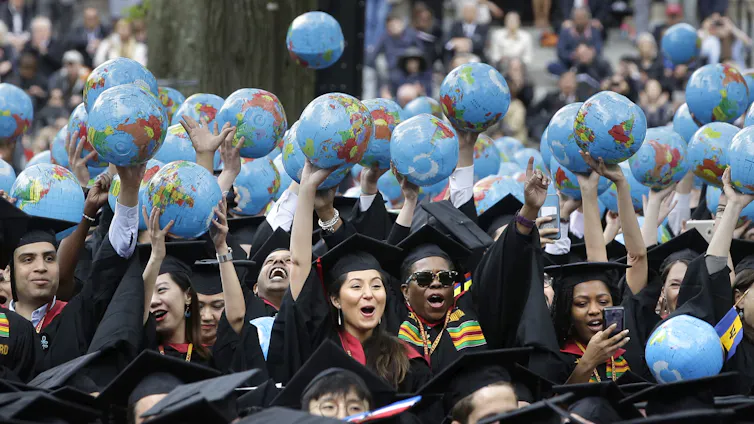
Graduates of Harvard’s John F. Kennedy School of Government celebrate during commencement exercises in Cambridge, Mass.
AP Photo/Steven Senne, File

Corey Mitchell, The Conversation

A federal judge in Boston on May 23, 2025, temporarily blocked a Trump administration order that would have revoked Harvard University’s authorization to enroll international students.

The directive from the U.S. Department of Homeland Security and resulting lawsuit from Harvard have escalated the ongoing conflict between the Trump administration and the Ivy League institution.

It’s also the latest step in a White House campaign to ramp up vetting and screening of foreign nationals, including students.

Homeland Security officials accused Harvard of creating a hostile campus climate by accommodating “anti-American” and “pro-terrorist agitators.” The accusation stems from the university’s alleged support for certain political groups and their activities on campus.

In early April, the Trump administration terminated the immigration statuses of thousands of international students listed in a government database, the Student and Exchange Visitor Information System. The database includes country of citizenship, which U.S. school they attend and what they study.

Barring Harvard from enrolling international students could have significant implications for the campus’s climate and the local economy. International students account for 27% of the university’s enrollment.

Here are four stories from The Conversation’s archive about the Trump administration’s battle with Harvard and the economic impact of international students.

1. A target on Harvard

This isn’t the first time the Trump administration has targeted the university.

The White House has threatened to end the university’s tax-exempt status, and some media outlets have reported that the Internal Revenue Service is taking steps in that direction.

Advertisement
Reveal Your Skin's Youthful Radiance with FOREO's LUNA 2 Facial Massager. Shop Now For $199

But it is illegal to revoke an entity’s tax-emempt status “on a whim,” according to Philip Hackney, a University of Pittsburgh law professor, and Brian Mittendorf, an accounting professor at Ohio State University.

“Before the IRS can do that, tax law requires that it first audit that charity,” they wrote. “And it’s illegal for U.S. presidents or other officials to force the IRS to conduct an audit or stop one that’s already begun.”

Several U.S. senators, all Democrats, have urged the IRS inspector general to see whether the IRS has begun auditing Harvard or any nonprofits in response to the administration’s requests or whether Trump has violated any laws with his pressure campaign.

Hackney and Mittendorf wrote that the Trump administration’s moves are part of a larger push to exert control over Harvard, including its efforts to increase its diversity and its response to claims of discrimination on campus.

Young people walk and bike along a paved road lined with red brick buildings on one side and trees on the other.
University of Michigan students on campus on April 3, 2025, in Ann Arbor, Mich.
Bill Pugliano/Getty Images

2. International students help keep ‘America First’

The U.S. has long been the global leader in attracting international students. But competition for these students is increasing as other countries vie to attract the scholars.

In a recent story for The Conversation, David L. Di Maria, vice provost for global engagement at the University of Maryland, Baltimore County, wrote that stepped-up screening and vetting of students could make the U.S. a less attractive study destination.

Di Maria wrote that such efforts could hamper the Trump administration’s ability to achieve its “America First” priorities related to the economy, science and technology, and national security.

Trump administration officials have emphasized the importance of recruiting top global talent. And Trump has said that international students who graduate from U.S. colleges should be awarded a green card with their degree.

Research shows that international students launch successful startups at a rate that is eight to nine times higher than their U.S.-born peers. Roughly 25% of billion-dollar companies in the U.S. were founded by former international students, Di Maria noted.

3. A boost to local economies

Indeed, international students have a tremendous economic impact on local communities.

If these global scholars stay home or go elsewhere, that’s bad economic news for cities and towns across the United States, wrote Barnet Sherman, a professor of multinational finance and trade at Boston University.

Advertisement
Reveal Your Skin's Youthful Radiance with FOREO's LUNA 2 Facial Massager. Shop Now For $199

With the money they spend on tuition, food, housing and other other items, international students pump money into the local economy, but there are additional benefits.

On average, a new job is created for every three international students enrolled in a U.S. college or university. In the 2023-24 academic year, about 378,175 jobs were created, Sherman wrote.

In Greater Boston, where Harvard is located, there are about 63,000 international students who contribute to the economy. The gains are huge – about US$3 billion.

4. Rising number of international students

The rising number of foreign students studying in the U.S. has long led to concerns about U.S. students being displaced by international peers.

The unease is often fueled by the assumption that financial interests are driving the trend, Cynthia Miller-Idriss of American University and Bernhard Streitwieser of George Washington University wrote in a 2015 story for The Conversation.

A common claim, they wrote, is the flawed assumption that “cash-strapped public universities” aggressively recruit more affluent students from abroad who can afford to pay rising tuition costs. The pair wrote that, historically, shifting demographics on college campuses result from social and economic changes.

In today’s context, Miller-Idriss and Streitwieser maintain that the argument that colleges prioritize international students fails to account for the global role of U.S. universities, which help support national security, foster international development projects and accelerate the pace of globalization.

This story is a roundup of articles from The Conversation’s archives.

Corey Mitchell, Education Editor, The Conversation

This article is republished from The Conversation under a Creative Commons license. Read the original article.

Advertisement
Reveal Your Skin's Youthful Radiance with FOREO's LUNA 2 Facial Massager. Shop Now For $199
Continue Reading
Advertisement Simply Wholesale

The Knowledge

How San Francisco Got Its Cable Cars: The Story Behind an Icon

Published

on

Discover the history of San Francisco’s cable cars—from a 19th-century innovation to a preserved national landmark still running today.

Few transportation systems in the world are as instantly recognizable as the cable cars of San Francisco. Climbing steep hills with a steady hum and a nostalgic charm, these moving landmarks are more than just a tourist attraction—they’re a triumph of innovation born out of necessity.

🐎 A Problem on the Hills

In the mid-1800s, San Francisco was growing rapidly, but its geography posed a serious challenge. The city’s steep inclines made travel difficult, especially for horse-drawn streetcars, which were the primary form of public transportation at the time.

Horses often struggled to pull heavy loads uphill, and accidents were common. In some cases, animals collapsed under the strain. This dangerous and inefficient system needed a solution.

💡 The Vision of Andrew Hallidie

That solution came from Andrew Smith Hallidie, an engineer and entrepreneur who envisioned a safer, more reliable way to move people through the city.

Hallidie developed a system in which streetcars would be pulled by a continuously moving cable running beneath the street—eliminating the need for horses altogether.

⚙️ The First Cable Car Line

On August 2, 1873, Hallidie launched the world’s first cable car system: the Clay Street Hill Railroad.

This groundbreaking line proved that cable-powered transit could successfully navigate San Francisco’s steep terrain. Instead of relying on animal power, cars used a mechanical grip to latch onto a moving cable underground, allowing them to glide smoothly up and down hills.

The innovation quickly captured public attention—and demand.

🚀 A City Transformed

Following the success of the Clay Street line, cable car systems spread rapidly across San Francisco.

By the late 19th century:

  • Dozens of routes crisscrossed the city
  • Cable cars became the backbone of urban transportation
  • The system helped shape the city’s growth and accessibility

For a time, San Francisco operated the largest and most advanced cable car network in the world.

⚡ The Rise of Electric Streetcars

Despite their success, cable cars faced competition from emerging electric streetcar systems in the early 20th century. Electric trolleys were cheaper to build and operate, and they didn’t require the complex underground cable infrastructure.

Advertisement
Reveal Your Skin's Youthful Radiance with FOREO's LUNA 2 Facial Massager. Shop Now For $199

The turning point came after the devastating 1906 San Francisco earthquake, which destroyed much of the city—including large portions of the cable car network.

When rebuilding began, many lines were converted to electric systems instead of restoring the older cable technology.

The cable cars are now designated as a National Historic Landmark, recognized for their cultural and engineering significance by the National Park Service .

Visitors can explore the history and mechanics of the system at the San Francisco Cable Car Museum , which preserves original equipment and archives.

🛑 Saving a Symbol

By the 1940s, cable cars were on the brink of extinction.

That’s when Friedel Klussmann stepped in. A passionate preservationist, Klussmann led a public campaign to protect the remaining lines from being dismantled.

Her efforts culminated in a successful 1947 voter referendum that ensured the survival of San Francisco’s cable cars—transforming them from everyday transit into a preserved cultural landmark.

🌉 Cable Cars Today

Today, San Francisco’s cable cars are:

  • The last manually operated cable car system in the world
  • A National Historic Landmark
  • One of the most visited attractions in California

Three lines remain in operation:

  • Powell–Hyde Line
  • Powell–Mason Line
  • California Street Line

While they still function as public transit, they now serve as a moving museum—connecting modern riders with the city’s past.

🎯 Why It Matters

San Francisco’s cable cars represent more than a mode of transportation. They tell a story of innovation, resilience, and community action.

Advertisement
Reveal Your Skin's Youthful Radiance with FOREO's LUNA 2 Facial Massager. Shop Now For $199

From solving a practical problem to becoming a global icon, the cable car system reflects how cities adapt—and how people fight to preserve what makes them unique.


📌 “Now You Know”

San Francisco’s cable cars weren’t built for tourism—they were invented to solve a life-and-death problem on steep city streets. Today, they remain the last system of their kind anywhere in the world.

🔗 External Sources & Related Links

Explore the latest in innovation, AI, gadgets, startups, and digital trends in STM Daily News’ Techsection.

View recent photos

Unlock fun facts & lost history—get The Knowledge in your inbox!

We don’t spam! Read our privacy policy for more info.

Continue Reading

Community

Viewpoint Hosted by Dennis Quaid Brings Attention to a Little-Understood Condition Affecting Families Nationwide

A new Viewpoint hosted by Dennis Quaid segment with APFED raises awareness of eosinophilic esophagitis, its subtle symptoms, and its impact on families.
For more information, readers can visit viewpointproject.com and apfed.org.

Published

on

For many families, health conditions do not always begin with a dramatic diagnosis. Sometimes they show up in small, everyday habits that seem easy to explain away. Cutting food into tiny bites. Drinking extra water with every meal. Quietly avoiding certain foods altogether. A new educational segment from Viewpoint hosted by Dennis Quaid is shining a light on those subtle warning signs through a collaboration with the American Partnership for Eosinophilic Disorders, helping more people recognize the realities of living with eosinophilic esophagitis, or EoE.

photo of a studio set up. Viewpoint hosted by Dennis Quaid 
Photo by SHAHBAZ ZAMAN on Pexels.com

Viewpoint hosted by Dennis Quaid 

The segment, distributed to Public Television stations across the country, focuses on making this chronic inflammatory condition easier for the public to understand. For viewers, that matters because EoE is often misunderstood or overlooked, even as it affects daily routines, family meals, and quality of life. By connecting medical information to real-life experiences, the program gives audiences a more human picture of what people with the condition may be facing.

Viewpoint APFED
APFED

When everyday habits tell a bigger story

Eosinophilic esophagitis occurs when eosinophils, a type of white blood cell, build up in the esophagus, causing inflammation that can lead to tissue damage and narrowing. But what stands out most in this story is not just the science. It is the way people often adapt without realizing it. Behaviors like chewing excessively, avoiding certain textures, or relying on liquids to help swallow can become so routine that they no longer feel unusual.

That is one reason the segment carries real community value. It encourages people to look more closely at symptoms that may have been normalized for years and to seek evaluation from specialists such as gastroenterologists or allergists. It also raises awareness among parents, caregivers, and primary care providers who may be the first to notice that something is not quite right.

More than awareness

The program also explores the emotional and social side of the condition, especially for people navigating dietary restrictions and the uncertainty of delayed diagnosis. In that sense, this is not only a story about medicine. It is also a story about advocacy, support, and the importance of helping people feel seen.

APFED Executive Director Mary Jo Strobel noted that many people with EoE do not realize they have adapted their lives around a medical condition. That message gives the segment its strongest human element: awareness can change lives, not only by leading to diagnosis, but by helping families better understand experiences that may have felt isolating or confusing.

Originally distributed in January 2025, the documentary will continue to be made available to stations through March 2027, extending its reach to more households nationwide.


Related Coverage

Read more from STM Daily News on community issues, public television, health awareness, and stories that connect national topics to everyday life.

For More Information

STM Daily News is a vibrant news blog dedicated to sharing the brighter side of human experiences. Emphasizing positive, uplifting stories, the site focuses on delivering inspiring, informative, and well-researched content. With a commitment to accurate, fair, and responsible journalism, STM Daily News aims to foster a community of readers passionate about positive change and engaged in meaningful conversations. Join the movement and explore stories that celebrate the positive impacts shaping our world. 

https://stmdailynews.com/

Authors

Continue Reading

The Knowledge

Why Is It Called Century Boulevard? The Story Behind South Los Angeles’ “100th Street”

Published

on

Century Boulevard in Los Angeles is actually named after its position as 100th Street in the city grid.

LOS ANGELES — Century Boulevard is one of the most recognizable east–west corridors in South Los Angeles, stretching from Watts to Los Angeles International Airport (LAX). But despite its grand-sounding name, the origin of “Century” is surprisingly simple—and rooted in math.

The Meaning Behind “Century”

Century Boulevard sits roughly 100 blocks south of downtown Los Angeles, where the city’s street numbering system begins at 1st Street and Main Street. Instead of naming the road “100th Street,” city planners opted for a more distinctive and memorable name: Century Boulevard.

In this case, “Century” literally means 100.

22E451DC CC5D 4786 8A11 502809AABDD7

Part of Los Angeles’ Grid System

Los Angeles was designed using a grid-based street layout, especially in its expanding southern neighborhoods during the early 20th century. Streets were often named or numbered based on their distance from downtown.

Century Boulevard aligns with what would have been the 100th Street corridor—making it a key reference point in the city’s geography.

A Street That Evolved Over Time

Before it became Century Boulevard, portions of the roadway were known by other names, including Pine Avenue and San Antonio Street. As the region developed and expanded, these segments were unified under a single name in the 1920s.

This consolidation helped streamline navigation and supported growing transportation needs.

lax airport los angeles sign with light colors night timelapse SBI 350771173

From Local Road to Global Gateway

The importance of Century Boulevard grew significantly with the rise of Los Angeles International Airport (LAX). Today, it serves as a major gateway for millions of travelers entering the city.

The road connects diverse communities—from historic neighborhoods in South Los Angeles to the bustling airport corridor—making it both a local lifeline and an international entry point.

More Than Just a Name

Century Boulevard reflects a broader pattern in Los Angeles street naming:

  • Some streets honor historical figures
  • Others reflect geography or culture
  • And some, like Century, are rooted in the city’s structured grid system

It’s a reminder that even the most ordinary street names can reveal deeper stories about how a city was built.

The Bottom Line

Century Boulevard isn’t named after an event—it’s named for its location. Positioned at the 100th Street line, it represents both the logic of Los Angeles’ design and the growth of the city over time.

Now you know.

Related External Links

Dive into “The Knowledge,” where curiosity meets clarity. This playlist, in collaboration with STMDailyNews.com, is designed for viewers who value historical accuracy and insightful learning. Our short videos, ranging from 30 seconds to a minute and a half, make complex subjects easy to grasp in no time. Covering everything from historical events to contemporary processes and entertainment, “The Knowledge” bridges the past with the present. In a world where information is abundant yet often misused, our series aims to guide you through the noise, preserving vital knowledge and truths that shape our lives today. Perfect for curious minds eager to discover the ‘why’ and ‘how’ of everything around us. Subscribe and join in as we explore the facts that matter.  https://stmdailynews.com/the-knowledge/

Advertisement
Reveal Your Skin's Youthful Radiance with FOREO's LUNA 2 Facial Massager. Shop Now For $199
Continue Reading

Trending


