Connect with us

Science

How a Record-Breaking Copper Catalyst Converts CO2 Into Liquid Fuels

Published

on

Researchers at Berkeley Lab have made real-time movies of copper nanoparticles as they evolve to convert carbon dioxide and water into renewable fuels and chemicals. Their new insights could help advance the next generation of solar fuels
Credit: Yao Yang/Berkeley Lab. Courtesy of Nature.
Video of a 4D-STEM experiment: Berkeley Lab researchers used a new electrochemical liquid cell to observe copper nanoparticles (ranging in size from 7 nanometers to 18 nanometers) evolve into active nanograins during CO2 electrolysis – a process that uses electricity to drive a reaction on the surface of an electrocatalyst. The new electrochemical liquid cell allows researchers to resolve images of objects smaller than 10 nanometers.
Previous

Newswise — Since the 1970s, scientists have known that copper has a special ability to transform carbon dioxide into valuable chemicals and fuels. But for many years, scientists have struggled to understand how this common metal works as an electrocatalyst, a mechanism that uses energy from electrons to chemically transform molecules into different products. 

Now, a research team led by Lawrence Berkeley National Laboratory (Berkeley Lab) has gained new insight by capturing real-time movies of copper nanoparticles (copper particles engineered at the scale of a billionth of a meter) as they convert CO2 and water into renewable fuels and chemicals: ethylene, ethanol, and propanol, among others. The work was reported in the journal Nature last week. 

“This is very exciting. After decades of work, we’re finally able to show – with undeniable proof – how copper electrocatalysts excel in CO2 reduction,” said Peidong Yang, a senior faculty scientist in Berkeley Lab’s Materials Sciences and Chemical Sciences Divisions who led the study. Yang is also a professor of chemistry and materials science and engineering at UC Berkeley. “Knowing how copper is such an excellent electrocatalyst brings us steps closer to turning CO2 into new, renewable solar fuels through artificial photosynthesis.”

The work was made possible by combining a new imaging technique called operando 4D electrochemical liquid-cell STEM (scanning transmission electron microscopy) with a soft X-ray probe to investigate the same sample environment: copper nanoparticles in liquid. First author Yao Yang, a UC Berkeley Miller postdoctoral fellow, conceived the groundbreaking approach under the guidance of Peidong Yang while working toward his Ph.D. in chemistry at Cornell University.


Scientists who study artificial photosynthesis materials and reactions have wanted to combine the power of an electron probe with X-rays, but the two techniques typically can’t be performed by the same instrument. 

Electron microscopes (such as STEM or TEM) use beams of electrons and excel at characterizing the atomic structure in parts of a material. In recent years, 4D STEM (or “2D raster of 2D diffraction patterns using scanning transmission electron microscopy”) instruments, such as those at Berkeley Lab’s Molecular Foundry, have pushed the boundaries of electron microscopy even further, enabling scientists to map out atomic or molecular regions in a variety of materials, from hard metallic glass to soft, flexible films. 

On the other hand, soft (or lower-energy) X-rays are useful for identifying and tracking chemical reactions in real time in an operando, or real-world, environment. 

But now, scientists can have the best of both worlds. At the heart of the new technique is an electrochemical “liquid cell” sample holder with remarkable versatility. A thousand times thinner than a human hair, the device is compatible with both STEM and X-ray instruments. 

The electrochemical liquid cell’s ultrathin design allows reliable imaging of delicate samples while protecting them from electron beam damage. A special electrode custom-designed by co-author Cheng Wang, a staff scientist at Berkeley Lab’s Advanced Light Source, enabled the team to conduct X-ray experiments with the electrochemical liquid cell. Combining the two allows researchers to comprehensively characterize electrochemical reactions in real time and at the nanoscale. 

Getting granular

Advertisement
Get More From A Face Cleanser And Spa-like Massage

During 4D-STEM experiments, Yao Yang and team used the new electrochemical liquid cell to observe copper nanoparticles (ranging in size from 7 nanometers to 18 nanometers) evolve into active nanograins during CO2 electrolysis – a process that uses electricity to drive a reaction on the surface of an electrocatalyst. 

The experiments revealed a surprise: copper nanoparticles combined into larger metallic copper “nanograins” within seconds of the electrochemical reaction. 

To learn more, the team turned to Wang, who pioneered a technique known as “resonant soft X-ray scattering (RSoXS) for soft materials,” at the Advanced Light Source more than 10 years ago. 

With help from Wang, the research team used the same electrochemical liquid cell, but this time during RSoXS experiments, to determine whether copper nanograins facilitate COreduction. Soft X-rays are ideal for studying how copper electrocatalysts evolve during CO2 reduction, Wang explained. By using RSoXS, researchers can monitor multiple reactions between thousands of nanoparticles in real time, and accurately identify chemical reactants and products. 

The RSoXS experiments at the Advanced Light Source – along with additional evidence gathered at Cornell High Energy Synchrotron Source (CHESS) – proved that metallic copper nanograins serve as active sites for CO2 reduction. (Metallic copper, also known as copper(0), is a form of the element copper.) 

During CO2 electrolysis, the copper nanoparticles change their structure during a process called “electrochemical scrambling.” The copper nanoparticles’ surface layer of oxide degrades, creating open sites on the copper surface for CO2 molecules to attach, explained Peidong Yang. And as CO2 “docks” or binds to the copper nanograin surface, electrons are then transferred to CO2, causing a reaction that simultaneously produces ethylene, ethanol, and propanol along with other multicarbon products. 

“The copper nanograins essentially turn into little chemical manufacturing factories,” Yao Yang said.

Further experiments at the Molecular Foundry, the Advanced Light Source, and CHESS revealed that size matters. All of the 7-nanometer copper nanoparticles participated in CO2 reduction, whereas the larger nanoparticles did not. In addition, the team learned that only metallic copper can efficiently reduce COinto multicarbon products. The findings have implications for “rationally designing efficient CO2 electrocatalysts,” Peidong Yang said.

The new study also validated Peidong Yang’s findings from 2017: That the 7-nanometer-sized copper nanoparticles require low inputs of energy to start CO2 reduction. As an electrocatalyst, the 7-nanometer copper nanoparticles required a record-low driving force that is about 300 millivolts less than typical bulk copper electrocatalysts. The best-performing catalysts that produce multicarbon products from CO2 typically operate at high driving force of 1 volt.

The copper nanograins could potentially boost the energy efficiency and productivity of some catalysts designed for artificial photosynthesis, a field of research that aims to produce solar fuels from sunlight, water, and CO2. Currently, researchers within the Department of Energy-funded Liquid Sunlight Alliance (LiSA) plan to use the copper nanograin catalysts in the design of future solar fuel devices. 

Advertisement
Get More From A Face Cleanser And Spa-like Massage

“The technique’s ability to record real-time movies of a chemical process opens up exciting opportunities to study many other electrochemical energy conversion processes. It’s a huge breakthrough, and it would not have been possible without Yao and his pioneering work,” Peidong Yang said. 

Researchers from Berkeley Lab, UC Berkeley, and Cornell University contributed to the work. Other authors on the paper include co-first authors Sheena Louisa and Sunmoon Yu, former UC Berkeley Ph.D. students in Peidong Yang’s group, along with Jianbo Jin, Inwhan Roh, Chubai Chen, Maria V. Fonseca Guzman, Julian Feijóo, Peng-Cheng Chen, Hongsen Wang, Christopher Pollock, Xin Huang, Yu-Tsuan Shao, Cheng Wang, David A. Muller, and Héctor D. Abruña.

Parts of the experiments were performed by Yao Yang at Cornell under the supervision of Héctor Abruña, professor of chemistry and chemical biology, and David A. Muller, professor of engineering. 

This work was supported by the DOE Office of Science. 

The Molecular Foundry and Advanced Light Source are user facilities at Berkeley Lab. 

Source:  Lawrence Berkeley National Laboratory

Author


Discover more from Daily News

Subscribe to get the latest posts sent to your email.

Continue Reading
Advertisement Tool Tickets

Science

If evolution is real, then why isn’t it happening now? An anthropologist explains that humans actually are still evolving

Humans are still evolving! From skin color to lactose tolerance and disease resistance, discover how our bodies keep adapting to changing environments and why evolution is an ongoing process—even in the modern world.

Published

on

Is Human Evolution Still Happening? Why We’re Evolving Right Now
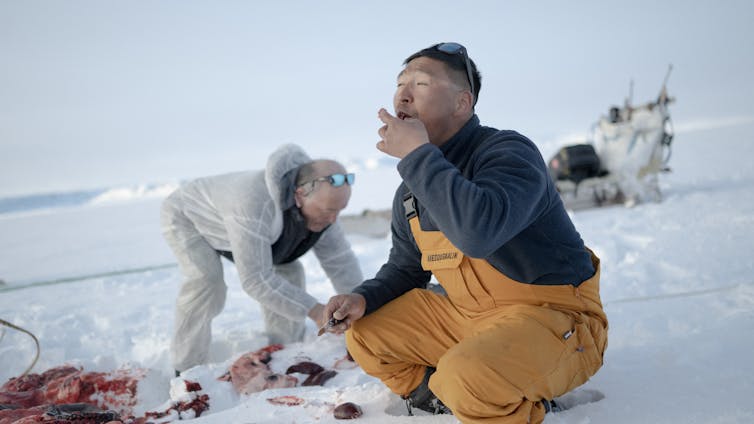
Inuit people such as these Greenlanders have evolved to be able to eat fatty foods with a low risk of getting heart disease. Olivier Morin/AFP via Getty Images

If evolution is real, then why isn’t it happening now? An anthropologist explains that humans actually are still evolving

Michael A. Little, Binghamton University, State University of New York Curious Kids is a series for children of all ages. If you have a question you’d like an expert to answer, send it to CuriousKidsUS@theconversation.com.
If evolution is real, then why is it not happening now? – Dee, Memphis, Tennessee

Many people believe that we humans have conquered nature through the wonders of civilization and technology. Some also believe that because we are different from other creatures, we have complete control over our destiny and have no need to evolve. Even though lots of people believe this, it’s not true. Like other living creatures, humans have been shaped by evolution. Over time, we have developed – and continue to develop – the traits that help us survive and flourish in the environments where we live. I’m an anthropologist. I study how humans adapt to different environments. Adaptation is an important part of evolution. Adaptations are traits that give someone an advantage in their environment. People with those traits are more likely to survive and pass those traits on to their children. Over many generations, those traits become widespread in the population.

The role of culture

We humans have two hands that help us skillfully use tools and other objects. We are able to walk and run on two legs, which frees our hands for these skilled tasks. And we have large brains that let us reason, create ideas and live successfully with other people in social groups. All of these traits have helped humans develop culture. Culture includes all of our ideas and beliefs and our abilities to plan and think about the present and the future. It also includes our ability to change our environment, for example by making tools and growing food. Although we humans have changed our environment in many ways during the past few thousand years, we are still changed by evolution. We have not stopped evolving, but we are evolving right now in different ways than our ancient ancestors. Our environments are often changed by our culture. We usually think of an environment as the weather, plants and animals in a place. But environments include the foods we eat and the infectious diseases we are exposed to. A very important part of the environment is the climate and what kinds of conditions we can live in. Our culture helps us change our exposure to the climate. For example, we build houses and put furnaces and air conditioners in them. But culture doesn’t fully protect us from extremes of heat, cold and the sun’s rays.
a man runs after one of several goats in a dry, dusty landscape
The Turkana people in Kenya have evolved to survive with less water than other people, which helps them live in a desert environment. Tony Karumba/AFP via Getty Images
Here are some examples of how humans have evolved over the past 10,000 years and how we are continuing to evolve today.

The power of the sun’s rays

While the sun’s rays are important for life on our planet, ultraviolet rays can damage human skin. Those of us with pale skin are in danger of serious sunburn and equally dangerous kinds of skin cancer. In contrast, those of us with a lot of skin pigment, called melanin, have some protection against damaging ultraviolet rays from sunshine. People in the tropics with dark skin are more likely to thrive under frequent bright sunlight. Yet, when ancient humans moved to cloudy, cooler places, the dark skin was not needed. Dark skin in cloudy places blocked the production of vitamin D in the skin, which is necessary for normal bone growth in children and adults. The amount of melanin pigment in our skin is controlled by our genes. So in this way, human evolution is driven by the environment – sunny or cloudy – in different parts of the world.

The food that we eat

Ten thousand years ago, our human ancestors began to tame or domesticate animals such as cattle and goats to eat their meat. Then about 2,000 years later, they learned how to milk cows and goats for this rich food. Unfortunately, like most other mammals at that time, human adults back then could not digest milk without feeling ill. Yet a few people were able to digest milk because they had genes that let them do so. Milk was such an important source of food in these societies that the people who could digest milk were better able to survive and have many children. So the genes that allowed them to digest milk increased in the population until nearly everyone could drink milk as adults. This process, which occurred and spread thousands of years ago, is an example of what is called cultural and biological co-evolution. It was the cultural practice of milking animals that led to these genetic or biological changes. Other people, such as the Inuit in Greenland, have genes that enable them to digest fats without suffering from heart diseases. The Turkana people herd livestock in Kenya in a very dry part of Africa. They have a gene that allows them to go for long periods without drinking much water. This practice would cause kidney damage in other people because the kidney regulates water in your body. These examples show how the remarkable diversity of foods that people eat around the world can affect evolution.
gray scale microscope image of numerous blobs
These bacteria caused a devastating pandemic nearly 700 years ago that led humans to evolve resistance to them. Image Point FR/NIH/NIAID/BSIP/Universal Images Group via Getty Images

Diseases that threaten us

Like all living creatures, humans have been exposed to many infectious diseases. During the 14th century a deadly disease called the bubonic plague struck and spread rapidly throughout Europe and Asia. It killed about one-third of the population in Europe. Many of those who survived had a specific gene that gave them resistance against the disease. Those people and their descendants were better able to survive epidemics that followed for several centuries. Some diseases have struck quite recently. COVID-19, for instance, swept the globe in 2020. Vaccinations saved many lives. Some people have a natural resistance to the virus based on their genes. It may be that evolution increases this resistance in the population and helps humans fight future virus epidemics. As human beings, we are exposed to a variety of changing environments. And so evolution in many human populations continues across generations, including right now.
Hello, curious kids! Do you have a question you’d like an expert to answer? Ask an adult to send your question to CuriousKidsUS@theconversation.com. Please tell us your name, age and the city where you live. And since curiosity has no age limit – adults, let us know what you’re wondering, too. We won’t be able to answer every question, but we will do our best. Michael A. Little, Distinguished Professor Emeritus of Anthropology, Binghamton University, State University of New York This article is republished from The Conversation under a Creative Commons license. Read the original article.
Sinking Cities: Why Parts of Phoenix—and Much of Urban America—Are Slowly Dropping
Link: https://stmdailynews.com/sinking-cities-why-parts-of-phoenix-and-much-of-urban-america-are-slowly-dropping/
View recent photos

Unlock fun facts & lost history—get The Knowledge in your inbox!

We don’t spam! Read our privacy policy for more info.


Discover more from Daily News

Subscribe to get the latest posts sent to your email.

Continue Reading

Science

Why can’t I wiggle my toes one at a time, like my fingers?

why can’t I wiggle my toes? Ever wondered why you can’t wiggle your toes one at a time like your fingers? Learn how evolution, muscles, and your brain all play a part in making fingers more independent than toes—and why that’s key for walking and balance.

Published

on

Why can’t I wiggle my toes one at a time, like my fingers?
A baby chimp can grab a stick equally well with its fingers and its toes. Anup Shah/Stone via Getty Images

Why Can’t You Wiggle Your Toes Like Your Fingers? The Science Behind Toe and Finger Movement

Steven Lautzenheiser, University of Tennessee Curious Kids is a series for children of all ages. If you have a question you’d like an expert to answer, send it to curiouskidsus@theconversation.com.
Why can’t I wiggle my toes individually, like I can with my fingers? – Vincent, age 15, Arlington, Virginia

One of my favorite activities is going to the zoo where I live in Knoxville when it first opens and the animals are most active. On one recent weekend, I headed to the chimpanzees first. Their breakfast was still scattered around their enclosure for them to find. Ripley, one of the male chimpanzees, quickly gathered up some fruits and vegetables, sometimes using his feet almost like hands. After he ate, he used his feet to grab the fire hoses hanging around the enclosure and even held pieces of straw and other toys in his toes. I found myself feeling a bit envious. Why can’t people use our feet like this, quickly and easily grasping things with our toes just as easily as we do with our fingers? I’m a biological anthropologist who studies the biomechanics of the modern human foot and ankle, using mechanical principles of movement to understand how forces affect the shape of our bodies and how humans have changed over time. Your muscles, brain and how human feet evolved all play a part in why you can’t wiggle individual toes one by one.
young chimp running on all fours
Chimpanzee hands and feet do similar jobs. Manoj Shah/Stone via Getty Images

Comparing humans to a close relative

Humans are primates, which means we belong to the same group of animals that includes apes like Riley the chimp. In fact, chimpanzees are our closest genetic relatives, sharing almost 98.8% of our DNA. Evolution is part of the answer to why chimpanzees have such dexterous toes while ours seem much more clumsy. Our very ancient ancestors probably moved around the way chimpanzees do, using both their arms and legs. But over time our lineage started walking on two legs. Human feet needed to change to help us stay balanced and to support our bodies as we walk upright. It became less important for our toes to move individually than to keep us from toppling over as we moved through the world in this new way.
bare feet walking across sandy surface toward camera
Feet adapted so we could walk and balance on just two legs. Karina Mansfield/Moment via Getty Images
Human hands became more important for things such as using tools, one of the hallmark skills of human beings. Over time, our fingers became better at moving on their own. People use their hands to do lots of things, such as drawing, texting or playing a musical instrument. Even typing this article is possible only because my fingers can make small, careful and controlled movements. People’s feet and hands evolved for different purposes.

Muscles that move your fingers or toes

Evolution brought these differences about by physically adapting our muscles, bones and tendons to better support walking and balance. Hands and feet have similar anatomy; both have five fingers or toes that are moved by muscles and tendons. The human foot contains 29 muscles that all work to help you walk and stay balanced when you stand. In comparison, a hand has 34 muscles. Most of the muscles of your foot let you point your toes down, like when you stand on tiptoes, or lift them up, like when you walk on your heels. These muscles also help feet roll slightly inward or outward, which lets you keep your balance on uneven ground. All these movements work together to help you walk and run safely. The big toe on each foot is special because it helps push your body forward when you walk and has extra muscles just for its movement. The other four toes don’t have their own separate muscles. A few main muscles in the bottom of your foot and in your calf move all four toes at once. Because they share muscles, those toes can wiggle, but not very independently like your fingers can. The calf muscles also have long tendons that reach into the foot; they’re better at keeping you steady and helping you walk than at making tiny, precise movements.
a pen and ink drawing of the interior anatomy of a human hand
Your hand is capable of delicate movements thanks to the muscles and ligaments that control its bones. Henry Gray, ‘Anatomy of the Human Body’/Wikimedia Commons, CC BY
In contrast, six main muscle groups help move each finger. The fingers share these muscles, which sit mostly in the forearm and connect to the fingers by tendons. The thumb and pinky have extra muscles that let you grip and hold objects more easily. All of these muscles are specialized to allow careful, controlled movements, such as writing. So, yes, I have more muscles dedicated to moving my fingers, but that is not the only reason I can’t wiggle my toes one by one.

Divvying up brain power

You also need to look inside your brain to understand why toes and fingers work differently. Part of your brain called the motor cortex tells your body how to move. It’s made of cells called neurons that act like tiny messengers, sending signals to the rest of your body. Your motor cortex devotes many more neurons to controlling your fingers than your toes, so it can send much more detailed instructions to your fingers. Because of the way your motor cortex is organized, it takes more “brain power,” meaning more signals and more activity, to move your fingers than your toes.
illustration of a brain looking down at the top of the head with one section highlighted orange
The motor cortex of your brain sends orders to move parts of your body. Kateryna Kon/Science Photo Library via Getty Images
Even though you can’t grab things with your feet like Ripley the chimp can, you can understand why.
Hello, curious kids! Do you have a question you’d like an expert to answer? Ask an adult to send your question to CuriousKidsUS@theconversation.com. Please tell us your name, age and the city where you live. And since curiosity has no age limit – adults, let us know what you’re wondering, too. We won’t be able to answer every question, but we will do our best. Steven Lautzenheiser, Assistant Professor of Biological Anthropology, University of Tennessee This article is republished from The Conversation under a Creative Commons license. Read the original article.
❄️ The Man Who Made Air Conditioning Cool
Link: https://stmdailynews.com/%e2%9d%84%ef%b8%8f-the-man-who-made-air-conditioning-cool/

Discover more from Daily News

Subscribe to get the latest posts sent to your email.

Continue Reading

Artificial Intelligence

More than half of new articles on the internet are being written by AI – is human writing headed for extinction?

A new study finds over 50% of online articles are now AI-generated, raising questions about the future of human writing. Discover why formulaic content is most at risk, and why authentic, creative voices may become more valuable than ever.

Published

on

Is AI Replacing Human Writers? Why Over Half of Online Articles Are Now AI-Generated
Preserving the value of real human voices will likely depend on how people adapt to artificial intelligence and collaborate with it. BlackJack3D/E+ via Getty Images

More than half of new articles on the internet are being written by AI – is human writing headed for extinction?

Francesco Agnellini, Binghamton University, State University of New York The line between human and machine authorship is blurring, particularly as it’s become increasingly difficult to tell whether something was written by a person or AI. Now, in what may seem like a tipping point, the digital marketing firm Graphite recently published a study showing that more than 50% of articles on the web are being generated by artificial intelligence. As a scholar who explores how AI is built, how people are using it in their everyday lives, and how it’s affecting culture, I’ve thought a lot about what this technology can do and where it falls short. If you’re more likely to read something written by AI than by a human on the internet, is it only a matter of time before human writing becomes obsolete? Or is this simply another technological development that humans will adapt to?

It isn’t all or nothing

Thinking about these questions reminded me of Umberto Eco’s essay “Apocalyptic and Integrated,” which was originally written in the early 1960s. Parts of it were later included in an anthology titled “Apocalypse Postponed,” which I first read as a college student in Italy. In it, Eco draws a contrast between two attitudes toward mass media. There are the “apocalyptics” who fear cultural degradation and moral collapse. Then there are the “integrated” who champion new media technologies as a democratizing force for culture.
An older man with a beard, glasses and a suit poses while holding a cigarette.
Italian philosopher, cultural critic and novelist Umberto Eco cautioned against overreacting to the impact of new technologies. Leonardo Cendamo/Getty Images
Back then, Eco was writing about the proliferation of TV and radio. Today, you’ll often see similar reactions to AI. Yet Eco argued that both positions were too extreme. It isn’t helpful, he wrote, to see new media as either a dire threat or a miracle. Instead, he urged readers to look at how people and communities use these new tools, what risks and opportunities they create, and how they shape – and sometimes reinforce – power structures. While I was teaching a course on deepfakes during the 2024 election, Eco’s lesson also came back to me. Those were days when some scholars and media outlets were regularly warning of an imminent “deepfake apocalypse.” Would deepfakes be used to mimic major political figures and push targeted disinformation? What if, on the eve of an election, generative AI was used to mimic the voice of a candidate on a robocall telling voters to stay home? Those fears weren’t groundless: Research shows that people aren’t especially good at identifying deepfakes. At the same time, they consistently overestimate their ability to do so. In the end, though, the apocalypse was postponed. Post-election analyses found that deepfakes did seem to intensify some ongoing political trends, such as the erosion of trust and polarization, but there’s no evidence that they affected the final outcome of the election.

Listicles, news updates and how-to guides

Of course, the fears that AI raises for supporters of democracy are not the same as those it creates for writers and artists. For them, the core concerns are about authorship: How can one person compete with a system trained on millions of voices that can produce text at hyper-speed? And if this becomes the norm, what will it do to creative work, both as an occupation and as a source of meaning? It’s important to clarify what’s meant by “online content,” the phrase used in the Graphite study, which analyzed over 65,000 randomly selected articles of at least 100 words on the web. These can include anything from peer-reviewed research to promotional copy for miracle supplements. A closer reading of the Graphite study shows that the AI-generated articles consist largely of general-interest writing: news updates, how-to guides, lifestyle posts, reviews and product explainers. https://stmdailynews.com/wp-admin/post-new.php#visibility The primary economic purpose of this content is to persuade or inform, not to express originality or creativity. Put differently, AI appears to be most useful when the writing in question is low-stakes and formulaic: the weekend-in-Rome listicle, the standard cover letter, the text produced to market a business. A whole industry of writers – mostly freelance, including many translators – has relied on precisely this kind of work, producing blog posts, how-to material, search engine optimization text and social media copy. The rapid adoption of large language models has already displaced many of the gigs that once sustained them.

Collaborating with AI

The dramatic loss of this work points toward another issue raised by the Graphite study: the question of authenticity, not only in identifying who or what produced a text, but also in understanding the value that humans attach to creative activity. How can you distinguish a human-written article from a machine-generated one? And does that ability even matter? Over time, that distinction is likely to grow less significant, particularly as more writing emerges from interactions between humans and AI. A writer might draft a few lines, let an AI expand them and then reshape that output into the final text. This article is no exception. As a non-native English speaker, I often rely on AI to refine my language before sending drafts to an editor. At times the system attempts to reshape what I mean. But once its stylistic tendencies become familiar, it becomes possible to avoid them and maintain a personal tone. Also, artificial intelligence is not entirely artificial, since it is trained on human-made material. It’s worth noting that even before AI, human writing has never been entirely human, either. Every technology, from parchment and stylus paper to the typewriter and now AI, has shaped how people write and how readers make sense of it. Another important point: AI models are increasingly trained on datasets that include not only human writing but also AI-generated and human–AI co-produced text. This has raised concerns about their ability to continue improving over time. Some commentators have already described a sense of disillusionment following the release of newer large models, with companies struggling to deliver on their promises.

Human voices may matter even more

But what happens when people become overly reliant on AI in their writing? Some studies show that writers may feel more creative when they use artificial intelligence for brainstorming, yet the range of ideas often becomes narrower. This uniformity affects style as well: These systems tend to pull users toward similar patterns of wording, which reduces the differences that usually mark an individual voice. Researchers also note a shift toward Western – and especially English-speaking – norms in the writing of people from other cultures, raising concerns about a new form of AI colonialism. In this context, texts that display originality, voice and stylistic intention are likely to become even more meaningful within the media landscape, and they may play a crucial role in training the next generations of models. If you set aside the more apocalyptic scenarios and assume that AI will continue to advance – perhaps at a slower pace than in the recent past – it’s quite possible that thoughtful, original, human-generated writing will become even more valuable. Put another way: The work of writers, journalists and intellectuals will not become superfluous simply because much of the web is no longer written by humans. Francesco Agnellini, Lecturer in Digital and Data Studies, Binghamton University, State University of New York This article is republished from The Conversation under a Creative Commons license. Read the original article.
 

Dive into “The Knowledge,” where curiosity meets clarity. This playlist, in collaboration with STMDailyNews.com, is designed for viewers who value historical accuracy and insightful learning. Our short videos, ranging from 30 seconds to a minute and a half, make complex subjects easy to grasp in no time. Covering everything from historical events to contemporary processes and entertainment, “The Knowledge” bridges the past with the present. In a world where information is abundant yet often misused, our series aims to guide you through the noise, preserving vital knowledge and truths that shape our lives today. Perfect for curious minds eager to discover the ‘why’ and ‘how’ of everything around us. Subscribe and join in as we explore the facts that matter.  https://stmdailynews.com/the-knowledge/


Discover more from Daily News

Subscribe to get the latest posts sent to your email.

Continue Reading

Trending