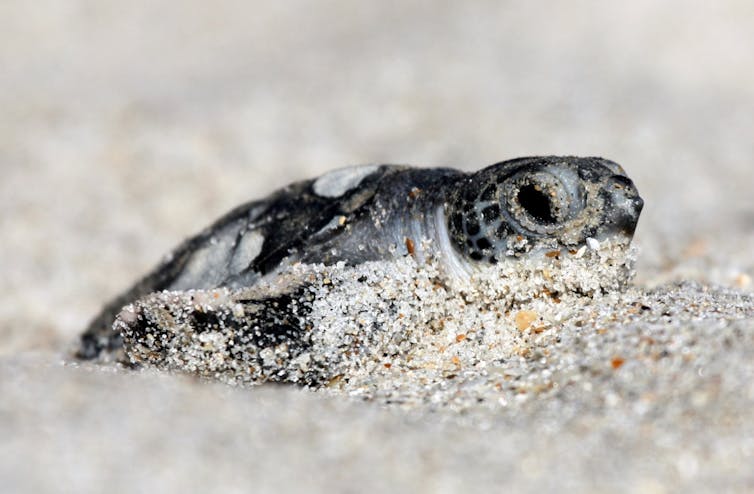
Green sea turtles, like this hatchling in Florida, are endangered due in part to habitat destruction and fishing nets. Keenan Adams/USFWSMariah Meek, Michigan State University and Karrigan Börk, University of California, Davis It wouldn’t make much sense to prohibit people from shooting a threatened woodpecker while allowing its forest to be cut down, or to bar killing endangered salmon while allowing a dam to dry out their habitat. But that’s exactly what the Trump administration is proposing to do by changing how one word in the Endangered Species Act is interpreted: harm. For 50 years, the U.S. government has interpreted the Endangered Species Act as protecting threatened and endangered species from actions that either directly kill them or eliminate their habitat. Most species on the brink of extinction are on the list because there is almost no place left for them to live. Their habitats have been paved over, burned or transformed. Habitat protection is essential for their survival.The golden-cheeked warbler breeds only in Texas, primarily in Texas Hill Country. It has been losing habitat as development expands in the region.Steve Maslowski/USFWS, CC BY As an ecologist and a law professor, we have spent our entire careers working to understand the law and science of helping imperiled species thrive. We recognize that the rule change the Trump administration quietly proposed could green-light the destruction of protected species’ habitats, making it nearly impossible to protect those endangered species.
The legal gambit
The Endangered Species Act, passed in 1973, bans the “take” of “any endangered species of fish or wildlife,” which includes harming protected species. Since 1975, regulations have defined “harm” to include habitat destruction that kills or injures wildlife. Developers and logging interests challenged that definition in 1995 in a Supreme Court case, Babbitt v. Sweet Home Chapter of Communities for a Great Oregon. However, the court ruled that the definition was reasonable and allowed federal agencies to continue using it. In short, the law says “take” includes harm, and under the existing regulatory definition, harm includes indirect harm through habitat destruction.Critical habitat throughout the U.S., including many coastlines and mountain areas. Note: Alaska is not to scale.U.S. Fish and Wildlife Service The Trump administration is seeking to change that definition of “harm” in a way that leaves out habitat modification. This narrowed definition would undo the most significant protections granted by the Endangered Species Act.
Why habitat protection matters
Habitat protection is the single most important factor in the recovery of endangered species in the United States – far more consequential than curbing direct killing alone. A 2019 study examining the reasons species were listed as endangered between 1975 and 2017 found that only 17% were primarily threatened by direct killing, such as hunting or poaching. That 17% includes iconic species such as the red wolf, American crocodile, Florida panther and grizzly bear. In contrast, a staggering 81% were listed because of habitat loss and degradation. The Chinook salmon, island fox, southwestern willow flycatcher, desert tortoise and likely extinct ivory-billed woodpecker are just a few examples. Globally, a 2022 study found that habitat loss threatened more species than all other causes combined. As natural landscapes are converted to agriculture or taken over by urban sprawl, logging operations and oil and gas exploration, ecosystems become fragmented and the space that species need to survive and reproduce disappears. Currently, more than 107 million acres of land in the U.S. are designated as critical habitat for Endangered Species Act-listed species. Industries and developers have called for changes to the rules for years, arguing it has been weaponized to stop development. However, research shows species worldwide are facing an unprecedented threat from human activities that destroy natural habitat. Under the proposed change, development could be accelerated in endangered species’ habitats.
Gutting the Endangered Species Act
The definition change is a quiet way to gut the Endangered Species Act. It is also fundamentally incompatible with the purpose Congress wrote into the act: “to provide a means whereby the ecosystems upon which endangered species and threatened species depend may be conserved [and] to provide a program for the conservation of such endangered species and threatened species.” It contradicts the Supreme Court precedent, and it would destroy the act’s habitat protections.Northern spotted owls, like these fledglings, living in old growth forests in the Pacific Northwest are listed as threatened species because of habitat loss.Tom Kogut/USFS, CC BY Secretary of the Interior Doug Burgum has argued that the recent “de-extinction” of dire wolves by changing 14 genes in the gray wolf genome means that America need not worry about species protection because technology “can help forge a future where populations are never at risk.” But altering an existing species to look like an extinct one is both wildly expensive and a paltry substitute for protecting existing species.The Catalina Island fox is endemic to Catalina Island. Habitat loss, diseases introduced by domestic dogs, and predators have diminished the population of these small foxes to threatened status.Catalina Island Conservancy/Wikimedia Commons, CC BY-SA The administration has also refused to conduct the required analysis of the environmental impact that changing the definition could have. That means the American people won’t even know the significance of this change to threatened and endangered species until it’s too late, though if approved it will certainly end up in court.
The ESA is saving species
Surveys have found the Endangered Species Act is popular with the public, including Republicans. The Center for Biological Diversity estimates that the Endangered Species Act has saved 99% of protected species from extinction since it was created, not just from bullets but also from bulldozers. This regulatory rollback seeks to undermine the law’s greatest strength: protecting the habitats species need to survive. Congress knew the importance of habitat when it passed the law, and it wrote a definition of “take” that allows the agencies to protect it.Mariah Meek, Associate Professor of Integrative Biology, Michigan State University and Karrigan Börk, Professor of Law, University of California, Davis This article is republished from The Conversation under a Creative Commons license. Read the original article.
Rod: A creative force, blending words, images, and flavors. Blogger, writer, filmmaker, and photographer. Cooking enthusiast with a sci-fi vision. Passionate about his upcoming series and dedicated to TNC Network. Partnered with Rebecca Washington for a shared journey of love and art.
Rod: A creative force, blending words, images, and flavors. Blogger, writer, filmmaker, and photographer. Cooking enthusiast with a sci-fi vision. Passionate about his upcoming series and dedicated to TNC Network. Partnered with Rebecca Washington for a shared journey of love and art.
Harkins Theatres Announces Rob Reiner Tribute Screening of The American President
Harkins Theatres has announced a special one-day tribute screening honoring acclaimed filmmaker Rob Reiner, celebrating his life’s work and cinematic legacy.
On December 17, select Harkins locations will screen Reiner’s 1995 political romance The American President, with all proceeds benefiting the Human Rights Campaign. Tickets are priced at $5, making the event both an accessible film experience and a charitable fundraiser.
The tribute was announced via Harkins’ official, verified social media accounts and is positioned as a legacy celebration, not a memorial.
🎥 Why The American President?
Released in 1995 and written by Aaron Sorkin, The American President stars Michael Douglas and Annette Bening and remains one of Rob Reiner’s most politically resonant films. The movie blends romance, idealism, and civic responsibility — themes that have consistently appeared throughout Reiner’s career.
The film later served as a creative blueprint for The West Wing, cementing its place in modern political storytelling.
Rob Reiner’s career spans more than five decades, including landmark films such as:
This Is Spinal Tap
Stand By Me
The Princess Bride
When Harry Met Sally…
Misery
A Few Good Men
His work is often praised for balancing entertainment, empathy, and social conscience, making tribute events like this especially meaningful to longtime audiences.
Hollywood Legend Rob Reiner and Wife Found Dead; Son in Custody
Renowned filmmaker Rob Reiner and his wife, Michele Singer Reiner, were found dead in their Los Angeles home in a reported homicide. Police have arrested their son in connection with the case, and tributes are pouring in.
Director Rob Reiner participates in a discussion following a screening of the film LBJ at the LBJ Presidential Library in Austin, Texas on Saturday October 22, 2016 On Saturday evening October 22, 2016, the LBJ Presidential Library held a sneak peek of Rob Reiner’s new filmÊLBJ, starring Woody Harrelson as the 36th president. The film, which premiered at the Toronto International Film Festival in September, chronicles the life and times of Lyndon Johnson who would inherit the presidency at one of the most fraught moments in American history. Following the screening, director Rob Reiner, actor Woody Harrelson, and writer Joey Hartstone joined LBJ Library Director Mark Updegrove on stage for a conversation about the film. LBJ Library photo by Jay Godwin 10/22/2016
Hollywood Legend Rob Reiner and Wife Found Dead; Son in Custody
December 15, 2025
Renowned filmmaker and actor Rob Reiner, 78, and his wife Michele Singer Reiner, 68, were found dead in their Brentwood, Los Angeles home on Sunday, authorities say. Emergency responders were called to the residence Sunday afternoon, where both were discovered with fatal wounds consistent with a stabbing. Police are treating the case as a double homicide.
Los Angeles police arrested the couple’s 32-year-old son, Nick Reiner, in connection with the deaths. He is being held in custody as investigators continue to piece together the circumstances surrounding the incident.
2016 SAMHSA Voice Awards
Reiner was one of Hollywood’s most influential figures, known for his work as a director, producer and actor. His career spanned decades, from early television fame to directing beloved films that shaped American cinema.
Friends, colleagues and public figures have begun sharing tributes and reactions to the news as the investigation is ongoing.
More details will be updated as they become available.
FDA’s COVID-19 Vaccine Safety Claims Lack Solid Evidence—Why Overreaction Could Harm Public Health
COVID-19 vaccine safety: The FDA’s claims about COVID-19 vaccine deaths in children lack strong evidence and could restrict vaccine access. Learn why experts say VAERS reports aren’t proof, and how overreacting may harm public health and trust in vaccines.
The death of children due to an unsafe vaccine is a serious allegation. I am a pediatric cardiologist who has studied the link between COVID-19 vaccines and heart-related side effects such as myocarditis in children. To my knowledge, studies to date have shown such side effects are rare, and severe outcomes even more so. However, I am open to new evidence that could change my mind. But without sufficient justification and solid evidence, restricting access to an approved vaccine and changing well-established procedures for testing vaccines would carry serious consequences. These moves would limit access for patients, create roadblocks for companies and worsen distrust in vaccines and public health. In my view, it’s important for people reading about these FDA actions to understand how the evidence on a vaccine’s safety is generally assessed.
Determining cause of death
The FDA memo claims that the deaths of these children were directly related to receiving a COVID-19 immunization. From my perspective as a clinician, it is awful that any child should die from a routine vaccination. However, health professionals like me owe it to the public to uphold the highest possible standards in investigating why these deaths occurred. If the FDA has evidence demonstrating something that national health agencies worldwide have missed – widespread child deaths due to myocarditis caused by the COVID-19 vaccine – I don’t doubt that even the most pro-vaccine physician will listen. So far, however, no such evidence has been presented. While a death logged in VAERS is a starting point, on its own it is insufficient to conclude whether a vaccine caused the death or other medical causes were to blame. To demonstrate a causal link, FDA staff and physicians must align the VAERS report with physicians’ assessments of the patient, as well as data from other sources for monitoring vaccine safety. These include PRISM, which logs insurance claims data, and the Vaccine Safety Datalink, which tracks safety signals in electronic medical records. It’s known that most deaths logged only in VAERS of children who recently received vaccines have been incorrectly attributed to the vaccines – either by accident or in some cases on purpose by anti-vaccine activists.
Heart-related side effects of COVID-19 vaccines
In his Substack and Twitter accounts, Prasad has said that he believes the rate of severe cardiac side effects after COVID-19 vaccination is severely underestimated and that the vaccines should be restricted far more than they currently are. In a July 2025 presentation, Prasad quoted a risk of 27 cases per million of myocarditis in young men who received the COVID-19 vaccine. A 2024 review suggested that number was a bit lower – about 20 cases out of 1 million people. But that same study found that unvaccinated people had greater risk of heart problems after a COVID-19 infection than vaccinated people. In a different study, people who got myocarditis after a COVID-19 vaccination developed fewer complications than people who got myocarditis after a COVID-19 infection. Existing vaccine safety infrastructure in the U.S. successfully identifies dangers posed by vaccines – and did so during the COVID-19 pandemic. Today, most COVID-19 vaccines in the U.S. rely on mRNA technology. But as vaccines were first emerging during the COVID-19 pandemic, two pharmaceutical companies, Janssen and AstraZeneca, rolled out a vaccine that used a different technology, called a viral vector. This type of vaccine had a very rare but genuine safety problem that was detected.A report in VAERS is at most a first step to determining whether a vaccine caused harm. VAERS, the Vaccine Safety Datalink, clinical investigators in the U.S. and their European counterparts detected that these vaccines did turn out to cause blood clotting. In April 2021, the FDA formally recommended pausing their use, and they were later pulled from the market. Death due to myocarditis from COVID-19 vaccination is exceedingly rare. Demonstrating that it occurred requires proof that the person had myocarditis, evidence that no other reasonable cause of death was present, and the absence of any additional cause of myocarditis. These factors cannot be determined from VAERS data, however – and to date, the FDA has presented no other relevant data.
A problematic vision for future vaccine approvals
Currently, vaccines are tested both by seeing how well they prevent disease and by how well they generate antibodies, which are the molecules that help your body fight viruses and bacteria. Some vaccines, such as the COVID-19 vaccine and the influenza vaccine, need to be updated based on new strains. The FDA generally approves these updates based on how well the new versions generate antibodies. Since the previous generation of vaccines was already shown to prevent infection, if the new version can generate antibodies like the previous one, researchers assume its ability to prevent infection is comparable too. Later studies can then test how well the vaccines prevent severe disease and hospitalization. The FDA memo says this approach is insufficient and instead argues for replacing such studies with many more placebo-controlled trials – not just for COVID-19 vaccines but also for widely used influenza and pneumonia vaccines. That may seem reasonable theoretically. In practice, however, it is not realistic. Today’s influenza vaccines must be changed every season to reflect mutations to the virus. If the FDA were to require new placebo-controlled trials every year, the vaccine being tested would become obsolete by the time it is approved. This would be a massive waste of time and resources.Influenza vaccines must be updated for every flu season.Jacob Wackerhausen/iStock via Getty Images Plus Also, detecting vaccine-related myocarditis at the low rate at which it occurs would have required clinical trials many times larger than the ones that were done to approve COVID-19 mRNA vaccines. This would have cost at least millions of dollars more, and the delay in rolling out vaccines would have also cost lives. Placebo-controlled trials would require comparing people who receive the updated vaccine with people who remain unvaccinated. When an older version of the vaccine is already available, this means purposefully asking people to forgo that vaccine and risk infection for the sake of the trial, a practice that is widely considered unethical. Current scientific practice is that only a brand-new vaccine may be compared against placebo. While suspected vaccine deaths should absolutely be investigated, stopping a vaccine for insufficient reasons can lead to a significant drop in public confidence. That’s why it’s essential to thoroughly and transparently investigate any claims that a vaccine causes harm.





 Mariah Meek, Associate Professor of Integrative Biology, Michigan State University and Karrigan Börk, Professor of Law, University of California, Davis This article is republished from The Conversation under a Creative Commons license. Read the original article.