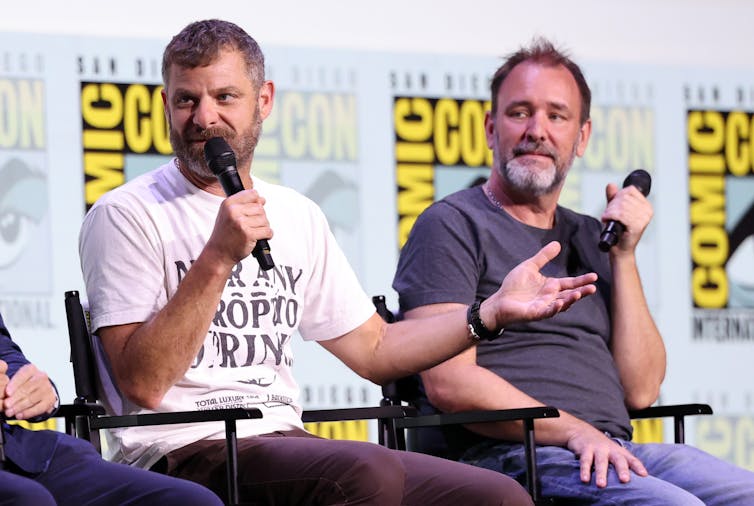
‘South Park’ creators Matt Stone and Trey Parker appear at Comic-Con 2025 in San Diego on July 24, 2025. Amy Sussman/Getty Images
How ‘South Park’ could help Democrats win back the young voters the party lost to Trump
Nick Marx, Colorado State University The Season 27 premiere of “South Park” in July 2025 began like so many of the show’s episodes: Resident bigot Eric Cartman is pissed off. He directs his ire at the Trump administration, which had recently pulled federal funding for NPR, because he enjoyed hearing liberals “whine about stuff.” In other words, Cartman is irate that Trump has stolen his hateful, vindictive shtick. As the episode goes on, other South Park residents join Cartman in rallying against Donald Trump. In the show’s infamously over-the-top style, the president is depicted as thin-skinned, deceitful – and, well, sexually ill-equipped. The episode ends with a surreal, graphic deepfake scene of a totally nude Donald Trump stumbling around a desert. The White House immediately blasted “South Park” as irrelevant and “desperate for attention.” The ratings tell a different story. The season premiere scored 6 million viewers across Comedy Central and Paramount+, with even more tuning in two weeks later for the follow-up. Each ensuing episode has further skewered Trump and his administration. “South Park” has long targeted ineffectual authority figures with ripped-from-the-headlines timeliness, which is made possible by its weekly production schedule. Whereas most animated television shows require months of production lead time, series co-creators Trey Parker and Matt Stone need just a weekor two to write, voice and animate an entire episode. While the ever-churning news cycle has made it more difficult to hold those in power accountable, the cartoon’s timely satire still galvanizes viewer attention. This makes it uniquely suited to channel rage toward Trump and other political leaders – and, perhaps, influence an audience that has recently proved elusive to Democrats.
A history of poking the powerful
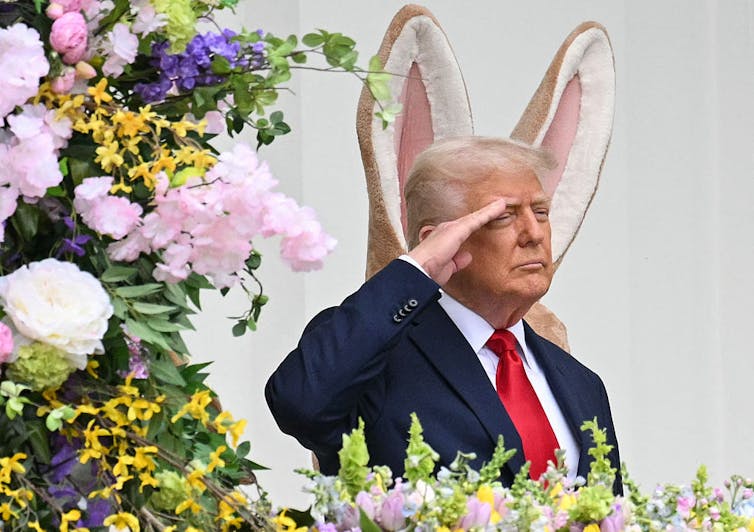
The appeal of “South Park” doesn’t necessarily lie in partisan attacks on Republicans. Its politics have always been all over the map, with both liberals and conservatives railing against the show at various points. The 2006 episode “ManBearPig” ridiculed former Democratic Vice President Al Gore’s climate activism. In 2014, liberal critics decried an episode titled “Mr. Garrison’s Fancy New Vagina” for deploying transphobic tropes. And “The Pandemic Special,” which aired in 2020, mocked the restrictive vaccine policies promoted by progressives. Meanwhile, conservative watchdog groups such as the Parents Television and Media Council have long targeted “South Park” for its allegedly harmful influence on children. The none-too-subtly titled 1999 movie “South Park: Bigger, Longer & Uncut” satirized these efforts: Throughout the movie, Kyle’s mom, Sheila, tries to censor the graphic children’s cartoon characters Terrance and Phillip. That movie also marks one of the earliest appearances of the Iraqi despot Saddam Hussein. It portrays him as a crazed, lecherous supervillain hellbent on taking over the world alongside his gay lover, Satan.Former Iraqi dictator Saddam Hussein has been a recurring character on ‘South Park.’ The current “South Park” season has animated Trump with the same cutout, stop-motion style as it did with Hussein, implying direct parallels between their dictatorial desires. Behind the scenes, Trump has reportedly been “seething” over the depiction. In the 2006 two-part episode “Cartoon Wars,” Parker and Stone warred with Comedy Central over the right to show an animated depiction of the Muslim prophet Muhammad. The network rejected the idea after political violence followed in the wake of a Danish newspaper’s publication of a cartoon featuring Muhammad. Eventually, censored animations of Muhammad aired with disclaimers from Comedy Central, but only after Parker and Stone’s refusal to address the issue before broadcast. The cartoon continues to relish poking its corporate benefactors. The current season premiered hours after Trump’s Federal Communications Commission approved a merger for the show’s parent company, Paramount. The administration delayed the transaction in order to settle its lawsuit against the Paramount-owned news show “60 Minutes,” which Trump had accused of favorably editing an interview with former Vice President Kamala Harris while she was running as the Democratic nominee for president. That same day also saw the announcement of a new US$1.5 billion deal keeping “South Park” at Paramount. Parker and Stone’s skewering of Trump sends a message to Paramount in the wake of the “60 Minutes” settlement and the cancellation of “The Late Show with Stephen Colbert”: Let politics dictate your content at your own risk.‘South Park’ has sought to take President Trump down a notch.Mandel Ngan/AFP via Getty Images
Reaching the right voters
As the Democratic Party’s establishment struggles to appeal to young, internet-savvy, male voters – look no further than party strategists’ attempts to find “a liberal Joe Rogan” – “South Park” is garnering record viewership with young audiences. The rest of the season, meanwhile, has provided a timely, steady drumbeat of Trump mockery. The second episode of the current season calls out the Trump administration’s illegal ICE raids. The next episode lampoons Trump’s affinity for lavish gifts and compliments. In it, tech CEOs and world leaders obsequiously note that Trump “does not have a small penis.” The fourth episode depicts him as a negligent and emotionally abusive lover to Satan, further connecting him to the show’s previous portrayals of Saddam Hussein.Satan is depicted as President Trump’s lover in Season 27 of ‘South Park.’ Despite its penchant for outrageous and, at times, scattershot satire, “South Park” has an important lesson to teach Trump’s political opponents. The appeal of both Trump and “South Park” to many young men is not in the positive ideas they offer, but in the way they both humiliate their opponents. I research comedy on the right, and I’ve written about how right-wing humor has long thrived on “owning the libs.” Now, “South Park” is owning Trump, and with each new lurid reveal in the Jeffrey Epstein saga, it will have plenty of fodder as the season progresses. Simply calling attention to Trump’s hypocrisies and corruption – long the forte of media figures such as Jon Stewart, John Oliver and the hosts of the podcast “Pod Save America” – becomes white noise after a while. But actually animating the sitting president with a micropenis? Making a mockery of the self-serving business deals of the “dealmaker in chief” and his spineless corporate cronies? Well, those things won’t win an election on their own. But they inadvertently could help Democrats lure back some of the young men who drifted to Trump in 2024. Nick Marx, Professor of Film and Media Studies, Colorado State University This article is republished from The Conversation under a Creative Commons license. Read the original article.
Why the chemtrail conspiracy theory lingers and grows – and why Tucker Carlson is talking about it
The chemtrail conspiracy theory has surged despite being thoroughly debunked. Learn why people believe contrails are chemical weapons, how Tucker Carlson amplified the theory, and what psychology reveals about conspiracy thinking and our need for control.
Contrails have a simple explanation, but not everyone wants to believe it. AP Photo/Carolyn Kaster
Why the chemtrail conspiracy theory lingers and grows – and why Tucker Carlson is talking about it
Calum Lister Matheson, University of Pittsburgh Everyone has looked up at the clouds and seen faces, animals, objects. Human brains are hardwired for this kind of whimsy. But some people – perhaps a surprising number – look to the sky and see government plots and wicked deeds written there. Conspiracy theorists say that contrails – long streaks of condensation left by aircraft – are actually chemtrails, clouds of chemical or biological agents dumped on the unsuspecting public for nefarious purposes. Different motives are ascribed, from weather control to mass poisoning. The chemtrails theory has circulated since 1996, when conspiracy theorists misinterpreted a U.S. Air Force research paper about weather modification, a valid topic of research. Social media and conservative news outlets have since magnified the conspiracy theory. One recent study notes that X, formerly Twitter, is a particularly active node of this “broad online community of conspiracy.” I’m a communications researcher who studies conspiracy theories. The thoroughly debunked chemtrails theory provides a textbook example of how conspiracy theories work.
Boosted into the stratosphere
Conservative pundit Tucker Carlson, whose podcast averages over a million viewers per episode, recently interviewed Dane Wigington, a longtime opponent of what he calls “geoengineering.” While the interview has been extensivelydiscredited and mocked in other media coverage, it is only one example of the spike in chemtrail belief. Although chemtrail belief spans the political spectrum, it is particularly evident in Republican circles. U.S. Secretary of Health and Human Services Robert F. Kennedy Jr. has professed his support for the theory. U.S. Rep. Marjorie Taylor Greene of Georgia has written legislation to ban chemical weather control, and many state legislatures have done the same. Online influencers with millions of followers have promoted what was once a fringe theory to a large audience. It finds a ready audience among climate change deniers and anti-deep state agitators who fear government mind control.
Heads I win, tails you lose
Although research on weather modification is real, the overwhelming majority of qualifiedexperts deny that the chemtrail theory has any solid basis in fact. For example, geoengineering researcher David Keith’s lab posted a blunt statement on its website. A wealth of other resources exist online, and many of their conclusions are posted at contrailscience.com. But even without a deep dive into the science, the chemtrail theory has glaring logical problems. Two of them are falsifiability and parsimony.The philosopher Karl Popper explains that unless your conjecture can be proved false, it lies outside the realm of science. According to psychologist Rob Brotherton, conspiracy theories have a classic “heads I win, tails you lose” structure. Conspiracy theorists say that chemtrails are part of a nefarious government plot, but its existence has been covered up by the same villains. If there was any evidence that weather modification was actually happening, that would support the theory, but any evidence denying chemtrails also supports the theory – specifically, the part that alleges a cover-up. People who subscribe to the conspiracy theory consider anyone who confirms it to be a brave whistleblower and anyone who denies it to be foolish, evil or paid off. Therefore, no amount of information could even hypothetically disprove it for true believers. This denial makes the theory nonfalsifiable, meaning it’s impossible to disprove. By contrast, good theories are not false, but they must also be constructed in such a way that if they were false, evidence could show that. Nonfalsifiable theories are inherently suspect because they exist in a closed loop of self-confirmation. In practice, theories are not usually declared “false” based on a single test but are taken more or less seriously based on the preponderance of good evidence and scientific consensus. This approach is important because conspiracy theories and disinformation often claim to falsify mainstream theories, or at least exploit a poor understanding of what certainty means in scientific methods. Like most conspiracy theories, the chemtrail story tends not to meet the criteria of parsimony, also known as Occam’s razor, which suggests that the more suppositions a theory requires to be true, the less likely it actually is. While not perfect, this concept can be an important way to think about probability when it comes to conspiracy theories. Is it more likely that the government is covering up a massive weather program, mind-control program or both that involve thousands or millions of silent, complicit agents, from the local weather reporter to the Joint Chiefs of Staff, or that we’re seeing ice crystals from plane engines? Of course, calling something a “conspiracy theory” does not automatically invalidate it. After all, real conspiracies do exist. But it’s important to remember scientist and science communicator Carl Sagan’s adage that “extraordinary claims require extraordinary evidence.” In the case of chemtrails, the evidence just isn’t there.Scientists explain how humans are susceptible to believing conspiracy theories.
Psychology of conspiracy theory belief
If the evidence against it is so powerful and the logic is so weak, why do people believe the chemtrail conspiracy theory? As I have argued in my new book, “Post-Weird: Fragmentation, Community, and the Decline of the Mainstream,” conspiracy theorists create bonds with each other through shared practices of interpreting the world, seeing every detail and scrap of evidence as unshakable signs of a larger, hidden meaning. Uncertainty, ambiguity and chaos can be overwhelming. Conspiracy theories are symptoms, ad hoc attempts to deal with the anxiety caused by feelings of powerlessness in a chaotic and complicated world where awful things like tornadoes, hurricanes and wildfires can happen seemingly at random for reasons that even well-informed people struggle to understand. When people feel overwhelmed and helpless, they create fantasies that give an illusion of mastery and control. Although there are liberal chemtrail believers, aversion to uncertainty might explain why the theory has become so popular with Carlson’s audience: Researchers have longargued that authoritarian, right-wing beliefs have a similar underlying structure. On some level, chemtrail theorists would rather be targets of an evil conspiracy than face the limits of their knowledge and power, even though conspiracy beliefs are not completely satisfying. Sigmund Freud described a fort-da (“gone-here”) game played by his grandson where he threw away a toy and dragged it back on a string, something Freud interpreted as a simulation of control when the child had none. Conspiracy theories may serve a similar purpose, allowing their believers to feel that the world isn’t really random and that they, the ones who see through the charade, really have some control over it. The grander the conspiracy, the more brilliant and heroic the conspiracy theorists must be. Conspiracies are dramatic and exciting, with clear lines of good and evil, whereas real life is boring and sometimes scary. The chemtrail theory is ultimately prideful. It’s a way for theorists to feel powerful and smart when they face things beyond their comprehension and control. Conspiracy theories come and go, but responding to them in the long term means finding better ways to embrace uncertainty, ambiguity and our own limits alongside a new embrace of the tools we do have: logic, evidence and even humility. Calum Lister Matheson, Associate Professor of Communication, University of Pittsburgh This article is republished from The Conversation under a Creative Commons license. Read the original article.
Dive into “The Knowledge,” where curiosity meets clarity. This playlist, in collaboration with STMDailyNews.com, is designed for viewers who value historical accuracy and insightful learning. Our short videos, ranging from 30 seconds to a minute and a half, make complex subjects easy to grasp in no time. Covering everything from historical events to contemporary processes and entertainment, “The Knowledge” bridges the past with the present. In a world where information is abundant yet often misused, our series aims to guide you through the noise, preserving vital knowledge and truths that shape our lives today. Perfect for curious minds eager to discover the ‘why’ and ‘how’ of everything around us. Subscribe and join in as we explore the facts that matter. https://stmdailynews.com/the-knowledge/
Chasing Virality: When Seeking Fame Becomes Reckless
Chasing Virality: A commentary on the rising dangers of chasing viral fame, examining the DoorDash TikTok incident and the LA freeway music-video stunt. Explore how reckless social-media behavior leads to legal trouble, public backlash, and real-world harm.
Chasing Virality: When Seeking Fame Becomes Reckless
In the age of social media, the pursuit of viral content has become a dangerous obsession for some. Every day, people are willing to put themselves — and others — at risk for a fleeting moment of fame. Two recent incidents illustrate the consequences of prioritizing virality over common sense, ethics, and safety.
Listen to the podcast
Stopping Freeway Traffic for a Music Video
In Los Angeles, Eduardo Erik Martínez allegedly shut down a portion of the 110 Freeway during rush hour to film a music video. Authorities say he orchestrated the blockade with several vehicles, allowing him to shoot scenes that included cars performing donuts around him. The stunt caused massive traffic delays and could have easily led to serious injuries. Martínez faces multiple felony charges and, if convicted, could spend years behind bars.
This incident highlights the dangerous lengths some will go to for online recognition. The pursuit of a viral “moment” turned an ordinary freeway into a public hazard, endangering countless drivers and commuters.
The DoorDash TikTok Controversy
Meanwhile, in Oswego, New York, a DoorDash driver, Olivia Henderson, posted videos of a partially nude, unconscious man in his home on TikTok, claiming she was sexually assaulted. Investigations revealed that she entered the home when delivery instructions only required leaving food at the door. Police said there was no evidence supporting assault claims against the man. Henderson has been charged with unlawful surveillance and dissemination of an unlawful surveillance image.
This case underscores how the desire for viral attention can blur the lines between victimhood and exploitation. Henderson’s videos — whether intentionally or not — transformed a personal encounter into a public spectacle, bringing legal consequences and ethical scrutiny.
The Cost of Chasing Virality
Both incidents share a common thread: reckless pursuit of attention can lead to serious real-world consequences. Viral fame may feel like a shortcut to recognition, but the fallout can include:
Advertisement
Legal consequences, including criminal charges Public backlash and reputational damage Harm to innocent bystanders Emotional and ethical repercussions
The internet rewards shock, spectacle, and risk-taking — but those rewards are often short-lived, while the consequences can last a lifetime.
Reflection
We live in a culture where being seen online can feel more valuable than acting responsibly. But as these cases show, seeking viral moments without considering the risks to yourself or others is a dangerous gamble. Fame achieved through recklessness is rarely worth the cost, and sometimes, a few seconds of content can lead to years of regret.
STM Daily News is a vibrant news blog dedicated to sharing the brighter side of human experiences. Emphasizing positive, uplifting stories, the site focuses on delivering inspiring, informative, and well-researched content. With a commitment to accurate, fair, and responsible journalism, STM Daily News aims to foster a community of readers passionate about positive change and engaged in meaningful conversations. Join the movement and explore stories that celebrate the positive impacts shaping our world.
STM Daily News is a multifaceted podcast that explores a wide range of topics, from life and consumer issues to the latest in food and beverage trends. Our discussions dive into the realms of science, covering everything from space and Earth to nature, artificial intelligence, and astronomy. We also celebrate the amateur sports scene, highlighting local athletes and events, including our special segment on senior Pickleball, where we report on the latest happenings in this exciting community. With our diverse content, STM Daily News aims to inform, entertain, and engage listeners, providing a comprehensive look at the issues that matter most in our daily lives. https://stories-this-moment.castos.com/
In September 2024, Miami Dolphins star Tyreek Hill found himself at the center of a controversy that spread across social media, sparked national debate, and triggered an internal investigation inside the Miami-Dade Police Department (MDPD). More than a year later, many fans still wonder what actually happened that day — and whether Hill ever moved forward with legal action. Here’s a clear breakdown of the incident and the current status of the case.
The Traffic Stop That Sparked Outrage
On the morning of September 8, 2024 — just hours before the Dolphins’ season opener — Hill was pulled over near Hard Rock Stadium for alleged careless driving and a seat-belt violation. What followed was a violent escalation that shocked fans and critics alike.
Body-cam and bystander video footage released shortly after the incident showed officers pulling Hill from his vehicle, forcing him to the ground, placing a knee on his back, and handcuffing him. Hill later said he complied with commands and didn’t understand why the encounter became so aggressive.
The videos went viral almost instantly, raising widespread concerns about excessive force, bias in traffic stops, and how police interact with high-profile Black athletes.
A Police Officer With a History of Complaints
The MDPD later identified the officer who forcibly removed Hill from the vehicle as Danny Torres — a 27-year veteran of the department. Records revealed Torres had a long disciplinary history, including multiple suspensions for issues such as improper procedures, force violations, discourtesy, and body-camera failures.
Following public backlash, MDPD placed Torres on administrative duty pending an internal-affairs investigation. As of the latest updates, the department has not released final findings or announced disciplinary action beyond that initial administrative reassignment.
Traffic Citations Dismissed — But Not Because Hill Was Innocent or Guilty
In November 2024, Hill’s traffic tickets were officially dismissed — not because the court ruled in Hill’s favor, but because the officers who issued the citations didn’t show up in court. Without the officers present to testify, the judge dropped the case due to “lack of prosecution.”
The dismissal frustrated Hill’s legal team, who argued it showed a lack of accountability within the department. The MDPD later stated that an officer’s absence from court “does not indicate the citation lacked merit.”
Did Tyreek Hill Sue the Miami-Dade Police Department?
Short answer: No — at least not yet, and not publicly.
Hill’s legal team has repeatedly said they were exploring “every legal remedy,” including a potential civil-rights lawsuit (often filed federally under Section 1983). But after extensive research through public court records and news archives, there is no evidence that Hill has filed a federal or state civil lawsuit against MDPD or any of its officers.
Advertisement
If a lawsuit had been filed, it likely would have generated major media coverage — especially given Hill’s profile and the viral nature of the incident. Instead, all reporting continues to describe Hill’s legal posture as “considering,” “evaluating,” or “preparing,” not filing.
Why the Case Remains Unresolved
Several factors may explain why the legal process remains in limbo:
Internal affairs reviews take time — and MDPD has not publicly concluded its investigation. Hill’s legal team may be waiting for the department’s findings before proceeding. Negotiations or private discussions between attorneys and the county may be occurring behind the scenes. A lawsuit could still be filed at any time if Hill’s team decides to move forward.
Without public filings, official disciplinary announcements, or new footage, the case remains in a holding pattern.
The Bigger Picture
The Tyreek Hill incident resurfaces bigger questions about policing, transparency, and accountability. The videos of Hill’s detainment reignited debates familiar to many Americans: When does a routine traffic stop become unnecessarily violent? Why aren’t officers held accountable when they fail to appear in court? And how do prior disciplinary issues go unaddressed for years?
While Hill returned to the field that same day — even mocking the handcuffs in a now-famous touchdown celebration — the impact of the incident still lingers in Miami and the NFL community.
What to Watch For Next
Here’s what could happen going forward:
MDPD may eventually release the internal-affairs findings. The county could impose discipline or policy changes based on the investigation. Hill’s legal team may file a civil-rights lawsuit. The case could appear in federal or state court if filings become public.
Until then, the situation remains officially unresolved, with more questions than answers.
For more information on the Tyreek Hill incident, see the following sources: