Connect with us

Entertainment

The dystopian Pottersville in ‘It’s a Wonderful Life’ is starting to feel less like fiction

A fresh look at It’s a Wonderful Life through the film’s darkest detour—Pottersville—and why its greed, corruption, and desensitization to cruelty feels uncomfortably familiar in America today.

Published

on

Last Updated on March 8, 2026 by Daily News Staff

file 20251209 56 ruqe19.png?ixlib=rb 4.1
To many Americans, George Bailey’s dystopian nightmare is disquietingly familiar.
Paramount

The dystopian Pottersville in ‘It’s a Wonderful Life’ is starting to feel less like fiction

Nora Gilbert, University of North Texas

Along with millions of others, I’ll soon be taking 2 hours and 10 minutes out of my busy holiday schedule to sit down and watch a movie I’ve seen countless times before: Frank Capra’sIt’s a Wonderful Life,” which tells the story of a man’s existential crisis one Christmas Eve in the fictional town of Bedford Falls.

There are lots of reasons why this eight-decade-old film still resonates, from its nostalgic pleasures to its cultural critiques.

But when I watch it this year, the sequence where Bedford Falls transforms into the dark and dystopian “Pottersville” will resonate the most.

In the film, protagonist George Bailey, who’s played by Jimmy Stewart, is on the brink of suicide. He seems to have achieved the hallmarks of the American dream: He’s taken over his father’s loan business, married the love of his life and fathered four excessively adorable children. But George feels stifled and beaten down. His Uncle Billy has misplaced US$8,000 of the company’s money, and the town’s resident tyrant, Mr. Potter, is using the mishap to try to ruin George, who’s his last remaining business competitor.

An angel named Clarence is tasked with pulling George back from the brink. To stop him from attempting suicide, Clarence decides to show George what life would have been like if he’d never been born. In this alternate reality, Bedford Falls is called Pottersville, a place Mr. Potter runs as a ruthless banker and slumlord.
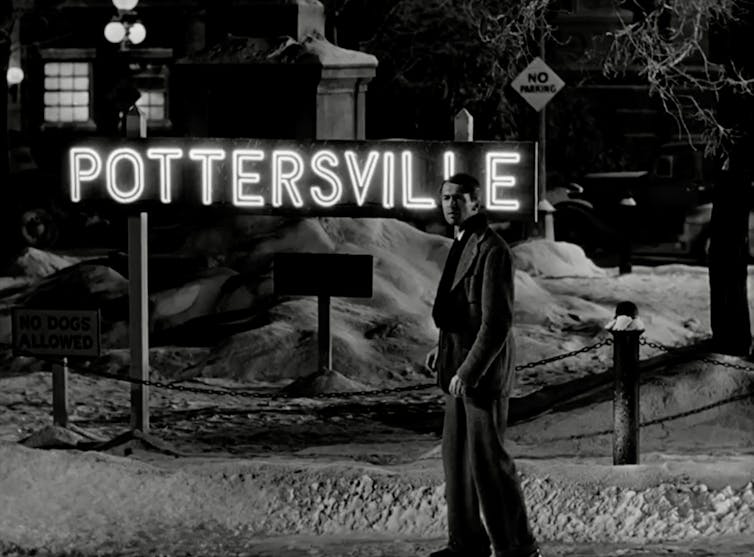
Movie still of young man walking through a dark, snowy town and passing by a bright sign reading 'Pottersville.'
Pottersville, the dark, dystopian version of Bedford Falls, is a place characterized by vice and moral decay.
Paramount

Having previously written about “It’s a Wonderful Life” in my book on literary and film censorship, I can’t help but see parallels between Pottersville and the U.S. today.

Think about it:

In Pottersville, one man hoards all the financial profits and political power.

In Pottersville, greed, corruption and cynicism reign supreme.

In Pottersville, hard-working immigrants like Giuseppe Martini who were able to build a life and run a business in Bedford Falls have vanished.

Advertisement
Get More From A Face Cleanser And Spa-like Massage

In Pottersville, homeless addicts like Mr. Gower and nonconformist “pixies” like Clarence are scorned and ostracized, then booted out of the local watering hole.

In Pottersville, cops arrest people like Violet Bick while they’re at work and haul them away, kicking and screaming.
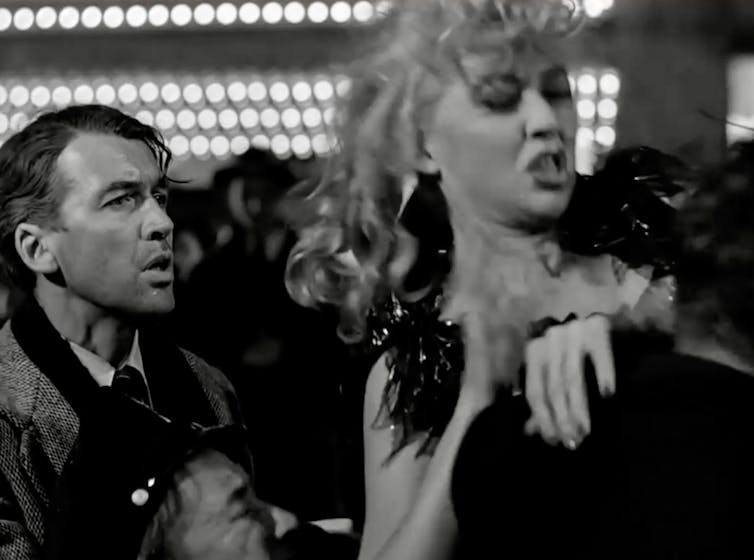
Black-and-white movie still of a young women being dragged away by the police as a worried young man looks on.
Violet Bick gets dragged away by the Pottersville police as George looks on.
Paramount

But what horrifies George the most about Pottersville is how desensitized the people living in it seem to be to its harshness and cruelty – how they treat him like he’s the crazy, deranged one for wanting and expecting things to be different and better.

This is what the current political moment feels like to me. There are days when the latest headlines feel so jarringly unprecedented that I find myself thinking, “Can this be happening? Can this be real?”

If you think these comparisons are a bit of a stretch, consider when “It’s a Wonderful Life” was made, and the frame of mind Capra was in when he made it.

Frank Capra, anti-fascist

In 1946, Capra was just returning to Hollywood filmmaking after serving for four years in the U.S. Army, where the Office of War Information had tasked him with producing a series of documentary films about World War II and the lead-up to it. Even though Capra hadn’t been on the front lines, he’d been immersed in the sounds and images of war for years on end, and he had become acutely familiar with Germany, Italy and Japan’s respective rises to fascism.

When deciding on his first postwar film, Capra recalled in his autobiography that he specifically “knew one thing – it would not be about war.” Instead, he chose to adapt a short story by Philip Van Doren Stern, “The Greatest Gift,” that Stern had originally sent to friends and family as a Christmas card in 1943.

Stern’s story is certainly not about war. But it’s not exactly about Christmas, either.

As Stern writes in his opening lines:

“The little town straggling up the hill was bright with colored Christmas lights. But George Pratt did not see them. He was leaning over the railing of the iron bridge, staring down moodily at the black water.”

The protagonist contemplates suicide because he’s “sick of everything” in the small-town “mudhole” he’s stuck in – until, that is, a “strange little man” gives him the chance to see what life would be like if he’d never been born.

It was Capra and his team of screenwriters who added the sinister Henry F. Potter to Stern’s short, simple tale. The Potter subplot encapsulates the film’s most trenchant, still-resonant themes: the unfairness of socioeconomic injustices; the pervasiveness of corporate and political corruption; the threat of monopolized power; the need for affordable housing.

Advertisement
Get More From A Face Cleanser And Spa-like Massage

These themes had, of course, run through many of Capra’s prewar films as well: “Mr. Deeds Goes to Town,” “You Can’t Take It with You,” “Meet John Doe” and “Mr. Smith Goes to Washington,” the last of which also starred Jimmy Stewart.

But they take on a different kind of weight in “It’s a Wonderful Life” – a weight that’s especially visible on the weathered face of Stewart, who himself had just returned from a harrowing four-year tour of duty as a bomber pilot in Europe.

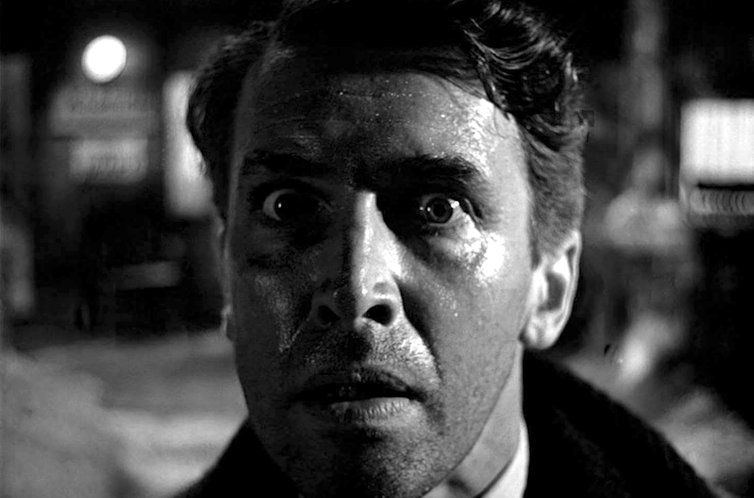
The idealistic vigor with which Stewart had fought crooked politicians and oligarchs as Mr. Smith is replaced by the bitterness, exhaustion, frustration and desperation with which he battles against Mr. Potter as George Bailey.
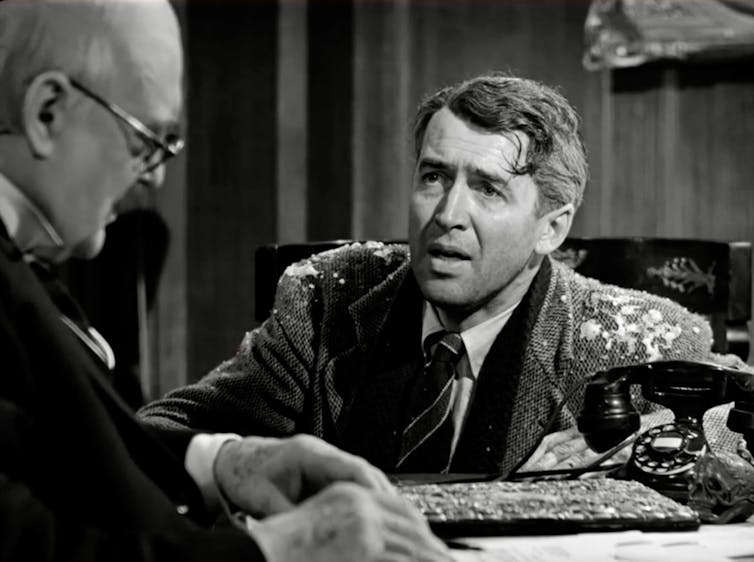
Black-and-white movie still of a distraught man with snow on his jacket.
George Bailey feels helpless in the face of corruption and cruelty.
Paramount

Life after Pottersville

By the time George has begged and pleaded his way out of Pottersville, the lost $8,000 is no longer top of mind. He’s mainly just relieved to find Bedford Falls as he had left it, warts and all.

And yet, the Bedford Falls that George returns to isn’t quite the same as the one he left behind.

In this Bedford Falls, the community rallies together to figure out a way to recoup George’s missing money. Their pre-digital version of a GoFundMe page saves George from what he’d feared most: bankruptcy, scandal and prison.

And even though his wife, Mary, tries to attribute this sudden wave of collectivist, activist energy to some sort of divine intervention – “George, it’s a miracle; it’s a miracle!” – Uncle Billy points out that it really came about through more earthly organizing means: “Mary did it, George; Mary did it! She told some people you were in trouble, and they scattered all over town collecting money!”
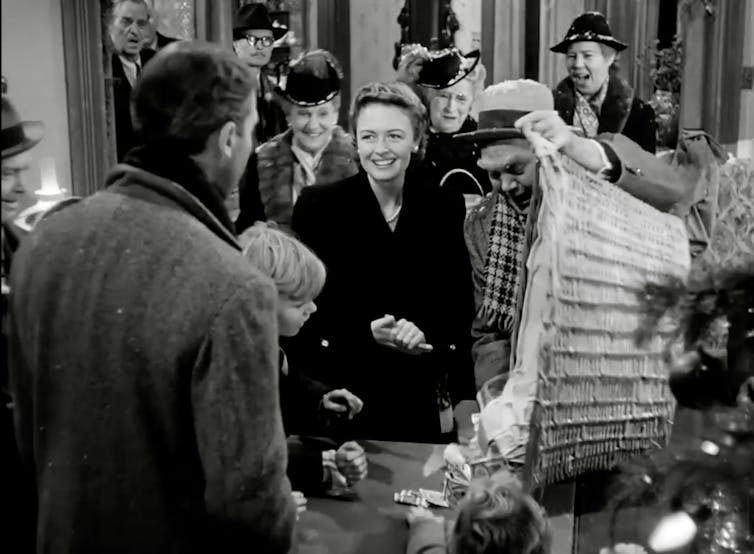
A group of smiling people dump a large basket of cash on a desk.
The residents of Bedford Falls come together to save George from financial ruin.
Paramount

But the question of whether George actually wins his battle against Potter is a murky one.

While the typical Capra protagonist triumphs by defeating vice and exposing subterfuge, George never even realizes that Potter is the one who got hold of his money and tried to ruin his life. Potter is never held accountable for his crimes.

On the other hand, George is able to learn, from his time in Pottersville, what a crucial role he plays in his community. George’s victory over Potter, then, lies not in some grand final act of retribution, but in the incremental ways he has stood up to Potter throughout his life: not capitulating to Potter’s bullying or intimidation tactics; speaking truth to power; and running a community-centered business rather than one guided by greed and exploitation.

In recent months, there have been similar acts of protest, large and small, in the form of rallies, boycotts, immigrant aid efforts, subscription cancellations, food bank donations and more.

That doesn’t mean the U.S. has made it out of Pottersville, however.

Advertisement
Get More From A Face Cleanser And Spa-like Massage

Each day, more head-spinning headlines appear, whether they’re about masked agents terrorizing immigrant communities, the dismantling of anti-corruption oversights, the consolidation of executive power or the naked display of political grift.

Zuzu’s petals are still missing. Clarence still hasn’t gotten his wings.

But this holiday season, I’m hoping it will feel helpfully cathartic to go with George Bailey, for the umpteenth time, through the dark abyss of his dystopian nightmare – and come out with him, stronger and wiser, on the other side.

Nora Gilbert, Professor of Literary and Film Studies, University of North Texas

This article is republished from The Conversation under a Creative Commons license. Read the original article.

Link: https://stmdailynews.com/dreambreaker-a-pickleball-story-a-closer-look-at-the-documentary-and-its-uncredited-voice/

Want more stories 👋
“Your morning jolt of Inspiring & Interesting Stories!”

Sign up to receive awesome articles directly to your inbox.

STM Coffee Newsletter 1

We don’t spam! Read our privacy policy for more info.

awards and contests

The Largest AI Film Competition Is a Snapshot of Where AI Filmmaking Is Headed

Higgsfield released results from its largest AI filmmaking competition: nearly 8,800 submissions from 139 countries and $500,000 in prizes—highlighting a fast-growing, global, creator-led filmmaking ecosystem.

Published

on

A year ago, “AI film” still sounded like a niche experiment—cool demos, rough edges, and lots of debate about whether it could ever look truly cinematic. Higgsfield’s latest competition results suggest we’ve crossed into a new phase: AI filmmaking is becoming a real, global production lane, driven by independent creators working outside traditional studio systems.

AI Filmmaking Goes Worldwide: Higgsfield Contest Highlights New Creator Hubs and Workflows
Higgsfield’s AI Film Competition

According to the company, its AI Film Competition drew nearly 8,800 submissions from 139 countries, with a $500,000 cash prize pool distributed to independent filmmakers. Beyond the winners, the dataset reads like a market signal: generative tools are lowering the cost of entry for high-end visuals, and the talent pipeline is no longer geographically locked to legacy production hubs.

A global creator map is replacing the old studio map

One of the most telling takeaways is where the work is coming from. Higgsfield reports the largest volume of entries came from:

  • India (1,805)
  • United States (1,041)
  • Germany (278)
  • France (230)
  • Italy (228)
  • Brazil (212)
  • United Kingdom (196)

Historically, cinematic action and high-end VFX were concentrated in a handful of established centers—places with the budgets, infrastructure, and specialized crews to pull off complex sequences. Higgsfield’s results point to a different reality: subscription-based, production-grade AI tools are reducing geographic barriers, enabling creators across Latin America, Southeast Asia, and Eastern Europe to compete in the same visual arena.

Higgsfield CEO Alex Mashrabov framed it as a creator inflection point, arguing that the scale of participation signals the next breakout franchise “can come from anywhere on Earth.” Whether or not you buy the blockbuster prediction, the underlying shift is hard to ignore: global access is now a feature of the production model.

AI Filmmaking Goes Worldwide: Higgsfield Contest Highlights New Creator Hubs and Workflows
Higgsfield’s AI Film Competition Winner, ‘Grandma vs Wasp’ by Muhannad Nassar and Simon Meyer

The judging criteria hints at what matters next

Another important detail: the prize pool wasn’t awarded for “best render” alone. Higgsfield says the jury—made up of both traditional production veterans and AI-native creators—prioritized storytelling and directorial intent over technical polish.

That’s a meaningful signal for where AI filmmaking is headed. As tools improve, the baseline for visual quality rises. What differentiates creators isn’t just the ability to generate a shot—it’s the ability to direct one: pacing, tone, character, and clarity of vision.

The jury included names and studios spanning both worlds, such as Secret Level (founded by Emmy-winning filmmaker Jason Zada), Buralqy, concept artist Jama Jurabaev, and PJ Ace of Genre.ai—who called it “the best-looking AI film contest” they’ve seen.

Decentralized production is no longer theoretical

The Grand Prize winner is also a case study in how AI changes collaboration. 1st Place ($150,000) went to Muhannad Nassar (Detroit) and Simon Meyer (Germany) for “GRANDMA vs WASP.” The pair reportedly never met in person, instead using an asynchronous workflow across time zones with Higgsfield’s Cinema Studio.

That’s not just a fun anecdote—it’s a preview of a parallel production ecosystem where teams form around taste and capability rather than geography. If the toolchain is centralized in the cloud, the “studio” becomes a workflow, not a building.

Winners show two pathways: new creators and experienced pros

The rest of the top placements reflect how broad the adoption curve is becoming:

  • 2nd Place ($100,000): Nikolay Shestak for “CUPID,” using Higgsfield to execute concepts that would normally be budget-prohibitive. He plans to apply the prize toward an independent superhero film.
  • 3rd Place ($50,000): Brothers Ash and Aram Gevorkyan for “SCRATCH,” created in five days. Ash noted audiences mistook it for a studio-backed theatrical release and asked for a link to the “full movie.”

What’s emerging is a two-lane future: newcomers using AI to enter filmmaking for the first time, and established creatives using it to expand what they can produce independently.

Money is starting to loop back into production

Higgsfield also highlights something that looks a lot like early-stage industry deal flow: one top winner is reportedly reinvesting prize money back into the platform to produce a feature-length film, and the project has already attracted involvement from a major Hollywood figure.

That matters because it suggests AI-generated work isn’t staying in a separate “AI corner.” It’s beginning to intersect with the traditional financing-and-distribution ecosystem—especially when the output looks cinematic enough to be taken seriously.

Advertisement
Get More From A Face Cleanser And Spa-like Massage

The market is growing—and the infrastructure is consolidating

The competition results land in a market that’s expanding quickly. Citing Grand View Research, Higgsfield notes the global AI video generator market was estimated at $788.5 million in 2025 and is projected to reach $3.44 billion by 2033 (a 20.3% CAGR).

Higgsfield is positioning itself as an all-in-one workflow layer, combining its own models with third-party options (including OpenAI’s Sora and Google’s Veo, among others) so creators can choose the best model per task without rebuilding pipelines. The company says it serves 20 million+ users who have generated 50 million+ videos, and it reports a most recent valuation of $1.3 billion.

What to watch for next

If you’re tracking where AI filmmaking is going, this competition offers a few clear “watch points”:

  • More global breakout creators as the cost of cinematic visuals continues to fall
  • Decentralized teams forming around projects, not locations
  • A shift from “can it look good?” to “can you direct it?” as quality becomes more accessible
  • Traditional industry crossover as AI-native projects attract recognizable partners

Want to see the winning films and action scenes? Higgsfield has them here: https://higgsfield.ai/contests/make-your-action-scene

Source: Higgsfield press release distributed via PRNewswire (March 18, 2026).

Looking for an entertainment experience that transcends the ordinary? Look no further than STM Daily News Blog’s vibrant Entertainment section. Immerse yourself in the captivating world of indie films, streaming and podcasts, movie reviews, music, expos, venues, and theme and amusement parks. Discover hidden cinematic gems, binge-worthy series and addictive podcasts, gain insights into the latest releases with our movie reviews, explore the latest trends in music, dive into the vibrant atmosphere of expos, and embark on thrilling adventures in breathtaking venues and theme parks. Join us at STM Entertainment and let your entertainment journey begin! https://stmdailynews.com/category/entertainment/

and let your entertainment journey begin!

Continue Reading

Festivals

Presqu’ile Winery Partners With LAND to Bring Contemporary Art to Santa Maria Valley

Presqu’ile Winery and LAND are partnering to bring free, site-responsive contemporary art to the Santa Maria Valley estate in Santa Barbara Wine Country.

Published

on

glass of wine
Photo by Arthur Brognoli on Pexels.com

Santa Barbara Wine Country is about to get a fresh reason to linger a little longer. Presqu’ile Winery has announced a new collaboration with Los Angeles Nomadic Division (LAND), the nationally recognized nonprofit known for taking contemporary art out of traditional museums and galleries and placing it directly into the environments that shape it. The result: curated, site-responsive works—some created specifically for the property—installed across Presqu’ile’s Santa Maria Valley estate.

A winery becomes an open-air gallery—at no cost

Under the partnership, Presqu’ile will serve as a host site for LAND programming, opening its estate to the public for free. Visitors can expect contemporary art integrated into the vineyard setting, with select installations shaped by the landscape itself. The goal is simple and ambitious at the same time: expand no-cost access to contemporary art along California’s Central Coast while creating a cultural experience that feels inseparable from the place it inhabits.

LAND’s approach is rooted in the belief that art should be experienced where people actually live, work, and gather. Rather than building exhibitions around white walls and controlled lighting, LAND supports projects driven by place—work that engages the environment, the community, and the lived experience of the artists creating it.

“Nourishing reciprocity” between art, landscape, and community

Laura Hyatt, Director of LAND, emphasized how the Central Coast setting opens new creative possibilities for artists.

Hyatt noted that collaborating with Presqu’ile gives artists the opportunity to engage with the region’s natural beauty and unique ecology—placing artworks in what she described as “nourishing reciprocity” with the landscape and the visitors moving through it. She also highlighted the long-term potential of the partnership, which allows for deeper exploration over time, expands LAND’s geographic reach, and strengthens connections between Southern and Central California.

For Hyatt, the collaboration is personal as well: her family has roots in the area going back five generations, adding another layer of community connection to the work LAND hopes to cultivate.

A shared mindset: tradition, experimentation, and a sense of place

Presqu’ile framed the partnership as a natural extension of what the winery already does—balancing tradition with experimentation. In the same way winemaking can honor time-tested methods while still pushing toward new expressions, contemporary art can offer new ways of seeing familiar processes and landscapes.

Matt Murphy, co-founder of Presqu’ile Winery, said the family’s appreciation for the visual arts made the collaboration an easy “yes.” He pointed to the opportunity to create “fun, compelling and unexpected” ways for the community to engage with both the installations and the estate itself—and to experience Presqu’ile through each artist’s creative lens.

PQLAND
Presqu’ile Winery x LAND

What happens next

In the near term, LAND will install artworks developed through its programming on the Presqu’ile property, with public access remaining free. The collaboration is designed with community benefit at its center, positioning the estate as a cultural and agricultural destination—not just a tasting room.

Looking ahead, Presqu’ile has submitted plans for approval to develop expanded spaces intended to support free public art, cultural programming, and community gathering. If approved, those improvements would signal a long-term commitment to integrating arts and culture into the estate experience and welcoming future partners whose work aligns with Presqu’ile’s values of openness, creativity, and place-based expression.

Additional details—including participating artists and installation timelines—will be announced as the collaboration progresses.

About the partners

Presqu’ile Winery

Presqu’ile (pronounced press-keel) is a family-owned estate winery in Santa Maria Valley on California’s Central Coast. Founded in 2007, the winery produces cool-climate wines from its sustainably farmed estate vineyard and from a select group of growers across Santa Barbara County. The name—French Creole for “almost an island”—reflects the Murphy family’s Gulf Coast heritage and the winery’s deep emphasis on place.

Advertisement
Get More From A Face Cleanser And Spa-like Massage

Los Angeles Nomadic Division (LAND)

Founded in 2009, LAND is a nonprofit arts organization dedicated to connecting people and places through site-responsive public art and programs. Over 15 years, LAND has presented more than 500 artists across 300+ programs and exhibitions, ranging from large-scale sculptural commissions to billboards, roadside screenings, workshops, and city-wide video presentations—reaching millions of people.

Why it matters

This collaboration isn’t just about adding art to a winery—it’s about rethinking where art belongs, who gets to access it, and how landscape can become part of the creative process. For the Central Coast, Presqu’ile and LAND are setting the stage for a new kind of cultural destination: one where a walk through the vines can also be a walk through contemporary ideas, made visible in the open air.

Source: Presqu’ile Winery

Organization: Los Angeles Nomadic Division (LAND)

Our Lifestyle section on STM Daily News is a hub of inspiration and practical information, offering a range of articles that touch on various aspects of daily life. From tips on family finances to guides for maintaining health and wellness, we strive to empower our readers with knowledge and resources to enhance their lifestyles. Whether you’re seeking outdoor activity ideas, fashion trends, or travel recommendations, our lifestyle section has got you covered. Visit us today at https://stmdailynews.com/category/lifestyle/ and embark on a journey of discovery and self-improvement.

Author

Continue Reading

Food and Beverage

NYC to Host 5th International Volcanic Wines Conference on June 10

New York City will host the 5th International Volcanic Wines Conference on June 10, 2026 at Manhatta, featuring global volcanic regions, masterclasses, a Grand Tasting, and the Volcanic Wine Awards with JancisRobinson.com.

Published

on

New York City is about to get a crash course in “wines with a sense of place.” Volcanic Wines International (VWI) announced the 5th International Volcanic Wines Conference (IVWC), set for June 10, 2026 at Manhatta in Manhattan. The one-day event brings together producers, sommeliers, buyers, journalists, and educators for tastings and masterclasses focused on wines grown in volcanic soils—an increasingly talked-about category known for its tension, mineral-driven structure, and unmistakable origin.

red wine pouring into glass close up shot. 5th International Volcanic Wines Conference (IVWC)
Photo by Andrew Patrick Photo on Pexels.com

Why volcanic wines are having a moment

Volcanic vineyards sit on some of the planet’s most dramatic landscapes—think steep slopes, black sand, and lava-strewn terrain. But the conference isn’t just about scenery. The IVWC is built around a simple idea: volcanic terroir can shape wine in distinctive ways, influencing everything from texture and acidity to aromatics and perceived “energy” in the glass.

As VWI co-founder John Szabo, MS put it, volcanic wines often stand out for their “energy, structure, and clear sense of origin,” making them a natural fit for wine lists that prioritize discovery.

A global tasting tour—without leaving Manhattan

Hosted in what VWI calls the largest and most influential wine market in the U.S., the conference offers a rare side-by-side look at volcanic regions from around the world. Participating producers are expected from territories including:

  • Etna (Sicily)
  • Santorini (Greece)
  • Canary Islands (Spain)
  • Hungary
  • Pantelleria (Italy)
  • Lake County (California)

Masterclasses, seminars, and a Grand Tasting

The June 10 program is designed for wine professionals who want to go deeper than a quick sip. Attendees can expect guided tastings and educational sessions exploring how different volcanic soils—and the climates that surround them—can influence grape varieties and wine styles.

Seminars are slated to spotlight volcanic wines from:

  • Soave (Italy)
  • Etna
  • Hungary
  • Canary Islands
  • Lazio (Italy)

The day also includes a Grand Tasting, where exhibiting wineries will pour for a curated audience of sommeliers, buyers, importers, educators, and media.

A new “Volcanic Origin” certification will be announced in the U.S.

One of the headline moments: the conference will host the official U.S. announcement of a new Volcanic Origin certification, created by the Vinora association of Auvergne, France. The certification is designed to help recognize authentic expressions from volcanic regions worldwide—an important step as interest grows and consumers look for clearer signals of provenance.

Volcanic Wine Awards + JancisRobinson.com partnership

VWI also highlighted a major media partnership with JancisRobinson.com for the Volcanic Wine Awards, an international competition celebrating standout wines from volcanic regions.

Award-winning wines will be featured on JancisRobinson.com and showcased in a dedicated space during the NYC conference.

“Volcanic regions produce some of the most characterful wines in the world,” said Tara Q Thomas, Managing Editor at JancisRobinson.com, adding that the partnership aims to bring greater attention to these terroirs.

The big picture: story-driven wine in a crowded market

Beyond the technical details, the conference is tapping into something the wine world is actively chasing: narrative and identity.

“Today more than ever, the wine world needs compelling stories that reconnect wine lovers with place and identity,” said Gino Colangelo, President of Colangelo & Partners and partner in VWI. Volcanic wines, he noted, offer “dramatic landscapes, ancient soils, and wines with unmistakable character.”

Advertisement
Get More From A Face Cleanser And Spa-like Massage

How to attend or exhibit

For information about exhibiting or attending, VWI directs inquiries to Bianca Panichi at bpanichi@colangelopr.com. Updates are also available at www.volcanicwinesinternational.com, with social channels on Instagram (@volcanicwines_intl) and Facebook (Volcanic Wines International).

What to watch for (STM Daily News)

  • Whether the new Volcanic Origin certification becomes a widely adopted benchmark
  • Which regions and producers dominate the Volcanic Wine Awards spotlight
  • How volcanic wines continue to move from “sommelier obsession” to broader consumer demand

Hungry for what’s next? STM Daily News’ Food and Drink section dishes up the latest in restaurant news, beverage trends, seasonal recipes, culinary events, and food culture stories readers love to share.

Continue Reading

Trending