Influencer Alix Earle, a self-described ‘hot mess,’ has legions of online haters. Greg Doherty/Getty Images for RevolveJessica Maddox, University of Alabama and Jess Rauchberg, Seton Hall University Since 2020, content creator Remi Bader had accumulated millions of TikTok followers by offering her opinions on the fits of popular clothing brands as a plus-size woman. In 2023, however, Bader appeared noticeably thinner. When some fans asked her whether she’d undergone a procedure, she blocked them. Later that year, she announced that she would no longer be posting about her body. Enter snark subreddits. On Reddit, these forums exist for the sole purpose of calling out internet celebrities, whether they’re devoted to dinging the late-night antics of self-described “hot mess” Alix Earle or venting over Savannah and Cole LaBrant, a family vlogging couple who misleadingly implied that their daughter had cancer. While the internet is synonymous with fan culture, snark subreddits aren’t for enthusiasts. Instead, snarkers are anti-fans who hone the art of hating.Remi Bader attends New York Fashion Week on Feb. 10, 2025.Dimitrios Kambouris/Getty Images for Tory Burch After Bader’s refusal to talk about her weight loss, the Remi Bader snark subreddit blew up. Posters weren’t upset that Bader had lost weight or had stopped posting about her body size. Instead, they believed Bader the influencer, who’d built her brand on plus-size inclusion in fashion, wasn’t being straight with her fans and needed to be taken to account. It worked. During a March 2025 appearance on Khloe Kardashian’s podcast, Bader finally revealed that she had, in fact, had weight-loss surgery. Some critics see snarkers as a big problem and understandably denounce their tendency to harass, body shame and try to cancel influencers. But completely dismissing snark glosses over the fact that it can serve a purpose. In our work as social media researchers, we’ve written about how snark can actually be thought of as a way to call out bad actors in the largely unregulated world of influencing and content creation.
Grassroots policing
Before there were influencers, there were bloggers. While bloggers covered topics that ranged from entertainment to politics to travel, parenting and fashion bloggers probably have the closest connection to today’s influencers. After Google introduced AdSense in 2003, bloggers were easily able to run advertising on their websites. Then brands saw an opportunity. Parenting and fashion bloggers had large, loyal followings. Many readers felt an intimate connection to their favorite bloggers, who seemed more like friends than out-of-touch celebrity spokespersons. Brands realized they could send bloggers their products in exchange for a write-up or a feature. Furthermore, advertisers understood that parenting and fashion bloggers didn’t have to adhere to the same industry regulations or code of ethics as most news media outlets, such as disclosing payments or conflicts of interest. This changed the dynamic between bloggers and their fans, who wondered whether bloggers could be trusted if they were sometimes being paid to promote certain products. In response, websites emerged in 2009 to critique bloggers. “Get Off My Internets,” for example, fashioned itself as a “quality control watchdog” to provide constructive criticism and call out deceptive practices. As Instagram and YouTube became more popular, the subreddit “r/Blogsnark” launched in 2015 to critique early influencers, in addition to bloggers.
Few guardrails in place
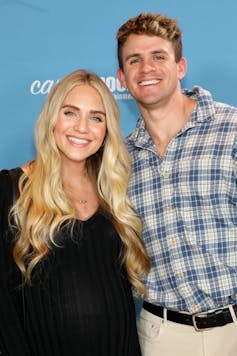
Today the influencer industry has a valuation of over US$250 billion in the U.S. alone, and it’s on track to be worth over $500 billion by 2027. Yet there are few regulations in place for influencers. A few laws have emerged to protect child influencers, and the U.S. Federal Trade Commission has established legal guidelines for sponsored content. That said, the influencing industry remains rife with exploitation. It goes both ways: Corporations can exploit influencers. For example, a 2021 study found that Black influencers receive below-market offers compared with white influencers.Savannah and Cole LaBrant came under fire for implying that their daughter had cancer, in what their critics called a ploy for attention.Danielle Del Valle/Getty Images for Lionsgate Likewise, influencers can deceive or exploit their followers. They might use unrealistic body filters to appear thinner than they are. They could hide who’s paying them. They may promote health misinformation such as the controversial ParaGuard cleanse, a fake treatment pushed by wellness influencers that claimed to rid its users of parasites. Or, in the case of Remi Bader, they might gain a huge following by promoting body positivity, only to conceal a weight-loss procedure from their fans. For disappointed fans or followers who feel burned, snark can seem like the only regulatory guardrail in an industry that has gone largely unchecked. Think of snark as a Better Business Bureau for the untamable world of influencing – a form of accountability that brings attention to the scammers and hustlers.
Keeping it real
Todays’s snark exists at the intersection of gossip and cancel culture. Though cancel culture certainly has its faults, we approach cancel culture in our writing as a worthy tool that allows audiences to hold the powerful accountable. For example, communities of color have joined forces to call out racists, as they did in 2024 when they exposed lifestyle influencer Brooke Schofield’s anti-Black tweets. Influencers build trust with their audiences based on being “real” and relatable. But there’s nothing preventing them from breaking that trust, and snarkers can swoop in to point out bad behavior or hypocrisy. Within the competitive world of family vlogging, snarkers see themselves as doing more than stirring the pot. They’re truth-tellers who bring injustices to light, such as abuse and child labor exploitation. Some of this exposure is paying off, with more and more states introducing and passing family vlogger laws that require children to one day receive a portion of their parents’ earnings or restrict how often children can appear in their parents’ videos. Yes, snark can veer into cyberbullying. But that shouldn’t discount its value as a tool for transparency. Influencers are ultimately brands. They sell audiences ideas, lifestyles and products. When people feel as if they’ve been misled, we think they have every right to call it out. Jessica Maddox, Assistant Professor of Journalism and Creative Media, University of Alabama and Jess Rauchberg, Assistant Professor of Communication Technologies, Seton Hall University This article is republished from The Conversation under a Creative Commons license. Read the original article.
The Substitute Teacher Who Wanted Blueprints of Our House
A fifth-grade assignment took a strange turn when a substitute teacher asked students to draw schematics of their homes. What followed — a wildly fictional floor plan and a priceless reaction from my mom — turned into one of my funniest childhood memories.
The Substitute Teacher Who Wanted Blueprints of Our House
Elementary school memories tend to blend together — cafeteria pizza, playground arguments, the eternal struggle of times tables — but every once in a while, something happens that sticks with you for life. For me, that moment came in the fifth grade during a week when our regular teacher was out, and we cycled through substitute teachers like we were testing models for durability. By midweek, in walked a substitute with a mysterious, slightly intense energy — the kind of vibe that suggested he either meditated at dawn or worked a graveyard shift doing something he couldn’t talk about. We settled into our seats, expecting worksheets or quiet reading time. But nope. He had other plans. “Today,” he announced, “we’re going to draw schematics of our houses.” Schematics. Not drawings. Not little houses with smoke coming out of the chimney. Actual blueprint-style schematics. He wanted the layout of our bedrooms, our parents’ rooms, and where the pets slept. Every detail. Now, to be fair, Highlights Magazine did have a feature that month teaching kids how to draw floor plans. So maybe he was just a bit overenthusiastic about cross-curricular learning. Or maybe — and this is my completely rhetorical adult theory — he worked the graveyard shift as a cat burglar gathering intel between heists. Just moonlighting between blueprints. While the rest of the class tried their best to recreate their actual homes, my imagination sprinted in a totally different direction. The house I drew had:
A massive master bedroom with an oversized bathroom for my parents
Separate bedrooms for us kids on the opposite side of the house
A kitchen placed right in the center like a command center
And the dog — the true VIP — had a luxurious two-story doghouse
I had basically created a dream home designed by a 10-year-old watching too much Fantasy Homes by the Yard. Later that day, my mom asked the usual question: “So, what did you guys do today?” “We drew schematics of our house,” I said casually. The look on her face was instant and intense. She wasn’t panicked, but there was definitely a “Why does a substitute teacher need to know the exact layout of my home?” expression happening. Parental instincts activated. But then I showed her my diagram. She stared at it. Blinked. Then sighed with massive relief. “This isn’t our house,” she said. “Nope! I made it up,” I replied proudly. Her shoulders relaxed so much she probably lost five pounds of tension in one instant. If the substitute was secretly planning a heist, my masterpiece of misinformation would have sent him to the wrong house entirely. Looking back, the whole moment feels like a sitcom setup — a mysterious substitute collecting “house schematics,” me creating a completely fictional piece of architecture, and my mom going on a full emotional journey in under 30 seconds. Maybe he was just excited about the Highlights Magazine floor-plan activity. Or maybe — just maybe — he moonlighted in cat burglary. We’ll never know. But if he was, I like to think I threw him completely off the scent.
Enjoy this story?
Check out more nostalgic and humorous stories on STM Daily News and be sure to sign up for our newsletter!
Our Lifestyle section on STM Daily News is a hub of inspiration and practical information, offering a range of articles that touch on various aspects of daily life. From tips on family finances to guides for maintaining health and wellness, we strive to empower our readers with knowledge and resources to enhance their lifestyles. Whether you’re seeking outdoor activity ideas, fashion trends, or travel recommendations, our lifestyle section has got you covered. Visit us today at https://stmdailynews.com/category/lifestyle/ and embark on a journey of discovery and self-improvement.
How China cleaned up its air pollution – and what that meant for the climate
How China cleaned up its air pollution: Beijing’s air quality went from hazardous to good while Delhi and Lahore still struggle. Discover how China dramatically reduced pollution since 2013—and why cleaner air may have unintended consequences for global warming and climate change.
Delhi: 442. Lahore: 334. Beijing: 16. These are the levels of PM 2.5, one of the principle measures for air pollution, on November 19. As Pakistanis and Indians struggle with hazardous air quality, in Beijing – a city once notorious for its smog – the air quality is currently rated as good. Ahead of the 2008 Beijing Olympics, the Chinese government was so concerned about pollution that it introduced temporary restrictions on cars, shut down factories and stopped work on some construction sites. The measures worked and one study later found that levels of air pollution were down 30% during the period when the temporary Olympic restrictions were in place. It would take a few more years before the Chinese government implemented a clean air action plan in 2013. Since then, China has achieved a dramatic improvement in its air quality. In this episode of The Conversation Weekly podcast, we speak to Laura Wilcox, a professor at the National Centre for Atmospheric Science at the University of Reading in the UK, to understand how China managed to clean up its air pollution. But Wilcox’s recent research uncovered some unintended consequences from this cleaner air for the global climate: the pollution was actually helping to cool the atmosphere and by taking it away, it may have accelerated global warming. Wilcox explains:
What we’re seeing is a removing of cooling that’s revealing warming that’s already there. So the air pollution isn’t the cause of the warming. It’s just letting us see stuff that we’ve already done.
Dive into “The Knowledge,” where curiosity meets clarity. This playlist, in collaboration with STMDailyNews.com, is designed for viewers who value historical accuracy and insightful learning. Our short videos, ranging from 30 seconds to a minute and a half, make complex subjects easy to grasp in no time. Covering everything from historical events to contemporary processes and entertainment, “The Knowledge” bridges the past with the present. In a world where information is abundant yet often misused, our series aims to guide you through the noise, preserving vital knowledge and truths that shape our lives today. Perfect for curious minds eager to discover the ‘why’ and ‘how’ of everything around us. Subscribe and join in as we explore the facts that matter. https://stmdailynews.com/the-knowledge/
What makes a true Santa is inside – and comes with the red suit
Research on 849 professional Santas reveals three types: prototypical, semi-prototypical, and nonprototypical. Discover how diverse Santas navigate stereotypes and why many see the red suit as a calling, not just a job.
Members of the Fraternal Order of Real Bearded Santas meet at Pink’s restaurant at Knott’s Berry Farm before the holiday rush in 2009. Business Wire via AP
What makes a true Santa is inside – and comes with the red suit
Christina Hymer, University of Tennessee When you picture Santa Claus, a white, bearded, overweight and jolly man who dashes around delivering gifts to children during the Christmas season probably comes to mind. Yet, not everyone who dons the red suit fits this stereotype. That’s what Bethany Cockburn, Borbala Csillag and I learned when we teamed up to study professional Santas. For our study, we looked into how these professional Santas were able to “be” Santa, even if they didn’t fully fit the image. As we explained in a forthcoming article in the Academy of Management Journal, many who do this work don’t see it as just a job – it’s a calling. For some professional Santas, it’s especially important that they look and feel like Santa to experience that sense of purpose in their work. We surveyed 849 professional Santas who live across the U.S. and interviewed 53 of them, collecting data between 2018 and 2021. We identified three types of professional Santas: prototypical (64%), semi-prototypical (23%) and nonprototypical (13%). Prototypical Santas look the part. They are white and overweight, have real beards and express confidence that they are the right fit. Semi-prototypical Santas looked the part, too, but felt like they weren’t quite suitable for a range of reasons. They might be introverted or use a fake beard. Nonprototypical Santas had characteristics at odds with the stereotype. They might be nonwhite, female or gay, or have a physical disability.Many Santas see their work, whether paid or volunteer, as a calling.Photo by Gwyn Sussman Whereas prototypical Santas could easily slide into the Santa role, the process was more complex for the others. Semi-prototypical Santas did things like come up with stories they’d tell themselves or share with children to explain away their fake beards. Nonprototypical Santas had values aligned with the Santa image, such as being peaceful, loving and kind. But they still made a big effort to look like what people expect when they visit a Santa. “Should it be a difference if you’re a Jewish Santa Claus or a Catholic Santa Claus?” asked an atheist professional Santa we called “Santa Aquila.” “No. You’re Santa Claus. What do you do? You’re not even supposed to preach anything.” Another Santa whom we called “Santa Lynx” hid that she was female in part by flattening her chest.
Why it matters
While anyone can take a turn being their neighborhood potluck’s Santa, the one you meet at the mall probably attended some combination of Santa schools, webinars and training. For instance, the Charles W. Howard Santa Claus School was founded in 1937 and conducts an annual Santa training each year. National networks also exist, such as the Fraternal Order of Real Bearded Santas, which says it has 1,000 members, – and the IBRBS, formerly known as the International Brotherhood of Real Bearded Santas, offering meetups and professional support.Actor B.J. Averell, dressed as Santa Claus, attends a toy drive for struggling Bay Area families in Burlingame, Calif., in December 2024.Tayfun Coskun/Anadolu via Getty Images There are also local organizations, such as the Lone Star Santas network in Texas. Although most professional Santas are paid for their work, many do this voluntarily. It’s not uncommon for there to be some sort of expectation around who should have a particular occupation. Pilots tend to be male, most schoolteachers are female, and salespeople are often seen as extroverted. But that doesn’t mean that women can’t be pilots, men can’t be teachers or that introverts can’t work in sales.
What’s next
I’m now looking at how broader institutional environments, current events and social movements can shape how people experience their callings and find meaning at work. The Research Brief is a short take on interesting academic work.Christina Hymer, Assistant Professor of Management and Entrepreneurship, University of Tennessee This article is republished from The Conversation under a Creative Commons license. Read the original article.
Dive into “The Knowledge,” where curiosity meets clarity. This playlist, in collaboration with STMDailyNews.com, is designed for viewers who value historical accuracy and insightful learning. Our short videos, ranging from 30 seconds to a minute and a half, make complex subjects easy to grasp in no time. Covering everything from historical events to contemporary processes and entertainment, “The Knowledge” bridges the past with the present. In a world where information is abundant yet often misused, our series aims to guide you through the noise, preserving vital knowledge and truths that shape our lives today. Perfect for curious minds eager to discover the ‘why’ and ‘how’ of everything around us. Subscribe and join in as we explore the facts that matter. https://stmdailynews.com/the-knowledge/