

News
In World War II’s dog-eat-dog struggle for resources, a Greenland mine launched a new world order
Greenland’s cryolite mine, vital for U.S. airplane production during World War II, became strategically important after Nazi invasions of Europe. President Roosevelt emphasized its significance in national security, advocating for its protection. This shifted U.S. resource access policies and shaped post-war international relations, prioritizing strategic minerals and military bases.

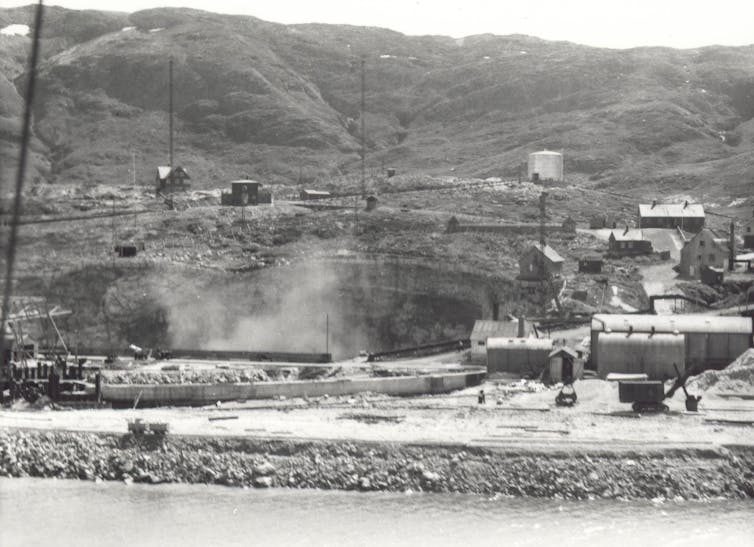
Thomas Robertson, Macalester College
On April 9, 1940, Nazi tanks stormed into Denmark. A month later, they blitzed into Belgium, Holland and France. As Americans grew increasingly rattled by the spreading threat, a surprising place became crucial to U.S. national security: the vast, ice-capped island of Greenland.
The island, a colony of Denmark’s at the time, was rich in mineral resources. The Nazi invasions left it and several other European colonies as international orphans.
Greenland was essential for air bases as U.S. planes flew to Europe, and also for strategic minerals. Greenland’s Ivittuut (formerly Ivigtut) mine contained the world’s only reliable supply of the most important material you’ve probably never heard of: cryolite, a frosty white mineral that the U.S. and Canadian industries relied upon to refine bauxite into aluminum, and thus essential to assembling a modern air force.
A month after the Nazis seized Denmark, five American Coast Guard cutters set sail for Greenland, in part to protect the Ivittuut mine from the Nazis.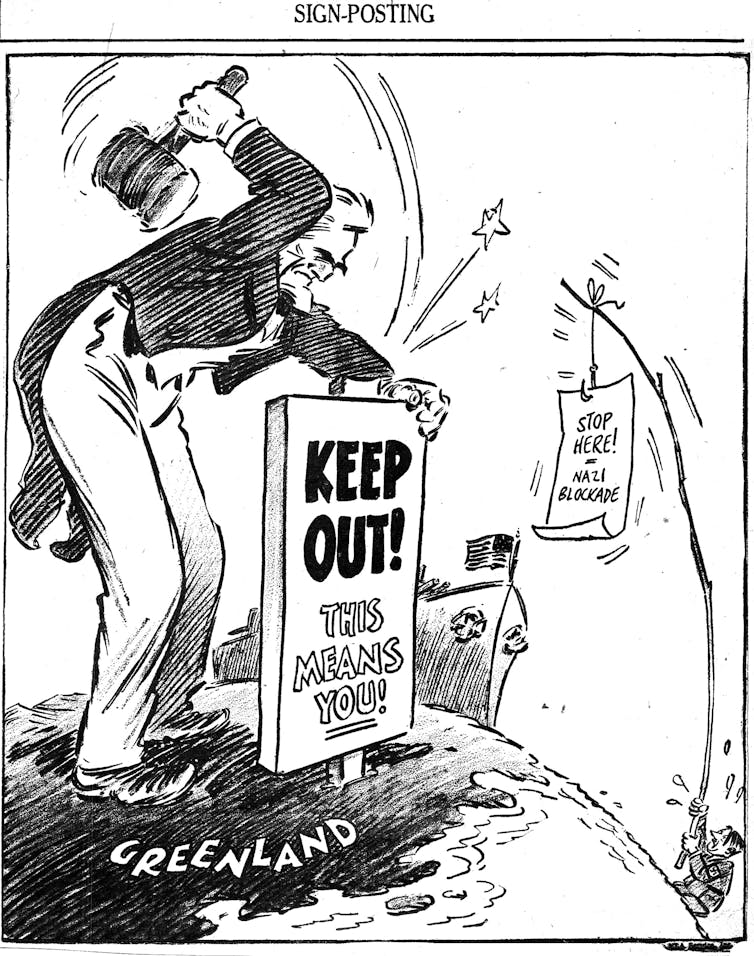
People sometimes forget that World War II was a dog-eat-dog struggle for resources – oil and uranium but also dozens of other materials, everything from rubber to copper. Without these strategic materials, no modern military could produce crucial new weapons such as tanks and airplanes. The resource struggle often started before actual fighting.
Foreign materials fueled American global power, but also raised tricky questions about access to resources and about sovereignty, just as the old European imperial order was being rethought. As in 2026, U.S. presidents had to skillfully balance force and diplomacy.
As a historian at Macalester College, I research how Americans shape environments around the world through their purchasing and national security needs, and how foreign landscapes enable and constrain American actions. Today, control of Greenland’s natural resources is again on an American president’s radar as demand for critical minerals rises and supply tightens.
During the spring of 1940, America and its European allies mapped out patterns of resource use and ideas of global interconnection that would shape the international order for decades. Greenland helped give birth to this new order.
Rethinking American vulnerability
On May 16, 1940, President Franklin Roosevelt addressed a joint session of Congress, including many “American first” isolationists wary of European entanglements. Roosevelt implored Americans to wake up to new threats in the world – to, in his words, “recast their thinking about national protection.”
New weapons, he warned, had shrunk the world, and oceans could no longer shield the United States. The nation’s fate was inextricably tied to Europe’s. Nothing showed this better than Greenland: “From the fiords of Greenland,” FDR warned, “it is four hours by air to Newfoundland; five hours to Nova Scotia, New Brunswick and to the province of Quebec; and only six hours to New England.”
But Greenland set off alarm bells for another reason. To protect itself in a dangerous world, Roosevelt famously called for the U.S. to hammer out 50,000 planes a year. But in 1938, America had produced only 1,800 planes.
To meet this ambitious goal, Roosevelt and his advisers knew that little could be done without Greenland. No Greenland, no cryolite. No cryolite, no massive American air force. Without cryolite, making 50,000 planes would be infinitely more difficult.
The age of alloys
Americans, National Geographic explained in 1942, lived in an “age of alloys.” Without aluminum alloys and other metallic mixtures, assembly lines churning out modern tanks, trucks and airplanes would grind to a halt. “More than any other struggle in history, this is a war of many metals, and the lack of a single one may be a blow far worse than the loss of a battle.”

Few materials mattered more than aluminum. Light yet strong, aluminum formed 60% of a heavy bomber’s engines, 90% of its wings and fuselage, and all of its propellers.
But there was a problem: Refining aluminum from bauxite ore required working with dangerously hot metallic mixtures, over 2,000 degrees Fahrenheit (1,100 degrees Celsius). Cryolite solved the problem by reducing the temperature to a more manageable 900 F (480 C).
The Nazis’ chemical industry had found a substitute for cryolite using fluorspar, but the U.S. preferred the more resource-efficient cryolite and wanted to prevent the Germans from having it.
After the Nazis seized Denmark
Just days after German tanks rolled into Denmark in April 1940, Allied officials huddled to devise ways to protect Ivittuut’s magical mineral. On May 3, Danish Ambassador to the U.S. Henrik de Kauffmann, risking trial for treason, requested American assistance. On May 10, the U.S. Coast Guard Cutter Comanche departed New England for Ivittuut. Four others soon followed, one with guns for the mine’s defenders.
That very week in Washington, at a meeting of the Pan American Union, Roosevelt and his advisers spoke with hundreds of geologists and other representatives from Latin America — a resource-rich region that the U.S. saw as an answer to its strategic materials shortages.
Nervous about the history of U.S. imperial high-handedness in the region, some Latin Americans thought that their countries should seal off their resources to outside control, as Mexico had in nationalizing U.S. and European oil holdings in 1938.
With European empires crumbling, Roosevelt faced a delicate diplomatic dance with Greenland. He wanted to maintain the appearance of neutrality, keep skeptical isolationists in Congress from revolting and give no provocations to Latin American anti-imperialists to cut off resources. Crucially, he also needed to avoid giving the resource-starved Japanese a legal justification to seize the oil-rich Dutch East Indies, now Indonesia – another European colony orphaned by the Nazi invasion.
Roosevelt’s solution: enlist Coast Guard “volunteers” to guard Ivittuut. By the end of the summer, long before the U.S. officially entered the war, 15 sailors resigned from their ships and took up residence near the mine.
Seeing Greenland as crucial to US security
Roosevelt also got creative with geography.
In an April 12, 1940, press conference, just days after the Nazi invasion, he began to emphasize Greenland as part of the Western Hemisphere, more American than European, and thus falling under Monroe Doctrine protections. To calm fears in Latin America, U.S. officials recast the doctrine as development-oriented hemispheric solidarity.
Maj. William S. Culbertson, a former U.S. trade official speaking before the Army Industrial College in fall 1940, noted how the scramble for resources pulled the U.S. into a form of nonmilitary warfare: “We are engaged at the present time in economic warfare with the totalitarian powers. Publicly, our politicians don’t state it quite as bluntly as that, but it is a fact.” For the rest of the century, the front line was just as likely a far-off mine as an actual battlefield.
On April 9, 1941, exactly a year after the Nazis seized Denmark, Kauffmann met with U.S. Secretary of State Cordell Hull to sign an agreement “on behalf of the King of Denmark” placing Greenland and its mines under the U.S. security blanket. At Narsarsuaq, on the island’s southern tip, the U.S. began constructing an airbase named “Bluie West One.”
During the rest of World War II and throughout the Cold War, Greenland would house several important U.S. military installations, including some that forced Inuit families to relocate.
Critical minerals today
What transpired in Greenland in the 18 months before Pearl Harbor fit into a larger emerging pattern.
As the U.S. ascended to global leadership and realized that it couldn’t maintain military dominance without wide access to foreign materials, it began to redesign the global system of resource flows and the rules for this new international order.
It rejected the Axis’ “might makes right” territorial conquest for resources, but found other ways to guarantee American access to critical resources, including loosening trade restrictions in European colonies.
The U.S. provided a lifeline to the British with the destroyers-for-bases deal in September 1940 and the Lend-Lease Act in March 1941, but it also gained strategic military bases around the world. It used aid as leverage to also pry open the British Empire’s markets.
The result was a postwar world interconnected by trade and low tariffs, but also a global network of U.S. bases and alliances of sometimes questionable legitimacy designed in part to protect U.S. access to strategic resources.
During the Cold War, these global resources helped defeat the Soviet Union. However, these security imperatives also gave the U.S. license for support of authoritarian regimes in places like Iran, Congo and Indonesia.
America’s voracious appetite for resources also often displaced local populations and Indigenous communities, justified by the old claim that they misused the resources around them. It left environmental damage from the Arctic to the Amazon.
Strategic resources have been at the center of the American-led global system for decades. But U.S. actions today are different. The cryolite mine was a working mine, rarer than today’s proposed critical mineral mines in Greenland, and the Nazi threat was imminent. Most important, Roosevelt knew how to gain what the U.S. needed without a “damn-what-the world-thinks” military takeover.
Thomas Robertson, Visiting Associate Professor of Environmental Studies, Macalester College
This article is republished from The Conversation under a Creative Commons license. Read the original article.
Dive into “The Knowledge,” where curiosity meets clarity. This playlist, in collaboration with STMDailyNews.com, is designed for viewers who value historical accuracy and insightful learning. Our short videos, ranging from 30 seconds to a minute and a half, make complex subjects easy to grasp in no time. Covering everything from historical events to contemporary processes and entertainment, “The Knowledge” bridges the past with the present. In a world where information is abundant yet often misused, our series aims to guide you through the noise, preserving vital knowledge and truths that shape our lives today. Perfect for curious minds eager to discover the ‘why’ and ‘how’ of everything around us. Subscribe and join in as we explore the facts that matter. https://stmdailynews.com/the-knowledge/
Discover more from Daily News
Subscribe to get the latest posts sent to your email.


Former President Barack Obama recently sparked headlines, social media debates, and a fresh wave of UFO chatter after a brief remark during a podcast interview. The comment quickly ricocheted across news outlets, with many asking: Did Obama just confirm aliens exist? And just as quickly, Donald Trump weighed in.
Let’s unpack what was actually said — and what it means.
🎙️ The Comment That Ignited the Conversation
During a rapid-fire question segment on a podcast hosted by Brian Tyler Cohen, Obama was asked directly:
“Are aliens real?”
Obama’s response:
“They’re real, but I haven’t seen them.”
That short answer fueled immediate speculation. Clips spread online, often stripped of context, with some interpreting the statement as a bombshell confirmation of extraterrestrial life.
🧠 What Obama Meant
Soon after the comment gained traction, Obama clarified his meaning.
His explanation aligned with a position he’s expressed before:
✔ He was referring to the statistical likelihood of life elsewhere in the universe
✔ He was not claiming evidence of alien visitation
✔ He emphasized that during his presidency he saw no proof of extraterrestrial contact
In other words:
Obama was speaking philosophically and scientifically — not revealing classified information.
This interpretation matches mainstream scientific thinking: given the size of the universe, life beyond Earth is plausible, but confirmed evidence remains elusive.
🛸 Why the Comment Resonated
The remark landed in a cultural moment where:
• Interest in UAPs (Unidentified Aerial Phenomena) is high
• Government transparency around UFO reports has increased
• Space exploration discoveries (exoplanets, water worlds) dominate science news
Even a casual statement from a former president can ignite intense discussion.
🇺🇸 Trump’s Reaction
Former (and current political figure) Donald Trump responded critically.
Trump characterized Obama’s comment as:
• A “mistake”
• Potentially involving “classified information”
He also reiterated his own stance:
He does not know whether aliens are real.
Trump pivoted the conversation toward disclosure, suggesting he would support or consider declassifying UFO/UAP-related files — a theme that has periodically surfaced in political rhetoric.
⚖️ Politics vs Interpretation
Trump’s reaction highlights how statements about extraterrestrial life often become political flashpoints, even when the original comment is speculative or philosophical.
Key distinction:Obama’s Clarification Public Interpretation Life elsewhere is likely “Obama confirmed aliens” No evidence of contact “Government disclosure”
🔬 The Scientific Reality
Organizations like NASA and the broader research community maintain:
✅ Life beyond Earth → statistically plausible
❓ Intelligent civilizations → unknown
❌ Confirmed alien contact → no verified evidence
Investigations into UAPs consistently conclude:
• Most sightings have conventional explanations
• Some remain unresolved due to limited data
• None confirmed as extraterrestrial craft
🌌 Why These Stories Keep Captivating Us
Conversations about aliens sit at the intersection of:
✨ Science
🧠 Curiosity
🛸 Mystery
🎭 Pop culture
🏛️ Politics
When a former president comments, the intrigue multiplies.
📌 Bottom Line
Did Obama say aliens are real?
Yes — but in the sense that life elsewhere in the universe is likely, not that aliens are visiting Earth.
Did he claim evidence?
No.
Trump’s response?
Critical, skeptical, and framed around classification and disclosure.
If you’re fascinated by this topic, you might also enjoy exploring:
• How scientists search for alien life
• What counts as real “evidence”
• Why UFO sightings are so often misinterpreted
Want me to craft a follow-up article like “How Close Are We to Discovering Alien Life?” 🚀👽
Related Links & Further Reading
- NASA – Search for Life
- NASA – Exoplanet Exploration
- SETI Institute – Search for Extraterrestrial Intelligence
- U.S. Department of Defense – UAP Reports
- How Close Are We to Discovering Alien Life?
- What Are UAPs? Explained
- A Brief History of UFO Investigations
Dive into “The Knowledge,” where curiosity meets clarity. This playlist, in collaboration with STMDailyNews.com, is designed for viewers who value historical accuracy and insightful learning. Our short videos, ranging from 30 seconds to a minute and a half, make complex subjects easy to grasp in no time. Covering everything from historical events to contemporary processes and entertainment, “The Knowledge” bridges the past with the present. In a world where information is abundant yet often misused, our series aims to guide you through the noise, preserving vital knowledge and truths that shape our lives today. Perfect for curious minds eager to discover the ‘why’ and ‘how’ of everything around us. Subscribe and join in as we explore the facts that matter. https://stmdailynews.com/the-knowledge/
Authors


Discover more from Daily News
Subscribe to get the latest posts sent to your email.
The Long Track Back
Why Downtown Los Angeles Feels Small Compared to Other Cities
Downtown Los Angeles often feels “small” compared to other U.S. cities, but that’s only part of the story. With some of the tallest buildings west of the Mississippi and skyline clusters spread across the region, LA’s downtown reflects the city’s unique polycentric identity—one that, if combined, could form a true mega downtown.

Last Updated on February 18, 2026 by Daily News Staff

Panorama of Los Angeles from Mount Hollywood – California, United States
When people think of major American cities, they often imagine a bustling, concentrated downtown core filled with skyscrapers. New York has Manhattan, Chicago has the Loop, San Francisco has its Financial District. Los Angeles, by contrast, often leaves visitors surprised: “Is this really downtown?”
The answer is yes—and no.
Downtown LA in Context
Compared to other major cities, Downtown Los Angeles (DTLA) is relatively small as a central business district. For much of the 20th century, strict height restrictions capped most buildings under 150 feet, while cities like Chicago and New York were erecting early skyscrapers. LA’s skyline didn’t really begin to climb until the late 1960s.
But history alone doesn’t explain why DTLA feels different. The real story lies in how Los Angeles grew: not as one unified city center, but as a collection of many hubs.

Downtown Los Angeles
A Polycentric City
Los Angeles is famously decentralized. Hollywood developed around the film industry. Century City rose on former studio land as a business hub. Burbank became a studio and aerospace center. Long Beach grew around the port. The Wilshire Corridor filled with office towers and condos.
Unlike other cities where downtown is the place for work, culture, and finance, Los Angeles spread its energy outward. Freeways and car culture made it easy for businesses and residents to operate outside of downtown. The result is a polycentric metropolis, with multiple “downtowns” rather than one dominant core.
A Resident’s Perspective
As someone who lived in Los Angeles for 28 years, I see DTLA differently. While some outsiders describe it as “small,” the reality is that Downtown Los Angeles is still significant. It has some of the tallest buildings west of the Mississippi River, including the Wilshire Grand Center and the U.S. Bank Tower. Over the last two decades, adaptive reuse projects have transformed old office buildings into lofts, while developments like LA Live, Crypto.com Arena, and the Broad Museum have revitalized the area.
In other words, DTLA is large enough—it just plays a different role than downtowns in other American cities.

View of Westwood, Century City, Beverly Hills, and the Wilshire Corridor.
The “Mega Downtown” That Isn’t
A friend once put it to me with a bit of imagination: “If you could magically pick up all of LA’s skyline clusters—Downtown, Century City, Hollywood, the Wilshire Corridor—and drop them together in one spot, you’d have a mega downtown.”
He’s right. Los Angeles doesn’t lack tall buildings or urban energy—it just spreads them out over a vast area, reflecting the city’s unique history, geography, and culture.
A Downtown That Fits Its City
So, is Downtown LA “small”? Compared to Manhattan or Chicago’s Loop, yes. But judged on its own terms, DTLA is a vibrant hub within a much larger, decentralized metropolis. It’s a downtown that reflects Los Angeles itself: sprawling, diverse, and impossible to fit neatly into the mold of other American cities.
🔗 Related Links
Dive into “The Knowledge,” where curiosity meets clarity. This playlist, in collaboration with STMDailyNews.com, is designed for viewers who value historical accuracy and insightful learning. Our short videos, ranging from 30 seconds to a minute and a half, make complex subjects easy to grasp in no time. Covering everything from historical events to contemporary processes and entertainment, “The Knowledge” bridges the past with the present. In a world where information is abundant yet often misused, our series aims to guide you through the noise, preserving vital knowledge and truths that shape our lives today. Perfect for curious minds eager to discover the ‘why’ and ‘how’ of everything around us. Subscribe and join in as we explore the facts that matter. https://stmdailynews.com/the-knowledge/
Author
Discover more from Daily News
Subscribe to get the latest posts sent to your email.
The Knowledge
Century City: From Hollywood Backlot to Business Hub
Century City, originally part of 20th Century Fox’s backlot, transformed into a prominent business district in Los Angeles during the 1950s amid the decline of cinema. Developer William Zeckendorf envisioned a mixed-use urban center, leading to iconic skyscrapers and establishing the area as a hub for law, finance, and media, blending Hollywood history with modern business.

Before Century City became one of Los Angeles’ premier business districts, it was part of 20th Century Fox’s sprawling backlot, used for filming movies and housing studio operations. By the 1950s, as television rose and movie attendance declined, 20th Century Fox faced financial challenges and decided to sell a portion of its land.

Developer William Zeckendorf envisioned a “city within a city”—a modern, mixed-use urban center with office towers, hotels, and entertainment facilities. Branded Century City, the name paid homage to its studio roots while symbolizing LA’s vision for the future.
The first skyscrapers, including the Gateway West Building, set the tone for the district’s sleek, futuristic skyline. Architects like Welton Becket and Minoru Yamasaki helped shape Century City’s iconic look. Over time, it evolved from Hollywood’s backlot to a corporate and legal hub, attracting law firms, financial institutions, and media companies.
Today, Century City stands as a testament to Los Angeles’ postwar optimism, westward expansion, and multi-centered urban growth—a unique blend of Hollywood history and modern business.
Related STM Daily News Links:
- The Evolution of Los Angeles Public Transportation
- Why Los Angeles Grew Into a Sprawling City
- Downtown Los Angeles: Past, Present, and Future
Dive into “The Knowledge,” where curiosity meets clarity. This playlist, in collaboration with STMDailyNews.com, is designed for viewers who value historical accuracy and insightful learning. Our short videos, ranging from 30 seconds to a minute and a half, make complex subjects easy to grasp in no time. Covering everything from historical events to contemporary processes and entertainment, “The Knowledge” bridges the past with the present. In a world where information is abundant yet often misused, our series aims to guide you through the noise, preserving vital knowledge and truths that shape our lives today. Perfect for curious minds eager to discover the ‘why’ and ‘how’ of everything around us. Subscribe and join in as we explore the facts that matter. https://stmdailynews.com/the-knowledge/
Discover more from Daily News
Subscribe to get the latest posts sent to your email.





