Connect with us

Science

Moss Landing Battery Fire Fallout: Study Finds Toxic Metals Captured in Nearby Wetlands

After the January 2025 Moss Landing battery storage fire, researchers found nickel, manganese and cobalt particles raining onto nearby wetlands. A new study shows how toxic metals settled, spread with tides and rain, and may bioaccumulate through Elkhorn Slough’s food web—raising fresh questions about battery storage safety.

Published

on

Last Updated on December 19, 2025 by Daily News Staff

After the January 2025 Moss Landing battery storage fire, researchers found nickel, manganese and cobalt particles raining onto nearby wetlands. A new study shows how toxic metals settled, spread with tides and rain, and may bioaccumulate through Elkhorn Slough’s food web—raising fresh questions about battery storage safety.
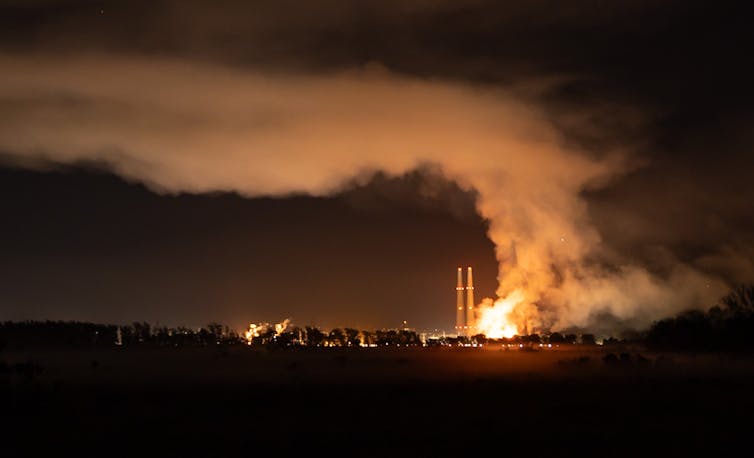
A battery energy storage facility that was built inside an old power plant burned from Jan. 16-18, 2025.
Mike Takaki

Moss Landing Battery Fire Fallout: Study Finds Toxic Metals Captured in Nearby Wetlands

Ivano W. Aiello, San José State University

When fire broke out at the world’s largest battery energy storage facility in January 2025, its thick smoke blanketed surrounding wetlands, farms and nearby communities on the central California coast.

Highways closed, residents evacuated and firefighters could do little but watch as debris and ash rained down. People living in the area reported headaches and respiratory problems, and some pets and livestock fell ill.

Two days later, officials announced that the air quality met federal safety standards. But the initial all-clear decision missed something important – heavy metal fallout on the ground.

A large charred piece of material with a putty knife to show the size.
A chunk of charred battery debris found near bird tracks in the mud, with a putty knife to show the size. The surrounding marshes are popular stopovers for migrating seabirds. Scientists found a thin layer of much smaller debris across the wetlands.
Ivano Aiello, et al, 2025

When battery energy storage facilities burn, the makeup of the chemical fallout can be a mystery for surrounding communities. Yet, these batteries often contain metals that are toxic to humans and wildlife.

The smoke plume from the fire in Vistra’s battery energy storage facility at Moss Landing released not just hazardous gases such as hydrogen fluoride but also soot and charred fragments of burned batteries that landed for miles around.

I am a marine geologist who has been tracking soil changes in marshes adjacent to the Vistra facility for over a decade as part of a wetland-restoration project. In a new study published in the journal Scientific Reports, my colleagues and I were able to show through detailed before-and-after samples from the marshes what was in the battery fire’s debris and what happened to the heavy metals.

The batteries’ metal fragments, often too tiny to see with the naked eye, didn’t disappear. They continue to be remobilized in the environment today.

A satellite image of the area where the fire was, surrounded by farm fields and marshes.
The Vistra battery energy storage facility – the large gray building in the lower left, near Monterey Bay – is surrounded by farmland and marshes. The smoke plume from the fire rained ash on the area and reached four counties.
Google Earth, with data from Google, Airbus, MBARI, CSUMB, CC BY

What’s inside the batteries

Moss Landing, at the edge of Monterey Bay, has long been shaped by industry – a mix of power generation and intensive agriculture on the edge of a delicate coastal ecosystem.

The Vistra battery storage facility rose on the site of an old Duke Energy and PG&E gas power plant, which was once filled with turbines and oil tanks. When Vistra announced it was converting the site into the world’s largest lithium-ion battery facility, the plan was hailed as a clean energy milestone. Phase 1 alone housed batteries with 300 megawatts of capacity, enough to power about 225,000 homes for four hours.

The energy in rechargeable batteries comes from the flow of electrons released by lithium atoms in the anode moving toward the cathode.

In the type of batteries at the Moss Landing facility, the cathode was rich in three metals: nickel, manganese and cobalt. These batteries are prized for their high energy density and relatively low cost, but they are also prone to thermal runaway.

Advertisement
Get More From A Face Cleanser And Spa-like Massage

Lab experiments have shown that burning batteries can eject metal particles like confetti.

Metals found in wetlands matched batteries

When my team and I returned to the marsh three days after the fire, ash and burned debris covered the ground. Weeks afterward, charred fragments still clung to the vegetation.

Our measurements with portable X-ray fluorescence showed sharp increases in nickel, manganese and cobalt compared with data from before the fire. As soon as we saw the numbers, we alerted officials in four counties about the risk.

We estimate that about 25 metric tons (55,000 pounds) of heavy metals were deposited across roughly half a square mile (1.2 square kilometers) of wetland around Elkorn Slough, and that was only part of the area that saw fallout.

To put this in perspective, the part of the Vistra battery facility that burned was hosting 300 megawatts of batteries, which equates to roughly 1,900 metric tons of cathode material. Estimates of the amount of batteries that burned range from 55% to 80%. Based on those estimates, roughly 1,000 to 1,400 metric tons of cathode material could have been carried into the smoke plume. What we found in the marsh represents about 2% of what may have been released.

Three series of maps of the area showing change in quantities of the three metals.
These contour maps show how metals from the Moss Landing battery fire settled across nearby wetlands. Each color represents how much of a metal – nickel, manganese or cobalt – was found in surface soils. Darker colors mean higher concentrations. The highest levels were measured about two weeks after the fire, then declined as rain and tides dispersed the deposits.
Charlie Endris

We took samples at hundreds of locations and examined millimeter-thin soil slices with a scanning electron microscope. Those slices revealed metallic particles smaller than one-tenth the width of a human hair – small enough to travel long distances and lodge deep in the lungs.

The ratio of nickel to cobalt in these particles matched that of nickel, manganese and cobalt battery cathodes, clearly linking the contamination to the fire.

Over the following months, we found that surface concentrations of the metals dropped sharply after major rain and tidal events, but the metals did not disappear. They were remobilized. Some migrated to the main channel of the estuary and may have been flushed out into the ocean. Some of the metals that settled in the estuary could enter the food chain in this wildlife hot spot, often populated with sea otters, harbor seals, pelicans and herons.

A zoomed in look at a small lump on a leaf
A high-magnification image of a leaf of bristly oxtongue, seen under a scanning electron microscope, shows a tiny metal particle typically used in cathode material in lithium-ion batteries, a stark reminder that much of the fallout from the fire landed on vegetation and croplands. The image’s scale is in microns: 1 micron is 0.001 millimeters.
Ivano Aiello

Making battery storage safer as it expands

The fire at Moss Landing and its fallout hold lessons for other communities, first responders and the design of future lithium-ion battery systems, which are proliferating as utilities seek to balance renewable power and demand peaks.

When fires break out, emergency responders need to know what they’re dealing with. A California law passed after the fire helps address this by requiring strengthening containment and monitoring at large battery installations and meetings with local fire officials before new facilities open.

How lithium-ion batteries work, and why they can be prone to thermal runaway.

Newer lithium-ion batteries that use iron phosphate cathodes are also considered safer from fire risk. These are becoming more common for utility-scale energy storage than batteries with nickel, manganese and cobalt, though they store less energy.

How soil is tested is also important. At Moss Landing, some of the government’s sampling turned up low concentrations of the metals, likely because the samples came from broad, mixed layers that diluted the concentration of metals rather than the thin surface deposits where contaminants settled.

Advertisement
Get More From A Face Cleanser And Spa-like Massage

Continuing risks to marine life

Metals from the Moss Landing battery fire still linger in the region’s sediments and food webs.

These metals bioaccumulate, building up through the food chain: The metals in marsh soils can be taken up by worms and small invertebrates, which are eaten by fish, crabs or shorebirds, and eventually by top predators such as sea otters or harbor seals.

Our research group is now tracking the bioaccumulation in Elkhorn Slough’s shellfish, crabs and fish. Because uptake varies among species and seasons, the effect of the metals on ecosystems will take months or years to emerge.

Ivano W. Aiello, Professor of Marine Geology, San José State University

This article is republished from The Conversation under a Creative Commons license. Read the original article.

Hollywood vs. Reality: How LA’s Wilshire Subway Was Really Built

Link: https://stmdailynews.com/wilshire-subway-tunneling-hollywood-vs-reality/

View recent photos

Unlock fun facts & lost history—get The Knowledge in your inbox!

We don’t spam! Read our privacy policy for more info.

Advertisement
Get More From A Face Cleanser And Spa-like Massage

Discover more from Daily News

Subscribe to get the latest posts sent to your email.

Continue Reading
Advertisement Tool Tickets
Click to comment
0 0 votes
Article Rating
Subscribe
Notify of
guest

0 Comments
Oldest
Newest Most Voted
Inline Feedbacks
View all comments

Blog

NASA Astronaut Jonny Kim to Share Insights from Eight-Month Space Station Mission

NASA astronaut Jonny Kim will discuss his eight-month International Space Station mission during a live news conference on Dec. 19. Discover the science, technology, and teamwork behind his groundbreaking journey, streaming live via NASA and covered by STM Daily News.

Published

on

Last Updated on December 19, 2025 by Daily News Staff

NASA astronaut Jonny Kim inside the International Space Station’s cupola, orbiting above the Indian Ocean near Madagascar.

NASA astronaut Jonny Kim poses inside the International Space Station’s cupola as it orbits 265 miles above the Indian Ocean near Madagascar. Credit: NASA


NASA Astronaut Jonny Kim Recaps Eight-Month International Space Station Mission in Live News Conference

Space exploration continues to push the boundaries of science and human achievement. This month, NASA astronaut Jonny Kim returns from an extraordinary eight-month mission aboard the International Space Station (ISS)—and he’s ready to share his story.
Event Details:
  • What: Jonny Kim’s ISS Mission Recap News Conference
  • When: Friday, Dec. 19, 3:30 p.m. EST
  • Where: NASA’s YouTube channel (also available on other NASA streaming platforms)

A Mission Marked by Discovery

Returning to Earth on Dec. 9 with Roscosmos cosmonauts Sergey Ryzhikov and Alexey Zubritsky, Kim logged an impressive 245 days in space as a flight engineer for Expeditions 72/73. The crew completed a staggering 3,920 orbits—covering nearly 104 million miles—and managed the arrival and departure of multiple spacecraft.
But it’s the science behind the mission that stands out:

Advancing Medicine and Technology

  • Bioprinted Tissues in Microgravity: Kim helped study the behavior of bioprinted tissues containing blood vessels, a step forward in space-based tissue production that could one day revolutionize patient care on Earth.
  • Remote Robotics Operations: Through the Surface Avatar study, Kim tested the remote command of multiple robots in space—work that could lead to more advanced robotic assistants for future missions to the Moon, Mars, and beyond.
  • Nanomaterials for Medicine: Kim contributed to the development of DNA-mimicking nanomaterials, opening doors for improved drug delivery and regenerative medicine both in space and at home.

How to Watch and Participate

NASA invites the public and media to join the news conference. For those interested in direct participation, media accreditation is required (details available via NASA’s newsroom). For everyone else, the event will be streamed live—no registration needed.
Learn more about International Space Station research and ongoing missions: NASA’s ISS Page

Why This Matters

Jonny Kim’s journey is a testament to the power of international collaboration and the relentless pursuit of knowledge. His work aboard the ISS is already shaping the future of medicine, robotics, and exploration—impacting lives both in space and right here on Earth.
Stay tuned to STM Daily News for more updates on science, innovation, and the stories that connect our community to the world beyond.

Want more space and science coverage? Visit STM Daily News for the latest updates, features, and community stories.

Discover more from Daily News

Subscribe to get the latest posts sent to your email.

Continue Reading

The Knowledge

What Is a Gustnado?

A gustnado may look like a tornado, but it’s a different weather phenomenon. Learn what a gustnado is, how it forms, and why it’s usually weaker.

Published

on

Last Updated on December 18, 2025 by Daily News Staff

A gustnado may look like a tornado, but it’s a different weather phenomenon. Learn what a gustnado is, how it forms, and why it’s usually weaker.

A gustnado east of Limon, Colorado. Image Credit: Jessica Kortekaas

Severe weather can produce dramatic sights—but not every spinning column of air is a tornado.

A [gustnado](chatgpt://generic-entity?number=0) is a brief, ground-level swirl of rotating air that forms along a thunderstorm’s gust front. Gustnadoes often appear suddenly, kicking up dust or debris, which can make them look more dangerous than they actually are.

Unlike tornadoes, gustnadoes do not connect to a storm’s rotating updraft. Because of this, they are usually weaker, short-lived, and difficult to detect on weather radar.

Gustnadoes typically last only seconds to a few minutes and are most commonly spotted in dry regions, where loose soil makes their rotation visible.

The takeaway: If it’s spinning near the ground ahead of a storm, it may look intense—but it’s not always a tornado.

Further Reading

Learn the differences between tornadoes, dust devils, and other rotating weather phenomena in our STM Daily News Knowledge Series.

Author

  • Rod Washington

    Rod: A creative force, blending words, images, and flavors. Blogger, writer, filmmaker, and photographer. Cooking enthusiast with a sci-fi vision. Passionate about his upcoming series and dedicated to TNC Network. Partnered with Rebecca Washington for a shared journey of love and art.

    View all posts

Discover more from Daily News

Subscribe to get the latest posts sent to your email.

Continue Reading

astronomy

When darkness shines: How dark stars could illuminate the early universe

Scientists using the James Webb Space Telescope identified three unusual early-universe objects that may be “dark stars”—not dark, and not quite stars—powered by dark matter annihilation, potentially reshaping how we understand the first stars and the origins of supermassive black holes.

Published

on

file 20251113 76 inwlvm.jpg?ixlib=rb 4.1
NASA’s James Webb Space Telescope has spotted some potential dark star candidates. NASA, ESA, CSA, and STScI
Alexey A. Petrov, University of South Carolina Scientists working with the James Webb Space Telescope discovered three unusual astronomical objects in early 2025, which may be examples of dark stars. The concept of dark stars has existed for some time and could alter scientists’ understanding of how ordinary stars form. However, their name is somewhat misleading. “Dark stars” is one of those unfortunate names that, on the surface, does not accurately describe the objects it represents. Dark stars are not exactly stars, and they are certainly not dark. Still, the name captures the essence of this phenomenon. The “dark” in the name refers not to how bright these objects are, but to the process that makes them shine — driven by a mysterious substance called dark matter. The sheer size of these objects makes it difficult to classify them as stars. As a physicist, I’ve been fascinated by dark matter, and I’ve been trying to find a way to see its traces using particle accelerators. I’m curious whether dark stars could provide an alternative method to find dark matter.

What makes dark matter dark?

Dark matter, which makes up approximately 27% of the universe but cannot be directly observed, is a key idea behind the phenomenon of dark stars. Astrophysicists have studied this mysterious substance for nearly a century, yet we haven’t seen any direct evidence of it besides its gravitational effects. So, what makes dark matter dark?
A pie chart showing the composition of the universe. The largest proportion is 'dark energy,' at 68%, while dark matter makes up 27% and normal matter 5%. The rest is neutrinos, free hydrogen and helium and heavy elements.
Despite physicists not knowing much about it, dark matter makes up around 27% of the universe. Visual Capitalist/Science Photo Library via Getty Images
Humans primarily observe the universe by detecting electromagnetic waves emitted by or reflected off various objects. For instance, the Moon is visible to the naked eye because it reflects sunlight. Atoms on the Moon’s surface absorb photons – the particles of light – sent from the Sun, causing electrons within atoms to move and send some of that light toward us. More advanced telescopes detect electromagnetic waves beyond the visible spectrum, such as ultraviolet, infrared or radio waves. They use the same principle: Electrically charged components of atoms react to these electromagnetic waves. But how can they detect a substance – dark matter – that not only has no electric charge but also has no electrically charged components? Although scientists don’t know the exact nature of dark matter, many models suggest that it is made up of electrically neutral particles – those without an electric charge. This trait makes it impossible to observe dark matter in the same way that we observe ordinary matter. Dark matter is thought to be made of particles that are their own antiparticles. Antiparticles are the “mirror” versions of particles. They have the same mass but opposite electric charge and other properties. When a particle encounters its antiparticle, the two annihilate each other in a burst of energy. If dark matter particles are their own antiparticles, they would annihilate upon colliding with each other, potentially releasing large amounts of energy. Scientists predict that this process plays a key role in the formation of dark stars, as long as the density of dark matter particles inside these stars is sufficiently high. The dark matter density determines how often dark matter particles encounter, and annihilate, each other. If the dark matter density inside dark stars is high, they would annihilate frequently.

What makes a dark star shine?

The concept of dark stars stems from a fundamental yet unresolved question in astrophysics: How do stars form? In the widely accepted view, clouds of primordial hydrogen and helium — the chemical elements formed in the first minutes after the Big Bang, approximately 13.8 billion years ago — collapsed under gravity. They heated up and initiated nuclear fusion, which formed heavier elements from the hydrogen and helium. This process led to the formation of the first generation of stars.
Two bright clouds of gas condensing around a small central region
Stars form when clouds of dust collapse inward and condense around a small, bright, dense core. NASA, ESA, CSA, and STScI, J. DePasquale (STScI), CC BY-ND
In the standard view of star formation, dark matter is seen as a passive element that merely exerts a gravitational pull on everything around it, including primordial hydrogen and helium. But what if dark matter had a more active role in the process? That’s exactly the question a group of astrophysicists raised in 2008. In the dense environment of the early universe, dark matter particles would collide with, and annihilate, each other, releasing energy in the process. This energy could heat the hydrogen and helium gas, preventing it from further collapse and delaying, or even preventing, the typical ignition of nuclear fusion. The outcome would be a starlike object — but one powered by dark matter heating instead of fusion. Unlike regular stars, these dark stars might live much longer because they would continue to shine as long as they attracted dark matter. This trait would make them distinct from ordinary stars, as their cooler temperature would result in lower emissions of various particles.

Can we observe dark stars?

Several unique characteristics help astronomers identify potential dark stars. First, these objects must be very old. As the universe expands, the frequency of light coming from objects far away from Earth decreases, shifting toward the infrared end of the electromagnetic spectrum, meaning it gets “redshifted.” The oldest objects appear the most redshifted to observers. Since dark stars form from primordial hydrogen and helium, they are expected to contain little to no heavier elements, such as oxygen. They would be very large and cooler on the surface, yet highly luminous because their size — and the surface area emitting light — compensates for their lower surface brightness. They are also expected to be enormous, with radii of about tens of astronomical units — a cosmic distance measurement equal to the average distance between Earth and the Sun. Some supermassive dark stars are theorized to reach masses of roughly 10,000 to 10 million times that of the Sun, depending on how much dark matter and hydrogen or helium gas they can accumulate during their growth. So, have astronomers observed dark stars? Possibly. Data from the James Webb Space Telescope has revealed some very high-redshift objects that seem brighter — and possibly more massive — than what scientists expect of typical early galaxies or stars. These results have led some researchers to propose that dark stars might explain these objects.
Artist's impression of the James Webb telescope, which has a hexagonal mirror made up of smaller hexagons, and sits on a rhombus-shaped spacecraft.
The James Webb Space Telescope, shown in this illustration, detects light coming from objects in the universe. Northrup Grumman/NASA
In particular, a recent study analyzing James Webb Space Telescope data identified three candidates consistent with supermassive dark star models. Researchers looked at how much helium these objects contained to identify them. Since it is dark matter annihilation that heats up those dark stars, rather than nuclear fusion turning helium into heavier elements, dark stars should have more helium. The researchers highlight that one of these objects indeed exhibited a potential “smoking gun” helium absorption signature: a far higher helium abundance than one would expect in typical early galaxies.

Dark stars may explain early black holes

What happens when a dark star runs out of dark matter? It depends on the size of the dark star. For the lightest dark stars, the depletion of dark matter would mean gravity compresses the remaining hydrogen, igniting nuclear fusion. In this case, the dark star would eventually become an ordinary star, so some stars may have begun as dark stars. Supermassive dark stars are even more intriguing. At the end of their lifespan, a dead supermassive dark star would collapse directly into a black hole. This black hole could start the formation of a supermassive black hole, like the kind astronomers observe at the centers of galaxies, including our own Milky Way. Dark stars might also explain how supermassive black holes formed in the early universe. They could shed light on some unique black holes observed by astronomers. For example, a black hole in the galaxy UHZ-1 has a mass approaching 10 million solar masses, and is very old – it formed just 500 million years after the Big Bang. Traditional models struggle to explain how such massive black holes could form so quickly. The idea of dark stars is not universally accepted. These dark star candidates might still turn out just to be unusual galaxies. Some astrophysicists argue that matter accretion — a process in which massive objects pull in surrounding matter — alone can produce massive stars, and that studies using observations from the James Webb telescope cannot distinguish between massive ordinary stars and less dense, cooler dark stars. Researchers emphasize that they will need more observational data and theoretical advancements to solve this mystery. Alexey A. Petrov, Professor of physics and astronomy, University of South Carolina This article is republished from The Conversation under a Creative Commons license. Read the original article.
Sinking Cities: Why Parts of Phoenix—and Much of Urban America—Are Slowly Dropping
Link: https://stmdailynews.com/sinking-cities-why-parts-of-phoenix-and-much-of-urban-america-are-slowly-dropping/

Discover more from Daily News

Subscribe to get the latest posts sent to your email.

Continue Reading

Trending

0
Would love your thoughts, please comment.x
()
x


