

STM Blog
Science costs money – research is guided by who funds it and why
Science costs money: Funding is essential for scientific research, shaping its direction and outcomes. Government and private investments drive both basic and applied research, leading to innovation and societal benefits, particularly in health.

Last Updated on October 12, 2025 by Daily News Staff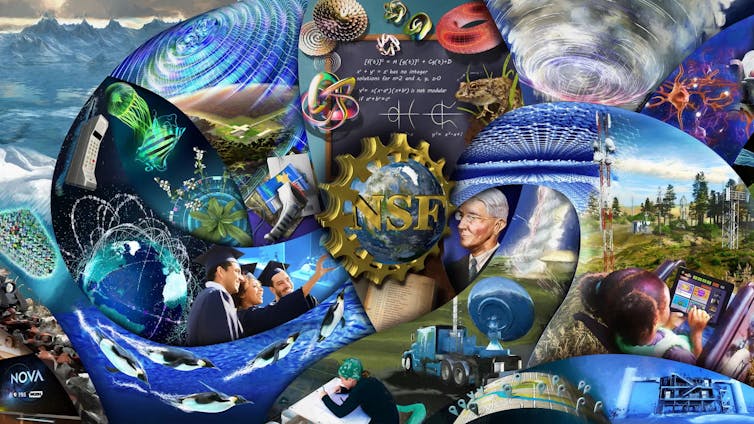
Ryan Summers, University of North Dakota
Science costs money – research is guided by who funds it and why
Scientists have always needed someone to help foot the bill for their work.
In the 19th century, for example, Charles Darwin made an expensive voyage to the southernmost tip of the Americas, visiting many other places en route, including his famous trek through the Galapagos Islands. The fossil evidence Darwin collected over his five-year journey eventually helped him to think about an infinite variety of species, both past and present.
The HMS Beagle and its crew traversed these places while testing clocks and drawing maps for the Royal Navy, and the voyage was funded by the British government. Darwin’s position as a naturalist aboard the ship was unpaid, but, fortunately, his family’s private assets were enough to cover his living expenses while he focused on his scientific work.
Today, government and private funding both remain important for scientific discoveries and translating knowledge into practical applications.
As a professor of science education, one of my goals while preparing future teachers is to introduce them to the characteristics of scientific knowledge and how it is developed. For decades, there has been a strong consensus in my field that educated citizens also need to know about the nature of the scientific enterprise. This includes understanding who pays for science, which can differ depending on the type of research, and why it matters.
Funding for science is more than just the amount of money. To a large extent, the organizations that fund research set the agenda, and different funders have different priorities. It can also be hard to see the downstream benefits of scientific research, but they typically outweigh the upfront costs.
Basic research leads to new knowledge
Basic research, also called fundamental research, involves systematic study aimed at acquiring new knowledge. Scientists often pursue research that falls into this category without specific applications or commercial objectives in mind.
Of course, it costs money to follow where curiosity leads; scientists need funding to pursue questions about the natural and material world.
About 40% of basic research in the U.S. has been federally funded in recent years. The government makes this investment because basic research is the foundation of long-term innovation, economic growth and societal well-being.
Funding for basic research is distributed by the federal government through several agencies and institutes. For more than a century, the U.S. National Institutes of Health have sponsored a breadth of scientific and health research and education programs. Since 1950, the National Science Foundation has advanced basic research and education programs, including the training of the next generation of scientists.
Other federal agencies have complementary missions, such as the Defense Advanced Research Projects Agency, created in response to the Soviet Union’s launch of Sputnik in 1957. DARPA focuses on technological innovations for national security, many of which have become fixtures of civilian life.
Through a competitive review process at these agencies, subject experts vet research proposals and make funding recommendations. The amount of funding available from the NIH, NSF and DARPA varies annually, depending on congressional appropriations. Most of the awarded funds go to universities, research institutions and other health and science organizations that conduct research. The sum of research dollars awarded differs among states.
Applying research
Scientists undertake basic research to generate new knowledge with no specific end goal in mind. Applied research is different in that it aims to find solutions to real-world problems.
Research that investigates specific, practical objectives or improvements with commercial potential is more likely to attract private investors. Companies directly invest in research and development to gain a competitive edge and turn a profit. Private industry is more likely to sink dollars into applied rather than basic research because the potential payoff in the form of a new product or advance is more visible.
From discovery to real-world implementation
As applied research addresses problems, promising findings are moved toward clinical application or mainstream use. This research and development process can lead to tangible benefits for individuals and society.
Federal agencies such as the NIH make substantial investments in the basic and applied science underlying new drugs. Pharmaceutical and biotechnology companies heavily invest in the development of drug candidates. Recent reports have shown that industry has been responsible for 50% or more of the dollars invested in health and biomedical research in recent years. This expenditure includes significant spending to advance clinical trials – the studies that test new medical treatments before they get approved for use.
The NIH funded basic research that contributed to every single drug approved by the U.S. Food and Drug Administration between 2010 and 2016. This includes key work that led to COVID-19 vaccines. The COVID-19 vaccination campaign likely saved the U.S. more than $1 trillion in health care expenses that would have otherwise been incurred and also saved lives.
Initial NSF investments in research was instrumental in capturing images of black holes and exploring deep oceans. Basic research funded by NSF paved the way for everyday conveniences such as smartphones, the Google search engine and artificial intelligence. Other funded projects led to quality of life improvements such as American Sign Language and kidney matching for transplants. Educational programming, such as “Bill Nye the Science Guy” and “The Magic School Bus,” were NSF-backed projects, too.
It matters who pays: Funding shapes science
Funders and financial systems shape the trajectory of research across fields. Institutions advertise funding opportunities based on their current priorities. Changes in the amount of funding available ultimately direct the attention of researchers. Any interruptions to basic research, such as changes to financial supports or institutions, may threaten future discoveries and potential payoffs for years to come.
According to numbers reported by a coalition of research institutions, every dollar that NIH spends on research leads to $2.56 of new economic activity. For the 2024 fiscal year, this means, of the $47.35 billion Congress appropriated for NIH, the $36.94 billion awarded to U.S. researchers fueled $94 billion in activity through employment and the purchase of research-related goods and services.
Economist Pierre Azoulay and colleagues recently imagined an alternative history where NIH was 40% smaller and dispersed less money – a budget akin to current federal proposals. They argued that more than half of the drugs FDA approved since 2000 are tied to NIH-funded research that would have been cut under this scenario. This thought experiment underscores how valuable those basic research dollars are. https://www.youtube.com/embed/xk94il8L820?wmode=transparent&start=1369 ‘Last Week Tonight with John Oliver’ points out some seemingly outlandish basic research that has yielded surprising real-world applications.
Even seemingly out-of-touch or abstract studies may precede discoveries with major impact. Basic research into bee nectar foraging and movement around the colony, recently mentioned on “Last Week Tonight with John Oliver,” led to the development of an algorithm that distributes internet traffic between computer servers, which now powers the multibillion-dollar web-hosting industry. Learning about applications of research with visible societal impacts can help people understand and appreciate the role of funding in the scientific enterprise.
Ryan Summers, Associate Professor of Science Education, University of North Dakota
This article is republished from The Conversation under a Creative Commons license. Read the original article.
STM Daily News is a vibrant news blog dedicated to sharing the brighter side of human experiences. Emphasizing positive, uplifting stories, the site focuses on delivering inspiring, informative, and well-researched content. With a commitment to accurate, fair, and responsible journalism, STM Daily News aims to foster a community of readers passionate about positive change and engaged in meaningful conversations. Join the movement and explore stories that celebrate the positive impacts shaping our world.
Author


Last Updated on April 4, 2026 by Daily News Staff

Few transportation systems in the world are as instantly recognizable as the cable cars of San Francisco. Climbing steep hills with a steady hum and a nostalgic charm, these moving landmarks are more than just a tourist attraction—they’re a triumph of innovation born out of necessity.
🐎 A Problem on the Hills
In the mid-1800s, San Francisco was growing rapidly, but its geography posed a serious challenge. The city’s steep inclines made travel difficult, especially for horse-drawn streetcars, which were the primary form of public transportation at the time.
Horses often struggled to pull heavy loads uphill, and accidents were common. In some cases, animals collapsed under the strain. This dangerous and inefficient system needed a solution.
💡 The Vision of Andrew Hallidie
That solution came from Andrew Smith Hallidie, an engineer and entrepreneur who envisioned a safer, more reliable way to move people through the city.
Hallidie developed a system in which streetcars would be pulled by a continuously moving cable running beneath the street—eliminating the need for horses altogether.
⚙️ The First Cable Car Line
On August 2, 1873, Hallidie launched the world’s first cable car system: the Clay Street Hill Railroad.
This groundbreaking line proved that cable-powered transit could successfully navigate San Francisco’s steep terrain. Instead of relying on animal power, cars used a mechanical grip to latch onto a moving cable underground, allowing them to glide smoothly up and down hills.
The innovation quickly captured public attention—and demand.
🚀 A City Transformed
Following the success of the Clay Street line, cable car systems spread rapidly across San Francisco.
By the late 19th century:
- Dozens of routes crisscrossed the city
- Cable cars became the backbone of urban transportation
- The system helped shape the city’s growth and accessibility
For a time, San Francisco operated the largest and most advanced cable car network in the world.
⚡ The Rise of Electric Streetcars
Despite their success, cable cars faced competition from emerging electric streetcar systems in the early 20th century. Electric trolleys were cheaper to build and operate, and they didn’t require the complex underground cable infrastructure.
The turning point came after the devastating 1906 San Francisco earthquake, which destroyed much of the city—including large portions of the cable car network.
When rebuilding began, many lines were converted to electric systems instead of restoring the older cable technology.
San Francisco’s cable car system, first launched in 1873, remains the last manually operated system of its kind. According to the San Francisco Municipal Transportation Agency (SFMTA) , the system was designed to safely navigate the city’s steep terrain.
The cable cars are now designated as a National Historic Landmark, recognized for their cultural and engineering significance by the National Park Service .
Visitors can explore the history and mechanics of the system at the San Francisco Cable Car Museum , which preserves original equipment and archives.
🛑 Saving a Symbol
By the 1940s, cable cars were on the brink of extinction.
That’s when Friedel Klussmann stepped in. A passionate preservationist, Klussmann led a public campaign to protect the remaining lines from being dismantled.
Her efforts culminated in a successful 1947 voter referendum that ensured the survival of San Francisco’s cable cars—transforming them from everyday transit into a preserved cultural landmark.
🌉 Cable Cars Today
Today, San Francisco’s cable cars are:
- The last manually operated cable car system in the world
- A National Historic Landmark
- One of the most visited attractions in California
Three lines remain in operation:
- Powell–Hyde Line
- Powell–Mason Line
- California Street Line
While they still function as public transit, they now serve as a moving museum—connecting modern riders with the city’s past.
🎯 Why It Matters
San Francisco’s cable cars represent more than a mode of transportation. They tell a story of innovation, resilience, and community action.
From solving a practical problem to becoming a global icon, the cable car system reflects how cities adapt—and how people fight to preserve what makes them unique.
📌 “Now You Know”
San Francisco’s cable cars weren’t built for tourism—they were invented to solve a life-and-death problem on steep city streets. Today, they remain the last system of their kind anywhere in the world.
🔗 External Sources & Related Links
- SFMTA – Cable Cars Overview
- San Francisco Cable Car Museum
- National Park Service – Historic Landmark Info
- Britannica – Cable Car History
- History.com – Invention of Cable Cars
Explore the latest in innovation, AI, gadgets, startups, and digital trends in STM Daily News’ Techsection.
Last Updated on April 2, 2026 by Daily News Staff
🕒 [UPDATE] Orion Performs Translunar Injection Burn
The spacecraft has completed its critical engine burn, sending Artemis II on a trajectory toward the Moon. This marks the official start of its deep space journey.

Artemis II Successfully Launches
CAPE CANAVERAL, Fla. — NASA has successfully launched its Artemis II mission, marking the first crewed journey toward the Moon in more than 50 years.
The powerful Space Launch System (SLS) rocket lifted off from Kennedy Space Center on April 1, carrying four astronauts on a 10-day mission around the Moon and back.
On board are Commander Reid Wiseman, Pilot Victor Glover, Mission Specialist Christina Koch, and Canadian astronaut Jeremy Hansen. The mission is already being hailed as a major milestone in NASA’s effort to return humans to deep space.
Shortly after liftoff, the Orion spacecraft successfully reached orbit and deployed its solar arrays, beginning its journey that will eventually send the crew on a translunar trajectory toward the Moon. 
Artemis II is a lunar flyby mission, meaning astronauts will not land but will travel farther from Earth than any human mission in decades while testing critical systems needed for future landings.
The mission also marks several historic firsts, including the first woman and the first person of color—Victor Glover—to travel into lunar space.
NASA says the mission is a key step toward future lunar landings and long-term plans to establish a human presence on the Moon later this decade.
🛰️ Artemis II Mission Timeline
The 10-day Artemis II mission follows a carefully planned trajectory from Earth to the Moon and back:
- Day 1: Launch and Earth orbit
- Day 1–2: Translunar injection burn
- Days 2–4: Deep space travel
- Days 4–5: Lunar flyby
- Days 5–8: Return to Earth
- Days 9–10: Reentry and splashdown
For official updates and in-depth mission details, visit the following trusted sources:
- NASA: Artemis II Mission Overview
- NASA Artemis Program (Return to the Moon)
- Orion Spacecraft – Mission Details
- Space Launch System (SLS) Rocket Overview
- Kennedy Space Center – Launch Operations
- Watch NASA Live Coverage and Replays
🧾 Sources
- NASA official launch coverage and mission updates
- NASA Artemis II press materials and briefings
- NASA Kennedy Space Center launch operations updates
Stay with STM Daily News for live updates on Artemis II.

Feeding America is marking National Agriculture Day by recognizing farmers, ranchers, and producers as key partners in the fight against hunger.
In a March 24 press release, the organization said the agricultural community plays a vital role in helping food banks and pantries deliver fresh, nutritious food to families across the country. Feeding America noted that produce, dairy, and protein are among the most requested foods by neighbors facing hunger and make up half of all food distributed through its network.
The organization said that in 2025, its network worked with growers to rescue 971 million pounds of fresh produce, helping redirect surplus food to communities in need. Feeding America also pointed to federal nutrition and farm support programs, saying government purchases from U.S. growers provide more than 20% of the food distributed through its network.
Ami McReynolds, Feeding America’s chief advocacy and community partnerships officer, said supporting farmers is directly connected to helping families access healthy meals. The organization is also urging Congress to support additional farm aid and a Farm Bill that strengthens nutrition programs.
Feeding America said a recent poll found that 95% of voters view hunger as a nonpartisan issue, reinforcing support for collaborative solutions between agriculture, food banks, and policymakers.
Related Links
Source Links
The Bridge is a section of the STM Daily News Blog meant for diversity, offering real news stories about bona fide community efforts to perpetuate a greater good. The purpose of The Bridge is to connect the divides that separate us, fostering understanding and empathy among different groups. By highlighting positive initiatives and inspirational actions, The Bridge aims to create a sense of unity and shared purpose. This section brings to light stories of individuals and organizations working tirelessly to promote inclusivity, equality, and mutual respect. Through these narratives, readers are encouraged to appreciate the richness of diverse perspectives and to participate actively in building stronger, more cohesive communities.
https://stmdailynews.com/the-bridge






