Connect with us

Entertainment

Some ‘Star Wars’ stories have already become reality

Published

on

Star Wars Stories
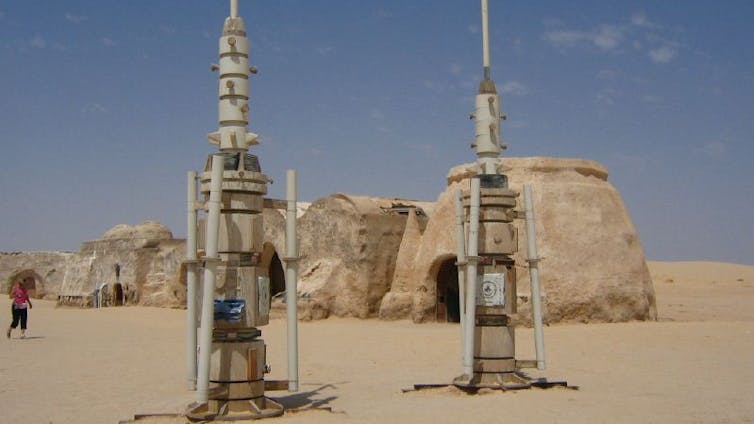
Tatooine’s moisture farming equipment stands in the desert of Tunisia, where parts of the ‘Star Wars’ movie series were filmed. Véronique Debord-Lazaro via Flickr, CC BY-SA
Daniel B. Oerther, Missouri University of Science and Technology and William Schonberg, Missouri University of Science and Technology Just 48 short years ago, movie director George Lucas used the phrase “A long time ago in a galaxy far, far away” as the opening to the first “Star Wars” movie, later labeled “Episode IV: A New Hope.” But at least four important aspects of the “Star Wars” saga are much closer – both in time and space – than Lucas was letting on. One, the ability to add blue food coloring to milk, was possible even at the time the first film came out. But in 2024, “Star Wars”-themed blue milk became periodically available in grocery stores. And we, an environmental health engineer and a civil engineer, know there are at least three more elements of these ancient, distant Lucas stories that might seem like science fiction but are, in fact, science reality.

Moisture farming

In that first movie, “Episode IV,” Luke Skywalker’s Uncle Owen was a farmer on the planet of Tatooine. He farmed water from air in the middle of a desert. It might sound impossible, but it’s exactly what experts discussed at the second International Atmospheric Water Harvesting Summit hosted by Arizona State University in March 2025. Each day, a human needs to consume about the equivalent of 0.8 gallons of water (3 liters). With more than 8 billion people living on the planet, that means engineers need to produce nearly 2.6 trillion gallons (10 trillion liters) of clean drinking water every year. Taken globally, rainfall would be enough, but it’s distributed very unevenly – including landing in the oceans, where it immediately becomes too salty to drink safely. Deserts, which cover about one-fifth of the Earth’s land area, are home to about 1 billion people. Researchers at places such as Berkeley have developed solar-powered systems that can produce clean drinking water from thin air. In general, they use a material that traps water molecules from the air within its structure and then use sunlight to condense that water out of the material and into drinkable liquid. But there is still a ways to go before they are ready for commercial distribution and available to help large numbers of people.
Researchers can harvest water from air in the desert, in a process powered only by the Sun.

Space debris

When the second Death Star was destroyed in “Return of the Jedi,” it made a huge mess, as you would expect when blowing to smithereens an object at least 87 miles across (140 kilometers). But the movie’s mythology helpfully explains a hyperspace wormhole briefly opened, scattering much of the falling debris across the galaxy. As best as anyone can tell, a hyperspace wormhole has never appeared near Earth. And even if such a thing existed or happened, humans might not have the technology to chuck all our trash in there anyway. So we’re left with a whole lot of stuff all around us, including in space. According to the website Orbiting Now, in late April 2025 there were just over 12,000 active satellites orbiting the planet. All in all, the United States and other space-faring nations are trying to keep track of nearly 50,000 objects orbiting Earth. And there are millions of fragments of space debris too small to be observed or tracked. Just as on Earth’s roads, space vehicles crash into each other if traffic gets too congested. But unlike the debris that falls to the road after an Earth crash, all the bits and pieces that break off in a space crash fly away at speeds of several thousand miles per hour (10,000 to 30,000 kph) and can then hit other satellites or spacecraft that cross their paths. This accumulation of space debris is creating an increasing problem. With more satellites and spacecraft heading to orbit, and more stuff up there moving around that might hit them, space travel is becoming more like flying the Millennium Falcon through an asteroid field every day. Engineers at NASA, the European Space Agency and other space programs are exploring a variety of technologies – including a net, a harpoon and a laser – to remove the more dangerous pieces of space junk and clean up the space environment.
Dodging obstacles in space is no picnic.

The Force itself

To most Earth audiences, the Force was a mysterious energy field created by life that binds the galaxy together. That is until 1999, when “Episode I: The Phantom Menace” revealed that the Force came from midi-chlorians, a microscopic, sentient life form that lives within every living cell. To biologists, midi-chlorians sound suspiciously similar to mitochondria, the powerhouse of our cells. The current working hypothesis is that mitochondria emerged from bacteria that lived within cells of other living things. And mitochondria can communicate with other life forms, including bacteria. There are many different kinds of mitochondria, and medical professionals are learning how to transplant mitochondria from one cell to another just like they transplant organs from one person’s body to another. Maybe one day a transplant procedure could help people find the light side of the Force and turn away from the dark side. May the Fourth – and the Force – be with you.The Conversation Daniel B. Oerther, Professor of Environmental Health Engineering, Missouri University of Science and Technology and William Schonberg, Professor of Civil Engineering, Missouri University of Science and Technology This article is republished from The Conversation under a Creative Commons license. Read the original article.

Discover more from Daily News

Subscribe to get the latest posts sent to your email.

Continue Reading
Advertisement Tool Tickets

actors & performers

Hollywood Legend Rob Reiner and Wife Found Dead; Son in Custody

Renowned filmmaker Rob Reiner and his wife, Michele Singer Reiner, were found dead in their Los Angeles home in a reported homicide. Police have arrested their son in connection with the case, and tributes are pouring in.

Published

on

Last Updated on December 16, 2025 by Daily News Staff

Portrait of filmmaker Rob Reiner

Director Rob Reiner participates in a discussion following a screening of the film LBJ at the LBJ Presidential Library in Austin, Texas on Saturday October 22, 2016
On Saturday evening October 22, 2016, the LBJ Presidential Library held a sneak peek of Rob Reiner’s new filmÊLBJ, starring Woody Harrelson as the 36th president. The film, which premiered at the Toronto International Film Festival in September, chronicles the life and times of Lyndon Johnson who would inherit the presidency at one of the most fraught moments in American history.
Following the screening, director Rob Reiner, actor Woody Harrelson, and writer Joey Hartstone joined LBJ Library Director Mark Updegrove on stage for a conversation about the film.
LBJ Library photo by Jay Godwin
10/22/2016

Hollywood Legend Rob Reiner and Wife Found Dead; Son in Custody

December 15, 2025

Renowned filmmaker and actor Rob Reiner, 78, and his wife Michele Singer Reiner, 68, were found dead in their Brentwood, Los Angeles home on Sunday, authorities say. Emergency responders were called to the residence Sunday afternoon, where both were discovered with fatal wounds consistent with a stabbing. Police are treating the case as a double homicide. 

Los Angeles police arrested the couple’s 32-year-old son, Nick Reiner, in connection with the deaths. He is being held in custody as investigators continue to piece together the circumstances surrounding the incident. 

Nick Reiner and Rob Reiner at the 2016 Substance Abuse and Mental Health Services Administrations 2016 SAMHSA Voice Awards cropped

2016 SAMHSA Voice Awards

Reiner was one of Hollywood’s most influential figures, known for his work as a director, producer and actor. His career spanned decades, from early television fame to directing beloved films that shaped American cinema. 

Friends, colleagues and public figures have begun sharing tributes and reactions to the news as the investigation is ongoing. 

More details will be updated as they become available.

The Inspiring Legacy of Raymond E. Fowler: A Journey into the Unknown
Link: https://stmdailynews.com/the-inspiring-legacy-of-raymond-e-fowler-a-journey-into-the-unknown/

Discover more from Daily News

Subscribe to get the latest posts sent to your email.

Continue Reading

Entertainment

Hollywood vs. Reality: How LA’s Wilshire Subway Was Really Built

Wilshire Subway: Did LA blast subway tunnels under Wilshire Boulevard? Hollywood says yes — engineers say no. Here’s how Metro safely tunneled beneath Miracle Mile.

Published

on

envato labs image edit

When the 1997 disaster film Volcano depicted lava erupting along Wilshire Boulevard and referenced blasting during Red Line subway construction, it delivered gripping cinema — but not accurate engineering.

In reality, Los Angeles Metro did not rely on large-scale blasting to construct subway tunnels beneath Wilshire Boulevard and the Miracle Mile. Instead, engineers used tunnel boring machines (TBMs) specifically to avoid the very risks Hollywood dramatized.

Why Blasting Was Avoided

The Wilshire Corridor sits atop historic oil fields, making methane gas pockets a known and serious concern. A deadly methane explosion near Fairfax Avenue in 1985 led to heightened scrutiny of underground construction in the area. Blasting in such conditions could have caused unpredictable gas releases, ground instability, or damage to surface structures.

As a result, Metro engineers chose pressurized, closed-face tunnel boring machines, which allow for:

  • Controlled excavation in dense urban environments

  • Continuous ground support to prevent settlement

  • Integrated gas detection and ventilation systems

These machines grind slowly through soil and rock while installing precast concrete tunnel linings, creating a sealed, gas-resistant structure as they advance. envato labs image edit

The Real Engineering Feat

Although Volcano took creative liberties for dramatic effect, the true story of tunneling under Wilshire is no less impressive. Advances in TBM technology and methane mitigation ultimately allowed the Metro D Line (formerly the Red Line/Purple Line) to safely pass through one of Los Angeles’ most geologically complex corridors — without explosions, collapsing streets, or cinematic chaos.

Bottom Line

Volcano remains a memorable piece of 1990s disaster cinema, but its portrayal of subway construction is fiction. The real achievement lies in decades of careful planning, modern tunneling technology, and engineering solutions that quietly reshaped Los Angeles beneath its busiest boulevard.

Related Links:

Dreambreaker: A Pickleball Story — A Closer Look at the Documentary and Its Uncredited Voice
Link: https://stmdailynews.com/dreambreaker-a-pickleball-story-a-closer-look-at-the-documentary-and-its-uncredited-voice/

Discover more from Daily News

Subscribe to get the latest posts sent to your email.

Continue Reading

Entertainment

Beam Unveils Veo 3.1-Powered AI Platform: Transforming Videos into Playable Games and Interactive Stories

Discover Beam’s new Veo 3.1-powered AI platform, transforming videos into playable mini-games and interactive stories—no coding required. Explore the future of interactive media for creators and storytellers.

Published

on

Last Updated on December 13, 2025 by Daily News Staff

Beam Unveils Veo 3.1-Powered AI Platform: Transforming Videos into Playable Games and Interactive Stories

Play and Create
Interactive Shorts

Beam Unveils Veo 3.1-Powered AI Platform: Transforming Videos into Playable Games and Interactive Stories

In a year where generative AI and short-form content are rewriting the rules of digital storytelling, Beam is pushing the boundaries even further. Today, Beam—developed by Phaser Studio Inc.—announced the launch of its Veo 3.1-powered AI platform, a groundbreaking tool that empowers creators to turn ordinary videos into playable mini-games and interactive AI stories, all without writing a single line of code.

Video, Reimagined: From Passive Watching to Active Playing

For decades, video has been the dominant format online—but it’s always been a one-way street: watch, react, repeat. Beam is flipping that script. By introducing “playable video,” Beam merges the worlds of generative AI, interactive media, and game creation. The result? Stories and experiences that aren’t just watched, but actively played and explored.
“Video has become the dominant format on the internet, but it’s always been passive,” says Matt Dukes, CEO of Beam. “Beam turns video into something interactive. By combining Veo 3.1 with a no-code game-creation workflow, we’re giving creators a new medium where stories, games, and short-form content all converge and come to life.”

How It Works: No-Code Creation, Limitless Possibilities

Beam’s platform is powered by a multi-model AI engine, including the latest Veo 3.1 and other advanced video generation models. Here’s what makes it unique:
  • AI-Generated Media: Instantly create video, images, and music using cutting-edge AI tools.
  • Drag-and-Drop Grid Editor: Arrange scenes, add branching choices, and build interactive storylines—all visually, right in your browser.
  • Instant Publishing: Share your playable mini-games and interactive shorts to the web with a single click.
The platform is designed for everyone—from indie storytellers and educators to brands and viral content creators. Early adopters are already bringing to life dating sims, choose-your-own-adventure stories, action-packed mini-games, interactive ASMR experiences, and even wholesome, playable pet tales.

Free Early Access for Creators

Beam is rolling out with an early-access program that offers unlimited free generations. This means creators can experiment, iterate, and publish their first projects without barriers. Looking ahead, Beam plans to introduce monetization, discovery, and distribution tools to help creators grow their audiences and revenue.
One early creator summed it up perfectly: “I’ve used AI video tools before, but Beam is the first time I felt like I was actually building a game, not just generating clips. Being able to turn a video into something people can interact with completely changes how I think about storytelling.”

The Future of Interactive Media

Beam isn’t just another AI tool—it’s a new creative medium. As Dukes puts it, “AI unlocked image creation. Then it unlocked video. Playable video is the next step in the evolution of digital media, and Beam is built specifically for that future.”
Ready to start building? Explore Beam’s platform and see how you can turn your next story into a playable experience: https://beam.game/

About Beam: Beam, from Phaser Studio Inc., is an AI-powered platform that lets anyone turn video into playable mini-games and interactive stories. With Veo 3.1 at its core, Beam brings together AI video, sound, visuals, and easy-to-use branching logic for a true no-code creative workflow.
For more info, visit https://beam.game/

Who do you see benefiting most from this kind of platform—independent creators, educators, brands, or someone else? Let’s discuss how this tech could shape the next wave of interactive storytelling!
Source: Phaser Studio Inc.
https://beam.game/ (official site)
For more coverage on the latest AI tools and digital media innovations, check out our Artificial Intelligence section on STM Daily News.

STM Daily News is a multifaceted podcast that explores a wide range of topics, from life and consumer issues to the latest in food and beverage trends. Our discussions dive into the realms of science, covering everything from space and Earth to nature, artificial intelligence, and astronomy. We also celebrate the amateur sports scene, highlighting local athletes and events, including our special segment on senior Pickleball, where we report on the latest happenings in this exciting community. With our diverse content, STM Daily News aims to inform, entertain, and engage listeners, providing a comprehensive look at the issues that matter most in our daily lives. https://stories-this-moment.castos.com/

Authors

  • IMG 0366

    Hal Machina is a passionate writer, blogger, and self-proclaimed journalist who explores the intersection of science, tech, and futurism. Join him on a journey into innovative ideas and groundbreaking discoveries!

    View all posts journalist

Discover more from Daily News

Subscribe to get the latest posts sent to your email.

Continue Reading

Trending


