Connect with us

News

The Hong Kong high-rise fire shows how difficult it is to evacuate in an emergency

Hong Kong High-Rise Fire: The deadly Hong Kong fire exposes critical challenges in evacuating tall buildings. Learn why stair descent is slower than expected, how human behavior causes delays, and what modern safety features can save lives.

Published

on

Hong Kong High-Rise Fire Reveals Why Evacuating Tall Buildings Is So Dangerous
Tommy Wang/Getty

The Hong Kong high-rise fire shows how difficult it is to evacuate in an emergency

Milad Haghani, The University of Melbourne; Erica Kuligowski, RMIT University, and Ruggiero Lovreglio, Te Kunenga ki Pūrehuroa – Massey University

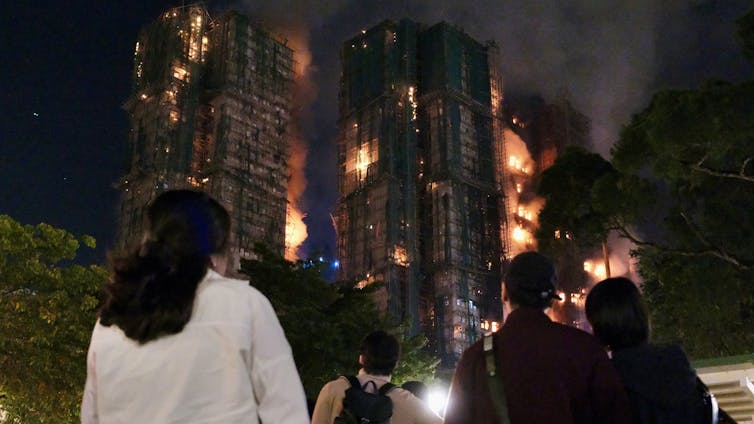
The Hong Kong high-rise fire, which spread across multiple buildings in a large residential complex, has killed dozens, with hundreds reported missing.

The confirmed death toll is now 44, with close to 300 people still unaccounted for and dozens in hospital with serious injuries.

This makes it one of Hong Kong’s deadliest building fires in living memory, and already the worst since the Garley Building fire in 1996.

Although more than 900 people have been reportedly evacuated from the Wang Fuk Court, it’s not clear how many residents remain trapped.

This catastrophic fire – which is thought to have spread from building to building via burning bamboo scaffolding and fanned by strong winds – highlights how difficult it is to evacuate high-rise buildings in an emergency.

When the stakes are highest

Evacuations of high-rises don’t happen every day, but occur often enough. And when they do, the consequences are almost always severe. The stakes are highest in the buildings that are full at predictable times: residential towers at night, office towers in the day.

We’ve seen this in the biggest modern examples, from the World Trade Center in the United States to Grenfell Tower in the United Kingdom.

The patterns repeat: once a fire takes hold, getting thousands of people safely down dozens of storeys becomes a race against time.

But what actually makes evacuating a high-rise building so challenging?

It isn’t just a matter of “getting people out”. It’s a collision between the physical limits of the building and the realities of human behaviour under stress.

Advertisement
Get More From A Face Cleanser And Spa-like Massage

It’s a long way down to safety

The biggest barrier is simply vertical distance. Stairwells are the only reliable escape route in most buildings.

Stair descent in real evacuations is far slower than most people expect. Under controlled or drill conditions people move down at around 0.4–0.7 metres per second. But in an actual emergency, especially in high-rise fires, this can drop sharply.

During 9/11, documented speeds at which survivors went down stairs were often slower than 0.3 m/s. These slow-downs accumulate dramatically over long vertical distances.

Fatigue is a major factor. Prolonged walking significantly reduces the speed of descent. Surveys conducted after incidents confirm that a large majority of high-rise evacuees stop at least once. During the 2010 fire of a high-rise in Shanghai, nearly half of older survivors reported slowing down significantly.

Long stairwells, landings, and the geometry of high-rise stairs all contribute to congestion, especially when flows from multiple floors merge into a single shaft.

Slower movers include older adults, people with physical or mobility issues and groups evacuating together. These reduce the overall pace of descent compared with the speeds typically assumed for able-bodied individuals. This can create bottlenecks. Slow movers are especially relevant in residential buildings, where diverse occupants mean movement speeds vary widely.

Visibility matters too. Experimental studies show that reduced lighting significantly slows down people going down stairs. This suggests that when smoke reduces visibility in real events, movement can slow even further as people hesitate, misjudge steps, or adjust their speed.

Human behaviour can lead to delays

Human behaviour is one of the biggest sources of delay in high-rise evacuations. People rarely act immediately when an alarm sounds. They pause, look for confirmation, check conditions, gather belongings, or coordinate with family members.

These early minutes are consistently some of the costliest when evacuating from tall buildings.

Studies of the World Trade Center evacuations show the more cues people saw – smoke, shaking, noise – the more they sought extra information before moving. That search for meaning adds delay. People talk to colleagues, look outside windows, phone family, or wait for an announcement. Ambiguous cues slow them even further.

Advertisement
Get More From A Face Cleanser And Spa-like Massage

In residential towers, families, neighbours and friend-groups naturally try to evacuate together. Groups tend to form wider steps, or group together in shapes that reduce overall flow. But our research shows when a group moves in a “snake” formation – one behind the other – they travel faster, occupy less space, and allow others to pass more easily.

These patterns matter in high-rise housing, where varied household types and mixed abilities make moving in groups the norm.

Why stairs aren’t enough

As high-rises grow taller and populations age, the old assumption that “everyone can take the stairs” simply no longer holds. A full building evacuation can take too long, and for many residents (older adults, people with mobility limitations, families evacuating together) long stair descents are sometimes impossible.

This is why many countries have turned to refuge floors: fire- and smoke-protected levels built into towers as safe staging points. These can reduce bottlenecks and prevent long queues. They give people somewhere safe to rest, transfer across to a clearer stair, or wait for firefighters. Essentially, they make vertical movement more manageable in buildings where continuous descent isn’t realistic.

Alongside them are evacuation elevators. These are lifts engineered to operate during a fire with pressurised shafts, protected lobbies and backup power. The most efficient evacuations use a mix of stairs and elevators, with ratios adjusted to the building height, density and demographics.

The lesson is clear: high-rise evacuation cannot rely on one tool. Stairs, refuge floors and protected elevators should all be made part of ensuring vertical living is safer.The Conversation

Milad Haghani, Associate Professor and Principal Fellow in Urban Risk and Resilience, The University of Melbourne; Erica Kuligowski, Principal Research Fellow, School of Engineering, RMIT University, and Ruggiero Lovreglio, Professor in Digital Construction and Fire Engineering, Te Kunenga ki Pūrehuroa – Massey University

This article is republished from The Conversation under a Creative Commons license. Read the original article.

STM Daily News is a vibrant news blog dedicated to sharing the brighter side of human experiences. Emphasizing positive, uplifting stories, the site focuses on delivering inspiring, informative, and well-researched content. With a commitment to accurate, fair, and responsible journalism, STM Daily News aims to foster a community of readers passionate about positive change and engaged in meaningful conversations. Join the movement and explore stories that celebrate the positive impacts shaping our world.

https://stmdailynews.com/

Advertisement
Get More From A Face Cleanser And Spa-like Massage

Want more stories 👋
“Your morning jolt of Inspiring & Interesting Stories!”

Sign up to receive awesome articles directly to your inbox.

STM Coffee Newsletter 1

We don’t spam! Read our privacy policy for more info.

Continue Reading
Advertisement SodaStream USA, inc

The Knowledge

Metrolink Offers Fare-Free Rides for Earth Day 2026 Across Southern California

Metrolink offers fare-free rides for Earth Day 2026 across Southern California, encouraging sustainable travel and reduced emissions.

Published

on

Last Updated on April 21, 2026 by Daily News Staff

Metrolink Offers Fare-Free Rides for Earth Day 2026
Image Credit: Metrolink

Metrolink Offers Fare-Free Rides for Earth Day 2026

LOS ANGELES — April 22, 2026 — In a continued push toward sustainable transportation, Metrolink will once again offer systemwide free rides on Earth Day, inviting commuters and travelers to leave their cars behind and explore a cleaner way to move across the region.

A One-Day Opportunity to Ride Free

On Wednesday, April 22, passengers can board any Metrolink train — including the Arrow service — without purchasing a ticket. The initiative is part of the broader celebration of Earth Day, encouraging environmentally conscious travel choices.

The fare-free program is designed to appeal to both regular riders and first-time users, particularly those navigating Southern California’s persistent traffic congestion and rising fuel costs.

ml earth emailheader eng.jpg
Image Credit: Metrolink

Encouraging Sustainable Travel Habits

“Earth Day is a reminder that small changes, like choosing public transit over driving one day a week, can have a meaningful impact on our environment,” said Doug Chaffee, chair of the Metrolink Board.

With gas prices continuing to strain household budgets, the agency hopes the initiative will inspire more residents to consider rail as part of their regular commute.

Regional Connections Expand Access

Metrolink’s Earth Day promotion aligns with similar efforts by other Southern California transit providers. Riders can seamlessly connect to services operated by: LA Metro and the Orange County Transportation AuthorityRiverside County Transportation CommissionSan Bernardino County Transportation Authority and Ventura County Transportation Commission.

These partnerships extend the reach of fare-free travel across a six-county region, making it easier for riders to explore destinations without relying on personal vehicles.

Service Adjustments and Rider Tips

Passengers should note that trains will operate on a reduced weekday schedule, implemented earlier this spring. Despite the adjustment, all Metrolink lines and station cities remain in service.

For those planning a trip:

  • No ticket is required — simply board the train
  • Bikes are welcome, with capacity ranging from three bikes per standard car to nine in designated bike cars
  • A curated destination guide highlights attractions within walking or biking distance of stations

Environmental and Economic Impact

Metrolink is also promoting its Personal Impact Calculator, a digital tool that allows riders to estimate how switching from driving to rail can reduce greenhouse gas emissions and lower fuel expenses.

A Broader Trend in Public Transit

Fare-free transit days have gained traction nationwide as agencies look to boost ridership and promote sustainability. Southern California’s expansive commuter rail network makes it particularly well-suited for such initiatives, offering a viable alternative to one of the country’s most car-dependent regions.


Bottom Line

Metrolink’s Earth Day promotion is more than a one-day free ride — it’s a strategic effort to shift commuter behavior, reduce environmental impact, and showcase the convenience of regional rail. For Southern Californians, April 22 presents a low-risk opportunity to rethink how they travel.

Advertisement
Get More From A Face Cleanser And Spa-like Massage

Source: Metrolink

https://metrolinktrains.com/news/metrolink-goes-fare-free-for-earth-day-on-april-22

Dive into “The Knowledge,” where curiosity meets clarity. This playlist, in collaboration with STMDailyNews.com, is designed for viewers who value historical accuracy and insightful learning. Our short videos, ranging from 30 seconds to a minute and a half, make complex subjects easy to grasp in no time. Covering everything from historical events to contemporary processes and entertainment, “The Knowledge” bridges the past with the present. In a world where information is abundant yet often misused, our series aims to guide you through the noise, preserving vital knowledge and truths that shape our lives today. Perfect for curious minds eager to discover the ‘why’ and ‘how’ of everything around us. Subscribe and join in as we explore the facts that matter.  https://stmdailynews.com/the-knowledge/

Continue Reading

News

Money Management: The Importance of Financial Literacy

You may have mastered the core subjects like math and grammar in school, but financial literacy – or understanding the basics of money management in order to help you make better financial decisions – often goes overlooked before adulthood. It’s not so much a course of study as it is a plan of action. When you understand how to earn, save, spend and invest wisely, you aren’t just building a stable future for yourself, but your family and community as well.

Published

on

You may have mastered the core subjects like math and grammar in school, but financial literacy – or understanding the basics of money management in order to help you make better financial decisions – often goes overlooked before adulthood. It’s not so much a course of study as it is a plan of action. When you understand how to earn, save, spend and invest wisely, you aren’t just building a stable future for yourself, but your family and community as well.

(Feature Impact) You may have mastered the core subjects like math and grammar in school, but financial literacy – or understanding the basics of money management in order to help you make better financial decisions – often goes overlooked before adulthood. It’s not so much a course of study as it is a plan of action.

Financial literacy in the United States has remained stagnant at generally low levels for several years, according to research from TIAA Institute and the Global Financial Literacy Excellence Center, with even lower levels among Gen Z. Yet greater financial literacy – including key aspects such as goal-setting, budgeting, saving, credit management and investing – is strongly linked to better financial outcomes, including lower rates of debt constraint and financial fragility.

While emboldening yourself to understand financial terms can be a little overwhelming at first, once you have a grasp of basic concepts you can begin to get a handle on your money and make better financial decisions. Simply put: When you understand how to earn, save, spend and invest wisely, you aren’t just building a stable future for yourself, but your family and community as well.

From nonprofit partnerships to volunteer-led programs and fee online resources, Schwab and its employees help millions of people every year build the knowledge and confidence to take charge of their financial futures by serving as board members, mentors, role models and educators.

Because financial health is a lifelong journey, the earlier people learn vital money skills, the better. That’s why the financial advisory services provider develops education programs geared toward kids that continue into adulthood, helping people no matter where they are on their journeys.

Talk Money

It’s never too early to start a conversation about financial literacy. Having teens identify goals that are important to them – such as concert tickets or a first car – can kickstart coversations about money. Working with your child (and a financial advisor, if necessary) on a plan for saving to realize those goals can serve as a jumping off point. After achieving some success, their enthusiasm may grow, which is a powerful motivator to keep saving.

Support School Initiatives and Programs

Outreach programs that empower young people to make smart financial decisions is key to a bright future. Programs like Money Matters – Schwab’s flagship financial education program utilized by the Boys & Girls Clubs of America – gives young people hands-on experience with all aspects of money and investing.

This example, and others, don’t just include program funding – they build partnerships that create impact and opportunity with national collaborations that reach more than 17 million youth annually, empowering young people with the tools and confidence to make smart financial decisions for life.

Spread the Financial Love

Championing financial literacy empowers everyone – individuals, families and communities. By serving as a board member, mentor, role model or educator to help bring financial literacy to others in your community, you can supply the tools and knowledge to lead programs that focus on giving back, empowering future generations in countless ways.

To learn more about financial literacy and find resources to empower your local community, visit SchwabMoneywise.com.

Photo courtesy of Shutterstock

Advertisement
Get More From A Face Cleanser And Spa-like Massage
    collect?v=1&tid=UA 482330 7&cid=1955551e 1975 5e52 0cdb 8516071094cd&sc=start&t=pageview&dl=http%3A%2F%2Ftrack.familyfeatures
track

SOURCE:

Charles Schwab

Our Lifestyle section on STM Daily News is a hub of inspiration and practical information, offering a range of articles that touch on various aspects of daily life. From tips on family finances to guides for maintaining health and wellness, we strive to empower our readers with knowledge and resources to enhance their lifestyles. Whether you’re seeking outdoor activity ideas, fashion trends, or travel recommendations, our lifestyle section has got you covered. Visit us today at https://stmdailynews.com/category/lifestyle/ and embark on a journey of discovery and self-improvement.

Continue Reading

Automotive

SUVs and EVs Take Center Stage at the 2026 New York International Auto Show

Published

on

Kia. 2026 New York International Auto Show

SUVs and EVs Take Center Stage at the 2026 New York International Auto Show

(Feature Impact) The 2026 New York International Auto Show is shining a spotlight on the latest in automotive innovation, from advanced technology to the growing shift toward electric vehicles. One automaker, Kia, is using the show to highlight two versatile SUVs designed to offer more space, capability and flexibility for modern drivers.

Watch this video to learn more

The all-new 2027 Kia Seltos has grown in size, offering a roomier interior with additional legroom, headroom and cargo space. It also adds a hybrid powertrain, making it the only vehicle in its class with three powertrain options. The SUV comes packed with advanced safety features, a more capable all-wheel-drive system and premium interior touches, including dual 12.3-inch display screens and an available panoramic sunroof.

The automaker is also showcasing the all-electric EV3, a compact SUV designed to make electric vehicle ownership more practical. With an estimated range of up to 320 miles, fast-charging capability and optional all-wheel drive, it balances performance, technology and everyday usability. Its intuitive features and flexible design make transitioning to electric simpler for a wider range of drivers.

Both models represent Kia’s commitment to providing options that blend capability, innovation and style. To learn more, visit Kia.com.

   collect?v=1&tid=UA 482330 7&cid=1955551e 1975 5e52 0cdb 8516071094cd&sc=start&t=pageview&dl=http%3A%2F%2Ftrack.familyfeatures
track

SOURCE:

Kia Motors America

Welcome to the Consumer Corner section of STM Daily News, your ultimate destination for savvy shopping and informed decision-making! Dive into a treasure trove of insights and reviews covering everything from the hottest toys that spark joy in your little ones to the latest electronic gadgets that simplify your life. Explore our comprehensive guides on stylish home furnishings, discover smart tips for buying a home or enhancing your living space with creative improvement ideas, and get the lowdown on the best cars through our detailed auto reviews. Whether you’re making a major purchase or simply seeking inspiration, the Consumer Corner is here to empower you every step of the way—unlock the keys to becoming a smarter consumer today!

https://stmdailynews.com/category/consumer-corner

Continue Reading

Trending

