Connect with us

News

The new NextGen Acela trains promise faster travel and more seats – but arrive as US rail faces an uncertain future

Published

on

Last Updated on September 2, 2025 by Daily News Staff

file 20250521 56 xktk2d.jpg?ixlib=rb 4.1
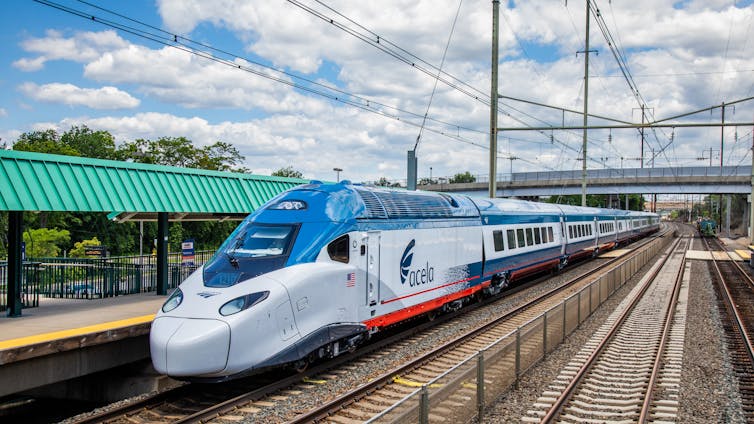
The new Acela trains are scheduled to start running on the Northeast Corridor soon.
Courtesy of Amtrak

David Alff, University at Buffalo

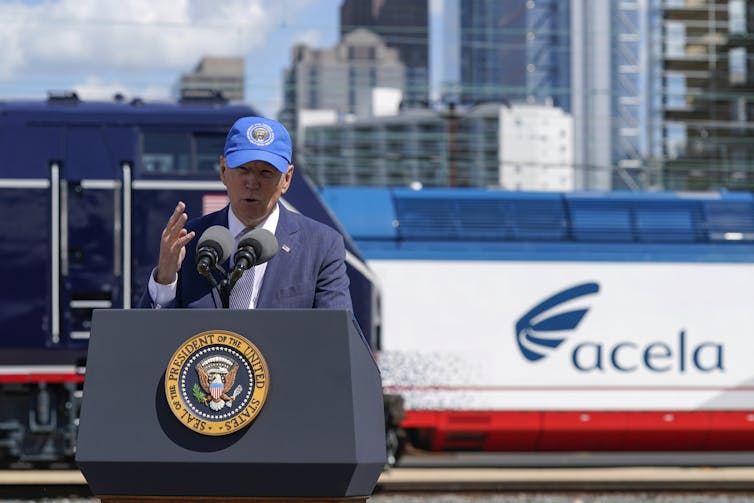
When former President Joe Biden unveiled his US$1.9 trillion infrastructure plan in 2021, he found the perfect place to go public: Philadelphia’s 30th Street Station rail yard.

Over the din of crackling wires and grumbling engines, the president made his case for revitalizing the country’s roads, ports, airports and rail lines.

Behind Biden sat rows of gleaming Amtrak trains. Among them was a prototype of NextGen Acela, a sleek machine engineered to deliver the fastest passenger service in American history.

On Aug. 28, 2025, NextGen will finally hit the rails, after years of delays.

As the author of a book on the Northeast Corridor, the rail line that connects Boston, New York, Philadelphia and Washington, I know this new train cannot come soon enough for many seaboard riders, even though it launches at a time of diminished political will for passenger rail.
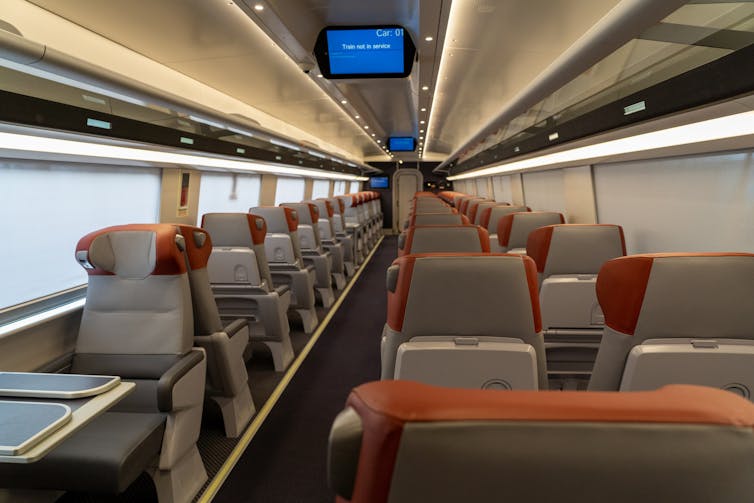
Interior of modern train with seats with red headrests
Red headrests distinguish first-class cars from business class on the NextGen Acela trains.
Courtesy of Amtrak

Rail renaissance under fire

The French-designed, American-manufactured NextGen arrives years late due to mechanical defects and failed simulation tests mandated by the Federal Railroad Administration. The new Acela will begin whisking passengers along the corridor after a chaotic year that saw downed wires, busted circuit breakers and brushfires disrupt Amtrak operations.

Gone is Amtrak’s White House champion, railfan-in-chief Biden, replaced by Donald Trump, whose one-time adviser, Elon Musk, called Amtrak a “sad situation,” and who proposed replacing the government-owned carrier with private competitors.
Man in suit and blue baseball cap speaks behind a lectern in front of a train with an urban skyline in the background
Former President Joe Biden delivers remarks at an Amtrak 50th anniversary event in Philadelphia in 2021.
AP Photo/Patrick Semansky

Amtrak CEO Stephen Gardner resigned in March 2025, and, in May, Amtrak cut 450 employee positions.

NextGen Acela promises an American rail renaissance in a moment when federally sponsored trains are fighting for their lives, as Biden’s infrastructure ambitions fall to an administration bent on cutting government costs.

These contradictions, however, are nothing new.

Not-so-fast trains

America’s love-hate relationship with fast trains stretches back to October 1964, when Japanese National Railways opened its Shinkansen high-speed line between Tokyo and Osaka.

Advertisement
Get More From A Face Cleanser And Spa-like Massage

Japan’s iconic 130-mph bullet train entranced audiences, many of whom saw footage of the new service during televised coverage of the Tokyo Olympics.
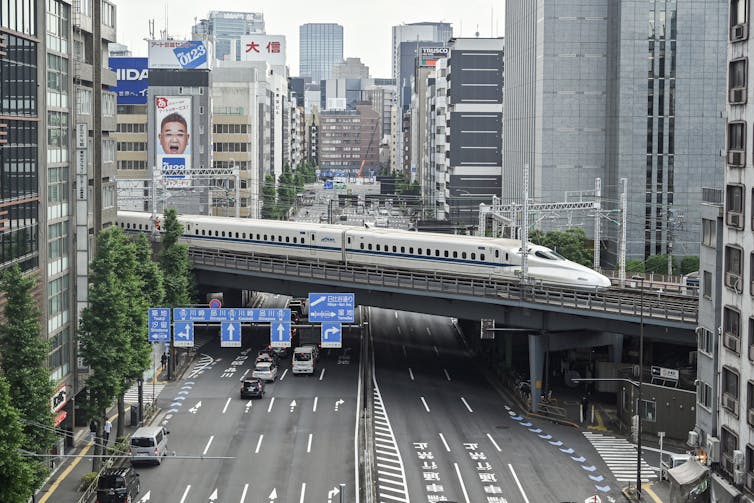
High-speed bullet train crosses bridge between skyscrapers
A Shinkansen high-speed bullet train passes through Tokyo.
Richard A. Brooks/AFP via Getty Images

Americans wanted their own bullet train but were reluctant to pay the massive infrastructural costs of a Shinkansen system. When Congress passed the High-Speed Ground Transportation Act of 1965, it prioritized the development of trains over the reconstruction of tracks, power systems and maintenance facilities.

The resulting services underperformed.

On Dec. 20, 1967, a gas turbine train manufactured by United Aircraft topped 170 mph while testing in New Jersey. But when the so-called TurboTrain entered service, it managed an average pace of just 63 mph on the weaving track between New York and Boston.

The electric-powered Metroliner, which began service in 1969, boasted similar potential but rarely held triple-digit speeds in service and broke down so often that its carrier, the Penn Central Railroad, struggled to keep the trains running between New York and Washington.

Historians usually regard these high-speed forays as resounding failures.

But riders loved them.

Technical flaws aside, both the TurboTrain and Metroliner were a hit with northeastern riders, so much so that Amtrak retained the Metroliner brand until 2006, long after it had retired the ‘60s-era trains.

Reflecting in 1999, rail journalist Don Phillips expressed disbelief “that those dogs were actually popular with the riding public.”

The birth of Acela

Amtrak opened a new era of high-speed rail in 2000 when it launched Acela Express.

Derived from France’s acclaimed TGV design, Acela carries passengers at speeds up to 150 mph on the Northeast Corridor.

Advertisement
Get More From A Face Cleanser And Spa-like Massage

Like the Metroliner before it, Acela suffered from design problems and mechanical faults, including cracked yaw dampers and brake discs, which temporarily sidelined the trains.

Rail writer Joseph Vranich described Acela as both “Amtrak’s crown jewel” and a “remarkable fiasco.”

And yet riders flocked to the service. Acela became one of Amtrak’s most popular and lucrative trains – so attractive that it lured business travelers off regional airlines.

When Acela entered service in 2000, Amtrak trains claimed just 37% of air-rail traffic between New York and Washington. By 2021, it had 83%. Between New York and Boston, that figure jumped from 20% to 75%.
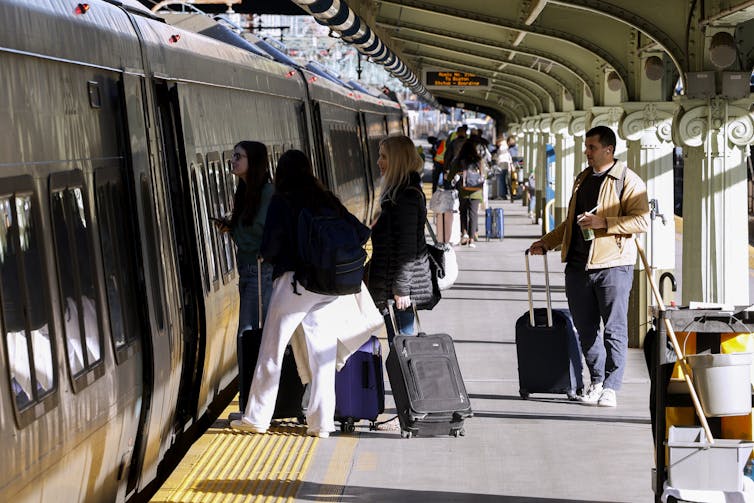
Passengers stand on platform waiting to board a train
Acela trains are popular and lucrative for Amtrak, in part because they draw so many business travelers.
Anna Moneymaker via Getty Images

Acela 2.0

Now, NextGen Acela takes up the fraught legacy of American high-speed rail. What can we expect of the new train?

NextGen is faster than the original Acela but will not set any world speed records. Its top velocity of 160 mph falls short of global benchmarks set by China’s Fuxing, which hits 217 mph, and Japan’s newest Shinkansens, which reach 200 mph.

With better tracks and signals, NextGen could conceivably ramp up to 186 mph, though such speeds won’t be possible anytime soon.

For now, NextGen will make do with an imperfect corridor. The train’s lightweight design means faster acceleration and lower energy consumption. An enhanced dynamic tilting system will let carriages lean into curves on the corridor’s twisting track, so they lose less speed on turns. The original Acela also tilted, but not as much.
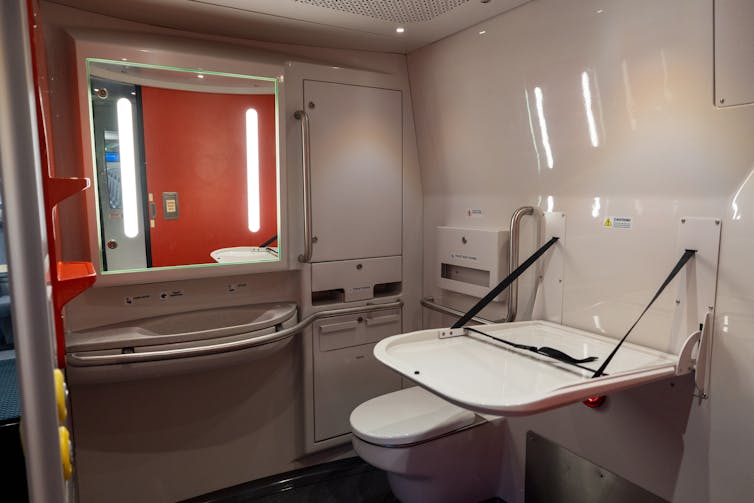
Modern white-and-red bathroom with changing table open
The NextGen Acela bathrooms are more spacious and have more touchless features than the previous design.
Courtesy of Amtrak

The upgraded onboard experience includes winged headrests, seat-side USB ports and 5G Wi-Fi. More importantly, each NextGen train can seat 82 more passengers than its predecessor. When Amtrak’s full fleet of 28 NextGens enters service, sending the first-generation trains into retirement, Acela service capacity will have increased by 4,728 seats.

This figure may be the train’s greatest achievement in a congested region at a time when Amtrak is posting record ridership.

The effects of the Northeast’s post-pandemic passenger surge are nowhere more visible than the Philadelphia rail yard where Biden spoke four years ago. Amtrak is constructing a new maintenance shop beside the Schuylkill River that will service NextGen trains and cement Philly’s role in the railroad’s addition of a million annual seats to its non-Acela corridor trains. Powered by conventional electric locomotives, these slower, cheaper “Regionals” accounted for 77% of corridor ridership in 2024 and will continue to carry the bulk of northeastern passengers.

Meanwhile, a quarter-mile south of the maintenance shop, America’s third-busiest passenger hub, 30th Street Station, is receiving a generational overhaul with a new food court, exterior plaza, shops and underground access to rapid transit.

Advertisement
Get More From A Face Cleanser And Spa-like Massage

These projects demonstrate the economic power of fast, frequent trains in Philly and throughout trackside communities of the Northeast. America’s embattled but resilient high-speed rail tradition may never be the world’s best, but even incremental improvements, like NextGen, cannot help but transform the places they serve.

For Amtrak’s corridor region, the stakes have never been higher.

Read more of our stories about Philadelphia.

David Alff, Associate Professor of English, University at Buffalo

This article is republished from The Conversation under a Creative Commons license. Read the original article.

Dive into “The Knowledge,” where curiosity meets clarity. This playlist, in collaboration with STMDailyNews.com, is designed for viewers who value historical accuracy and insightful learning. Our short videos, ranging from 30 seconds to a minute and a half, make complex subjects easy to grasp in no time. Covering everything from historical events to contemporary processes and entertainment, “The Knowledge” bridges the past with the present. In a world where information is abundant yet often misused, our series aims to guide you through the noise, preserving vital knowledge and truths that shape our lives today. Perfect for curious minds eager to discover the ‘why’ and ‘how’ of everything around us. Subscribe and join in as we explore the facts that matter.  https://stmdailynews.com/the-knowledge/

Continue Reading
Advertisement SodaStream USA, inc

The Knowledge

Metrolink Offers Fare-Free Rides for Earth Day 2026 Across Southern California

Metrolink offers fare-free rides for Earth Day 2026 across Southern California, encouraging sustainable travel and reduced emissions.

Published

on

Last Updated on April 21, 2026 by Daily News Staff

Metrolink Offers Fare-Free Rides for Earth Day 2026
Image Credit: Metrolink

Metrolink Offers Fare-Free Rides for Earth Day 2026

LOS ANGELES — April 22, 2026 — In a continued push toward sustainable transportation, Metrolink will once again offer systemwide free rides on Earth Day, inviting commuters and travelers to leave their cars behind and explore a cleaner way to move across the region.

A One-Day Opportunity to Ride Free

On Wednesday, April 22, passengers can board any Metrolink train — including the Arrow service — without purchasing a ticket. The initiative is part of the broader celebration of Earth Day, encouraging environmentally conscious travel choices.

The fare-free program is designed to appeal to both regular riders and first-time users, particularly those navigating Southern California’s persistent traffic congestion and rising fuel costs.

ml earth emailheader eng.jpg
Image Credit: Metrolink

Encouraging Sustainable Travel Habits

“Earth Day is a reminder that small changes, like choosing public transit over driving one day a week, can have a meaningful impact on our environment,” said Doug Chaffee, chair of the Metrolink Board.

With gas prices continuing to strain household budgets, the agency hopes the initiative will inspire more residents to consider rail as part of their regular commute.

Regional Connections Expand Access

Metrolink’s Earth Day promotion aligns with similar efforts by other Southern California transit providers. Riders can seamlessly connect to services operated by: LA Metro and the Orange County Transportation AuthorityRiverside County Transportation CommissionSan Bernardino County Transportation Authority and Ventura County Transportation Commission.

These partnerships extend the reach of fare-free travel across a six-county region, making it easier for riders to explore destinations without relying on personal vehicles.

Service Adjustments and Rider Tips

Passengers should note that trains will operate on a reduced weekday schedule, implemented earlier this spring. Despite the adjustment, all Metrolink lines and station cities remain in service.

For those planning a trip:

  • No ticket is required — simply board the train
  • Bikes are welcome, with capacity ranging from three bikes per standard car to nine in designated bike cars
  • A curated destination guide highlights attractions within walking or biking distance of stations

Environmental and Economic Impact

Metrolink is also promoting its Personal Impact Calculator, a digital tool that allows riders to estimate how switching from driving to rail can reduce greenhouse gas emissions and lower fuel expenses.

A Broader Trend in Public Transit

Fare-free transit days have gained traction nationwide as agencies look to boost ridership and promote sustainability. Southern California’s expansive commuter rail network makes it particularly well-suited for such initiatives, offering a viable alternative to one of the country’s most car-dependent regions.


Bottom Line

Metrolink’s Earth Day promotion is more than a one-day free ride — it’s a strategic effort to shift commuter behavior, reduce environmental impact, and showcase the convenience of regional rail. For Southern Californians, April 22 presents a low-risk opportunity to rethink how they travel.

Advertisement
Get More From A Face Cleanser And Spa-like Massage

Source: Metrolink

https://metrolinktrains.com/news/metrolink-goes-fare-free-for-earth-day-on-april-22

Dive into “The Knowledge,” where curiosity meets clarity. This playlist, in collaboration with STMDailyNews.com, is designed for viewers who value historical accuracy and insightful learning. Our short videos, ranging from 30 seconds to a minute and a half, make complex subjects easy to grasp in no time. Covering everything from historical events to contemporary processes and entertainment, “The Knowledge” bridges the past with the present. In a world where information is abundant yet often misused, our series aims to guide you through the noise, preserving vital knowledge and truths that shape our lives today. Perfect for curious minds eager to discover the ‘why’ and ‘how’ of everything around us. Subscribe and join in as we explore the facts that matter.  https://stmdailynews.com/the-knowledge/

View recent photos

Unlock fun facts & lost history—get The Knowledge in your inbox!

We don’t spam! Read our privacy policy for more info.

Continue Reading

News

Money Management: The Importance of Financial Literacy

You may have mastered the core subjects like math and grammar in school, but financial literacy – or understanding the basics of money management in order to help you make better financial decisions – often goes overlooked before adulthood. It’s not so much a course of study as it is a plan of action. When you understand how to earn, save, spend and invest wisely, you aren’t just building a stable future for yourself, but your family and community as well.

Published

on

You may have mastered the core subjects like math and grammar in school, but financial literacy – or understanding the basics of money management in order to help you make better financial decisions – often goes overlooked before adulthood. It’s not so much a course of study as it is a plan of action. When you understand how to earn, save, spend and invest wisely, you aren’t just building a stable future for yourself, but your family and community as well.

(Feature Impact) You may have mastered the core subjects like math and grammar in school, but financial literacy – or understanding the basics of money management in order to help you make better financial decisions – often goes overlooked before adulthood. It’s not so much a course of study as it is a plan of action.

Financial literacy in the United States has remained stagnant at generally low levels for several years, according to research from TIAA Institute and the Global Financial Literacy Excellence Center, with even lower levels among Gen Z. Yet greater financial literacy – including key aspects such as goal-setting, budgeting, saving, credit management and investing – is strongly linked to better financial outcomes, including lower rates of debt constraint and financial fragility.

While emboldening yourself to understand financial terms can be a little overwhelming at first, once you have a grasp of basic concepts you can begin to get a handle on your money and make better financial decisions. Simply put: When you understand how to earn, save, spend and invest wisely, you aren’t just building a stable future for yourself, but your family and community as well.

From nonprofit partnerships to volunteer-led programs and fee online resources, Schwab and its employees help millions of people every year build the knowledge and confidence to take charge of their financial futures by serving as board members, mentors, role models and educators.

Because financial health is a lifelong journey, the earlier people learn vital money skills, the better. That’s why the financial advisory services provider develops education programs geared toward kids that continue into adulthood, helping people no matter where they are on their journeys.

Talk Money

It’s never too early to start a conversation about financial literacy. Having teens identify goals that are important to them – such as concert tickets or a first car – can kickstart coversations about money. Working with your child (and a financial advisor, if necessary) on a plan for saving to realize those goals can serve as a jumping off point. After achieving some success, their enthusiasm may grow, which is a powerful motivator to keep saving.

Support School Initiatives and Programs

Outreach programs that empower young people to make smart financial decisions is key to a bright future. Programs like Money Matters – Schwab’s flagship financial education program utilized by the Boys & Girls Clubs of America – gives young people hands-on experience with all aspects of money and investing.

This example, and others, don’t just include program funding – they build partnerships that create impact and opportunity with national collaborations that reach more than 17 million youth annually, empowering young people with the tools and confidence to make smart financial decisions for life.

Spread the Financial Love

Championing financial literacy empowers everyone – individuals, families and communities. By serving as a board member, mentor, role model or educator to help bring financial literacy to others in your community, you can supply the tools and knowledge to lead programs that focus on giving back, empowering future generations in countless ways.

To learn more about financial literacy and find resources to empower your local community, visit SchwabMoneywise.com.

Photo courtesy of Shutterstock

Advertisement
Get More From A Face Cleanser And Spa-like Massage
    collect?v=1&tid=UA 482330 7&cid=1955551e 1975 5e52 0cdb 8516071094cd&sc=start&t=pageview&dl=http%3A%2F%2Ftrack.familyfeatures
track

SOURCE:

Charles Schwab

Our Lifestyle section on STM Daily News is a hub of inspiration and practical information, offering a range of articles that touch on various aspects of daily life. From tips on family finances to guides for maintaining health and wellness, we strive to empower our readers with knowledge and resources to enhance their lifestyles. Whether you’re seeking outdoor activity ideas, fashion trends, or travel recommendations, our lifestyle section has got you covered. Visit us today at https://stmdailynews.com/category/lifestyle/ and embark on a journey of discovery and self-improvement.

Continue Reading

Automotive

SUVs and EVs Take Center Stage at the 2026 New York International Auto Show

Published

on

Kia. 2026 New York International Auto Show

SUVs and EVs Take Center Stage at the 2026 New York International Auto Show

(Feature Impact) The 2026 New York International Auto Show is shining a spotlight on the latest in automotive innovation, from advanced technology to the growing shift toward electric vehicles. One automaker, Kia, is using the show to highlight two versatile SUVs designed to offer more space, capability and flexibility for modern drivers.

Watch this video to learn more

The all-new 2027 Kia Seltos has grown in size, offering a roomier interior with additional legroom, headroom and cargo space. It also adds a hybrid powertrain, making it the only vehicle in its class with three powertrain options. The SUV comes packed with advanced safety features, a more capable all-wheel-drive system and premium interior touches, including dual 12.3-inch display screens and an available panoramic sunroof.

The automaker is also showcasing the all-electric EV3, a compact SUV designed to make electric vehicle ownership more practical. With an estimated range of up to 320 miles, fast-charging capability and optional all-wheel drive, it balances performance, technology and everyday usability. Its intuitive features and flexible design make transitioning to electric simpler for a wider range of drivers.

Both models represent Kia’s commitment to providing options that blend capability, innovation and style. To learn more, visit Kia.com.

   collect?v=1&tid=UA 482330 7&cid=1955551e 1975 5e52 0cdb 8516071094cd&sc=start&t=pageview&dl=http%3A%2F%2Ftrack.familyfeatures
track

SOURCE:

Kia Motors America

Welcome to the Consumer Corner section of STM Daily News, your ultimate destination for savvy shopping and informed decision-making! Dive into a treasure trove of insights and reviews covering everything from the hottest toys that spark joy in your little ones to the latest electronic gadgets that simplify your life. Explore our comprehensive guides on stylish home furnishings, discover smart tips for buying a home or enhancing your living space with creative improvement ideas, and get the lowdown on the best cars through our detailed auto reviews. Whether you’re making a major purchase or simply seeking inspiration, the Consumer Corner is here to empower you every step of the way—unlock the keys to becoming a smarter consumer today!

https://stmdailynews.com/category/consumer-corner

Continue Reading

Trending

