Threatening texts targeting minorities after election were vile − but they might not be illegal
Following the election, a surge of hateful texts targeting minorities prompted FBI and state investigations, raising questions about the balance between free speech and potential criminality.
The anonymously sent messages, which may have numbered up to 500,000, varied in their specific language but had similarly menacing themes. Some referred to recipients as “selected for slavery” and ordered them to a plantation to pick cotton. Others said they’d be picked up for deportation or sent to a reeducation camp.
The threats lacked details on timing, location and the like. Some addressed recipients by name, while others contained no greeting or personal identifier. They seemed to be targeting Black people, immigrants and LGBTQ people but may have been dispatched indiscriminately to a wide swath of Americans.
Information technology experts have expressed confidence that the perpetrators will be identified. Yet it’s not clear to me as a professor of constitutional and criminal law that they can be prosecuted. The First Amendment generally protects free speech, even when it’s heinous.
“If there is a bedrock principle underlying the First Amendment, it is that the government may not prohibit the expression of an idea simply because society finds the idea itself offensive or disagreeable,” the justices wrote in Texas v. Johnson, a 1989 case that affirmed flag burning is protected expression.
Snyder v. Phelps, a 2010 case involving anti-LGBTQ protesters who carried hateful signs at the funerals of fallen soldiers, strengthened that precedent.
“Speech is powerful. It can stir people to action, move them to tears of both joy and sorrow, and – as it did here – inflict great pain,” the justices wrote. Nonetheless, they concluded, “We cannot react to that pain by punishing the speaker. As a Nation we have chosen a different course – to protect even hurtful speech.”
Limits to free speech
The Supreme Court has been cautious in recognizing exceptions to the freedom of speech because of its importance to democracy and individual autonomy. Under special circumstances, however, some types of speech can be illegal.
In the 2023 case Counterman v. Colorado, the Supreme Court held that for speech to cross over the true threat line, the speaker must both express an intent to commit violence and recklessly disregard “a substantial risk that his communications would be viewed as threatening violence.”
An example of a true threat under the Counterman case would be for a scorned lover to barrage their ex with messages promising to kill or maim them.
This standard is so new that it has not been tested thoroughly in the lower courts, making predictions risky at best. In my analysis, however, a message mass distributed to thousands of recipients indicating that they had been “selected” to be a slave might not meet the Counterman standard.
Additionally, “slave” is a legal status that hasn’t existed for over 150 years, so the threat to force someone into enslaved labor likely lacks both the peril of physical harm and the plausibility of harmful action. The anonymity of the senders may add to this implausibility.
Courts may also find that the communications didn’t create a “significant” risk that a “reasonable” recipient would feel threatened. An anonymous mass message may be interpreted as spam, or trolling.
Accordingly, the messages probably would not rise to the level of “true threat” exceptions to First Amendment protections.
Yost was likely referring to a 2011 Ohio statute that criminalizes telecommunications that are “threatening, intimidating, menacing, coercive, or obscene with the intent to abuse, threaten, or harass the recipient.”
The intersection of telephone harassment and the First Amendment is less clear, in my analysis. Laws vary by state, but illegal harassment and stalking typically involves physical conduct, which is not protected by the First Amendment – for example, repeated unwanted visits to someone’s home or workplace. Continually following someone in a manner intended to cause fear – or which recklessly causes fear or emotional distress – would be another example.
Could a text or email be characterized as conduct rather than speech? That is unsettled law. And where the law is unclear, novel legal strategies can set a new precedent.
If a court were to decide that the act of sending the November messages was “pure conduct,” rather than protected speech, then anti-harassment laws might be used to prosecute the senders.
Private action
Criminal law aside, people are not powerless against vile communications.
Telecommunications companies are free to block messages, both before they are received and in response to customer requests. After the wave of hateful texts in November, many did just that by closing accounts identified as sources of those messages.
If a blocked sender continues to send similar communications to a target, the elements of harassment would be met. A court could determine that to be expressive conduct or simply speech not protected by the First Amendment.
The U.S. draws the boundary widely around free speech because it enables wide, controversial discussions of politics, law and society. In this case, the senders ran up to the line of protected speech but quite possibility didn’t cross it.
Advertisement
“The trouble with fighting for human freedom is that one spends most of one’s time defending scoundrels,” the author H.L. Mencken once said. “For it is against scoundrels that oppressive laws are first aimed, and oppression must be stopped at the beginning if it is to be stopped at all.”
The Bridge is a section of the STM Daily News Blog meant for diversity, offering real news stories about bona fide community efforts to perpetuate a greater good. The purpose of The Bridge is to connect the divides that separate us, fostering understanding and empathy among different groups. By highlighting positive initiatives and inspirational actions, The Bridge aims to create a sense of unity and shared purpose. This section brings to light stories of individuals and organizations working tirelessly to promote inclusivity, equality, and mutual respect. Through these narratives, readers are encouraged to appreciate the richness of diverse perspectives and to participate actively in building stronger, more cohesive communities.
Harkins Theatres Announces Rob Reiner Tribute Screening of The American President
Harkins Theatres has announced a special one-day tribute screening honoring acclaimed filmmaker Rob Reiner, celebrating his life’s work and cinematic legacy.
On December 17, select Harkins locations will screen Reiner’s 1995 political romance The American President, with all proceeds benefiting the Human Rights Campaign. Tickets are priced at $5, making the event both an accessible film experience and a charitable fundraiser.
The tribute was announced via Harkins’ official, verified social media accounts and is positioned as a legacy celebration, not a memorial.
🎥 Why The American President?
Released in 1995 and written by Aaron Sorkin, The American President stars Michael Douglas and Annette Bening and remains one of Rob Reiner’s most politically resonant films. The movie blends romance, idealism, and civic responsibility — themes that have consistently appeared throughout Reiner’s career.
The film later served as a creative blueprint for The West Wing, cementing its place in modern political storytelling.
Rob Reiner’s career spans more than five decades, including landmark films such as:
This Is Spinal Tap
Stand By Me
The Princess Bride
When Harry Met Sally…
Misery
A Few Good Men
His work is often praised for balancing entertainment, empathy, and social conscience, making tribute events like this especially meaningful to longtime audiences.
Hollywood Legend Rob Reiner and Wife Found Dead; Son in Custody
Renowned filmmaker Rob Reiner and his wife, Michele Singer Reiner, were found dead in their Los Angeles home in a reported homicide. Police have arrested their son in connection with the case, and tributes are pouring in.
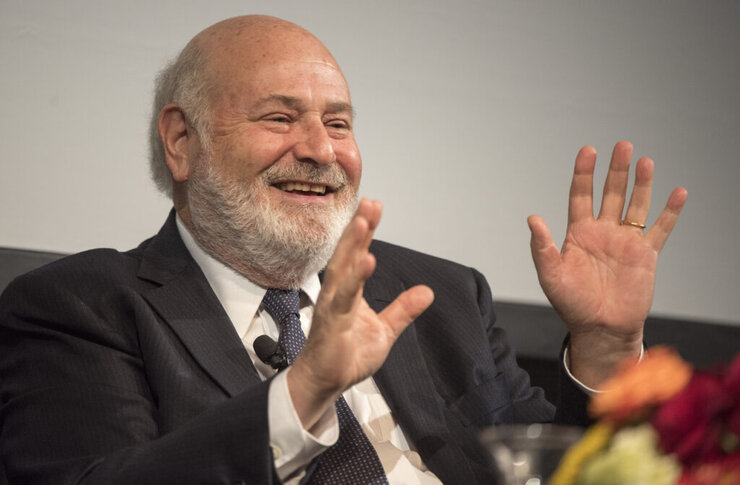
Director Rob Reiner participates in a discussion following a screening of the film LBJ at the LBJ Presidential Library in Austin, Texas on Saturday October 22, 2016 On Saturday evening October 22, 2016, the LBJ Presidential Library held a sneak peek of Rob Reiner’s new filmÊLBJ, starring Woody Harrelson as the 36th president. The film, which premiered at the Toronto International Film Festival in September, chronicles the life and times of Lyndon Johnson who would inherit the presidency at one of the most fraught moments in American history. Following the screening, director Rob Reiner, actor Woody Harrelson, and writer Joey Hartstone joined LBJ Library Director Mark Updegrove on stage for a conversation about the film. LBJ Library photo by Jay Godwin 10/22/2016
Hollywood Legend Rob Reiner and Wife Found Dead; Son in Custody
December 15, 2025
Renowned filmmaker and actor Rob Reiner, 78, and his wife Michele Singer Reiner, 68, were found dead in their Brentwood, Los Angeles home on Sunday, authorities say. Emergency responders were called to the residence Sunday afternoon, where both were discovered with fatal wounds consistent with a stabbing. Police are treating the case as a double homicide.
Los Angeles police arrested the couple’s 32-year-old son, Nick Reiner, in connection with the deaths. He is being held in custody as investigators continue to piece together the circumstances surrounding the incident.
2016 SAMHSA Voice Awards
Reiner was one of Hollywood’s most influential figures, known for his work as a director, producer and actor. His career spanned decades, from early television fame to directing beloved films that shaped American cinema.
Friends, colleagues and public figures have begun sharing tributes and reactions to the news as the investigation is ongoing.
More details will be updated as they become available.
FDA’s COVID-19 Vaccine Safety Claims Lack Solid Evidence—Why Overreaction Could Harm Public Health
COVID-19 vaccine safety: The FDA’s claims about COVID-19 vaccine deaths in children lack strong evidence and could restrict vaccine access. Learn why experts say VAERS reports aren’t proof, and how overreacting may harm public health and trust in vaccines.
The death of children due to an unsafe vaccine is a serious allegation. I am a pediatric cardiologist who has studied the link between COVID-19 vaccines and heart-related side effects such as myocarditis in children. To my knowledge, studies to date have shown such side effects are rare, and severe outcomes even more so. However, I am open to new evidence that could change my mind. But without sufficient justification and solid evidence, restricting access to an approved vaccine and changing well-established procedures for testing vaccines would carry serious consequences. These moves would limit access for patients, create roadblocks for companies and worsen distrust in vaccines and public health. In my view, it’s important for people reading about these FDA actions to understand how the evidence on a vaccine’s safety is generally assessed.
Determining cause of death
The FDA memo claims that the deaths of these children were directly related to receiving a COVID-19 immunization. From my perspective as a clinician, it is awful that any child should die from a routine vaccination. However, health professionals like me owe it to the public to uphold the highest possible standards in investigating why these deaths occurred. If the FDA has evidence demonstrating something that national health agencies worldwide have missed – widespread child deaths due to myocarditis caused by the COVID-19 vaccine – I don’t doubt that even the most pro-vaccine physician will listen. So far, however, no such evidence has been presented. While a death logged in VAERS is a starting point, on its own it is insufficient to conclude whether a vaccine caused the death or other medical causes were to blame. To demonstrate a causal link, FDA staff and physicians must align the VAERS report with physicians’ assessments of the patient, as well as data from other sources for monitoring vaccine safety. These include PRISM, which logs insurance claims data, and the Vaccine Safety Datalink, which tracks safety signals in electronic medical records. It’s known that most deaths logged only in VAERS of children who recently received vaccines have been incorrectly attributed to the vaccines – either by accident or in some cases on purpose by anti-vaccine activists.
Heart-related side effects of COVID-19 vaccines
In his Substack and Twitter accounts, Prasad has said that he believes the rate of severe cardiac side effects after COVID-19 vaccination is severely underestimated and that the vaccines should be restricted far more than they currently are. In a July 2025 presentation, Prasad quoted a risk of 27 cases per million of myocarditis in young men who received the COVID-19 vaccine. A 2024 review suggested that number was a bit lower – about 20 cases out of 1 million people. But that same study found that unvaccinated people had greater risk of heart problems after a COVID-19 infection than vaccinated people. In a different study, people who got myocarditis after a COVID-19 vaccination developed fewer complications than people who got myocarditis after a COVID-19 infection. Existing vaccine safety infrastructure in the U.S. successfully identifies dangers posed by vaccines – and did so during the COVID-19 pandemic. Today, most COVID-19 vaccines in the U.S. rely on mRNA technology. But as vaccines were first emerging during the COVID-19 pandemic, two pharmaceutical companies, Janssen and AstraZeneca, rolled out a vaccine that used a different technology, called a viral vector. This type of vaccine had a very rare but genuine safety problem that was detected.A report in VAERS is at most a first step to determining whether a vaccine caused harm. VAERS, the Vaccine Safety Datalink, clinical investigators in the U.S. and their European counterparts detected that these vaccines did turn out to cause blood clotting. In April 2021, the FDA formally recommended pausing their use, and they were later pulled from the market. Death due to myocarditis from COVID-19 vaccination is exceedingly rare. Demonstrating that it occurred requires proof that the person had myocarditis, evidence that no other reasonable cause of death was present, and the absence of any additional cause of myocarditis. These factors cannot be determined from VAERS data, however – and to date, the FDA has presented no other relevant data.
A problematic vision for future vaccine approvals
Currently, vaccines are tested both by seeing how well they prevent disease and by how well they generate antibodies, which are the molecules that help your body fight viruses and bacteria. Some vaccines, such as the COVID-19 vaccine and the influenza vaccine, need to be updated based on new strains. The FDA generally approves these updates based on how well the new versions generate antibodies. Since the previous generation of vaccines was already shown to prevent infection, if the new version can generate antibodies like the previous one, researchers assume its ability to prevent infection is comparable too. Later studies can then test how well the vaccines prevent severe disease and hospitalization. The FDA memo says this approach is insufficient and instead argues for replacing such studies with many more placebo-controlled trials – not just for COVID-19 vaccines but also for widely used influenza and pneumonia vaccines. That may seem reasonable theoretically. In practice, however, it is not realistic. Today’s influenza vaccines must be changed every season to reflect mutations to the virus. If the FDA were to require new placebo-controlled trials every year, the vaccine being tested would become obsolete by the time it is approved. This would be a massive waste of time and resources.Influenza vaccines must be updated for every flu season.Jacob Wackerhausen/iStock via Getty Images Plus Also, detecting vaccine-related myocarditis at the low rate at which it occurs would have required clinical trials many times larger than the ones that were done to approve COVID-19 mRNA vaccines. This would have cost at least millions of dollars more, and the delay in rolling out vaccines would have also cost lives. Placebo-controlled trials would require comparing people who receive the updated vaccine with people who remain unvaccinated. When an older version of the vaccine is already available, this means purposefully asking people to forgo that vaccine and risk infection for the sake of the trial, a practice that is widely considered unethical. Current scientific practice is that only a brand-new vaccine may be compared against placebo. While suspected vaccine deaths should absolutely be investigated, stopping a vaccine for insufficient reasons can lead to a significant drop in public confidence. That’s why it’s essential to thoroughly and transparently investigate any claims that a vaccine causes harm.