Connect with us

Science

Why the meteorites that hit Earth have less water than the asteroid bits brought back by space probes

Published

on

 A planetary scientist explains new research

meteorites
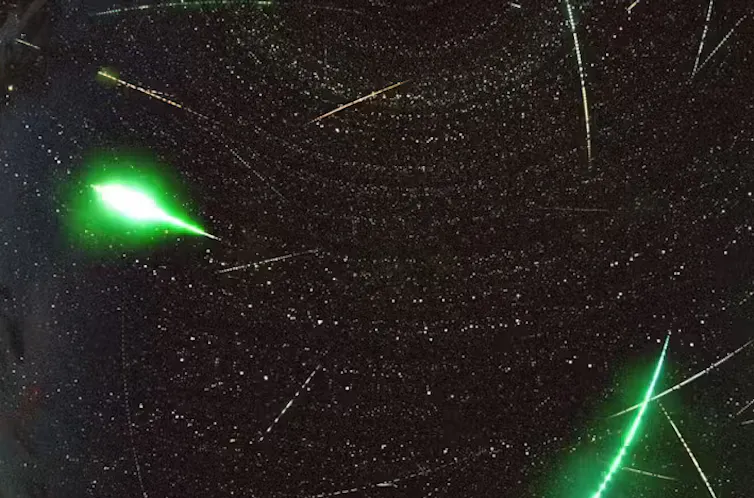
This image overlays over 100 fireball images recorded between 2016 and 2020. The streaks are fireballs; the dots are star positions at different times.
Desert Fireball Network

Patrick M. Shober, NASA

Much of what scientists know about the early solar system comes from meteorites – ancient rocks that travel through space and survive a fiery plunge through Earth’s atmosphere. Among meteorites, one type – called carbonaceous chondrites – stands out as the most primitive and provides a unique glimpse into the solar system’s infancy.

The carbonaceous chondrites are rich in water, carbon and organic compounds. They’re “hydrated,” which means they contain water bound within minerals in the rock. The components of the water are locked into crystal structures. Many researchers believe these ancient rocks played a crucial role in delivering water to early Earth.

Before hitting the Earth, rocks traveling through space are generally referred to as asteroids, meteoroids or comets, depending on their size and composition. If a piece of one of these objects makes it all the way to Earth, it becomes a “meteorite.”

From observing asteroids with telescopes, scientists know that most asteroids have water-rich, carbonaceous compositions. Models predict that most meteorites – over half – should also be carbonaceous. But less than 4% of all the meteorites found on Earth are carbonaceous. So why is there such a mismatch?

In a study published in the journal Nature Astronomy on April 14, 2025, my planetary scientist colleagues and I tried to answer an age-old question: Where are all the carbonaceous chondrites?

Sample-return missions

Scientists’ desire to study these ancient rocks has driven recent sample-return space missions. NASA’s OSIRIS‑REx and JAXA’s Hayabusa2 missions have transformed what researchers know about primitive, carbon‑rich asteroids.

Meteorites found sitting on the ground are exposed to rain, snow and plants, which can significantly change them and make analysis more difficult. So, the OSIRIS‑REx mission ventured to the asteroid Bennu to retrieve an unaltered sample. Retrieving this sample allowed scientists to examine the asteroid’s composition in detail.

Similarly, Hayabusa2’s journey to the asteroid Ryugu provided pristine samples of another, similarly water-rich asteroid.

Together these missions have let planetary scientists like me study pristine, fragile carbonaceous material from asteroids. These asteroids are a direct window into the building blocks of our solar system and the origins of life.

A dusty, rocky asteroid against a dark backdrop.
Carbonaceous near-Earth asteroid Bennu as seen from NASA’s OSIRIS-REx sample-return spacecraft.
NASA

The carbonaceous chondrite puzzle

For a long time, scientists assumed that the Earth’s atmosphere filtered out carbonaceous debris.

When an object hits Earth’s atmosphere, it has to survive significant pressures and high temperatures. Carbonaceous chondrites tend to be weaker and more crumbly than other meteorites, so these objects just don’t stand as much of a chance.

Advertisement
Get More From A Face Cleanser And Spa-like Massage

Meteorites usually start their journey when two asteroids collide. These collisions create a bunch of centimeter- to meter-size rock fragments. These cosmic crumbs streak through the solar system and can, eventually, fall to Earth. When they’re smaller than a meter, scientists call them meteoroids.

Meteoroids are far too small for researchers to see with a telescope, unless they’re about to hit the Earth, and astronomers get lucky.

But there is another way scientists can study this population, and, in turn, understand why meteorites have such different compositions.

Meteor and fireball observation networks

Our research team used the Earth’s atmosphere as our detector.

Most of the meteoroids that reach Earth are tiny, sand-sized particles, but occasionally, bodies up to a couple of meters in diameter hit. Researchers estimate that about 5,000 metric tons of micrometeorites land on Earth annually. And, each year, between 4,000 and 10,000 large meteorites – golf ball-sized or larger – land on Earth. That’s more than 20 each day.

A fireball observed by the FRIPON network in Normandy, France, in 2019.

Today, digital cameras have rendered round-the-clock observations of the night sky both practical and affordable. Low-cost, high-sensitivity sensors and automated detection software allow researchers to monitor large sections of the night sky for bright flashes, which signal a meteoroid hitting the atmosphere.

Research teams can sift through these real-time observations using automated analysis techniques – or a very dedicated Ph.D. student – to find invaluable information.

Our team manages two global systems: FRIPON, a French-led network with stations in 15 countries; and the Global Fireball Observatory, a collaboration started by the team behind the Desert Fireball Network in Australia. Together with other open-access datasets, my colleagues and I used the trajectories of nearly 8,000 impacts observed by 19 observation networks spread across 39 countries.

A camera, which looks like a glass sphere, attached to a metal stand on a railing overlooking mountains.
FRIPON camera installed at the Pic du Midi Observatory in the French Pyrenees.
FRIPON

By comparing all meteoroid impacts recorded in Earth’s atmosphere with those that successfully reach the surface as meteorites, we can pinpoint which asteroids produce fragments that are strong enough to survive the journey. Or, conversely, we can also pinpoint which asteroids produce weak material that do not show up as often on Earth as meteorites.
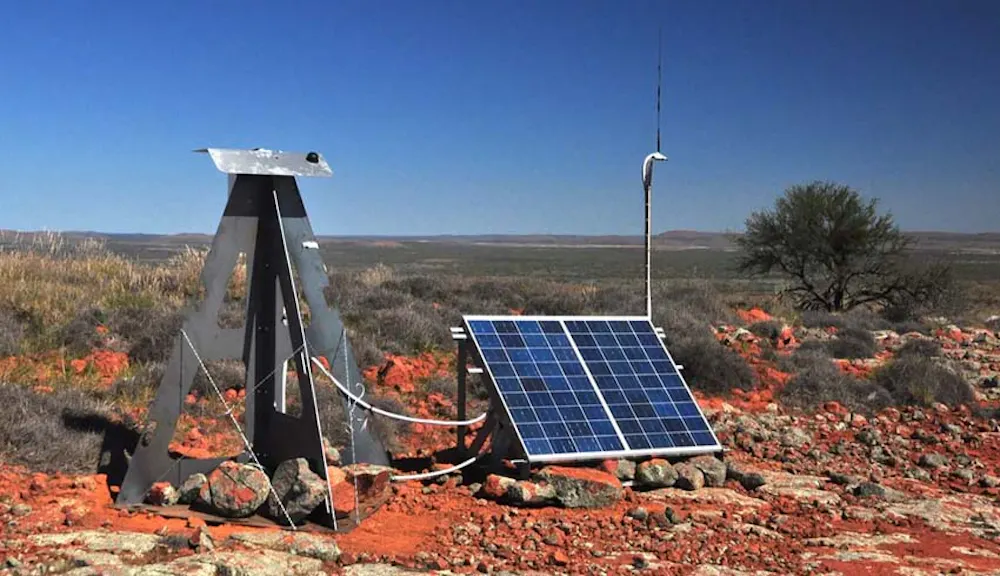
A mechanical panel sitting in a desert in Australia
Desert Fireball Network automated remote observatory in South Australia.
The Desert Fireball Network

The Sun is baking the rocks too much

Surprisingly, we found that many asteroid pieces don’t even make it to Earth. Something starts removing the weak stuff while the fragment is still in space. The carbonaceous material, which isn’t very durable, likely gets broken down through heat stress when its orbit takes it close to the Sun.

As carbonaceous chondrites orbit close, and then away from the Sun, the temperature swings form cracks in their material. This process effectively fragments and removes weak, hydrated boulders from the population of objects near the Earth. Anything left over after this thermal cracking then has to survive the atmosphere.

Only 30%-50% of the remaining objects survive the atmospheric passage and become meteorites. The debris pieces whose orbits bring them closer to the Sun tend to be significantly more durable, making them far more likely to survive the difficult passage through Earth’s atmosphere. We call this a survival bias.

Advertisement
Get More From A Face Cleanser And Spa-like Massage

For decades, scientists have presumed that Earth’s atmosphere alone explains the scarcity of carbonaceous meteorites, but our work indicates that much of the removal occurs beforehand in space.

Going forward, new scientific advances can help confirm these findings and better identify meteoroid compositions. Scientists need to get better at using telescopes to detect objects right before they hit the Earth. More detailed modeling of how these objects break up in the atmosphere can also help researchers study them.

Lastly, future studies can come up with better methods to identify what these fireballs are made of using the colors of the meteors.

Patrick M. Shober, Postdoctoral Fellow in Planetary Sciences, NASA

This article is republished from The Conversation under a Creative Commons license. Read the original article.

Continue Reading
Advertisement SodaStream USA, inc

aerospace

Boom Supersonic Update 2026: Overture Progress, XB-1 Milestones, and What’s Next

Boom Supersonic’s 2026 update: XB-1 test success, Overture production timeline, funding progress, and the challenges facing the return of commercial supersonic travel.

Published

on

By STM Daily News Staff

The race to bring back commercial supersonic travel is accelerating once again, led by Boom Supersonic, a Colorado-based aerospace company aiming to succeed where Concorde left off. As of 2026, the company has achieved meaningful technical milestones—but still faces significant financial, regulatory, and industrial hurdles.

Here’s a comprehensive look at where Boom stands today, and what it means for the future of high-speed air travel.

Boom Supersonic’s 2026 update: XB-1 test success, Overture production timeline, funding progress, and the challenges facing the return of commercial supersonic travel.
Image Credit: Boom Supersonic

XB-1 Demonstrator Completes Historic Test Program

Boom’s experimental aircraft, the XB-1, has successfully completed its flight test campaign, marking a critical step toward validating the company’s supersonic technology.

  • Achieved multiple supersonic flights in 2025
  • Demonstrated aerodynamic stability and performance
  • Tested “boomless cruise” capabilities to reduce sonic disturbances

The XB-1 program served as a scaled demonstrator for the company’s flagship commercial jet, proving that modern materials, software, and engine integration can support efficient supersonic flight.

With testing complete, the aircraft is expected to be preserved as a prototype, representing a turning point in private-sector aerospace innovation.


Overture: Boom’s Commercial Supersonic Jet

The centerpiece of Boom’s vision is the Overture, a next-generation supersonic passenger aircraft designed to carry between 60 and 80 passengers at speeds approaching Mach 1.7.

Current projected timeline:

  • Prototype rollout: Targeted for 2026
  • First flight: Expected around 2027
  • Commercial service entry: Late 2020s (estimated 2029–2030)

Unlike Concorde, which catered primarily to elite travelers, Boom aims to position Overture with business-class pricing, potentially expanding access to faster global travel.

The aircraft is also being designed with sustainability in mind, including compatibility with sustainable aviation fuel (SAF).


Funding and Financial Momentum

In recent developments, Boom Supersonic secured an additional $100 million in funding, reinforcing investor confidence in the company’s long-term vision.

However, building a supersonic passenger aircraft remains one of the most capital-intensive challenges in aviation. Continued fundraising and strategic partnerships will be essential as the company moves from prototype to production.


Boomless Cruise: A Potential Game-Changer

One of Boom’s most significant innovations is its focus on “boomless cruise,” a method of flying supersonically without producing an audible sonic boom on the ground.

Advertisement
Get More From A Face Cleanser And Spa-like Massage

If proven viable at scale, this technology could influence regulatory changes—particularly in the United States, where overland supersonic flight is currently restricted.

The ability to fly faster-than-sound over land would unlock major domestic routes, dramatically reducing travel times between cities like New York and Los Angeles.


Manufacturing Challenges and Delays

Despite technical progress, Boom’s manufacturing ambitions face uncertainty. A planned production facility in North Carolina has experienced delays, raising questions about when large-scale assembly will begin.

Scaling production from prototype to commercial aircraft remains one of the most difficult phases of any aerospace program, requiring supply chain coordination, workforce development, and regulatory alignment.


Industry Skepticism Remains

While Boom has secured interest from major airlines, skepticism persists within the aviation industry.

Key concerns include:

  • Certification complexity and regulatory approval timelines
  • Operational costs versus ticket pricing
  • Long-term demand for supersonic travel

Even airline executives have expressed cautious optimism, with some suggesting the project’s success remains uncertain.


The Bigger Picture: A Defining Decade for Supersonic Travel

Boom Supersonic has moved beyond concept and into real-world testing, demonstrating that modern supersonic flight is technically achievable.

However, the next phase—bringing Overture to market—will determine whether supersonic passenger travel becomes a viable industry once again or remains an ambitious experiment.

If successful, Boom could redefine global travel times. If not, it will join a long list of bold aerospace ventures that struggled to overcome economic reality.


Sources and External Links

Dive into “The Knowledge,” where curiosity meets clarity. This playlist, in collaboration with STMDailyNews.com, is designed for viewers who value historical accuracy and insightful learning. Our short videos, ranging from 30 seconds to a minute and a half, make complex subjects easy to grasp in no time. Covering everything from historical events to contemporary processes and entertainment, “The Knowledge” bridges the past with the present. In a world where information is abundant yet often misused, our series aims to guide you through the noise, preserving vital knowledge and truths that shape our lives today. Perfect for curious minds eager to discover the ‘why’ and ‘how’ of everything around us. Subscribe and join in as we explore the facts that matter.  https://stmdailynews.com/the-knowledge/

View recent photos

Unlock fun facts & lost history—get The Knowledge in your inbox!

We don’t spam! Read our privacy policy for more info.

Advertisement
Get More From A Face Cleanser And Spa-like Massage
Continue Reading

Space and Tech

I’ve fired one of America’s most powerful lasers – here’s what a shot day looks like

A lead scientist takes you inside the Texas Petawatt at UT Austin, where hours of careful alignment and safety checks build to a single, breath-holding laser shot that briefly creates star-like conditions in a vacuum chamber.

Published

on

file 20260410 57 e6icf4.jpg?ixlib=rb 4.1
Inside a laser clean room. The beam is contained within the blue pipe. Ahmed Helal

Ahmed Helal, The University of Texas at Austin

If you walk across the open yard in front of the Physics, Math and Astronomy building at the University of Texas at Austin, you’ll see a 17-story tower and a huge L-shaped building. What you won’t see is what’s underneath you. Two floors below ground, behind heavy double doors stamped with a logo that most students have never noticed, sits one of the most powerful lasers in the United States.

I was the lead laser scientist on the Texas Petawatt, or TPW as we called it, from 2020 to 2024. Texas Petawatt, which is currently closed due to funding cuts, was a government-funded research center where scientists from across the country applied for time to use specialized equipment. It was part of LaserNetUS, a Department of Energy network of high-power laser labs.

This type of laser takes a tiny pulse of light, stretches it out so it doesn’t blast optics to pieces, and amplifies it until, for a brief instant, it carries more power than the entire U.S. electrical grid. Then it compresses the pulse back to a trillionth of a second to create a star in a vacuum chamber.

On a typical shot day, the target might be a piece of metal foil thinner than a human hair, a jet of gas or a tiny plastic pellet – each designed to answer a different scientific question.

Scientists from across the country applied for time on TPW to study everything from the physics of stellar interiors and fusion energy to new approaches for cancer treatment.

Most people hear about petawatt lasers and picture something out of a movie. A “shot day” is actually hours of quiet, repetitive work followed by about 10 seconds where nobody breathes.

I now work as a research scientist at the University of Texas-Austin, studying the interaction of lasers with different materials, but a typical shot day during my time running TPW would look like this:

7 a.m.

I arrive two hours before the first scheduled shot. I put on my gown, boots and hairnet and step into the cold clean room. The laser doesn’t just turn on. You coax it awake.

I start with the oscillator, a small box that generates the first seed of light. I write down the parameters that define how the laser will behave during the shot: energy, center frequency, vacuum pressure in the tubes, cooling water level and flow. At this stage, they are fixed regardless of the experiment. The laser must perform the same way every time before the science can begin. Then I fire up the pump laser that will amplify this tiny pulse from nanojoules to about half a joule.

A diagram showing the layout of a large laser
The anatomy of a petawatt laser. A tiny pulse starts at the oscillator, gets stretched in time to avoid damaging the optics, is amplified through progressively larger stages, then is compressed back down to a trillionth of a second inside the vacuum chamber at right. Ahmed Helal, Fourni par l’auteur

The system needs at least 30 minutes to stabilize. During that time, I check alignment through every pinhole and every camera along the beam path. A slight misalignment at this stage isn’t just a problem; it can be catastrophic – a mispointed beam at full power can burn through optics that take months to source and replace, setting the entire laser back.

Building the beam

Once the system is warmed up, I send the beam into the first amplifier: a glass rod surrounded by bright flash lamps that pump light into the glass – like charging a battery. With each pass, the beam absorbs energy from the glass and grows stronger. Then the beam travels into a larger rod, where it makes four passes, picking up more energy each time until it reaches about 12 joules, roughly the energy of a ball thrown hard across a room.

Advertisement
Get More From A Face Cleanser And Spa-like Massage

This process alone takes the better part of an hour, most of it spent checking and confirming alignment and energy at each stage.

I expand the beam and send it through the final stage: the disk amplifiers. Two amplifiers, each consisting of two massive 30-centimeter glass disks, are pumped by a huge bank of flash lamps powered by capacitor banks – essentially giant batteries that store electrical energy and release it in a sudden burst. They are so large that they have their own room on a separate floor. Fast optical shutters between each stage act as gates, controlling exactly when and where the beam travels.

The shot

When the experimental team confirms that the target is in position, it asks me to prepare for a system shot. I run through the long checklist. We test the shutters and switch to system shot mode. Every monitor in the facility changes to display the same message – “System Shot Mode” – and flashes red.

A desk with 11 monitors displaying graphs.
The Texas Petawatt control room allows scientists to track a variety of parameters and metrics. On the left is the big red emergency stop button. Ahmed Helal

I lean into the microphone at the control desk, a vintage piece that looks like it belongs in a World War II radio room, and announce that we’re going into a system shot. Then I open the compressor beam dump: a heavy glass plate that normally blocks the beam from reaching the target. It takes about two minutes to move.

“Sweeping, sweeping for a system shot.”

The announcement goes out over speakers across the facility. I grab a small interlock key, put on my laser safety goggles and head downstairs. I walk a specific pattern through every room, checking that nobody is still inside. As I go, I lock each door with the key. If anyone opens one of those doors after I’ve locked them, the entire shot sequence aborts.

A microphone on a stand sitting on a desk.
Texas Petawatt scientists make announcements about the shot through a microphone in the control room. Ahmed Helal

Back in the control room, I sit down and start charging the capacitor banks. At this point, there’s no going back except for an emergency shutdown, and that means losing the shot and waiting for everything to cool down.

“Charging.”

The room goes silent. Everyone’s eyes are on the monitors. Nobody talks.

I typically will share a glance with the researcher whose project the shot is for – today it’s Joe, a visiting scientist from Los Alamos National Lab, who designed the target we’re about to vaporize. He’s gripping his coffee cup like it owes him money. I turn back to the console.

“Charge complete. Firing system shot in three, two, one. Fire.”

I press the button. A loud thud rolls through the building as all that stored energy dumps into the beam. The monitors freeze, capturing everything at the moment of the shot: beam profiles, spectra, diagnostics – these metrics provide a full picture of exactly how the laser performed and whether the shot was clean. Downstairs, in the vacuum chamber, a spot smaller than a human hair just reached temperatures measured in millions of degrees.

Advertisement
Get More From A Face Cleanser And Spa-like Massage

I lean back in my chair and start recording laser parameters as everyone exhales. A radiation safety officer heads down first to check readings around the target chamber before anyone else can enter. The experimental team follows to collect data.

Sometimes it all works perfectly. Sometimes a shutter fails to open and you lose the shot.

For example, one afternoon in 2023, we’d spent three hours preparing for a high-priority shot. Target aligned. Capacitors charged. I pressed the button and heard nothing. A shutter had failed somewhere in the chain. The monitors stayed frozen, showing black. Nobody said anything. I wrote SHOT FAILED in the logbook and started the hourlong cooldown sequence. That’s the part they don’t show in movies: sitting in silence, waiting to try again. We got the shot four hours later.

This anticipation is all part of the job: hours of patience for 10 seconds you never quite get used to. Everything happens underneath a campus where thousands of people walk above, unaware that for a fraction of a second, a tiny point of matter hotter than the surface of the Sun just existed below their feet.

Ahmed Helal, Research Scientist, The University of Texas at Austin

This article is republished from The Conversation under a Creative Commons license. Read the original article.

The science section of our news blog STM Daily News provides readers with captivating and up-to-date information on the latest scientific discoveries, breakthroughs, and innovations across various fields. We offer engaging and accessible content, ensuring that readers with different levels of scientific knowledge can stay informed. Whether it’s exploring advancements in medicine, astronomy, technology, or environmental sciences, our science section strives to shed light on the intriguing world of scientific exploration and its profound impact on our daily lives. From thought-provoking articles to informative interviews with experts in the field, STM Daily News Science offers a harmonious blend of factual reporting, analysis, and exploration, making it a go-to source for science enthusiasts and curious minds alike. https://stmdailynews.com/category/science/

Advertisement
Get More From A Face Cleanser And Spa-like Massage
Continue Reading

Science

New Glenn’s Third Mission Set for April 19 as Blue Origin Advances Commercial Space Capabilities

Published

on

CAPE CANAVERAL, Fla. — Blue Origin has confirmed the launch window for the third mission of its heavy-lift New Glenn rocket, marking another step forward in the company’s expanding role in commercial spaceflight.

New Glenn’s Third Mission
Image Credit: Blue Origin

New Glenn’s Third Mission

Launch Details and Timeline

The mission is scheduled to lift off no earlier than Sunday, April 19, 2026, from Launch Complex 36 at Cape Canaveral Space Force Station. The two-hour launch window opens at 6:45 a.m. EDT (10:45 UTC) and closes at 8:45 a.m. EDT (12:45 UTC).

Viewers can follow the mission through a live webcast hosted by Blue Origin, beginning approximately 30 minutes before liftoff.

Mission Payload: Expanding Space-Based Connectivity

At the heart of the mission is the deployment of the BlueBird 7 satellite, developed by AST SpaceMobile. The satellite is designed to enhance a growing direct-to-smartphone broadband network, an emerging technology aimed at delivering connectivity to standard mobile devices without the need for ground-based towers.

BlueBird 7 will contribute to expanding network capacity and is expected to support initial service rollout plans targeted for 2026. The broader initiative reflects a significant shift in how satellite infrastructure could complement terrestrial telecom systems, particularly in underserved or remote regions.

Reusability Milestone: Booster Returns Again

A key feature of this mission is the planned reuse of New Glenn’s first-stage booster, “Never Tell Me The Odds.” The booster previously demonstrated a successful launch and landing during the rocket’s second mission in November, underscoring Blue Origin’s commitment to reusable rocket technology—a cornerstone of cost reduction and operational efficiency in modern spaceflight.

If successful, this mission will further validate the reliability of the New Glenn system and strengthen its competitiveness in a market increasingly shaped by reusable launch vehicles.

Industry Context: Competing in a Rapidly Evolving Market

The New Glenn program represents Blue Origin’s answer to heavy-lift launch demands, positioning the company alongside major players such as SpaceX. As satellite constellations grow in scale and ambition, reliable and cost-effective launch services have become a critical component of the global space economy.

The inclusion of commercial payloads like BlueBird 7 highlights the increasing collaboration between aerospace firms and telecommunications providers, signaling a future where space-based infrastructure plays a central role in everyday connectivity.

Looking Ahead

With its third mission, New Glenn continues to build momentum as a next-generation launch platform. The combination of reusable hardware, commercial partnerships, and advanced payload capabilities places this launch among the most closely watched developments in the 2026 spaceflight calendar.

For ongoing updates, mission tracking, and live coverage, audiences can follow Blue Origin across its digital platforms or visit its official website.

Advertisement
Get More From A Face Cleanser And Spa-like Massage

Source

Blue Origin Official Announcement – New Glenn Third Mission

Related External Links


Explore the latest in innovation, AI, gadgets, startups, and digital trends in STM Daily News’ Techsection.

Continue Reading

Trending