

astronomy for hobbyist
🌠 Draconid Meteor Shower 2025: The Last Outburst Until 2078!
The Draconid Meteor Shower 2025 peaks on October 8 — possibly the last major outburst until 2078. Learn how, when, and where to watch this rare celestial event.

Last Updated on October 8, 2025 by Daily News Staff
October 7, 2025
This October, skywatchers are in for a rare celestial show — one that won’t happen again for more than 50 years. The Draconid Meteor Shower is expected to put on a spectacular display on the evening of October 8, 2025, marking what astronomers predict could be the last major Draconid outburst until 2078.
🐉 What Are the Draconids?
The Draconids, sometimes called the Giacobinids, are born from dust and debris left behind by Comet 21P/Giacobini-Zinner. As Earth passes through the comet’s trail each October, the tiny fragments enter our atmosphere and burn up — creating bright streaks across the night sky.
Unlike most meteor showers that peak after midnight, the Draconids are best viewed right after sunset, when the constellation Draco the Dragon lies high in the northern sky.
“The Draconids are a bit of an oddball among meteor showers,” notes astronomer Peter Jenniskens. “They can go from almost nothing one year to a full-on meteor storm the next.”
🌌 When and Where to Watch
- Peak Date: October 8, 2025
- Peak Time: Around 7:00 PM UTC (early evening in North America and Europe)
- Active Period: October 6–10
- Best Viewing: Just after nightfall, facing northwest
This year’s shower comes with a catch — a bright full moon will be illuminating the sky, potentially washing out fainter meteors. Still, the brighter fireballs should be visible to the naked eye, especially from rural areas away from city lights.
💥 Why 2025 Is Special
Astronomers predict that in 2025, Earth will pass through dense trails of comet debris ejected during 21P/Giacobini-Zinner’s 2005 and 2012 orbits.
Models suggest a possible meteor outburst — perhaps as many as 150 to 400 meteors per hour under ideal conditions. Most of these will likely be faint, but a few bright “dragon fireballs” could stand out even in moonlight.
This will likely be the last significant Draconid outburst until 2078, as gravitational interactions — particularly with Jupiter — will soon pull the comet’s debris field away from Earth’s orbital path.
“The next time Earth crosses this kind of rich dust trail from Comet 21P will be decades away,” said meteor researcher Esko Lyytinen. “This is one of the last chances this century to see a strong Draconid display.”
🔭 Viewing Tips
- Go dark: Find a spot away from city lights.
- Look north: Aim your gaze near the constellation Draco, though meteors can appear anywhere.
- Be patient: Let your eyes adjust to the darkness for at least 20 minutes.
- Bring comfort: A reclining chair, blanket, and a warm drink go a long way.
- Watch early: Unlike other showers, Draconids are best seen right after dusk.
🌠 A Dragon’s Last Roar
The Draconids have a history of surprises — outbursts in 1933 and 1946 produced thousands of meteors per hour, while other years offered only a few. Whether 2025 brings a brief flare or a full-blown celestial storm, it’s a chance to witness a piece of cosmic history.
So mark your calendars for October 8, step outside after sunset, and watch as Draco breathes his last fiery breath — at least, until 2078.
🔗 Related Reading
- Starwatch: Draconids meteor shower promises an early-evening treat – The Guardian
- How to Watch the Draconid Meteor Shower This Week – People
- Dramatic Fireballs Expected During Draconid Meteor Shower – Live Science
- Everything You Need to Know About the Draconids – EarthSky
STM Daily News is a vibrant news blog dedicated to sharing the brighter side of human experiences. Emphasizing positive, uplifting stories, the site focuses on delivering inspiring, informative, and well-researched content. With a commitment to accurate, fair, and responsible journalism, STM Daily News aims to foster a community of readers passionate about positive change and engaged in meaningful conversations. Join the movement and explore stories that celebrate the positive impacts shaping our world.


astronomy for hobbyist
I found a new meteor shower, and it comes from an asteroid getting broken down by the Sun

New Meteor Shower
Across the Earth, every night, thousands of automated stargazers are waiting to take pictures of shooting stars. I am one of the scientists who study these meteors.
Most movies and news alerts focus on large asteroids that could destroy the Earth. And your phones notifies you every few months that an object nine washing machines wide is going to just narrowly skim past. However, the small dust and rubble that enter our atmosphere daily tell an equally interesting story.
My planetary science colleagues and I use camera observations of the night sky to better understand dust, car-sized asteroids and debris from comets in our solar system.
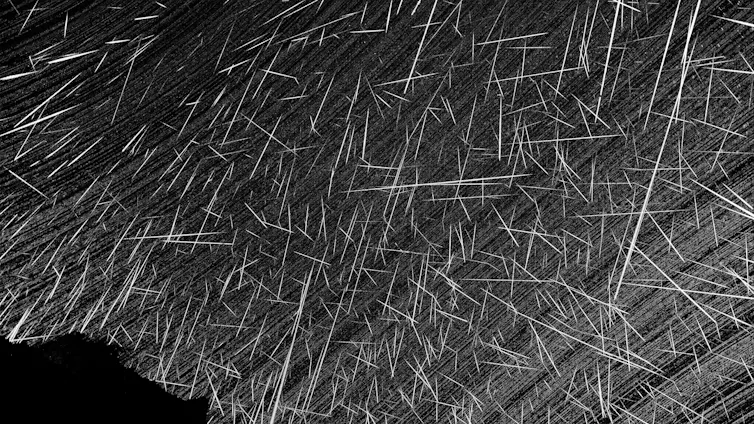
In a study published in March 2026, I searched through millions of meteor observations collected by all-sky camera networks based in Canada, Japan, California and Europe and found a small, recently formed cluster. The 282 meteors associated with this cluster tell the story of an asteroid that got a little too close to the Sun.
Meteor formation
When a sand-sized crumb of space rock hits our atmosphere, it heats up almost instantly, vaporizing its surface layer and turning it into an electrically charged gas. The whole fragment starts to glow — this is what we call a meteor. If the object is larger, like a boulder, and brighter, it’s called a bolide or a fireball. On average, these objects hit our atmosphere going over 15 miles per second. For small dust or sand-sized objects, the whole process lasts only a fraction of a second before they completely disappear.
Most of these sand-sized fragments in the solar system originate from comets – cold, icy objects from the outer reaches of the solar system. As comets pass by the Sun, their icy components turn to gas, releasing tons of dust. This is why comets are often called “dirty snowballs” and appear fuzzy in telescopic images.
Asteroids, on the other hand, are leftovers from the early solar system that formed closer to the Sun. They are dry and rocky, and do not have the same ices that give comets their characteristic tails.
What does it mean to be active?
Astronomers call an asteroid or comet “active” when it sheds dust, gas or larger fragments. This activity is caused by some external force on the object in space, like heat from the Sun, a small impact, or when asteroids spin too fast and fly apart.
Understanding and identifying activity helps scientists better understand how these objects change over time.
For comets, sublimation of ices – when solid ice turns directly into gas, skipping the liquid phase – is the primary culprit. However, for asteroids, the reason for activity can vary greatly.
For example, NASA’s OSIRIS-REx mission, which launched into space to study an asteroid named Bennu, saw activity from its surface, with heat stress and small impacts among the leading explanations.
Other sources for asteroid activity include breakup when an asteroid spins too fast, tidal forces ripping apart asteroids during close encounters with a planet, or gas release.
Researchers most commonly search for activity using telescopes. Astronomers can look for a “tail” or fuzziness around the object. This tail is a clear sign that there is gas and dust around the body. But there is another way to search for activity – meteor showers.
Finding hidden asteroids via meteor showers
The most famous active asteroid is 3200 Phaethon. It is the parent body of the Geminid meteor shower that occurs every year in mid-December. During past close approaches with the Sun, Phaethon released vast amounts of dust and larger fragments. These morsels of Phaethon have spread out along its entire orbit over time, leading to the present Geminid meteor stream.
Each meteor shower we observe occurs when the Earth passes through one of these debris streams. So if astronomers can detect meteor showers, they can also be used to find active objects in space.
At first, debris shed by an asteroid or comet travels closely together. Imagine squeezing a single drop of food dye into a moving stream of water: Initially, the dye stays in a tight, concentrated cloud. But as it flows, the water’s swirling currents pull at the dye, causing it to spread out and fade.
In space, the gravitational tugs from passing planets act like those currents. They pull on the individual meteor fragments in slightly different ways, causing the once-tight stream to gradually drift apart until it completely dilutes into the background dust of our solar system.
The discovery of a rock-comet
In a study published in March 2026 in the Astrophysical Journal, I used millions of observations of meteors to search for recent, unknown activity from asteroids near the Earth. I found one clear cluster of 282 meteors that stood out.
What makes this discovery so exciting is that we are essentially witnessing a hidden asteroid being baked to bits. This newly confirmed meteor stream follows an extreme orbit that plunges almost five times closer to the Sun than Earth does.
Based on how these meteors break apart when they hit our atmosphere, we can tell they are moderately fragile, but tougher than stuff from comets. This finding tells us that intense solar heat is literally cracking the asteroid’s surface, baking out trapped gases and causing it to crumble. This is likely a major source of past Phaethon activity and the main reason the meteorites on Earth are so diverse.
The search for the source
Why does finding a hidden, crumbling asteroid matter? Meteor observations act as a uniquely sensitive probe that lets us study objects that are completely invisible to traditional telescopes.
Beyond solving astronomical mysteries, analyzing this debris helps us understand the physical evolution of asteroids and comets in our solar system. More importantly, it reveals hidden populations of near-Earth asteroids, which is vital information for planetary defense.
The new meteor shower’s parent asteroid remains elusive. However, NASA’s NEO Surveyor mission, launching in 2027, offers a promising solution. This space telescope, dedicated to planetary defense and the discovery of dark, hazardous, Sun-approaching asteroids, will be the ideal tool for searching for the shower’s origin.
Patrick M. Shober, Postdoctoral Fellow in Planetary Sciences, NASA
This article is republished from The Conversation under a Creative Commons license. Read the original article.
The science section of our news blog STM Daily News provides readers with captivating and up-to-date information on the latest scientific discoveries, breakthroughs, and innovations across various fields. We offer engaging and accessible content, ensuring that readers with different levels of scientific knowledge can stay informed. Whether it’s exploring advancements in medicine, astronomy, technology, or environmental sciences, our science section strives to shed light on the intriguing world of scientific exploration and its profound impact on our daily lives. From thought-provoking articles to informative interviews with experts in the field, STM Daily News Science offers a harmonious blend of factual reporting, analysis, and exploration, making it a go-to source for science enthusiasts and curious minds alike. https://stmdailynews.com/category/science/
Science
After the Blood Moon: Scientists and Skywatchers React to the March 3, 2026 Total Lunar Eclipse
The March 3, 2026 total lunar eclipse amazed skywatchers worldwide. Scientists and amateur astronomers share reactions and photos from the dramatic blood moon event.
Last Updated on March 5, 2026 by Daily News Staff
Millions of people around the world looked to the sky in the early hours of March 3, 2026 to witness one of the most striking astronomical events of the year — a total lunar eclipse, often referred to as a “Blood Moon.” As the Moon passed completely into Earth’s shadow, it transformed from its familiar silver glow into a deep copper-red color, captivating observers from North America to Asia and across the Pacific.
Blood Moon Aftermath: Scientists and Skywatchers React to the March 3, 2026 Total Lunar Eclipse
For viewers in the western United States, including Arizona and California, the eclipse occurred just before sunrise. The timing created a dramatic scene as the reddish Moon hovered low in the western sky while the eastern horizon began to brighten with dawn.
A Global Skywatching Event
Total lunar eclipses occur when the Sun, Earth, and Moon align so that Earth’s shadow completely covers the Moon. During the March 3 event, the Moon spent nearly an hour fully inside the darkest part of Earth’s shadow, known as the umbra. During this phase, sunlight filtered through Earth’s atmosphere projected reddish light onto the Moon’s surface, creating the dramatic “blood moon” effect.
Astronomers noted that the event was particularly significant because total lunar eclipses are relatively infrequent. While partial eclipses occur more often, a full eclipse visible across large portions of the globe remains a memorable experience for both scientists and casual observers.
Scientists Explain the Phenomenon
According to researchers at NASA, the reddish color seen during totality occurs because Earth’s atmosphere scatters shorter wavelengths of sunlight — such as blue — while allowing longer red wavelengths to pass through. This filtered light is then bent, or refracted, into Earth’s shadow and projected onto the Moon.
Planetary scientists say lunar eclipses provide a powerful visual demonstration of the geometry of the Earth–Moon–Sun system. The curved shadow moving across the Moon also historically served as one of the earliest pieces of evidence that Earth is spherical.
Researchers also point out that lunar eclipses offer opportunities to study Earth’s atmosphere. Variations in dust, volcanic particles, and atmospheric conditions can influence how dark or red the Moon appears during totality.
Amateur Astronomers Share Their Views
While professional observatories monitored the eclipse with precision instruments, amateur astronomers and astrophotographers helped document the event from countless locations worldwide. Social media platforms and astronomy forums quickly filled with images showing the Moon’s color shifting from pale gray to orange and deep red.
Many skywatchers in the southwestern United States described the experience as particularly dramatic because the eclipse occurred just before moonset. Observers reported seeing the Moon glowing red above desert landscapes and city skylines before gradually fading into the brightening morning sky.
Astrophotographers also emphasized that lunar eclipses are among the easiest astronomical events to capture. Unlike solar eclipses, they can be photographed safely without special filters, making them accessible to beginners using smartphones as well as professionals using telescopes and high-end cameras.
A Rare Pre-Dawn Sight
In parts of the western United States, some observers were able to witness a rare atmospheric phenomenon known as a selenelion, when both the eclipsed Moon and the rising Sun appear in the sky at the same time due to atmospheric refraction. The effect added an unusual visual element to an already impressive celestial event.
The combination of a deep red Moon and the approaching dawn created striking photographic opportunities and memorable moments for early-morning skywatchers.
When Is the Next Total Lunar Eclipse?
Although partial eclipses occur periodically, the next widely visible total lunar eclipse will not occur until late 2028. That makes the March 2026 eclipse one of the most notable skywatching events of the decade.
For many observers, the event served as a reminder that some of the most spectacular astronomical experiences require nothing more than stepping outside, looking up, and taking a moment to appreciate the universe above.
References and Further Reading
- NASA – Lunar Eclipse Science Overview
- Time and Date – March 3, 2026 Total Lunar Eclipse Details
- Sky & Telescope – Astronomy News and Observing Guides
- Space.com – Guide to Lunar Eclipses
- STM Daily News – Science Coverage

Last Updated on March 2, 2026 by Daily News Staff
Early risers in Arizona are in for a celestial show.
On Tuesday, March 3, 2026, a total lunar eclipse will be visible across much of North America — including Phoenixand the Valley. During this event, the Moon will pass completely into Earth’s shadow, turning a deep copper-red color often called a “Blood Moon.”
Here’s what you need to know.

🌍 What Is a Total Lunar Eclipse?
A total lunar eclipse happens when the Sun, Earth, and Moon align perfectly, with Earth positioned directly between the Sun and the Moon. As the Moon moves into Earth’s darkest shadow (the umbra), it doesn’t disappear — instead, it glows red.
That reddish color comes from sunlight filtering through Earth’s atmosphere — essentially, we’re seeing all the world’s sunrises and sunsets projected onto the Moon at once.
🕒 Phoenix Viewing Times (MST)
Arizona does not observe Daylight Saving Time in March, so these times are in Mountain Standard Time (MST).
- 1:44 a.m. – Penumbral eclipse begins (subtle dimming begins)
- 2:50 a.m. – Partial eclipse begins (Earth’s shadow becomes clearly visible)
- 4:04 a.m. – Totality begins 🌕
- 4:34 a.m. – Greatest eclipse
- 5:03 a.m. – Totality ends
- 6:18 a.m. – Partial eclipse ends
- 7:20 a.m. – Penumbral eclipse ends

The most dramatic portion — totality — lasts nearly one hour.
🌅 Where to Look in Phoenix
The eclipse happens in the pre-dawn hours, so the Moon will be low in the western sky as it sets.
For the best view:
- Find a location with a clear western horizon
- Avoid city light glare if possible
- Consider desert viewpoints, parks, or elevated areas around the Valley
Because the Moon will be setting as the Sun begins to rise, the backdrop of early morning twilight could make for stunning photography.
🔭 Do You Need Special Equipment?
No.
Unlike a solar eclipse, lunar eclipses are completely safe to view with the naked eye. However:
- Binoculars enhance color detail
- A small telescope reveals subtle shadow gradients
- A tripod and DSLR or smartphone with night mode can capture impressive images
🌎 Why This Eclipse Matters
This will be one of the most accessible celestial events of 2026 for Arizona residents. Total lunar eclipses don’t happen every year in the same location, and the timing — just before sunrise — adds dramatic visual contrast.
If skies are clear, Phoenix could have a spectacular view.
📌 Quick Viewing Reminder for Phoenix
Set your alarm for around 3:45 a.m.
Step outside by 4:00 a.m.
Look west
Watch the Moon turn red
No tickets. No crowds. Just the sky putting on a show.
For more science, space, and Arizona skywatching coverage, visit STM Daily News.
Related Coverage
- NASA: What Is a Lunar Eclipse?
- Time and Date: March 3, 2026 Total Lunar Eclipse Details
- Sky & Telescope: How to Watch the March 2026 Lunar Eclipse
- Space.com: Where and When to See the 2026 Blood Moon
- STM Daily News – Science & Space Coverage




