Connect with us

The Bridge

200 years ago, France extorted Haiti in one of history’s greatest heists – and Haitians want reparations

Published

on

Haiti
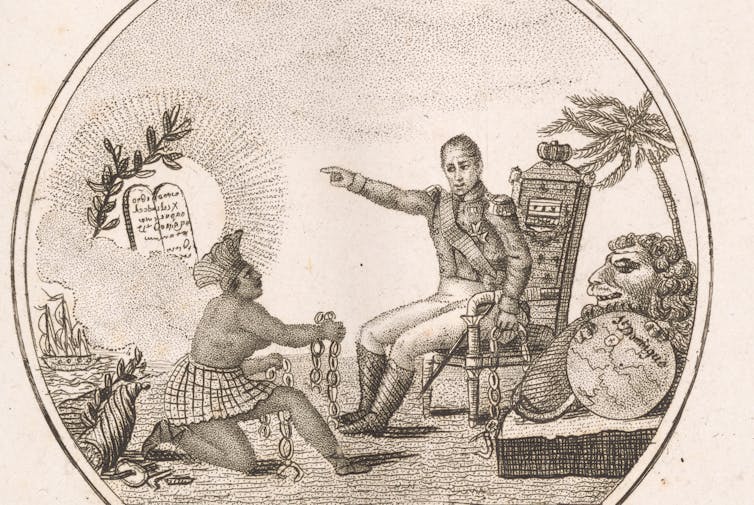
A French propaganda engraving from 1825 depicts King Charles X bestowing freedom on a Black man kneeling before him in chains. ‘S.M. Charles X, le bien-aimé, reconnaissant l’indépendance de St. Domingue,’ 1825, Bibliothèque Nationale de France, Cabinet des Estampes, CC BY-SA
Marlene L. Daut, Yale University In 2002, Haiti’s former president Jean-Bertrand Aristide argued that France should pay his country US$21 billion. The reason? In 1825, France extracted a huge indemnity from the young nation, in exchange for recognition of its independence. April 17, 2025, marks the 200th anniversary of that indemnity agreement. On Jan. 1 of this year, the now-former president of Haiti’s Transitional Presidential Council, Leslie Voltaire, reminded France of this call when he requested that France “repay the debt of independence and reparations for slavery.” In March, tennis star Naomi Osaka, who is of Haitian descent, added her voice to the chorus in a tweet wondering when France would pay Haiti back. As a scholar of 19th-century Haitian history and culture, I’ve dedicated a significant portion of my research to exploring Haiti’s particularly strong legal case for restitution from France. The story begins with the Haitian Revolution. France instituted slavery in the colony of Saint-Domingue on the western third of the island of Hispaniola – today’s Haiti – in the 17th century. In the late 18th century, the enslaved population rebelled and eventually declared independence. In the 19th century, the French demanded compensation for the former enslavers of the Haitian people, rather than the other way around. Just as the legacy of slavery in the United States has created a gross economic disparity between Black and white Americans, the tax on its freedom that France forced Haiti to pay – referred to as an “indemnity” at the time – severely damaged the newly independent country’s ability to prosper.

The cost of independence

Haiti officially declared its independence from France on Jan. 1, 1804. In October 1806, following the assassination of Haiti’s first head of state, the country was split into two, with Alexandre Pétion ruling in the south and Henry Christophe ruling in the north. Despite the fact that both Haiti rulers were veterans of the Haitian Revolution, the French had never quite given up on reconquering their former colony. In 1814, King Louis XVIII, restored as king after the overthrow of Napoléon earlier that year, sent three commissioners to Haiti to assess the willingness of the country’s rulers to surrender. Christophe, crowned king in 1811, remained obstinate in the face of France’s exposed plan to bring back slavery. Threatening war, the most prominent member of Christophe’s cabinet, Baron de Vastey, insisted,“ Our independence will be guaranteed by the tips of our bayonets!” In contrast, Pétion, the ruler of the south, was willing to negotiate, hoping that the country might be able to pay France for recognition of its independence. In 1803, Napoléon had sold Louisiana to the United States for US$15 million. Using this number as his compass, Pétion proposed paying the same amount. Unwilling to compromise with those he viewed as “runaway slaves,” Louis XVIII rejected the offer. Pétion died suddenly in 1818, but Jean-Pierre Boyer, his successor, kept up the negotiations. Talks, however, continued to stall due to Christophe’s stubborn opposition. “Any indemnification of the ex-colonists,” Christophe’s government stated, was “inadmissible.” Once Christophe died in October 1820, Boyer was able to reunify the two sides of the country. However, even with the obstacle of Christophe gone, Boyer repeatedly failed to successfully negotiate France’s recognition of independence. Determined to gain at least suzerainty over the island – which would have made Haiti a protectorate of France – Louis XVIII rebuked the two commissioners Boyer sent to Paris in 1824 to try to negotiate an indemnity in exchange for recognition. On April 17, 1825, Charles X, brother to Louis XVIII and the new French king, performed a sudden about-face. Charles X issued a decree stating that France would recognize Haitian independence but only at the price of 150 million francs – or nearly twice the 80 million francs the U.S. had paid for the Louisiana territory. Baron de Mackau, whom Charles X sent to deliver the ordinance, arrived in Haiti in July, accompanied by a squadron of 14 brigs of war carrying more than 500 cannons. His instructions stated that his “mission” was “not a negotiation.” It was not diplomacy either. It was extortion. Amid the threat of violent war and a looming economic blockade, on July 11, 1825, Boyer signed the fatal document, which stated, “The present inhabitants of the French part of St. Domingue shall pay … in five equal installments … the sum of 150,000,000 francs, destined to indemnify the former colonists.”

French prosperity built on Haitian poverty

Newspaper articles from the period reveal that the French king knew the Haitian government was hardly capable of making these payments, as the amount was nearly six times Haiti’s total annual revenue. The rest of the world seemed to agree that the agreement was absurd. One British journalist noted that the “enormous price” constituted a “sum which few states in Europe could bear to sacrifice.” Forced to borrow 30 million francs from French banks to make the first two payments, it was hardly a surprise to anyone when Haiti defaulted soon thereafter. Still, a subsequent French king sent another expedition in 1838 with 12 warships to force the Haitian president’s hand. The 1838 revision, inaccurately labeled “Traité d’Amitié” – or “Treaty of Friendship” – reduced the outstanding amount owed to 60 million francs, but the Haitian government was once again ordered to take out crushing loans to pay the balance. It was the Haitian people who suffered the brunt of the consequences of France’s theft. Boyer levied draconian taxes in order to pay back the loans. And while Christophe had been busy developing a national school system during his reign, under Boyer, and all subsequent presidents, such projects had to be put on hold. Moreover, researchers have found that the independence debt and the resulting drain on the Haitian treasury were directly responsible not only for the underfunding of education in 20th-century Haiti, but also for the lack of health care and the country’s inability to develop public infrastructure. A 2022 analysis by The New York Times, furthermore, revealed that Haitians ended up paying more than 112 million francs over seven decades, or $560 million – estimated between $22 billion and $44 billion in today’s dollars. Recognizing the gravity of this scandal, French economist Thomas Piketty has argued that France should repay at least $28 billion to Haiti in restitution.

A debt that’s both moral and material

Former French presidents, from Jacques Chirac to Nicolas Sarkozy to François Hollande, have a history of punishing, skirting or downplaying Haitian demands for recompense. In May 2015, when Hollande became only France’s second head of state to visit Haiti, he admitted that his country needed to “settle the debt.” Later, realizing he had unwittingly provided fuel for the legal claims already prepared by attorney Ira Kurzban on behalf of the Haitian people, Hollande clarified that he meant France’s debt was merely “moral.” To deny that the consequences of slavery were also material is to deny French history itself. France belatedly abolished slavery in 1848 in its remaining colonies of Martinique, Guadeloupe, Réunion and French Guyana, which are still territories of France today. Afterward, the French government demonstrated once again its understanding of slavery’s relationship to economics when it financially compensated the former “owners” of enslaved people. The resulting racial wealth gap is no metaphor. In metropolitan France, 14.1% of the population lives below the poverty line. In Martinique and Guadeloupe, in contrast, where more than 80% of the population is of African descent, the poverty rates are 38% and 46%, respectively. The poverty rate in Haiti is even more dire at 59%. And whereas the gross domestic product per capita – the best measure of a country’s standard of living – is $44,690 in France, it’s a mere $1,693 in Haiti. These discrepancies can be viewed as the concrete consequences of stolen labor from generations of Africans and their descendants. In recent years, French academics have begun to increasingly contribute to the conversation about the longitudinal harms the indemnity brought to Haiti. Yet what effectively amounts to a statement of “no comment” has historically been the only response from France’s current government under President Emmanuel Macron. On April 17, 2025, the bicentennial of the indemnity ordinance, Macron finally broke his silence. In an official communiqué, Macron acknowledged the “heavy financial indemnity” his country imposed upon Haiti and announced “a joint Franco-Haitian commission responsible for examining our common past and shedding light on all its dimensions.” But he did not address the question of reparations. Many Haitians were rightfully not satisfied: the only initiative from France that would really matter, they said, would be one detailing how it plans to provide economic recompense to the Haitian people. This is an updated version of an article originally published on June 30, 2020.The Conversation Marlene L. Daut, Professor of French and African American Studies, Yale University This article is republished from The Conversation under a Creative Commons license. Read the original article.

Author


Discover more from Daily News

Subscribe to get the latest posts sent to your email.

Blog

Tyreek Hill and the Miami-Dade Police Incident: What Really Happened and Where the Case Stands Now

Get the full timeline of the Tyreek Hill police incident in Miami, why the traffic stop sparked outrage, and what the investigation shows so far.

Published

on

Tyreek Hill Police Incident Explained: Timeline, Outcomes, and What’s Next

police officer on police bike, motorcycle

In September 2024, Miami Dolphins star Tyreek Hill found himself at the center of a controversy that spread across social media, sparked national debate, and triggered an internal investigation inside the Miami-Dade Police Department (MDPD). More than a year later, many fans still wonder what actually happened that day — and whether Hill ever moved forward with legal action. Here’s a clear breakdown of the incident and the current status of the case.

The Traffic Stop That Sparked Outrage

On the morning of September 8, 2024 — just hours before the Dolphins’ season opener — Hill was pulled over near Hard Rock Stadium for alleged careless driving and a seat-belt violation. What followed was a violent escalation that shocked fans and critics alike.

Body-cam and bystander video footage released shortly after the incident showed officers pulling Hill from his vehicle, forcing him to the ground, placing a knee on his back, and handcuffing him. Hill later said he complied with commands and didn’t understand why the encounter became so aggressive.

The videos went viral almost instantly, raising widespread concerns about excessive force, bias in traffic stops, and how police interact with high-profile Black athletes.

A Police Officer With a History of Complaints

The MDPD later identified the officer who forcibly removed Hill from the vehicle as Danny Torres — a 27-year veteran of the department. Records revealed Torres had a long disciplinary history, including multiple suspensions for issues such as improper procedures, force violations, discourtesy, and body-camera failures.

Following public backlash, MDPD placed Torres on administrative duty pending an internal-affairs investigation. As of the latest updates, the department has not released final findings or announced disciplinary action beyond that initial administrative reassignment.

Traffic Citations Dismissed — But Not Because Hill Was Innocent or Guilty

In November 2024, Hill’s traffic tickets were officially dismissed — not because the court ruled in Hill’s favor, but because the officers who issued the citations didn’t show up in court. Without the officers present to testify, the judge dropped the case due to “lack of prosecution.”

The dismissal frustrated Hill’s legal team, who argued it showed a lack of accountability within the department. The MDPD later stated that an officer’s absence from court “does not indicate the citation lacked merit.”

Did Tyreek Hill Sue the Miami-Dade Police Department?

Short answer: No — at least not yet, and not publicly.

Hill’s legal team has repeatedly said they were exploring “every legal remedy,” including a potential civil-rights lawsuit (often filed federally under Section 1983). But after extensive research through public court records and news archives, there is no evidence that Hill has filed a federal or state civil lawsuit against MDPD or any of its officers.

Advertisement
Get More From A Face Cleanser And Spa-like Massage

If a lawsuit had been filed, it likely would have generated major media coverage — especially given Hill’s profile and the viral nature of the incident. Instead, all reporting continues to describe Hill’s legal posture as “considering,” “evaluating,” or “preparing,” not filing.

Why the Case Remains Unresolved

Several factors may explain why the legal process remains in limbo:

Internal affairs reviews take time — and MDPD has not publicly concluded its investigation. Hill’s legal team may be waiting for the department’s findings before proceeding. Negotiations or private discussions between attorneys and the county may be occurring behind the scenes. A lawsuit could still be filed at any time if Hill’s team decides to move forward.

Without public filings, official disciplinary announcements, or new footage, the case remains in a holding pattern.

The Bigger Picture

The Tyreek Hill incident resurfaces bigger questions about policing, transparency, and accountability. The videos of Hill’s detainment reignited debates familiar to many Americans: When does a routine traffic stop become unnecessarily violent? Why aren’t officers held accountable when they fail to appear in court? And how do prior disciplinary issues go unaddressed for years?

While Hill returned to the field that same day — even mocking the handcuffs in a now-famous touchdown celebration — the impact of the incident still lingers in Miami and the NFL community.

What to Watch For Next

Here’s what could happen going forward:

MDPD may eventually release the internal-affairs findings. The county could impose discipline or policy changes based on the investigation. Hill’s legal team may file a civil-rights lawsuit. The case could appear in federal or state court if filings become public.

Until then, the situation remains officially unresolved, with more questions than answers.

For more information on the Tyreek Hill incident, see the following sources:

Advertisement
Get More From A Face Cleanser And Spa-like Massage


Discover more from Daily News

Subscribe to get the latest posts sent to your email.

Continue Reading

Stories of Change

Delivering What Matters Most This Holiday Season

Delivering What Matters! This holiday season, give gifts that matter. Support UNICEF’s mission to deliver essentials like nutrition, education, and shelter to children worldwide through meaningful charitable giving.

Published

on

Delivering What Matters Most This Holiday Season

Delivering What Matters Most This Holiday Season

(Family Features) As families prepare for the holidays, presents and packages fill doorsteps seemingly on demand. For millions of children around the world, however, each delivery carries more than convenience – it carries purpose. For example, UNICEF continues its lifesaving work, delivering essentials like nutrition, shelter and warm clothes to children who need it most. From Sudan to Ukraine, Gaza to Malawi and beyond, the organization delivers more than just supplies – it provides a hopeful future for children around the world. When conflict unfolds, when disaster strikes or when the winter cold hits, the organization’s critical aid is never out of reach, even for the world’s hardest-to-reach children. This holiday season, give a gift that matters. With UNICEF Market and Inspired Gifts, you can bring education and lifesaving tools to children around the world. An Art Therapy Kit can give children an outlet needed to heal while a Math Classroom Kit can open doors to brighter futures. Through The K.I.N.D. Fund – now celebrating its 15th anniversary – you can support education in Malawi by providing children with desks and scholarships to help kids go beyond elementary school learning levels. 17712 detail embed2You can send Essential Winter Kits – filled with clothing – to ensure children stay safe through the cold months. Every gift fuels the mission of pursuing a more equitable world for every child. These partner gift ideas also support the organization’s global work: Your Marriott Bonvoy points can protect and care for children worldwide. From Dec. 2-9, the travel company will match five points for every point members donate to philanthropic partners, up to 25 million total points. Furthermore, members who earn 50 or 75 qualifying nights in a calendar year are eligible to select UNICEF to benefit from their Annual Choice Benefit with a $100 USD donation. Learn more at giving.marriott.com. Give the gift of holiday radiance with The Serum by Clé de Peau Beauté. Whether you are treating yourself or a loved one, this gift is sure to spread some cheer. Since 2019, the brand has proudly donated $14.5 million total to UNICEF to support girls’ education and empowerment around the world. Find out how you can help unlock the power of girls at cledepeaubeaute.com. To help tackle the stigma around poor mental health and provide support for children, young people and caregivers globally, Jo Malone London will donate a minimum of 70% of the recommended retail price from each Charity Home Candle sold to the U.S. Fund for UNICEF with a commitment to raise at least $200,000 from July 1, 2025 by June 30, 2026. For more information, visit jomalone.com. Children of the world are too often at risk, exposed to conflicts, diseases and natural disasters that threaten their safety and well-being. Since 2016, Louis Vuitton has helped protect these children through its partnership with UNICEF. Each year, the brand creates a dedicated Silver Lockit collection in support of UNICEF’s work, and more than $24 million has been donated through this initiative. For 2025, a new design was created in collaboration with House Ambassador and UNICEF Korea Goodwill Ambassador Felix. Engraved with the word “DREAM,” representing every child’s right to grow, live and learn in a nurturing environment with access to education, health care and protection. For each piece purchased, $100-200 will be donated to help deliver life-saving assistance and education to children in urgent need around the world. Learn more at us.louisvuitton.com. Visit unicefusa.org/stories/delivering-vital-supplies-children-who-need-them-most to learn more and deliver what matters most to children this holiday season. collect?v=1&tid=UA 482330 7&cid=1955551e 1975 5e52 0cdb 8516071094cd&sc=start&t=pageview&dl=http%3A%2F%2Ftrack.familyfeatures SOURCE: UNICEF

Stories of Change: People Making a Difference

Discover inspiring stories of changemakers making a positive impact. Explore videos and articles of people tackling today’s biggest challenges with action and hope. Visit: https://stmdailynews.com/stories-of-change/


Discover more from Daily News

Subscribe to get the latest posts sent to your email.

Continue Reading

Stories of Change

Holiday Assist 2025: Assistory Outreach Services Distributes 400 Thanksgiving Meal Kits to South Phoenix Families

Assistory Outreach Services reached a milestone at Holiday Assist 2025, distributing 400 turkeys, grocery bags, and cases of water to South Phoenix families. Supported by Spinato’s Pizzeria, Niagara, Walmart, and Republic Services, the event continues its mission to help families enjoy a complete Thanksgiving meal.

Published

on

Last Updated on November 27, 2025 by Daily News Staff

Holiday Assist 2025: Assistory Outreach Services Provides 400 Thanksgiving Meal Kits to South Phoenix Families

Holiday Assist 2025: Assistory Outreach Services Provides 400 Thanksgiving Meal Kits to South Phoenix Families

Assistory Outreach Services, led by President and CEO Jon Taylor, celebrated a major milestone at this year’s Holiday Assist event that was held on November 21, 2025, which was its third year serving the South Phoenix community with free Thanksgiving meal supplies. What started as a neighborhood-centered effort has grown into a vital annual tradition that brings relief to families facing financial challenges during the holidays.

Held at South Pointe, the 2025 Holiday Assist event successfully provided 400 families with everything needed to prepare a full Thanksgiving meal. Volunteers and corporate partners came together to ensure each family left with a complete set of essentials including:

  • 1 turkey

  • 1 grocery bag packed with canned goods and side dish ingredients

  • 1 case of bottled water, provided through a generous donation from Niagara

Jon Taylor (through the Assistory Outreach Facebook Page) praised the community’s support, stating:

“We did it, South Pointe. We gave out 400 turkeys, 400 grocery bags, and 400 cases of water. Our goal was to give kids and their families what they needed for a Thanksgiving meal. The mission in year three was accomplished.”

img 1714 e1764045191200

Community Partnerships That Powered the Event

This year’s Holiday Assist was strengthened by a coalition of local organizations and businesses dedicated to giving back:

Spinato’s Pizzeria

Spinato’s showed up in force with volunteers who helped pack and distribute meals. Their team worked side-by-side with Assistory Outreach to ensure every family received their supplies with dignity and care.

Niagara

Niagara donated 400 cases of water, adding an essential household staple to each meal package.

Republic Services & Walmart

Both organizations offered volunteers and logistical support, contributing to the smooth delivery of the large-scale distribution.

Media Spotlight

The event drew local media attention, including coverage from NBC 12 News Phoenix, which highlighted Assistory Outreach’s continued growth and community-first mission.

A Growing Tradition of Giving

The success of Holiday Assist 2025 underscores Assistory Outreach Services’ commitment to uplifting families in tough economic times. With the help of sponsors and volunteers, Jon Taylor’s team continues to demonstrate that community, compassion, and collaboration are powerful tools for change.

“Our goal was to give kids and their families what they needed for a Thanksgiving meal.” — Jon Taylor
“The mission in year three was accomplished.”

Want to support Holiday Assist or volunteer at future events?

Visit Assistory Outreach Services online or follow them on social media to learn how you can help “Help Assist Others” year-round. https://assistoryoutreachservices.com/

Advertisement
Get More From A Face Cleanser And Spa-like Massage

Stories of Change: People Making a Difference

Discover inspiring stories of changemakers making a positive impact. Explore videos and articles of people tackling today’s biggest challenges with action and hope. Visit: https://stmdailynews.com/stories-of-change/


Author

HUNGRY FOR MORE?

Discover a feast for your senses with our Food & Drink Blog, a tantalizing part of STM Daily News. Get the latest articles, recipes, and foodie news delivered straight to your inbox. Satisfaction guaranteed!

SIGN UP TO RECEIVE THE LATEST RECIPES & FOODIE NEWS, PLUS SOME EXCLUSIVE GOODIES!

We don’t spam! Read our privacy policy for more info.

Food and Drink

Discover more from Daily News

Subscribe to get the latest posts sent to your email.

Continue Reading

Trending


