

Entertainment
Sidney Poitier – Hollywood’s first Black leading man reflected the civil rights movement on screen

Last Updated on March 7, 2026 by Daily News Staff
Aram Goudsouzian, University of Memphis
In the summer of 1967, Martin Luther King Jr. introduced the keynote speaker for the 10th-anniversary convention banquet of the Southern Christian Leadership Conference. Their guest, he said, was his “soul brother.”
“He has carved for himself an imperishable niche in the annals of our nation’s history,” King told the audience of 2,000 delegates. “I consider him a friend. I consider him a great friend of humanity.”
That man was Sidney Poitier.
Poitier, who died at 94 on Jan. 7, 2022, broke the mold of what a Black actor could be in Hollywood. Before the 1950s, Black movie characters generally reflected racist stereotypes such as lazy servants and beefy mammies. Then came Poitier, the only Black man to consistently win leading roles in major films from the late 1950s through the late 1960s. Like King, Poitier projected ideals of respectability and integrity. He attracted not only the loyalty of African Americans, but also the goodwill of white liberals.
In my biography of him, titled “Sidney Poitier: Man, Actor, Icon,” I sought to capture his whole life, including his incredible rags-to-riches arc, his sizzling vitality on screen, his personal triumphs and foibles and his quest to live up to the values set forth by his Bahamian parents. But the most fascinating aspect of Poitier’s career, to me, was his political and racial symbolism. In many ways, his screen life intertwined with that of the civil rights movement – and King himself.
An age of protests
In three separate columns in 1957, 1961 and 1962, a New York Daily News columnist named Dorothy Masters marveled that Poitier had the warmth and charisma of a minister. Poitier lent his name and resources to King’s causes, and he participated in demonstrations such as the 1957 Prayer Pilgrimage and the 1963 March on Washington. In this era of sit-ins, Freedom Rides and mass marches, activists engaged in nonviolent sacrifice not only to highlight racist oppression, but also to win broader sympathy for the cause of civil rights.
In that same vein, Poitier deliberately chose to portray characters who radiated goodness. They had decent values and helped white characters, and they often sacrificed themselves. He earned his first star billing in 1958, in “The Defiant Ones,” in which he played an escaped prisoner handcuffed to a racist played by Tony Curtis. At the end, with the chain unbound, Poitier jumps off a train to stick with his new white friend. Writer James Baldwin reported seeing the film on Broadway, where white audiences clapped with reassurance, their racial guilt alleviated. When he saw it again in Harlem, members of the predominantly Black audience yelled “Get back on the train, you fool!”
King won the Nobel Peace Prize in 1964. In that same year, Poitier won the Oscar for Best Actor for “Lilies of the Field,” in which he played Homer Smith, a traveling handyman who builds a chapel for German nuns out of the goodness of his heart. The sweet, low-budget movie was a surprise hit. In its own way, like the horrifying footage of water hoses and police dogs attacking civil rights activists, it fostered swelling support for racial integration.
A better man
By the time of the actor’s Southern Christian Leadership Conference speech, both King and Poitier seemed to have a slipping grip on the American public. Bloody and destructive riots plagued the nation’s cities, reflecting the enduring discontent of many poor African Americans. The swelling calls for “Black Power” challenged the ideals of nonviolence and racial brotherhood – ideals associated with both King and Poitier.
When Poitier stepped to the lectern that evening, he lamented the “greed, selfishness, indifference to the suffering of others, corruption of our value system, and a moral deterioration that has already scarred our souls irrevocably.” “On my bad days,” he said, “I am guilty of suspecting that there is a national death wish.”
By the late 1960s, both King and Poitier had reached a crossroads. Federal legislation was dismantling Jim Crow in the South, but African Americans still suffered from limited opportunity. King prescribed a “revolution of values,” denounced the Vietnam War, and launched a Poor People’s Campaign. Poitier, in his 1967 speech for the SCLC, said that King, by adhering to his convictions for social justice and human dignity, “has made a better man of me.”
Exceptional characters
Poitier tried to adhere to his own convictions. As long as he was the only Black leading man, he insisted on playing the same kind of hero. But in the era of Black Power, had Poitier’s saintly hero become another stereotype? His rage was repressed, his sexuality stifled. A Black critic, writing in The New York Times, asked “Why Does White America Love Sidney Poitier So?”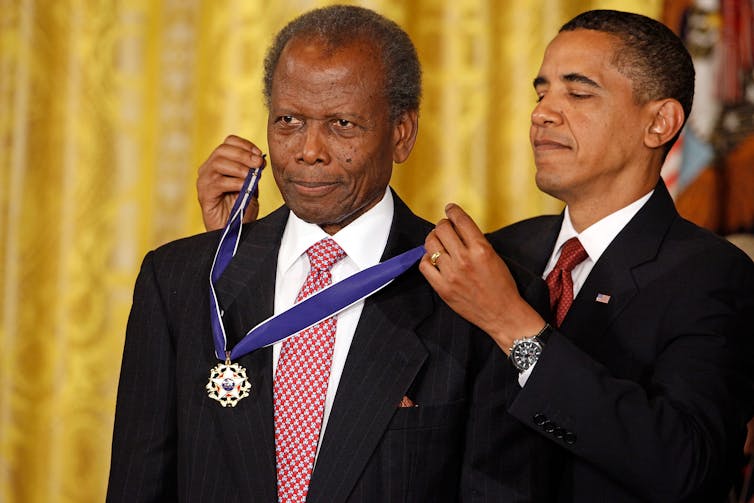
That critic had a point: As Poitier himself knew, his films created too-perfect characters. Although the films allowed white audiences to appreciate a Black man, they also implied that racial equality depends on such exceptional characters, stripped of any racial baggage. From late 1967 into early 1968, three of Poitier’s movies owned the top spot at the box office, and a poll ranked him the most bankable star in Hollywood.
Each film provided a hero who soothed the liberal center. His mannered schoolteacher in “To Sir, With Love” tames a class of teenage ruffians in London’s East End. His razor-sharp detective in “In the Heat of the Night” helps a crotchety white Southern sheriff solve a murder. His world-renowned doctor in “Guess Who’s Coming to Dinner” marries a white woman, but only after winning the blessing of her parents.
“I try to make movies about the dignity, nobility, the magnificence of human life,” he insisted. Audiences flocked to his films, in part, because he transcended racial division and social despair – even as more African Americans, baby boomers and film critics tired of the old-fashioned do-gooder spirit of these movies.
Intertwined lives
And then, the lives of Martin Luther King Jr. and Sidney Poitier intersected one final time. After King’s assassination on April 4, 1968, Poitier was a stand-in for the ideal that King embodied. When he presented at the Academy Awards, Poitier won a massive ovation. “In the Heat of the Night” and “Guess Who’s Coming to Dinner” captured most of the major awards. Hollywood again dealt with the nation’s racial upheaval through Poitier movies.
But after King’s violent murder, the Poitier icon no longer captured the national mood. In the 1970s, a generation of “Blaxploitation” films featured violent, sexually charged heroes. They were a reaction against the image of a Black leading man associated with Poitier. Although his career evolved, Poitier was no longer a superstar, and he no longer bore the burden of representing the Black freedom movement. Yet for a generation, he had served as popular culture’s preeminent expression of the ideals of Martin Luther King.
[Get the best of The Conversation, every weekend. Sign up for our weekly newsletter.]
Aram Goudsouzian, Bizot Family Professor of History, University of Memphis
This article is republished from The Conversation under a Creative Commons license. Read the original article.
The Bridge is a section of the STM Daily News Blog meant for diversity, offering real news stories about bona fide community efforts to perpetuate a greater good. The purpose of The Bridge is to connect the divides that separate us, fostering understanding and empathy among different groups. By highlighting positive initiatives and inspirational actions, The Bridge aims to create a sense of unity and shared purpose. This section brings to light stories of individuals and organizations working tirelessly to promote inclusivity, equality, and mutual respect. Through these narratives, readers are encouraged to appreciate the richness of diverse perspectives and to participate actively in building stronger, more cohesive communities.
https://stmdailynews.com/the-bridge


The next round of Street Fighter is heading to the big screen. Paramount Pictures and Legendary Pictures will release the new live-action movie exclusively in theaters on October 16, 2026, bringing Capcom’s video game characters into a story built around rivalries, a dangerous tournament, and a conspiracy lurking behind the competition.
Directed by Kitao Sakurai, the film features Andrew Koji as Ryu, Noah Centineo as Ken Masters, and Callina Liang as Chun-Li, alongside an ensemble that includes Jason Momoa, Curtis “50 Cent” Jackson, and wrestling stars Roman Reigns and Cody Rhodes.
Ryu and Ken Face a Fight Beyond the Arena
Set in 1993, the movie finds Ryu and Ken estranged when Chun-Li draws them back into combat for the next World Warrior Tournament. What initially looks like a chance to test their fighting skills becomes something much more dangerous.
According to the studio’s synopsis, a deadly conspiracy puts the two fighters on a collision course, forcing them to confront both each other and unresolved struggles from their past. That setup gives the film a personal conflict to explore alongside its tournament action.
For viewers who remember gathering around an arcade cabinet, the 1993 setting offers a nostalgic hook. The studio is also promising familiar signature moves, including Hadoukens and roundhouse kicks, as the game’s combat makes the jump to live action.
A Cast Packed With Familiar Fighters
Beyond its central trio, the announced lineup brings together actors, comedians, musicians, wrestlers, and martial artists. Among the character pairings:
- Joe “Roman Reigns” Anoai as Akuma
- David Dastmalchian as M. Bison
- Cody Rhodes as Guile
- Vidyut Jammwal as Dhalsim
- Orville Peck as Vega
- Olivier Richters as Zangief
- Hirooki Goto as E. Honda
- Mel Jarnson as Cammy
- Curtis “50 Cent” Jackson as Balrog
- Jason Momoa as Blanka
The cast also includes Andrew Schulz as Dan Hibiki, Eric André as Don Sauvage, Rayna Vallandingham as Juli, Kyle Mooney as Marvin, and Alexander Volkanovski as Joe.
With so many characters sharing the screen, one question will be how the movie balances the wider roster with Ryu and Ken’s central story. The announced cast gives longtime fans plenty of familiar names to watch for.
Who Is Behind the Movie?
Paramount Pictures and Legendary Pictures present Street Fighter in association with Capcom. The Legendary Pictures production is based on the Capcom video game, with a story by Dalan Musson and Gary Dauberman and a screenplay by T.J. Fixman and Kitao Sakurai.
Producers include Mary Parent, Cale Boyter, Jason Momoa, Takayuki Nakayama, and Stefan Makhoul. The supplied production announcement notes that credits are subject to change.
Release Date and Rating
Street Fighter opens only in theaters October 16, 2026. The film is rated PG-13 for violence/action, bloody images, strong language, sexual references, partial nudity, and brief smoking, according to the supplied studio announcement.
Fans can visit Paramount’s official Street Fighter page for the trailer and film information, and follow #StreetFighterMovie for promotional updates.
Which fighter are you most excited to see in live action? Share your pick in the comments, and visit STM Daily News for more Entertainment coverage and newsletter updates.
Source: Supplied Paramount Pictures/Legendary Pictures production announcement; release date, synopsis, and selected credits checked against Paramount’s official film page. This article is a preview, not a review.

amusement and theme parks
Six Flags Magic Mountain Unveils Record-Setting ‘Thrill Glider’ Coaster for 2027
Six Flags Magic Mountain is taking flight in 2027 with Thrill Glider, a first-of-its-kind coaster combining flying, motorbike and suspended ride technology with multiple launches, five inversions and speeds up to 50 mph.

Last Updated on September 27, 2026 by Daily News Staff
VALENCIA, Calif. — Six Flags Magic Mountain is preparing to add another major attraction to its coaster lineup with Thrill Glider, a first-of-its-kind roller coaster scheduled to open in 2027.
The Southern California theme park announced Sept. 10 that the new attraction will combine elements of flying, motorbike and suspended roller coasters to create what the park is calling an entirely new category: the “Thrillglider.”
Developed by coaster manufacturer Vekoma, Thrill Glider will place riders aboard specially designed “hovercycles.” Instead of sitting upright, riders will be positioned face-forward and prone beneath the track, creating the sensation of flying through the terrain.
The approximately 80-second ride will feature multiple launches reaching speeds of 50 mph, along with 12 airtime moments, five inversions and 20 track elements spread across nearly 3.5 acres. Onboard audio and lighting effects will add to the experience.
A Record-Setting New Coaster
According to Six Flags, Thrill Glider will stretch 3,380 feet — more than half a mile — and reach a maximum height of 107 feet. The company says the attraction will establish several records within the newly created Thrillglider category, including world’s longest, fastest and tallest Thrillglider.
The ride will also feature an elaborate science-fiction storyline centered on the fictional QuantumPulse Propulsion Systems and its discovery of an energy source called PSR B417. Guests will encounter futuristic displays, holographic presentations and other themed elements before boarding their hovercycles.
“Thrill Glider is more than a new attraction. It is the latest milestone in Six Flags Magic Mountain’s renaissance and a reflection of the park’s enduring role as an industry innovator,” park president Brian Oerding said in the announcement.
Where Will Thrill Glider Be Located?
Thrill Glider will occupy the former Golden Bear Theatre site, positioned between Full Throttle and LEX LUTHOR: Drop of Doom and next to the recently reimagined Looney Tunes Land.
Construction is already underway, with Six Flags planning to open the attraction sometime in 2027. A specific opening date has not yet been announced. The minimum rider height will be 48 inches.
The addition continues Magic Mountain’s long-running emphasis on ambitious roller coasters and introduces a substantially different ride experience: part flying coaster, part launched coaster and part futuristic motorcycle adventure.
Source/ Related Links
Six Flags Magic Mountain — Official Site
Source: Six Flags Magic Mountain press release, Sept. 10, 2026.
More Thrills, More Entertainment 🎢
Love roller coasters, theme parks and the latest attractions? STM Daily News Entertainment keeps you connected to amusement and theme park news, new rides, park updates and entertainment destinations. Explore our Entertainment section and discover what’s coming next!
Entertainment
Mattel Adventure Park and VAI Resort: What’s the Latest in Glendale?
Mattel Adventure Park and VAI Resort still have no announced opening date. VAI says construction continues and expects to share more about the park in late 2026.


GLENDALE, Ariz. — The wait continues for Mattel Adventure Park and VAI Resort near State Farm Stadium. Both remain under development, and neither has announced an opening date.
There has, however, been a change in how the park is being described. In August, Axios Phoenix reported that Epic Resort Destinations, the park’s original developer, appears to be out of the Glendale project. Asked about Epic’s involvement, a VAI spokesperson told Axios that VAI is the park’s owner and operator, but did not directly answer whether Epic still has any role. Another VAI spokesperson said the park and resort are now considered part of the same project and that construction continues on both.
VAI also told Axios it is redefining the park’s guest experience and creative vision and expects to share more in the fourth quarter of 2026. That is a promise of a project update, not an opening announcement.
The VAI Resort FAQ currently says it will announce an opening date approximately nine months in advance. Mattel Adventure Park’s Glendale page continues to promote planned attractions, including the Barbie Beach House and two Hot Wheels roller coasters, without listing an opening date.
For families hoping to visit, the practical answer is that there is still no date to put on the calendar. The next meaningful development to watch is VAI’s promised fourth-quarter update: it may clarify the park’s plans, but visitors will need an official opening announcement before they can plan a trip.
Source links: VAI Resort FAQ · Mattel Adventure Park Glendale page · Axios Phoenix’s August report
🎬🍿 Lights, camera, entertainment! From must-see movies and TV to music, celebrities, events, and the latest pop culture buzz, STM Daily News keeps you in the know. 💬 Join the conversation, share your take in the comments, and 📬 subscribe to our newsletter so you never miss the next big story!





