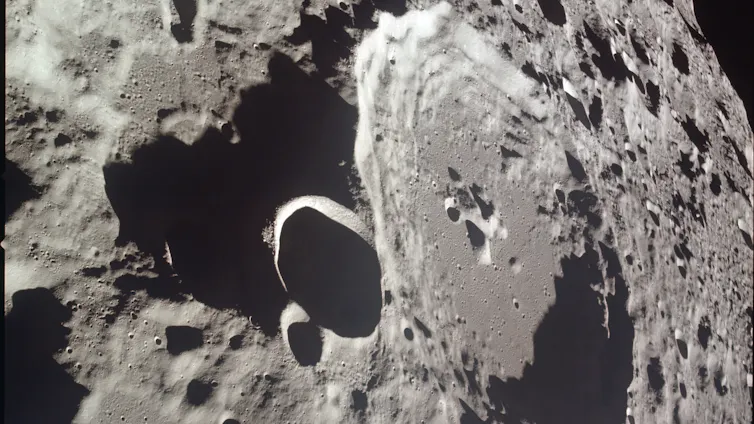
Craters in the lunar surface are visible in this photo taken during the Apollo 11 mission. NASA via APMichelle L.D. Hanlon, University of Mississippi April 2025 was a busy month for space. Pop icon Katy Perry joined five other civilian women on a quick jaunt to the edge of space, making headlines. Meanwhile, another group of people at the United Nations was contemplating a critical issue for the future of space exploration: the discovery, extraction and utilization of natural resources on the Moon. At the end of April, a dedicated Working Group of the United Nations Committee on the Peaceful Uses of Outer Space released a draft set of recommended principles for space resource activities. Essentially, these are rules to govern mining on the Moon, asteroids and elsewhere in space for elements that are rare here on Earth. As a space lawyer and co-founder of For All Moonkind, a nonprofit dedicated to protecting human heritage in outer space, I know that the Moon could be the proving ground for humanity’s evolution into a species that lives and thrives on more than one planet. However, this new frontier raises complex legal questions.
Space, legally
Outer space – including the Moon – from a legal perspective, is a unique domain without direct terrestrial equivalent. It is not, like the high seas, the “common heritage of humankind,” nor is it an area, like Antarctica, where commercial mining is prohibited. Instead, the 1967 Outer Space Treaty – signed by more than 115 nations, including China, Russia and the United States – establishes that the exploration and use of space are the “province of all humankind.” That means no country may claim territory in outer space, and all have the right to access all areas of the Moon and other celestial bodies freely. The fact that, pursuant to Article II of the treaty, a country cannot claim territory in outer space, known as the nonappropriation principle, suggests to some that property ownership in space is forbidden. Can this be true? If your grandchildren move to Mars, will they never own a home? How can a company protect its investment in a lunar mine if it must be freely accessible by all? What happens, as it inevitably will, when two rovers race to a particular area on the lunar surface known to host valuable water ice? Does the winner take all? As it turns out, the Outer Space Treaty does offer some wiggle room. Article IX requires countries to show “due regard” for the corresponding interests of others. It is a legally vague standard, although the Permanent Court of Arbitration has suggested that due regard means simply paying attention to what’s reasonable under the circumstances.
First mover advantage – it’s a race
The treaty’s broad language encourages a race to the Moon. The first entity to any spot will have a unilateral opportunity to determine what’s legally “reasonable.” For example, creating an overly large buffer zone around equipment might be justified to mitigate potential damage from lunar dust. On top of that, Article XII of the Outer Space Treaty assumes that there will be installations, like bases or mining operations, on the Moon. Contrary to the free access principle, the treaty suggests that access to these may be blocked unless the owner grants permission to enter. Both of these paths within the treaty would allow the first person to make it to their desired spot on the Moon to keep others out. The U.N. principles in their current form don’t address these loopholes. The draft U.N. principles released in April mirror, and are confined by, the language of the Outer Space Treaty. This tension between free access and the need to protect – most easily by forbidding access – remains unresolved. And the clock is ticking.
The Moon’s vulnerable legacy
The U.S. Artemis program aims to return humans to the Moon by 2028, China has plans for human return by 2030, and in the intervening years, more than 100 robotic missions are planned by countries and private industry alike. For the most part, these missions are all headed to the same sweet spot: the lunar south pole. Here, peaks of eternal light and deep craters containing water ice promise the best mining, science and research opportunities.Regions of the lunar south pole, left, and north pole, right, contain water in the form of ice (blue), which could be useful for space agencies hoping to set up lunar bases.NASA In this excitement, it’s easy to forget that humans already have a deep history of lunar exploration. Scattered on the lunar surface are artifacts displaying humanity’s technological progress. After centuries of gazing at our closest celestial neighbor with fascination, in 1959 the Soviet spacecraft, Luna 2, became the first human-made object to impact another celestial body. Ten years later, two humans, Neil Armstrong and Buzz Aldrin, became the first ever to set foot upon another celestial body. More recently, in 2019, China’s Chang’e 4 achieved the first soft landing on the Moon’s far side. And in 2023, India’s Chandrayaan-3 became the first to land successfully near the lunar south pole. These sites memorialize humanity’s baby steps off our home planet and easily meet the United Nations definition of terrestrial heritage, as they are so “exceptional as to transcend national boundaries and to be of common importance for present and future generations of all humanity.” The international community works to protect such sites on Earth, but those protection protocols do not extend to outer space.Astronaut footprints are still intact on the lunar surface because the Moon doesn’t have weather. But nearby spacecraft or rovers could kick up dust and cover them.AP Photo The more than 115 other sites on the Moon that bear evidence of human activity are frozen in time without degradation from weather, animal or human activity. But this could change. A single errant spacecraft or rover could kick up abrasive lunar dust, erasing bootprints or damaging artifacts.
Protection and the Outer Space Treaty
In 2011, NASA recommended establishing buffer, or safety zones, of up to 1.2 miles (2 kilometers) to protect certain sites with U.S. artifacts. Because it understood that outright exclusion violates the Outer Space Treaty, NASA issued these recommendations as voluntary guidelines. Nevertheless, the safety zone concept, essentially managing access to and activities around specific areas, could be a practical tool for protecting heritage sites. They could act as a starting point to find a balance between protection and access.The U.N. Committee on the Peaceful Uses of Outer Space recently proposed new principles for space resource use.United States Mission to International Organizations in Vienna, CC BY-NC-NDOne hundred and ninety-six nations have agreed, through the 1972 World Heritage Convention, on the importance of recognizing and protecting cultural heritage of universal value found here on Earth. Building on this agreement, the international community could require specific access protocols — such as a permitting process, activity restrictions, shared access rules, monitoring and other controls — for heritage sites on the Moon. If accepted, these protective measures for heritage sites could also work as a template for scientific and operational sites. This would create a consistent framework that avoids the perception of claiming territory. At this time, the draft U.N. principles released in April 2025 do not directly address the opposing concepts of access and protection. Instead, they defer to Article I of the Outer Space Treaty and reaffirm that everyone has free access to all areas of the Moon and other celestial bodies. As more countries and companies compete to reach the Moon, a clear lunar legal framework can guide them to avoid conflicts and preserve historical sites. The draft U.N. principles show that the international community is ready to explore what this framework could look like. Michelle L.D. Hanlon, Professor of Air and Space Law, University of Mississippi This article is republished from The Conversation under a Creative Commons license. Read the original article.
The science section of our news blog STM Daily News provides readers with captivating and up-to-date information on the latest scientific discoveries, breakthroughs, and innovations across various fields. We offer engaging and accessible content, ensuring that readers with different levels of scientific knowledge can stay informed. Whether it’s exploring advancements in medicine, astronomy, technology, or environmental sciences, our science section strives to shed light on the intriguing world of scientific exploration and its profound impact on our daily lives. From thought-provoking articles to informative interviews with experts in the field, STM Daily News Science offers a harmonious blend of factual reporting, analysis, and exploration, making it a go-to source for science enthusiasts and curious minds alike. https://stmdailynews.com/category/science/
Why can’t I wiggle my toes one at a time, like my fingers?
why can’t I wiggle my toes? Ever wondered why you can’t wiggle your toes one at a time like your fingers? Learn how evolution, muscles, and your brain all play a part in making fingers more independent than toes—and why that’s key for walking and balance.
Why can’t I wiggle my toes individually, like I can with my fingers? – Vincent, age 15, Arlington, Virginia
One of my favorite activities is going to the zoo where I live in Knoxville when it first opens and the animals are most active. On one recent weekend, I headed to the chimpanzees first. Their breakfast was still scattered around their enclosure for them to find. Ripley, one of the male chimpanzees, quickly gathered up some fruits and vegetables, sometimes using his feet almost like hands. After he ate, he used his feet to grab the fire hoses hanging around the enclosure and even held pieces of straw and other toys in his toes. I found myself feeling a bit envious. Why can’t people use our feet like this, quickly and easily grasping things with our toes just as easily as we do with our fingers? I’m a biological anthropologist who studies the biomechanics of the modern human foot and ankle, using mechanical principles of movement to understand how forces affect the shape of our bodies and how humans have changed over time. Your muscles, brain and how human feet evolved all play a part in why you can’t wiggle individual toes one by one.Chimpanzee hands and feet do similar jobs.Manoj Shah/Stone via Getty Images
Comparing humans to a close relative
Humans are primates, which means we belong to the same group of animals that includes apes like Riley the chimp. In fact, chimpanzees are our closest genetic relatives, sharing almost 98.8% of our DNA. Evolution is part of the answer to why chimpanzees have such dexterous toes while ours seem much more clumsy. Our very ancient ancestors probably moved around the way chimpanzees do, using both their arms and legs. But over time our lineage started walking on two legs. Human feet needed to change to help us stay balanced and to support our bodies as we walk upright. It became less important for our toes to move individually than to keep us from toppling over as we moved through the world in this new way.Feet adapted so we could walk and balance on just two legs.Karina Mansfield/Moment via Getty Images Human hands became more important for things such as using tools, one of the hallmark skills of human beings. Over time, our fingers became better at moving on their own. People use their hands to do lots of things, such as drawing, texting or playing a musical instrument. Even typing this article is possible only because my fingers can make small, careful and controlled movements. People’s feet and hands evolved for different purposes.
Muscles that move your fingers or toes
Evolution brought these differences about by physically adapting our muscles, bones and tendons to better support walking and balance. Hands and feet have similar anatomy; both have five fingers or toes that are moved by muscles and tendons. The human foot contains 29 muscles that all work to help you walk and stay balanced when you stand. In comparison, a hand has 34 muscles. Most of the muscles of your foot let you point your toes down, like when you stand on tiptoes, or lift them up, like when you walk on your heels. These muscles also help feet roll slightly inward or outward, which lets you keep your balance on uneven ground. All these movements work together to help you walk and run safely. The big toe on each foot is special because it helps push your body forward when you walk and has extra muscles just for its movement. The other four toes don’t have their own separate muscles. A few main muscles in the bottom of your foot and in your calf move all four toes at once. Because they share muscles, those toes can wiggle, but not very independently like your fingers can. The calf muscles also have long tendons that reach into the foot; they’re better at keeping you steady and helping you walk than at making tiny, precise movements.Your hand is capable of delicate movements thanks to the muscles and ligaments that control its bones.Henry Gray, ‘Anatomy of the Human Body’/Wikimedia Commons, CC BY In contrast, six main muscle groups help move each finger. The fingers share these muscles, which sit mostly in the forearm and connect to the fingers by tendons. The thumb and pinky have extra muscles that let you grip and hold objects more easily. All of these muscles are specialized to allow careful, controlled movements, such as writing. So, yes, I have more muscles dedicated to moving my fingers, but that is not the only reason I can’t wiggle my toes one by one.
Divvying up brain power
You also need to look inside your brain to understand why toes and fingers work differently. Part of your brain called the motor cortex tells your body how to move. It’s made of cells called neurons that act like tiny messengers, sending signals to the rest of your body. Your motor cortex devotes many more neurons to controlling your fingers than your toes, so it can send much more detailed instructions to your fingers. Because of the way your motor cortex is organized, it takes more “brain power,” meaning more signals and more activity, to move your fingers than your toes.The motor cortex of your brain sends orders to move parts of your body.Kateryna Kon/Science Photo Library via Getty Images Even though you can’t grab things with your feet like Ripley the chimp can, you can understand why.Hello, curious kids! Do you have a question you’d like an expert to answer? Ask an adult to send your question to CuriousKidsUS@theconversation.com. Please tell us your name, age and the city where you live.And since curiosity has no age limit – adults, let us know what you’re wondering, too. We won’t be able to answer every question, but we will do our best.Steven Lautzenheiser, Assistant Professor of Biological Anthropology, University of Tennessee This article is republished from The Conversation under a Creative Commons license. Read the original article.
Why do people get headaches? – Evie V., age 10, Corpus Christi, Texas
Whether sharp and stabbing or dull and throbbing, a headache can ruin your day. But your brain doesn’t actually feel pain. So what is going on when it feels like your head is in a vise or about to explode? I am a child neurologist – that is, a doctor who specializes in diseases of the brain in kids. Most of my patients are kids and adolescents who are struggling with headaches. Head pain is complicated, and there is still a lot to learn about what causes it and how it can be treated. But researchers know there are a few key players that take part in generating pain.
What are headaches?
Nerves communicate information like pain through electrical signals between the body and the brain. While the brain itself doesn’t have any nerve sensors to feel pain, blood vessels in the head and structures that protect and surround the brain do sense pain. When these tissues detect injury or damage, they release chemicals that trigger transmission of electrical signals through nerves to tell the brain the head is hurting. The brain will also use nerves to signal the body to respond to pain with symptoms like feeling tired, teary eyes, runny nose, upset stomach and discomfort in bright or loud environments. It’s not clear why humans evolved to feel these symptoms, but some scientists theorize that this can lead to healthier lifestyle choices to decrease the chance of future headache attacks.Weather changes are one of the most commonly reported migraine triggers. Danielle Wilhour, a neurologist and headache specialist at University of Colorado Anschutz Medical Campus, explains why shifts in weather can bring on migraines — and what you can do to ease the pain.
What causes headaches?
Often, headaches are a sign that the body is under some kind of stress. That stress triggers chemical and physical changes to the nerves and blood vessels around your brain, head and neck that can cause headaches. Many types of stresses can cause headaches, including an infection, allergies, hormone changes during puberty and menstrual cycles, not getting enough sleep, not drinking enough water, skipping meals or drinking too much caffeine or alcohol. Sometimes, headaches happen with emotional stress, like feeling anxious or depressed. Even pressure in your sinuses due to changes in the weather can cause your head to hurt. One in 11 kids have had a type of severe headache called a migraine. They feel like a pulsing and pounding pain in your head and come with other symptoms, including nausea or being sensitive to lights and sounds. During a migraine, it can be hard to do everyday activities because they can make the pain worse. It is also very common to feel unwell or irritable before the head pain starts and after the pain is gone.Migraines and chronic headaches can be debilitating.Viktoriya Skorikova/Moment via Getty Images Migraines occur when the nerves and other structures used in signaling and interpreting pain aren’t working properly, leading to pain and discomfort from stimulation that wouldn’t normally provoke this. There are many environmental and genetic factors that contribute to this dysfunction. Some people are born with a higher risk of developing migraines. Most people with migraines have someone in their family who also experiences them.
What can treat and prevent headaches?
Identifying what type of headache you’re experiencing is crucial to making sure it is treated properly. Because migraines can be severe, they’re the type of headache that most often leads to doctor’s visits for both kids and adults. There are several ways to reduce your chances of having headaches, such as drinking plenty of water and limiting caffeine. Eating, sleeping and exercising regularly are other ways you can help prevent headaches.Sleep deprivation can worsen headaches.DjelicS/iStock via Getty Images Plus While painkillers like ibuprofen are often enough to relieve a headache, prescription medications are sometimes necessary to make head pain more bearable. Some medications can also help control or prevent headache episodes. Physical therapy to exercise the body or behavioral therapy to work on the mind can also help you manage headache pain. There are even electronic devices to treat headaches by stimulating different parts of the nervous system. It is important to talk with a doctor about headaches, especially if it’s a new problem or you experience a change in how they usually feel. Sometimes, brain imaging or blood tests are needed to rule out another health issue. Recognizing a headache problem early will help your doctor get started on helping you figure out the best way to treat it.Hello, curious kids! Do you have a question you’d like an expert to answer? Ask an adult to send your question to CuriousKidsUS@theconversation.com. Please tell us your name, age and the city where you live.And since curiosity has no age limit – adults, let us know what you’re wondering, too. We won’t be able to answer every question, but we will do our best.Katherine Cobb-Pitstick, Assistant Professor of Child Neurology, University of Pittsburgh This article is republished from The Conversation under a Creative Commons license. Read the original article.
Fact Check: Did Mike Rogers Admit the Travis Walton UFO Case Was a Hoax?
A fact check of viral claims that Mike Rogers admitted the Travis Walton UFO case was a hoax. We examine the evidence, the spotlight theory, and what the record actually shows.
In recent years, viral YouTube videos and podcast commentary have revived claims that the 1975 Travis Walton UFO abduction case was an admitted hoax. One of the most widely repeated allegations asserts that Mike Rogers, the logging crew’s foreman, supposedly confessed that he and Walton staged the entire event using a spotlight from a ranger tower to fool their coworkers.
So, is there any truth to this claim?
After reviewing decades of interviews, skeptical investigations, and public records, the answer is clear:
There is no verified evidence that Mike Rogers ever admitted the Travis Walton incident was a hoax.
Where the Viral Claim Comes From
The “confession” story has circulated for years in online forums and was recently amplified by commentary-style YouTube and podcast content, including popular personality-driven shows. These versions often claim:
Rogers and Walton planned the incident in advance
A spotlight from a ranger or observation tower simulated the UFO
The rest of the crew was unaware of the hoax
Rogers later “admitted” this publicly
However, none of these claims are supported by primary documentation.
What the Documented Record Shows
No Recorded Confession Exists
There is no audio, video, affidavit, court record, or signed statement in which Mike Rogers admits staging the incident.
Rogers has repeatedly denied hoax allegations in interviews spanning decades.
Even prominent skeptical organizations do not cite any confession by Rogers.
If such an admission existed, it would be widely referenced in skeptical literature and would have effectively closed the case. It has not.
The “Ranger Tower Spotlight” Theory Lacks Evidence
No confirmed ranger tower or spotlight installation matching the claim has been documented at the location.
No ranger, third party, or equipment operator has ever come forward.
No physical evidence or corroborating testimony supports this explanation.
Even professional skeptics typically label this idea as speculative, not factual.
Why Skepticism Still Exists (Legitimately)
While the viral claim lacks evidence, skepticism about the Walton case is not unfounded. Common, well-documented critiques include:
Financial pressure tied to a logging contract
The limitations and inconsistency of polygraph testing
Walton’s later use of hypnosis, which is controversial in memory recall
Possible cultural influence from 1970s UFO media
Importantly, none of these critiques rely on a confession by Mike Rogers, because none exists.
Advertisement
Updates & Current Status of the Case
As of today:
No new witnesses have come forward to confirm a hoax
No participant has recanted their core testimony
No physical evidence has conclusively proven or disproven the event
Walton and Rogers have both continued to deny hoax allegations
The case remains unresolved, not debunked.
Why Viral Misinformation Persists
Online commentary formats often compress nuance into dramatic statements. Over time:
Speculation becomes repeated as “fact”
Hypothetical explanations are presented as admissions
Entertainment content is mistaken for investigative reporting
This is especially common with long-standing mysteries like the Walton case, where ambiguity invites exaggeration.
Viral Claims vs. Verified Facts
Viral Claim:
Mike Rogers admitted he and Travis Walton staged the UFO incident.
Verified Fact:
No documented confession exists. Rogers has consistently denied hoax claims.
Viral Claim:
A ranger tower spotlight was used to fake the UFO.
Advertisement
Verified Fact:
No evidence confirms a tower, spotlight, or third-party involvement.
Viral Claim:
The case was “officially debunked.”
Verified Fact:
No authoritative body has conclusively debunked or confirmed the incident.
Viral Claim:
All skeptics agree it was a hoax.
Verified Fact:
Even skeptical researchers acknowledge the absence of definitive proof.
Advertisement
Viral Claim:
Hollywood exposed the truth in Fire in the Sky.
Verified Fact:
The film significantly fictionalized Walton’s testimony for dramatic effect.
Bottom Line
❌ There is no verified admission by Mike Rogers
❌ There is no evidence of a ranger tower spotlight hoax
✅ There are legitimate unanswered questions about the case
✅ The incident remains debated, not solved
The Travis Walton story persists not because it has been proven — but because it has never been conclusively explained.
Dive into “The Knowledge,” where curiosity meets clarity. This playlist, in collaboration with STMDailyNews.com, is designed for viewers who value historical accuracy and insightful learning. Our short videos, ranging from 30 seconds to a minute and a half, make complex subjects easy to grasp in no time. Covering everything from historical events to contemporary processes and entertainment, “The Knowledge” bridges the past with the present. In a world where information is abundant yet often misused, our series aims to guide you through the noise, preserving vital knowledge and truths that shape our lives today. Perfect for curious minds eager to discover the ‘why’ and ‘how’ of everything around us. Subscribe and join in as we explore the facts that matter. https://stmdailynews.com/the-knowledge/
Rod: A creative force, blending words, images, and flavors. Blogger, writer, filmmaker, and photographer. Cooking enthusiast with a sci-fi vision. Passionate about his upcoming series and dedicated to TNC Network. Partnered with Rebecca Washington for a shared journey of love and art. View all posts