

News
Even as Jimmy Kimmel returns to the airwaves, TV networks remain more vulnerable to political pressure than ever before
Jimmy Kimmel returns: Jimmy Kimmel’s brief suspension by ABC highlights the increasing political pressure on TV networks today, contrasting with past eras. Unlike Nixon’s failed attempts against “The Dick Cavett Show,” Trump’s aggressive tactics reflect a shift in media dynamics, threatening free speech and network autonomy.

Last Updated on October 3, 2025 by Daily News Staff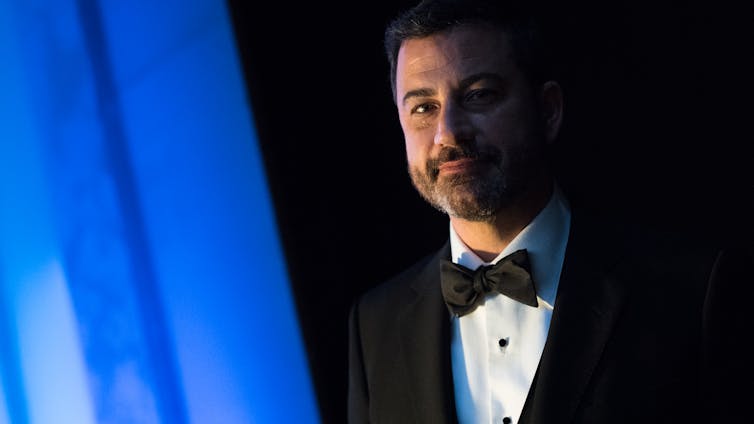
Even as Jimmy Kimmel returns to the airwaves, TV networks remain more vulnerable to political pressure than ever before
Sage Meredith Goodwin, Purdue University and Oscar Winberg, University of Turku
“Is there any way we can screw him?” asked President Richard M. Nixon.
“We’ve been trying to,” an aide replied, alluding to the White House’s efforts to remove from the airwaves an ABC talk show host whose critiques of the administration had placed that “son of a b—h” on the chief executive’s enemies list.
Over 50 years ago, Nixon and his team sought to use the full weight of the federal government – with calls to network executives, Federal Communications Commission complaints, IRS audits and FBI investigations – to silence “The Dick Cavett Show.”
https://embed-player.newsoveraudio.com/v4?key=x84olp&id=https://theconversation.com/even-as-jimmy-kimmel-returns-to-the-airwaves-tv-networks-remain-more-vulnerable-to-political-pressure-than-ever-before-265653&bgColor=F5F5F5&color=D8352A&playColor=D8352A
You can listen to more articles from The Conversation, narrated by Noa, here.
Cavett, who seemed to personify the liberalism that Nixon despised, had drawn the president’s ire by platforming anti-war activists like John Kerry and Jane Fonda, along with left-wing radicals such as Stokely Carmichael.
Nixon ultimately failed in his attempt to silence Cavett. ABC executives were committed to independent media, while the broadcasting industry as a whole had garnered the attention and trust of an enormous audience, which insulated them from political pressure.
It’s a sharp contrast to President Donald Trump’s second term, during which he has loudly announced his desire to rid the nation’s televisions of his critics, and is making headway in doing so. In July 2025, CBS announced the cancellation of Stephen Colbert’s late night show. While the network maintained this was “purely a financial decision” based on ratings, it came in the wake of Colbert mocking both the president and the network.
“I hear Kimmel is next,” Trump crowed in the days after. Lo and behold, ABC briefly suspended Jimmy Kimmel on Sept. 17 over comments the comedian made about the response to the murder of right-wing activist Charlie Kirk. The suspension was lifted five days later, after it generated widespread backlash and became a flash point for free speech debates in the U.S.
But why has Trump been able to shake up late-night TV in ways Nixon never could?
It’s tempting to think of the network era – those decades in the 20th century when CBS, NBC and ABC dominated television – as a golden age of independent broadcasting and free expression.
However, as political historians of media, we know from our research that TV has always been a battleground of politics, business interests and broadcasting ideals.
The apparent appeasement of Trump by network executives shows just how much has changed in both the media and regulatory landscape since Nixon’s time.
Television’s decline
Direct pressure from the White House was the immediate catalyst for ABC’s decision to briefly pull the plug on Kimmel.
Brendan Carr, the chair of the FCC, threatened ABC and its affiliates while speaking on the podcast of right-wing commentator Benny Johnson.
“These companies can find ways to change conduct to take action on Kimmel,” he said, “or, you know, there’s going to be additional work for the FCC ahead.” Soon, Nexstar and Sinclair, which own dozens of ABC affiliates, announced that they would pull the show, forcing ABC to act.
That said, network television’s fading place in the American media ecosystem probably made the call a whole lot easier.
When Nixon was trying to nix “The Dick Cavett Show,” the program averaged 5 million viewers a night. The rival “Tonight Show Starring Johnny Carson” regularly pulled in 11 million viewers.
Yet even Cavett’s relatively smaller audience is more than double what Kimmel and his colleagues in late night television can count on today.
The rise of cable loosened the networks’ chokehold on TV news and entertainment in the late 20th century. The internet – followed by the advent of podcasts, streaming and social media – merely accelerated this trend.
By the 2010s, more viewers were watching clips of late night talk shows on their phones and computers than on television. Today, over 40% of people under 30 say they don’t watch broadcast or cable TV.
Kimmel does have over 20 million subscribers on YouTube and millions more on social media, but ABC has struggled to monetize this following.
In short, late night is no longer the TV crown jewel it once was. As a result, it’s far easier for executives to decide to cut the cord on a Kimmel or a Colbert.
Deregulation and consolidation
Broadcasting has always been a business where those at the top are swayed by the bottom line.
But back in Cavett’s day, top decision-makers at the networks were still dyed-in-the-wool broadcasting executives. Leonard Goldenson, the president of ABC whom Nixon’s aides hounded, had created the network from scratch and was invested in the ideals of independent media. Over at CBS, founder William S. Paley had spent decades building the network’s brand and reputation and held similar beliefs. They wanted to shield the respectability of their networks, which made them more resolute when confronted with political attacks.
Now, however, the ultimate decisions about what happens at ABC and CBS are made by executives at the megacorporations that own them.
Decades of deregulation – in particular, the Telecommunications Act of 1996, which spurred a wave of media mergers and consolidation – have allowed broadcasting today to be dominated by a handful of massive conglomerates. They own not only the networks, but also studios, cable channels and internet services.
These media giants need government approval to further expand their empires. This includes the US$8 billion merger that made Paramount Skydance the owner of CBS in summer 2025 – a deal that was approved just a week after CBS announced the cancellation of “The Late Show with Stephen Colbert.” Disney, which owns ABC, also has major deals pending that require the government’s go-ahead.
If the ultimate goal is ever-increasing profits for shareholders, getting rid of a late night show may seem like a small price to pay – especially if a particular program threatens the government’s sign-off on a massive deal.
Charging ‘liberal bias’
The decline of ratings and media consolidation has left television more vulnerable to attempts at political intimidation than ever before.
Trump is far from the first conservative to use the television networks as a political punching bag. His strategy of tarring national broadcasters with the brush of “liberal media bias” can be traced back to right-wing media activists who, as early as the 1940s, argued that the mainstream media shut out conservative ideas and voices.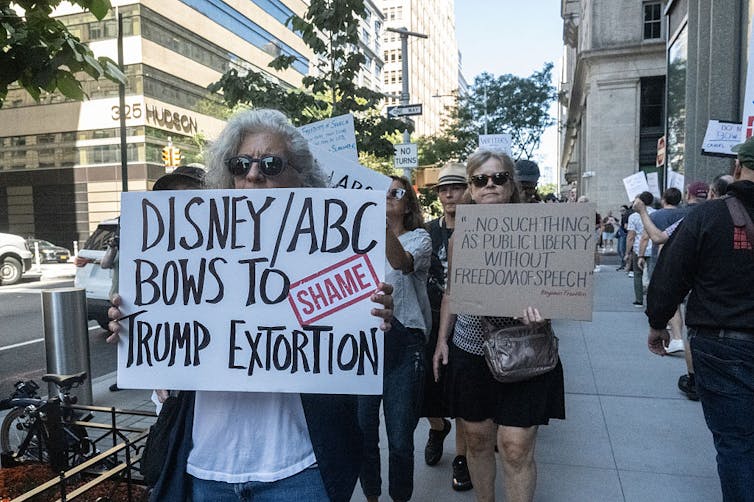
Nixon, convinced that the nation’s television industry was against him, brought those tactics to the White House. In public, he relied on his vice president, Spiro Agnew, to slam the networks as part of an irresponsibly hostile liberal “unelected elite” with “vast power.” In private, Nixon abused the office of the presidency to harass and intimidate broadcasting reporters, directors and executives.
These tactics largely failed. But in Nixon’s wake, partisan media activists like former Fox News executive Roger Ailes and radio host Rush Limbaugh continued to popularize the idea of “liberal media bias” within the conservative movement.
Today, Trump’s charges of “liberal bias” or “fake news” galvanize his supporters – and make media executives sweat – because they’re a key part of modern right-wing identity.
But the president’s no-holds-barred approach is unprecedented. By threatening broadcasting licenses, instigating investigations and filing lawsuits – all while declaring the mainstream media “the enemy of the people” – Trump has turned the dial up to 11.
His administration’s success in temporarily getting Kimmel off the air is obviously one more chapter in an ongoing crisis for free speech. Unfortunately, given the trends in the relationship between American media and politics over the past half-century, it likely won’t be the last.
Sage Meredith Goodwin, Postdoctoral Fellow at the Center for American Political History and Technology, Purdue University and Oscar Winberg, Postdoctoral Fellow, Turku Institute for Advanced Studies & John Morton Center for North American Studies, University of Turku
This article is republished from The Conversation under a Creative Commons license. Read the original article.
Dive into “The Knowledge,” where curiosity meets clarity. This playlist, in collaboration with STMDailyNews.com, is designed for viewers who value historical accuracy and insightful learning. Our short videos, ranging from 30 seconds to a minute and a half, make complex subjects easy to grasp in no time. Covering everything from historical events to contemporary processes and entertainment, “The Knowledge” bridges the past with the present. In a world where information is abundant yet often misused, our series aims to guide you through the noise, preserving vital knowledge and truths that shape our lives today. Perfect for curious minds eager to discover the ‘why’ and ‘how’ of everything around us. Subscribe and join in as we explore the facts that matter. https://stmdailynews.com/the-knowledge/


The Long Track Back
LA Metro Locks In Vermont BRT Funding as World Cup Results Point Toward 2028
Metro’s World Cup service carried 212,865 passenger trips across eight matches. Its after-action report points to strong demand while identifying bus lanes, shuttle frequency, parking prices, and shade as priorities for future major events.

Last Updated on September 21, 2026 by Daily News Staff
A fully funded rapid-bus project and more than 212,000 World Cup shuttle trips offer two revealing signs of how Los Angeles is preparing for the 2028 Olympic and Paralympic Games.
LA Metro has reached a major funding milestone for one of its most important bus projects while releasing new evidence that transit can move a significant share of spectators during major international events.
A newly issued Metro report confirms that the Federal Transit Administration executed a $149.9 million Small Starts grant agreement for the Vermont Transit Corridor Bus Rapid Transit project on September 2, 2026. Metro now describes the proposed $413.8 million life-of-project budget as fully funded through federal, state and local sources.
Separately, Metro’s official review of the 2026 FIFA World Cup found that its special bus network carried 212,865 passenger trips during eight matches in Inglewood—approximately 20 percent of total match attendance.
Together, the developments show Metro moving from planning toward delivery: building permanent improvements for one of Los Angeles County’s busiest bus corridors while applying lessons from the World Cup to the much larger transportation challenge awaiting the region in 2028.
Vermont Avenue BRT moves closer to construction
The Vermont Transit Corridor would create a 12.4-mile, all-day bus rapid transit route between Sunset Boulevard and 120th Street. It would connect with the B, C, D and E rail lines and include 26 enhanced stations at 13 locations.
Metro’s existing Vermont Avenue service carries approximately 38,000 weekday boardings but operates through some of the region’s most congested streets. The BRT project would add dedicated side-running bus lanes, upgraded stations, improved lighting, transit-signal priority, real-time arrival information and pedestrian-safety improvements.
Metro estimates that the project could attract approximately 12,000 additional daily riders while improving the speed and reliability of every bus operating through the corridor.
The funding package includes:
- $149.9 million from the FTA Small Starts program
- $106.34 million from the federal Congestion Mitigation and Air Quality program
- $81.06 million from California’s SB 1 Local Partnership Program
- $44.49 million in Proposition C funding
- $25 million from Measure M
- $5 million from the state Transit and Intercity Rail Capital Program
- $2 million in federal Community Project Funding
Metro anticipates authorizing and executing additional early-work packages beginning in the fourth quarter of 2026. Major construction is expected to begin in fall 2026, with passenger service targeted for June 2028—just weeks before the Olympic Games begin in Los Angeles.
That is a more precise schedule than earlier project information, which described construction as beginning in late 2026 or early 2027 and service starting generally in time for the Games.
The $413.8 million life-of-project budget still requires final Metro Board approval. The federal grant agreement, however, removes a major financial uncertainty and gives Metro a clearer path toward construction.
World Cup transit carried one in five spectators
Metro’s World Cup after-action report provides the most complete picture yet of how the agency performed during its first major test ahead of 2028.
Metro deployed 300 buses over 15 special routes connecting SoFi Stadium with rail stations, transit hubs and temporary park-and-ride locations across Los Angeles and Orange counties. The service carried 212,865 passenger trips over eight matches, including 31,536 trips on the busiest match day.
According to Metro, the operation recorded no missed trips caused by mechanical problems, no traffic incidents and no safety incidents. The agency reported 100 percent fleet availability.
Customer surveys were also favorable. Metro said 91 percent of special-shuttle riders were satisfied with the service, while 93 percent indicated they would likely use a similar direct-service option during the 2028 Games. Perceived safety received a 96 percent satisfaction rating.
Contactless payment played a significant role. Approximately 72 percent of World Cup shuttle riders paid directly with a contactless credit or debit card—a systemwide feature Metro launched shortly before the tournament.
The operation was not without lessons. Riders and participating agencies identified several areas needing improvement, including dedicated bus lanes, more frequent shuttles, lower park-and-ride prices, additional shade, better group-payment options and more seating for passengers with accessibility needs.
Those concerns become more consequential when looking toward 2028. The Olympics and Paralympics will last longer than the World Cup, involve substantially more events and disperse spectators across venues throughout the region. An operation that succeeded for eight matches must therefore be expanded without disrupting everyday bus and rail riders.
A glimpse of Metro’s 2028 strategy
The Vermont BRT and World Cup results represent different sides of the same challenge.
The BRT project is a permanent investment intended to improve everyday mobility in East Hollywood, Koreatown, Exposition Park, South Los Angeles, West Athens and Westmont. Its Olympic value is important, but its lasting value will be measured by whether buses become faster and more dependable for the thousands of residents who already use the corridor.
The World Cup service, meanwhile, demonstrates that direct event shuttles can persuade a meaningful share of spectators to leave their cars behind. It also reveals the extraordinary staffing, equipment, coordination and street priority required to make those services work.
Metro has now shown that the model can succeed at World Cup scale. The next test is whether the agency can complete projects such as the Vermont BRT on schedule and turn a successful temporary operation into a repeatable regional system for 2028—and beyond.
Primary sources
- LA Metro: Vermont Transit Corridor BRT life-of-project budget report
- Federal Transit Administration: Vermont Avenue BRT project profile
- LA Metro: 2026 FIFA World Cup debrief
The Long Track Back examines the projects, decisions and turning points reshaping public transportation across Los Angeles County.
The Long Track Back follows the history and future of Los Angeles transit—from the lines the region lost to the rail and bus projects reshaping how people move today. Explore the decisions, construction milestones, and ridership trends behind LA’s changing network.
Update (September 22, 2026): Metro’s separate 2028 Games mobility report explains what happens next with the World Cup lessons. Metro is using its observations and rider surveys to refine Olympic transit plans, but says it needs funding certainty by the end of 2026 to keep major preparations on schedule. The report does not announce a change to the World Cup ridership figures cited above. (File #: 2026-0617)
Community
PenFed Foundation Raises Over $1.2M for Veterans and Military Families at 23rd Annual Military Heroes Golf Classic
The PenFed Foundation says it raised over $1.2 million for veterans and military families at its 23rd annual Military Heroes Golf Classic.


The PenFed Foundation for Military Heroes said it raised more than $1.2 million to support veterans and military families during its 23rd annual Military Heroes Golf Classic, held Monday, Aug. 31, according to a PRNewswire release. The nonprofit, based in the Washington, D.C. region, focuses on helping veterans transition “from service to success” through programs and grants aimed at military-connected communities.
“We are deeply grateful to our partners and supporters whose generosity and dedication make this event—and the Foundation’s work—possible,” said retired Air Force Lt. Gen. Bradford J. “B.J.” Shwedo, president of the PenFed Foundation, in a statement announcing the fundraising total.
At a dinner held the night before the Golf Classic, PenFed Credit Union President/CEO and PenFed Foundation CEO James Schenck recognized Ed Cody for 25 years of service on the foundation’s board of directors. Cody also serves as chairman of the PenFed Credit Union board and was credited with helping guide initiatives including Defender’s Lodge, the Afghan Rescue and Resettlement Program, the Veteran Entrepreneur Program, and grants supporting wounded, ill, and injured service members.
The foundation said it has provided more than $55 million in financial support to veterans, active-duty service members, and military families since it was founded in 2001. It also noted that PenFed Credit Union covers salaries and administrative costs, allowing more donations to go directly to programs.
What to watch for: How the foundation allocates the new $1.2M across its veteran transition and emergency support programs—and whether it announces new grant rounds tied to entrepreneurship and resettlement work.
SOURCE PenFed Foundation
Subscribe to our newsletter STM Morning Brief!
Forgotten Genius Fridays
Benjamin O. Davis Sr.: The General Who Broke the U.S. Military’s Color Barrier
Benjamin O. Davis Sr. rose from the ranks of the Buffalo Soldiers to become the first Black general in U.S. military history. His remarkable career spanned roughly 50 years and helped challenge racial barriers inside a segregated Army.
Forgotten Genius Fridays | STM Daily News
Before the Tuskegee Airmen challenged segregation in the skies over World War II, another barrier was being broken within the ranks of the United States Army.
His name was Benjamin O. Davis Sr.
On October 25, 1940, Davis was promoted to brigadier general, becoming the first African American general officer in the Regular Army and the U.S. armed forces. His promotion represented an extraordinary milestone in a military that was still officially segregated.
But Davis’s story didn’t begin with stars on his shoulders.
It began more than four decades earlier.
From Volunteer to Buffalo Soldier
Born in Washington, D.C., on July 1, 1877, Davis entered military service during the Spanish-American War in 1898, serving as a temporary first lieutenant with the 8th United States Volunteer Infantry.
After that unit was mustered out, Davis made a consequential decision. In June 1899, he enlisted as a private in the Regular Army’s 9th Cavalry Regiment.
The 9th Cavalry was one of the famed Black regiments whose soldiers became widely known as the Buffalo Soldiers.
Davis quickly advanced through the enlisted ranks, becoming a corporal and then squadron sergeant major. In February 1901, he received a commission as a second lieutenant of cavalry in the Regular Army.
His journey through the ranks had begun.
Serving an Army That Wasn’t Equal
Davis would serve his country for decades, but his career unfolded inside an institution constrained by racial segregation.
Assignments available to Black officers were limited, particularly because military practices sought to prevent Black officers from commanding white soldiers. Davis consequently spent portions of his career teaching military science at historically Black institutions, including Wilberforce University and Tuskegee Institute, and served as a military attaché in Liberia.
These assignments were important, but they also reflected the racial restrictions under which Black Army officers served.
Despite those obstacles, Davis continued advancing.
He became a lieutenant colonel in 1920 and a colonel in 1930.
Then came 1940.
A Star That Made History
On October 25, 1940, President Franklin D. Roosevelt promoted Benjamin O. Davis Sr. to brigadier general.
For the first time, a Black officer wore a general’s star in the Regular Army.
The significance extended beyond Davis himself. Black Americans had served in the nation’s armed forces from its earliest conflicts, yet the highest levels of military leadership had remained closed to them.
Davis had broken through that barrier.
Yet the military remained segregated.
Becoming a general did not make segregation disappear.
Instead, Davis would spend part of World War II confronting some of its consequences.
A General Confronts Discrimination
During World War II, Davis served with the Army’s Inspector General organization and undertook assignments involving the conditions and treatment of Black troops.
He traveled extensively, investigated problems affecting soldiers and units, and advised military leaders on matters involving Black servicemen.
His work took him overseas as well. In 1942, he was sent to the European Theater on special duty concerning issues affecting Black troops. He later served in Paris as special assistant to the commanding general of the Communications Zone.
His Distinguished Service Medal citation credited his investigations and advice with helping produce fairer solutions to problems involving soldiers and contributing to broader War Department policy.
Davis therefore occupied an unusual position.
He was simultaneously a senior officer in the United States Army and a Black American serving inside a military whose segregation policies continued to restrict people who looked like him.
Then Came His Son
There is another remarkable dimension to the Benjamin O. Davis story.
While Davis Sr. was breaking barriers within the Army, his son was preparing to break barriers in the air.
Benjamin O. Davis Jr. graduated from the United States Military Academy at West Point in 1936 after enduring years of racial isolation from fellow cadets. He would later become a military pilot and eventually command both the 99th Fighter Squadron and the 332nd Fighter Group, becoming one of the most important leaders associated with the Tuskegee Airmen.
For a period, father and son represented an extraordinary rarity within the U.S. military: two Black career officers operating at a time when opportunities for Black commissioned officers remained severely restricted.
Their stories would eventually become intertwined with one of the most important experiments in American military history.
The Tuskegee Airmen.
Fifty Years of Service
Benjamin O. Davis Sr. retired from active military service on July 14, 1948, completing approximately 50 years of service.
Less than two weeks later, on July 26, President Harry S. Truman issued Executive Order 9981, declaring a policy of equality of treatment and opportunity in the armed services regardless of race, color, religion or national origin.
The transformation of the military would take years.
But Davis had spent much of his career pushing against the barriers that made such a transformation necessary.
He died on November 26, 1970, and was buried at Arlington National Cemetery.
Among his decorations were the Distinguished Service Medal, Bronze Star Medal, France’s Croix de Guerre with Palm, and Liberia’s Order of the Star of Africa.
Why Benjamin O. Davis Sr. Matters
It would be easy to remember Benjamin O. Davis Sr. simply as the first Black general in American military history.
But his significance runs deeper.
He rose from private to general in an institution that placed substantial racial barriers in his path. He served with the Buffalo Soldiers, educated future officers, represented the United States overseas and advised military leaders about the treatment of Black troops during World War II.
And his story became the first chapter of an extraordinary father-and-son legacy.
Benjamin O. Davis Sr. broke one barrier.
His son would soon take the fight into the skies.
Next in our special series: The Tuskegee Airmen — The Red Tails Who Fought Two Wars.
Then, on the following Forgotten Genius Friday, we’ll tell the remarkable story of Benjamin O. Davis Jr.—from four years of isolation at West Point to commanding the Tuskegee Airmen and ultimately wearing four stars.
Forgotten Genius Fridays is an STM Daily News series highlighting innovators, pioneers and historical figures whose achievements deserve a larger place in our collective memory.
Sources & Related Reading
Primary source: U.S. Army Center of Military History — Benjamin O. Davis Sr. — detailed official chronology of his Army service and historic promotion.
Biography: National Museum of the United States Army — Benjamin O. Davis Sr. — particularly useful for his Buffalo Soldier service, segregation-era assignments and World War II work.
Related: National Park Service — Benjamin O. Davis Jr. — provides the bridge to the next generation and the Tuskegee Airmen.





