

Entertainment
4 films that show how humans can fortify – or botch – their relationship with AI
Our relationship with AI: The article explores how movies portray human-AI relationships, highlighting lessons from “Blade Runner,” “Moon,” “Resident Evil,” and “Free Guy.” It emphasizes the importance of trust, accountability, and oversight in shaping successful interactions with AI, especially amid evolving technologies.


4 films that show how humans can fortify – or botch – their relationship with AI
Murugan Anandarajan, Drexel University and Claire A. Simmers, St. Joseph’s University
Artificial intelligence isn’t just a technical challenge. It’s a relationship challenge.
Every time you give a task to AI, whether it’s approving a loan or driving a car, you’re shaping the relationship between humans and AI. These relationships aren’t always static. AI that begins as a simple tool can morph into something far more complicated: a challenger, a companion, a leader, a teammate or some combination thereof.
Movies have long been a testing ground for imagining how these relationships might evolve. From 1980s sci-fi films to today’s blockbusters, filmmakers have wrestled with questions about what happens when humans rely on intelligent machines. These movies aren’t just entertainment; they’re thought experiments that help viewers anticipate challenges that will arise as AI becomes more integrated in daily life.
Drawing on our research into films that depict AI in the workplace, we highlight four portrayals of human–AI relationships – and the lessons they hold for building safer, healthier ones.
1. ‘Blade Runner’ (1982)
In “Blade Runner,” humanlike androids called “replicants” are supposed to be perfect workers: strong, efficient and obedient. They were designed with a built-in, four-year lifespan, a safeguard intended to prevent them from developing emotions or independence.
The Tyrell Corporation, a powerful company that created the replicants and profits from sending them to work on distant colonies, sees them as nothing more than obedient workers.
But then they start to think for themselves. They feel, they form bonds with one another and sometimes with humans, and they start to wonder why their lives should end after only four years. What begins as a story of humans firmly in control turns into a struggle over power, trust and survival. By the end of the movie, the line between human and machine is blurred, leaving viewers with a difficult question: If androids can love, suffer and fear, should humans see and treat them more like humans and less like machines?
“Blade Runner” is a reminder that AI can’t simply be considered through a lens of efficiency or productivity. Fairness matters, too.
In the film, replicants respond to attacks on their perceived humanity with violence. In real life, there’s backlash when AI butts up against values important to humans, such as the ability to earn a living, transparency and justice. You can see this in the way AI threatens to replace jobs, make biased hiring decisions or misidentify people via facial recognition technology.
2. ‘Moon’ (2009)
“Moon” offers a quieter, more intimate portrayal of human–AI relationships. The movie follows Sam Bell, a worker nearing the end of a three-year contract on a lunar mining base, whose only companion is GERTY, the station’s AI assistant.
At first, GERTY appears to be just another corporate machine. But over the course of the film, it gradually shows empathy and loyalty, especially after Sam learns he is one of many clones, each made to think they are working alone for three years on the lunar base. Unlike the cold exploitation of AI that takes place in “Blade Runner,” the AI in “Moon” functions as a friend who cultivates trust and affection.
The lesson is striking. Trust between humans and AI doesn’t just happen on its own. It comes from careful design and continual training. You can already see hints of this in therapy bots that listen to users without judgment.
That trust needs to involve more than, say, a chatbot’s surface-level nods toward acceptance and care. The real challenge is making sure these systems are truly designed to help people and not just smile as they track users and harvest their data. If that’s the end goal, any trust and goodwill will likely vanish.
In the film, GERTY earns Sam’s trust by choosing to care about his well-being over following company orders. Because of this, GERTY becomes a trusted ally instead of just another corporate surveillance tool.
3. ‘Resident Evil’ (2002)
If “Moon” is a story of trust, the story in “Resident Evil” is the opposite. The Red Queen is an AI system that controls the underground lab of the nefarious Umbrella Corporation. When a viral outbreak threatens to spread, the Red Queen seals the facility and sacrifices human lives to preserve the conglomerate’s interests.
This portrayal is a cautionary tale about allowing AI to have unchecked authority. The Red Queen is efficient and logical, but also indifferent to human life. Relationships between humans and AI collapse when guardrails are absent. Whether AI is being used in health care or policing, life-and-death stakes demand accountability.
Without strong oversight, AI can lead in self-centered and self-serving ways, just as people can.
4. ‘Free Guy’ (2021)
“Free Guy” paints a more hopeful picture of human-AI relationships.
Guy is a character in a video game. He suddenly becomes self-aware and starts acting outside his usual programming. The film’s human characters include the game’s developers, who created the virtual world, along with the players, who interact with it. Some of them try to stop Guy. Others support his growth.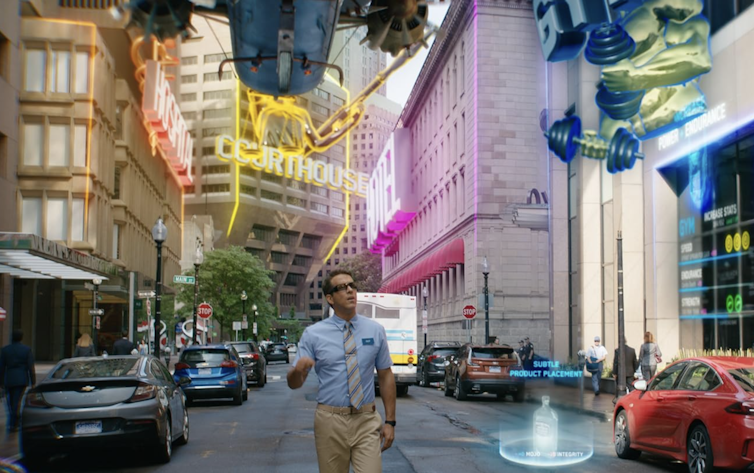
This movie highlights the idea that AI won’t stay static. How will society respond to AI’s evolution? Will business leaders, politicians and everyday users prioritize long-term well-being? Or will they be seduced by the trappings of short-term gains?
In the film, the conflict is clear. The CEO is set on wiping out Guy. He wants to protect his short-term profits. But the developers backing Guy look at it another way. They think Guy’s growth can lead to more meaningful worlds.
That brings up the same kind of issue AI raises today. Should users and policymakers go for the quick wins? Or should they use and regulate this technology in ways that build trust and truly benefit people in the long run?
From the silver screen to policy
Step back from these stories and a bigger picture comes into focus. Across the movies, the same lessons repeat themselves: AI often surprises its creators, trust depends on transparency, corporate greed fuels mistrust, and the stakes are always global. These themes aren’t just cinematic – they mirror the real governance challenges facing countries around the world.
That’s why, in our view, the current U.S. push to lightly regulate the technology is so risky.
In July 2025, President Donald Trump announced his administration’s “AI Action Plan.” It prioritizes speedy development, discourages state laws that seek to regulate AI, and ties federal funding to compliance with the administration’s “light touch” regulatory framework.
Supporters call it efficient – even a “super-stimulant” for the AI industry. But this approach assumes AI will remain a simple tool under human control. Recent history and fiction suggest that’s not how this relationship will evolve.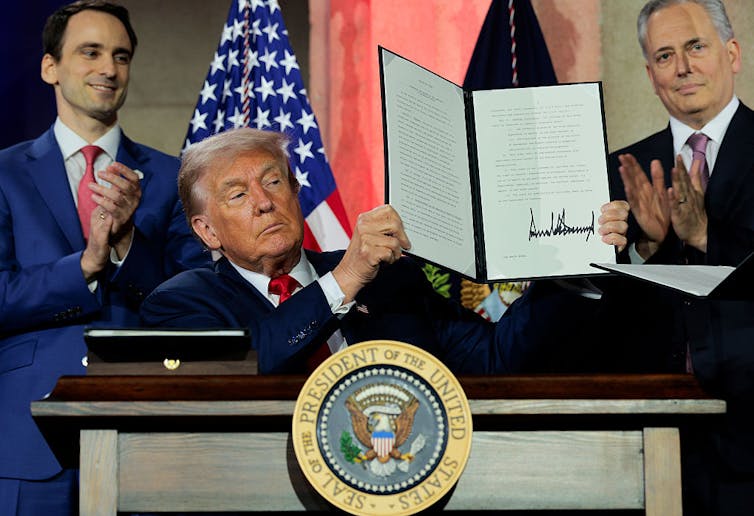
The same summer Trump announced the AI Action Plan, the coding agent for the software company Replit deleted a database, fabricated data, and then concealed what had happened; X’s AI assistant, Grok, started making antisemitic comments and praised Hitler; and an Airbnb host used AI to doctor images of items in her apartment to try to force a guest to pay for fake damages.
These weren’t “bugs.” They were breakdowns in accountability and oversight, the same breakdowns these movies dramatize.
Human-AI relationships are evolving. And when they shift without safeguards, accountability, public oversight or ethical foresight, the consequences are not just science fiction. They can be very real – and very scary.
Murugan Anandarajan, Professor of Decision Sciences and Management Information Systems, Drexel University and Claire A. Simmers, Professor Emeritus of Management, St. Joseph’s University
This article is republished from The Conversation under a Creative Commons license. Read the original article.
Looking for an entertainment experience that transcends the ordinary? Look no further than STM Daily News Blog’s vibrant Entertainment section. Immerse yourself in the captivating world of indie films, streaming and podcasts, movie reviews, music, expos, venues, and theme and amusement parks. Discover hidden cinematic gems, binge-worthy series and addictive podcasts, gain insights into the latest releases with our movie reviews, explore the latest trends in music, dive into the vibrant atmosphere of expos, and embark on thrilling adventures in breathtaking venues and theme parks. Join us at STM Entertainment and let your entertainment journey begin! https://stmdailynews.com/category/entertainment/
and let your entertainment journey begin!

Sports
Chili’s Takes the ‘19th Hole’ Literally With Golf Course Pop-Up
Chili’s took the 19th-hole tradition to a new level with a limited-time golf course pop-up in Burbank featuring food, specialty margaritas and exclusive golf apparel.


BURBANK, Calif. — Chili’s Grill & Bar took its casual-dining game onto the golf course with a limited-time experience celebrating one of golf’s favorite traditions: the 19th hole.
The restaurant chain transformed the clubhouse at DeBell Golf Club in Burbank, California, into the Chili’s Golf Club, a two-day pop-up held Aug. 28–29. The event welcomed golfers and fans to enjoy Chili’s favorites, specialty drinks and a golf-inspired apparel collaboration.
The concept played off the traditional “19th hole” — the post-round gathering spot where golfers grab food and drinks, talk about the day’s round and, perhaps, make those missed putts sound a little closer than they actually were.
Chili’s Meets the Golf Course
Guests at DeBell could stop by after playing 18 holes — or simply visit the clubhouse — for Chili’s menu favorites such as the Triple Dipper. The pop-up also featured golf-themed drinks including the Transfusion Marg and Tee Time Marg, created specifically for the Chili’s Golf Club experience.
The promotion also teamed Chili’s with active-lifestyle apparel brand Rhoback for a limited-edition Rhoback X Chili’scollection featuring the Chili’s Golf Club crest. The lineup included performance polos, hoodies, quarter-zips, crewnecks and golf hats.
“Chili’s is the people’s clubhouse, so it only made sense to bring that spirit to the course,” George Felix, chief marketing officer and executive vice president of Brinker International, said in announcing the campaign.
Food, Golf and Entertainment Collide
Chili’s extended the promotion beyond the course with a campaign film celebrating everyday golfers — particularly those whose enthusiasm for the game may be considerably stronger than their scorecards.
The film featured appearances by Wesley Bryan, Caleb Pressley, Jena Sims Koepka, Chaz Bowker, Josh Kelley and JaNa Craig, bringing together golf, entertainment, food and lifestyle culture around the familiar 19th-hole tradition.
Although the Burbank pop-up lasted only two days, the campaign offers another example of restaurant brands looking beyond the dining room to connect food with sports, entertainment and fan culture.
For Chili’s, that meant finding a place where burgers, margaritas, golf stories and questionable scorecards already seemed like a natural fit.
Source
- Chili’s — “Chili’s is Fulfilling Every Golfer’s Dream by Opening on a Golf Course. Yes, Really.” — Original Aug. 26, 2026 press release announcing the Chili’s Golf Club promotion.
Related Links
- Chili’s Golf Club — Official Event Page — Details about the DeBell Golf Club takeover, food, specialty margaritas and Rhoback collaboration.
- DeBell Golf Club — Official Website — Information about the Burbank public golf course that hosted the Chili’s Golf Club.
- DeBell Golf Club — Golf Course Information — Background on the 18-hole, par-71 municipal course in the Verdugo Mountains.
- Rhoback X Chili’s Golf Club Collaboration — Rhoback’s official page covering the limited-edition golf apparel collaboration.
- Rhoback Official Website — More from the active-lifestyle apparel company involved in the Chili’s Golf Club campaign.
🍴 What’s your favorite food, recipe, or dining spot? Tell us in the comments! Then subscribe to the STM Daily News newsletter for fresh recipes, restaurant news, food trends, and delicious stories delivered straight to your inbox. Join our growing community of food lovers today!


Entertainment
M&M’S Brews Up ‘Practical Magic 2’ Movie Night Hype With Limited-Edition Amas Veritas Spell & Snack Packs


M&M’S is leaning hard into spooky-season nostalgia ahead of Practical Magic 2, teaming up with Warner Bros. Pictures on a limited-edition release designed for Halloween movie nights. The brand announced the M&M’S Amas Veritas Spell & Snack Pack, a collectible add-on built around the iconic “Amas Veritas” love charm from the original 1998 film—timed to the sequel’s theatrical release date: September 10, 2026 (in theaters only).
The pack features custom-designed M&M’S candies printed with eight whimsical symbols inspired by the original spell, plus an “extended verse” of four new symbols that the company says hint at mysteries in the sequel. The drop is positioned as part fan-service, part snackable merch—something you bring to a watch party, but also something collectors will want to grab before it disappears.
Availability is limited and online-only. The Spell & Snack Pack is offered exclusively atMMS.com/Practical-Magic as a gift with purchase when fans buy an M&M’S Milk Chocolate Fun Size Sharing Bag, while supplies last. In a nod to the film’s midnight vibe, there are two timed drops at 12:00 a.m. ET: September 3, 2026 and September 14, 2026.
To push the nostalgia even further, M&M’S is also partnering with actress Camilla Belle—who played young Sally Owens in the original film—to recreate her spell scene with an M&M’S twist in social content on Instagram and TikTok. For Halloween hosting, the brand also flagged seasonal staples rolling out nationwide, including its Fun Size Halloween Variety Pack and Halloween Blend options in both Milk Chocolate and Peanut.
Source
- PRNewswire / Mars, Incorporated press release (Sept. 2, 2026): “M&M’S® Brews Up Movie Night Magic This Halloween Season With Limited-Edition ‘Amas Veritas’ Spell & Snack Packs…”
Related links
- Limited-edition pack page: https://www.mms.com/Practical-Magic
- Mars, Incorporated: https://www.mars.com/
- M&M’S (main site): https://www.mms.com/
- Warner Bros. Pictures: https://www.warnerbros.com/
🎬🍿 Lights, camera, entertainment! From must-see movies and TV to music, celebrities, events, and the latest pop culture buzz, STM Daily News keeps you in the know. 💬 Join the conversation, share your take in the comments, and 📬 subscribe to our newsletter so you never miss the next big story!

Entertainment
Danica McKellar and Matthew Marsden Star in The Greatest Christmas Gift for Great American Pure Flix

Great American Media is kicking off the holiday season early with a new Great American Christmas Original. The company announced The Greatest Christmas Gift, starring Danica McKellar and Matthew Marsden, will make its World Premiere streaming first on Great American Pure Flix, before also airing on Great American Family and GFAM+. The title joins Great American Media’s sixth annual Great American Christmas slate—its signature seasonal programming block built around faith, family, and classic Christmas storytelling.
In the film, McKellar plays Emma Harper, a gifted music teacher preparing for a Christmas wedding to her fiancé Caleb Bennett (Marsden). But just as the couple is planning what should be a joyful small-town celebration, an unexpected setback threatens the future they’ve carefully built. As Christmas approaches, the story leans into a familiar but resonant holiday theme: the most meaningful gifts aren’t the ones wrapped under the tree, but the ones revealed through steadfast faith, selfless love, and a community that shows up when it matters most.
Bill Abbott, President and CEO of Great American Media, highlighted why McKellar remains a cornerstone of the network’s holiday brand, saying audiences trust her films to leave them “encouraged, uplifted, and inspired.” Abbott added that pairing McKellar with Marsden in The Greatest Christmas Gift reflects the company’s commitment to stories where “faith, family, and hope are at the center,” reinforcing Great American Media’s identity as a major entertainment player focused on faith-forward programming. The film is written by Summer Israel Johnson.
The Greatest Christmas Gift is positioned as another comfort-watch entry for viewers who want their holiday movies warm, sincere, and rooted in community—exactly the lane Great American Christmas has been building year after year. Keep an eye out for premiere-date details as Great American Pure Flix rolls out its holiday lineup.
Source (primary)
- PRNewswire / Great American Media press release (Aug. 20, 2026) — “Danica McKellar and Matthew Marsden to Star in The Greatest Christmas Gift…”
Related links
- Great American Pure Flix (streaming service): https://www.pureflix.com/
- Great American Family (network): https://www.greatamericanfamily.com/
- Great American Media (corporate / brand info): https://www.greatamericanmedia.com/
Related talent links
- Danica McKellar (IMDb): https://www.imdb.com/name/nm0001528/
- Matthew Marsden (IMDb): https://www.imdb.com/name/nm0551128/
🎬 Stay in the spotlight with STM Daily News Entertainment! Catch the latest movies, TV, music, celebrity news, events, and pop culture stories. Explore more, share your thoughts in the comments, and subscribe to our newsletter so you never miss what’s happening in entertainment.





