Connect with us

Science

A decade after the release of ‘The Martian’ and a decade out from the world it envisions, a planetary scientist checks in on real-life Mars exploration

Published

on

The Martian
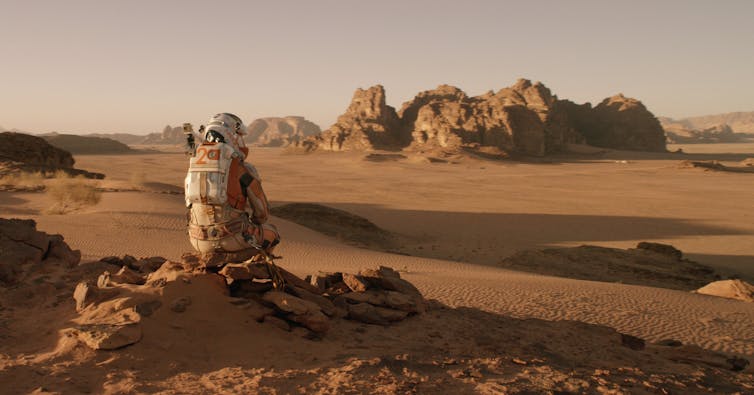
‘The Martian’ protagonist Mark Watney contemplates his ordeal. 20th Century Fox
Ari Koeppel, Dartmouth College

The Martian

Andy Weir’s bestselling story “The Martian” predicts that by 2035 NASA will have landed humans on Mars three times, perfected return-to-Earth flight systems and collaborated with the China National Space Administration. We are now 10 years past the Hollywood adaptation’s 2015 release and 10 years shy of its fictional timeline. At this midpoint, Mars exploration looks a bit different than how it was portrayed in “The Martian,” with both more discoveries and more controversy. As a planetary geologist who works with NASA missions to study Mars, I follow exploration science and policy closely. In 2010, the U.S. National Space Policy set goals for human missions to Mars in the 2030s. But in 2017, the White House Space Policy Directive 1 shifted NASA’s focus toward returning first to the Moon under what would become the Artemis program. Although concepts for crewed missions to Mars have gained popularity, NASA’s actual plans for landing humans on Mars remain fragile. Notably, over the last 10 years, it has been robotic, rather than crewed, missions that have propelled discovery and the human imagination forward.
A diagram showing the steps from lunar missions to Mars missions. The steps in the current scope are labeled 'Human presence on Moon,' 'Practice for Mars Exploration Demo' and 'Demo exploration framework on Mars.' The partial scope step is labeled 'Human presence on Mars.'
NASA’s 2023 Moon to Mars Strategy and Objectives Development document lays out the steps the agency was shooting for at the time, to go first to the Moon, and from there to Mars. NASA

Robotic discoveries

Since 2015, satellites and rovers have reshaped scientists’ understanding of Mars. They have revealed countless insights into how its climate has changed over time. As Earth’s neighbor, climate shifts on Mars also reflect solar system processes affecting Earth at a time when life was first taking hold. Thus, Mars has become a focal point for investigating the age old questions of “where do we come from?” and “are we alone?” The Opportunity, Curiosity and Perseverance rovers have driven dozens of miles studying layered rock formations that serve as a record of Mars’ past. By studying sedimentary layers – rock formations stacked like layers of a cake – planetary geologists have pieced together a vivid tale of environmental change that dwarfs what Earth is currently experiencing. Mars was once a world of erupting volcanoes, glaciers, lakes and flowing rivers – an environment not unlike early Earth. Then its core cooled, its magnetic field faltered and its atmosphere drifted away. The planet’s exposed surface has retained signs of those processes ever since in the form of landscape patterns, sequences of layered sediment and mineral mixtures.
Rock shelves layered on top of each other, shown from above.
Layered sedimentary rocks exposed within the craters of Arabia Terra, Mars, recording ancient surface processes. Photo from the Mars Reconnaissance Orbiter High Resolution Imaging Science Experiment. NASA/JPL/University of Arizona

Arabia Terra

One focus of scientific investigation over the last 10 years is particularly relevant to the setting of “The Martian” but fails to receive mention in the story. To reach his best chance of survival, protagonist Mark Watney, played by Matt Damon, must cross a vast, dusty and crater-pocked region of Mars known as Arabia Terra. In 2022 and 2023, I, along with colleagues at Northern Arizona University and Johns Hopkins University, published detailed analyses of the layered materials there using imagery from the Mars Reconnaissance Orbiter and Mars Odyssey satellites. By using infrared imagery and measuring the dimensions of surface features, we linked multiple layered deposits to the same episodes of formation and learned more about the widespread crumbling nature of the terrain seen there today. Because water tends to cement rock tightly together, that loose material indicates that around 3.5 billion years ago, that area had a drying climate. To make the discussions about this area easier, we even worked with the International Astronomical Union to name a few previously unnamed craters that were mentioned in the story. For example, one that Watney would have driven right by is now named Kozova Crater, after a town in Ukraine.

More to explore

Despite rapid advances in Mars science, many unknowns remain. Scientists still aren’t sure of the precise ages, atmospheric conditions and possible signatures of life associated with each of the different rock types observed on the surface. For instance, the Perseverance rover recently drilled into and analyzed a unique set of rocks hosting organic – that is, carbon-based – compounds. Organic compounds serve as the building blocks of life, but more detailed analysis is required to determine whether these specific rocks once hosted microbial life. The in-development Mars Sample Return mission aims to address these basic outstanding questions by delivering the first-ever unaltered fragments of another world to Earth. The Perseverance rover is already caching rock and soil samples, including ones hosting organic compounds, in sealed tubes. A future lander will then need to pick up and launch the caches back to Earth.
Sampling Mars rocks could tell scientists more about the red planet’s past, and whether it could have hosted life.
Once home, researchers can examine these materials with instruments orders of magnitude more sensitive than anything that could be flown on a spacecraft. Scientists stand to learn far more about the habitability, geologic history and presence of any signs of life on Mars through the sample return campaign than by sending humans to the surface. This perspective is why NASA, the European Space Agency and others have invested some US$30 billion in robotic Mars exploration since the 1960s. The payoff has been staggering: That work has triggered rapid technological advances in robotics, telecommunications and materials science. For example, Mars mission technology has led to better sutures for heart surgery and cars that can drive themselves. It has also bolstered the status of NASA and the U.S. as bastions of modern exploration and technology; and it has inspired millions of students to take an interest in scientific fields.
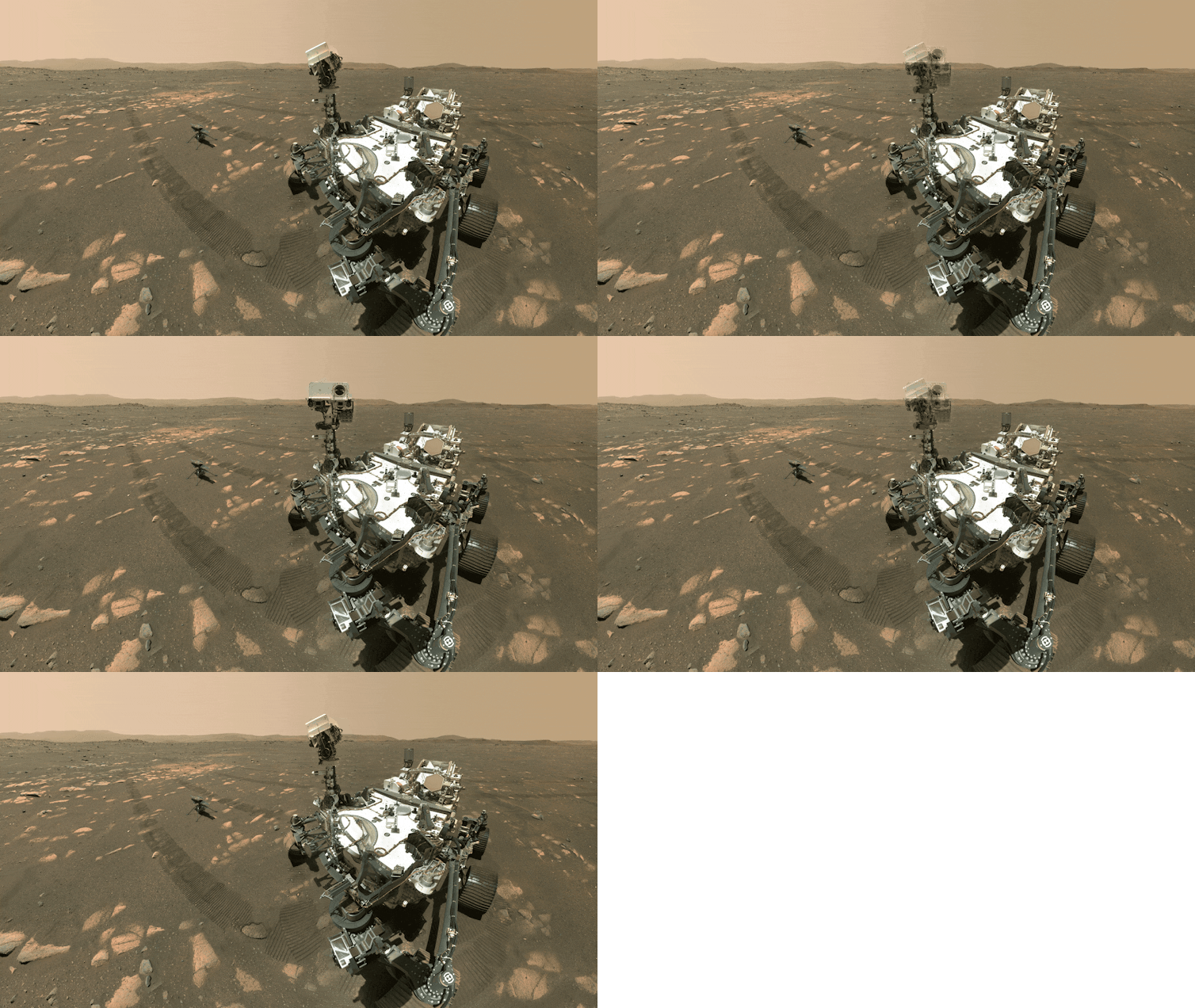
The Perseverance rover and the Ingenuity helicopter on the Martian surface, with the rover's camera moving to look down at Ingenuity.
A selfie from NASA’s Perseverance Mars rover with the Ingenuity helicopter, taken with the rover’s extendable arm on April 6, 2021. NASA/JPL-Caltech/MSSS

Calling the red planet home?

Colonizing Mars has a seductive appeal. It’s hard not to cheer for the indomitable human spirit while watching Watney battle dust storms, oxygen shortages and food scarcity over 140 million miles from rescue. Much of the momentum toward colonizing Mars is now tied to SpaceX and its CEO Elon Musk, whose stated mission to make humanity a “multi-planetary species” has become a sort of rallying cry. But while Mars colonization is romantic on paper, it is extremely difficult to actually carry out, and many critics have questioned the viability of a Mars habitation as a refuge far from Earth. Now, with NASA potentially facing a nearly 50% reduction to its science budget, the U.S. risks dissolving its planetary science and robotic operations portfolio altogether, including sample return. Nonetheless, President Donald Trump and Musk have pushed for human space exploration to somehow continue to progress, despite those proposed cuts – effectively sidelining the robotic, science-driven programs that have underpinned all of Mars exploration to date. Yet, it is these programs that have yielded humanity’s richest insights into the red planet and given both scientists and storytellers like Andy Weir the foundation to imagine what it must be like to stand on Mars’ surface at all.The Conversation Ari Koeppel, Postdoctoral Scientist in Earth and Planetary Science, Dartmouth College This article is republished from The Conversation under a Creative Commons license. Read the original article.

Discover more from Daily News

Subscribe to get the latest posts sent to your email.

Continue Reading
Advertisement Sports Research

Forgotten Genius Fridays

Valerie Thomas: NASA Engineer, Inventor, and STEM Trailblazer

Published

on

Last Updated on February 10, 2026 by Daily News StaffValerie Thomas

Valerie Thomas is a true pioneer in the world of science and technology. A NASA engineer and physicist, she is best known for inventing the illusion transmitter, a groundbreaking device that creates 3D images using concave mirrors. This invention laid the foundation for modern 3D imaging and virtual reality technologies.

Beyond her inventions, Thomas broke barriers as an African American woman in STEM, mentoring countless young scientists and advocating for diversity in science and engineering. Her work at NASA’s Goddard Space Flight Center helped advance satellite technology and data visualization, making her contributions both innovative and enduring.

In our latest short video, we highlight Valerie Thomas’ remarkable journey—from her early passion for science to her groundbreaking work at NASA. Watch and be inspired by a true STEM pioneer whose legacy continues to shape the future of space and technology.

🎥 Watch the video here: https://youtu.be/P5XTgpcAoHw

Dive into “The Knowledge,” where curiosity meets clarity. This playlist, in collaboration with STMDailyNews.com, is designed for viewers who value historical accuracy and insightful learning. Our short videos, ranging from 30 seconds to a minute and a half, make complex subjects easy to grasp in no time. Covering everything from historical events to contemporary processes and entertainment, “The Knowledge” bridges the past with the present. In a world where information is abundant yet often misused, our series aims to guide you through the noise, preserving vital knowledge and truths that shape our lives today. Perfect for curious minds eager to discover the ‘why’ and ‘how’ of everything around us. Subscribe and join in as we explore the facts that matter.  https://stmdailynews.com/the-knowledge/

Forgotten Genius Fridays

https://stmdailynews.com/the-knowledge-2/forgotten-genius-fridays/

🧠 Forgotten Genius Fridays

A Short-Form Series from The Knowledge by STM Daily News

Every Friday, STM Daily News shines a light on brilliant minds history overlooked.

Advertisement
Get More From A Face Cleanser And Spa-like Massage

Forgotten Genius Fridays is a weekly collection of short videos and articles dedicated to inventors, innovators, scientists, and creators whose impact changed the world—but whose names were often left out of the textbooks.

From life-saving inventions and cultural breakthroughs to game-changing ideas buried by bias, our series digs up the truth behind the minds that mattered.

Each episode of The Knowledge runs 30–90 seconds, designed for curious minds on the go—perfect for YouTube Shorts, TikTok, Reels, and quick reads.

Because remembering these stories isn’t just about the past—it’s about restoring credit where it’s long overdue.

 🔔 New episodes every Friday

📺 Watch now at: stmdailynews.com/the-knowledge

 🧠 Now you know.  

Author

  • Rod Washington

    Rod: A creative force, blending words, images, and flavors. Blogger, writer, filmmaker, and photographer. Cooking enthusiast with a sci-fi vision. Passionate about his upcoming series and dedicated to TNC Network. Partnered with Rebecca Washington for a shared journey of love and art. View all posts

View recent photos

Unlock fun facts & lost history—get The Knowledge in your inbox!

We don’t spam! Read our privacy policy for more info.

Advertisement
Get More From A Face Cleanser And Spa-like Massage

Discover more from Daily News

Subscribe to get the latest posts sent to your email.

Continue Reading

The Knowledge

Beneath the Waves: The Global Push to Build Undersea Railways

Undersea railways are transforming transportation, turning oceans from barriers into gateways. Proven by tunnels like the Channel and Seikan, these innovations offer cleaner, reliable connections for passengers and freight. Ongoing projects in China and Europe, alongside future proposals, signal a new era of global mobility beneath the waves.

Published

on

Train traveling through underwater tunnel
Trains beneath the ocean are no longer science fiction—they’re already in operation.

For most of modern history, oceans have acted as natural barriers—dividing nations, slowing trade, and shaping how cities grow. But beneath the waves, a quiet transportation revolution is underway. Infrastructure once limited by geography is now being reimagined through undersea railways.

Undersea rail tunnels—like the Channel Tunnel and Japan’s Seikan Tunnel—proved decades ago that trains could reliably travel beneath the ocean floor. Today, new projects are expanding that vision even further.

Around the world, engineers and governments are investing in undersea railways—tunnels that allow high-speed trains to travel beneath oceans and seas. Once considered science fiction, these projects are now operational, under construction, or actively being planned.

image 3

Undersea Rail Is Already a Reality

Japan’s Seikan Tunnel and the Channel Tunnel between the United Kingdom and France proved decades ago that undersea railways are not only possible, but reliable. These tunnels carry passengers and freight beneath the sea every day, reshaping regional connectivity.

Undersea railways are cleaner than short-haul flights, more resilient than bridges, and capable of lasting more than a century. As climate pressures and congestion increase, rail beneath the sea is emerging as a practical solution for future mobility.

What’s Being Built Right Now

China is currently constructing the Jintang Undersea Railway Tunnel as part of the Ningbo–Zhoushan high-speed rail line, while Europe’s Fehmarnbelt Fixed Link will soon connect Denmark and Germany beneath the Baltic Sea. These projects highlight how transportation and technology are converging to solve modern mobility challenges.

The Mega-Projects Still on the Drawing Board

Looking ahead, proposals such as the Helsinki–Tallinn Tunnel and the long-studied Strait of Gibraltar rail tunnel could reshape global affairs by linking regions—and even continents—once separated by water.

Why Undersea Rail Matters

The future of transportation may not rise above the ocean—but run quietly beneath it.


Discover more from Daily News

Subscribe to get the latest posts sent to your email.

Continue Reading

child education

Special Education Is Turning to AI to Fill Staffing Gaps—But Privacy and Bias Risks Remain

With special education staffing shortages worsening, schools are using AI to draft IEPs, support training, and assist assessments. Experts warn the benefits come with major risks—privacy, bias, and trust.

Published

on

Seth King, University of Iowa

With special education staffing shortages worsening, schools are using AI to draft IEPs, support training, and assist assessments. Experts warn the benefits come with major risks—privacy, bias, and trust.
Adobe Stock

In special education in the U.S., funding is scarce and personnel shortages are pervasive, leaving many school districts struggling to hire qualified and willing practitioners.

Amid these long-standing challenges, there is rising interest in using artificial intelligence tools to help close some of the gaps that districts currently face and lower labor costs.

Over 7 million children receive federally funded entitlements under the Individuals with Disabilities Education Act, which guarantees students access to instruction tailored to their unique physical and psychological needs, as well as legal processes that allow families to negotiate support. Special education involves a range of professionals, including rehabilitation specialists, speech-language pathologists and classroom teaching assistants. But these specialists are in short supply, despite the proven need for their services.

As an associate professor in special education who works with AI, I see its potential and its pitfalls. While AI systems may be able to reduce administrative burdens, deliver expert guidance and help overwhelmed professionals manage their caseloads, they can also present ethical challenges – ranging from machine bias to broader issues of trust in automated systems. They also risk amplifying existing problems with how special ed services are delivered.

Yet some in the field are opting to test out AI tools, rather than waiting for a perfect solution.

A faster IEP, but how individualized?

AI is already shaping special education planning, personnel preparation and assessment.

One example is the individualized education program, or IEP, the primary instrument for guiding which services a child receives. An IEP draws on a range of assessments and other data to describe a child’s strengths, determine their needs and set measurable goals. Every part of this process depends on trained professionals.

But persistent workforce shortages mean districts often struggle to complete assessments, update plans and integrate input from parents. Most districts develop IEPs using software that requires practitioners to choose from a generalized set of rote responses or options, leading to a level of standardization that can fail to meet a child’s true individual needs.

Preliminary research has shown that large language models such as ChatGPT can be adept at generating key special education documents such as IEPs by drawing on multiple data sources, including information from students and families. Chatbots that can quickly craft IEPs could potentially help special education practitioners better meet the needs of individual children and their families. Some professional organizations in special education have even encouraged educators to use AI for documents such as lesson plans.

Training and diagnosing disabilities

There is also potential for AI systems to help support professional training and development. My own work on personnel development combines several AI applications with virtual reality to enable practitioners to rehearse instructional routines before working directly with children. Here, AI can function as a practical extension of existing training models, offering repeated practice and structured support in ways that are difficult to sustain with limited personnel.

Advertisement
Get More From A Face Cleanser And Spa-like Massage

Some districts have begun using AI for assessments, which can involve a range of academic, cognitive and medical evaluations. AI applications that pair automatic speech recognition and language processing are now being employed in computer-mediated oral reading assessments to score tests of student reading ability.

Practitioners often struggle to make sense of the volume of data that schools collect. AI-driven machine learning tools also can help here, by identifying patterns that may not be immediately visible to educators for evaluation or instructional decision-making. Such support may be especially useful in diagnosing disabilities such as autism or learning disabilities, where masking, variable presentation and incomplete histories can make interpretation difficult. My ongoing research shows that current AI can make predictions based on data likely to be available in some districts.

Privacy and trust concerns

There are serious ethical – and practical – questions about these AI-supported interventions, ranging from risks to students’ privacy to machine bias and deeper issues tied to family trust. Some hinge on the question of whether or not AI systems can deliver services that truly comply with existing law.

The Individuals with Disabilities Education Act requires nondiscriminatory methods of evaluating disabilities to avoid inappropriately identifying students for services or neglecting to serve those who qualify. And the Family Educational Rights and Privacy Act explicitly protects students’ data privacy and the rights of parents to access and hold their children’s data.

What happens if an AI system uses biased data or methods to generate a recommendation for a child? What if a child’s data is misused or leaked by an AI system? Using AI systems to perform some of the functions described above puts families in a position where they are expected to put their faith not only in their school district and its special education personnel, but also in commercial AI systems, the inner workings of which are largely inscrutable.

These ethical qualms are hardly unique to special ed; many have been raised in other fields and addressed by early-adopters. For example, while automatic speech recognition, or ASR, systems have struggled to accurately assess accented English, many vendors now train their systems to accommodate specific ethnic and regional accents.

But ongoing research work suggests that some ASR systems are limited in their capacity to accommodate speech differences associated with disabilities, account for classroom noise, and distinguish between different voices. While these issues may be addressed through technical improvement in the future, they are consequential at present.

Embedded bias

At first glance, machine learning models might appear to improve on traditional clinical decision-making. Yet AI models must be trained on existing data, meaning their decisions may continue to reflect long-standing biases in how disabilities have been identified.

Indeed, research has shown that AI systems are routinely hobbled by biases within both training data and system design. AI models can also introduce new biases, either by missing subtle information revealed during in-person evaluations or by overrepresenting characteristics of groups included in the training data.

Such concerns, defenders might argue, are addressed by safeguards already embedded in federal law. Families have considerable latitude in what they agree to, and can opt for alternatives, provided they are aware they can direct the IEP process.

Advertisement
Get More From A Face Cleanser And Spa-like Massage

By a similar token, using AI tools to build IEPs or lessons may seem like an obvious improvement over underdeveloped or perfunctory plans. Yet true individualization would require feeding protected data into large language models, which could violate privacy regulations. And while AI applications can readily produce better-looking IEPs and other paperwork, this does not necessarily result in improved services.

Filling the gap

Indeed, it is not yet clear whether AI provides a standard of care equivalent to the high-quality, conventional treatment to which children with disabilities are entitled under federal law.

The Supreme Court in 2017 rejected the notion that the Individuals with Disabilities Education Act merely entitles students to trivial, “de minimis” progress, which weakens one of the primary rationales for pursuing AI – that it can meet a minimum standard of care and practice. And since AI really has not been empirically evaluated at scale, it has not been proved that it adequately meets the low bar of simply improving beyond the flawed status quo.

But this does not change the reality of limited resources. For better or worse, AI is already being used to fill the gap between what the law requires and what the system actually provides.

Seth King, Associate Profess of Special Education, University of Iowa

This article is republished from The Conversation under a Creative Commons license. Read the original article.


Discover more from Daily News

Subscribe to get the latest posts sent to your email.

Continue Reading

Trending