

Movies
A Palestinian-Israeli film just won an Oscar − so why is it so hard to see?
The Palestinian-Israeli film “No Other Land” won the 2025 Academy Award for best documentary but struggles to find a U.S. distributor due to its controversial subject matter around the Israeli-Palestinian conflict. Despite critical acclaim, it faces unique barriers compared to other independent films.

Last Updated on November 3, 2025 by Daily News Staff
A Palestinian-Israeli film just won an Oscar
Drew Paul, University of Tennessee
For many low-budget, independent films, an Oscar win is a golden ticket.
The publicity can translate into theatrical releases or rereleases, along with more on-demand rentals and sales.
However, for “No Other Land,” a Palestinian-Israeli film that just won best documentary feature at the 2025 Academy Awards, this exposure may not translate into commercial success in the U.S. That’s because the film has been unable to find a company to distribute it in America.
“No Other Land” chronicles the efforts of Palestinian townspeople to combat an Israeli plan to demolish their villages in the West Bank and use the area as a military training ground. It was directed by four Palestinian and Israeli activists and journalists: Basel Adra, who is a resident of the area facing demolition, Yuval Abraham, Hamdan Ballal and Rachel Szor. While the filmmakers have organized screenings in a number of U.S. cities, the lack of a national distributor makes a broader release unlikely.
Film distributors are a crucial but often unseen link in the chain that allows a film to reach cinemas and people’s living rooms. In recent years it has become more common for controversial award-winning films to run into issues finding a distributor. Palestinian films have encountered additional barriers.
As a scholar of Arabic who has written about Palestinian cinema, I’m disheartened by the difficulties “No Other Land” has faced. But I’m not surprised.
The role of film distributors
Distributors are often invisible to moviegoers. But without one, it can be difficult for a film to find an audience.
Distributors typically acquire rights to a film for a specific country or set of countries. They then market films to movie theaters, cinema chains and streaming platforms. As compensation, distributors receive a percentage of the revenue generated by theatrical and home releases.
The film “Soundtrack to a Coup D’Etat,” another finalist for best documentary, shows how this process typically works. It premiered at the Sundance Film Festival in January 2024 and was acquired for distribution just a few months later by Kino Lorber, a major U.S.-based distributor of independent films.
The inability to find a distributor is not itself noteworthy. No film is entitled to distribution, and most films by newer or unknown directors face long odds.
However, it is unusual for a film like “No Other Land,” which has garnered critical acclaim and has been recognized at various film festivals and award shows. Some have pegged it as a favorite to win best documentary at the Academy Awards. And “No Other Land” has been able to find distributors in Europe, where it’s easily accessible on multiple streaming platforms.
So why can’t “No Other Land” find a distributor in the U.S.?
There are a couple of factors at play.
Shying away from controversy
In recent years, film critics have noticed a trend: Documentaries on controversial topics have faced distribution difficulties. These include a film about a campaign by Amazon workers to unionize and a documentary about Adam Kinzinger, one of the few Republican congresspeople to vote to impeach Donald Trump in 2021.
The Israeli-Palestinian conflict, of course, has long stirred controversy. But the release of “No Other Land” comes at a time when the issue is particularly salient. The Hamas attacks of Oct. 7, 2023, and the ensuing Israeli bombardment and invasion of the Gaza Strip have become a polarizing issue in U.S. domestic politics, reflected in the campus protests and crackdowns in 2024. The filmmakers’ critical comments about the Israeli occupation of Palestine have also garnered backlash in Germany.
Yet the fact that this conflict has been in the news since October 2023 should also heighten audience interest in a film such as “No Other Land” – and, therefore, lead to increased sales, the metric that distributors care about the most.
Indeed, an earlier film that also documents Palestinian protests against Israeli land expropriation, “5 Broken Cameras,” was a finalist for best documentary at the 2013 Academy Awards. It was able to find a U.S. distributor. However, it had the support of a major European Union documentary development program called Greenhouse. The support of an organization like Greenhouse, which had ties to numerous production and distribution companies in Europe and the U.S., can facilitate the process of finding a distributor.
By contrast, “No Other Land,” although it has a Norwegian co-producer and received some funding from organizations in Europe and the U.S., was made primarily by a grassroots filmmaking collective.
Stages for protest
While distribution challenges may be recent, controversies surrounding Palestinian films are nothing new.
Many of them stem from the fact that the system of film festivals, awards and distribution is primarily based on a movie’s nation of origin. Since there is no sovereign Palestinian state – and many countries and organizations have not recognized the state of Palestine – the question of how to categorize Palestinian films has been hard to resolve.
In 2002, The Academy of Motion Picture Arts and Sciences rejected the first ever Palestinian film submitted to the best foreign language film category – Elia Suleiman’s “Divine Intervention” – because Palestine was not recognized as a country by the United Nations. The rules were changed for the following year’s awards ceremony.
In 2021, the cast of the film “Let It Be Morning,” which had an Israeli director but primarily Palestinian actors, boycotted the Cannes Film Festival in protest of the film’s categorization as an Israeli film rather than a Palestinian one.
Film festivals and other cultural venues have also become places to make statements about the Israeli-Palestinian conflict and engage in protest. For example, at the Cannes Film Festival in 2017, the right-wing Israeli culture minister wore a controversial – and meme-worthy – dress that featured the Jerusalem skyline in support of Israeli claims of sovereignty over the holy city, despite the unresolved status of Jerusalem under international law.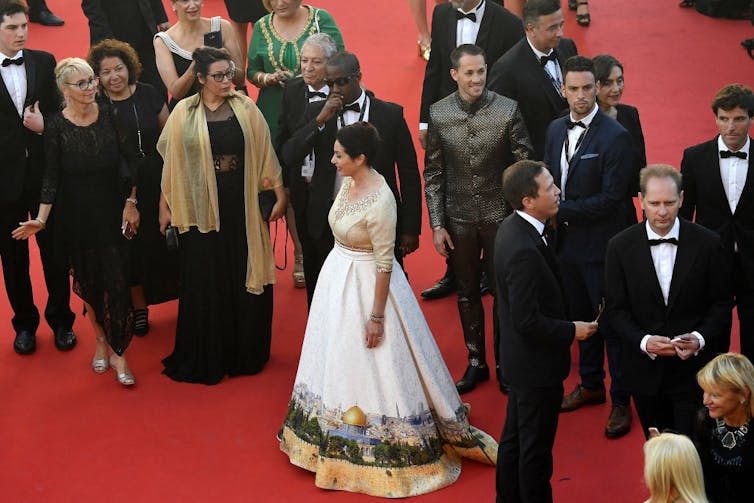
At the 2024 Academy Awards, a number of attendees, including Billie Eilish, Mark Ruffalo and Mahershala Ali, wore red pins in support of a ceasefire in Gaza, and pro-Palestine protesters delayed the start of the ceremonies.
As he accepted his award, “No Other Land” director Yuval Abraham called out “the foreign policy” of the U.S. for “helping to block” a path to peace.
Even though a film like “No Other Land” addresses a topic of clear interest to many Americans, I wonder if the quest to find a U.S. distributor just got even harder.
This article has been updated to clarify that the film was a collaborative effort between Palestinian and Israeli filmmakers. It has also been updated to reflect the film’s win at the 2025 Academy Awards.
Drew Paul, Associate Professor of Arabic, University of Tennessee
This article is republished from The Conversation under a Creative Commons license. Read the original article.
Discover more from Daily News
Subscribe to get the latest posts sent to your email.


Entertainment
One More Christmas Begins Production as Great American Media Unveils 2026 Holiday Original


Great American Media has announced One More Christmas, a new original holiday film starring Candace Cameron Bure and Jonathan Scarfe, now in production for Great American Christmas 2026. The film adds another early title to the network’s seasonal lineup as it heads into its sixth year of Christmas programming built around faith, family, hope, and redemption.
In the film, Bure plays Anna, a woman who has been divorced from James Campbell, played by Scarfe, for five years. The former couple reunites over Christmas after their daughter invites the family to a Smoky Mountain cabin to meet her serious boyfriend. What starts as an uneasy holiday gathering shifts when a major ice storm traps Anna and James together, forcing them to revisit the past and consider whether their story is really over.
Why It Stands Out
The setup gives One More Christmas a built-in second-chance romance angle, but the family dynamic may be what gives it the most emotional pull. Great American Media is clearly leaning into the kind of heartfelt, values-driven storytelling its audience expects, while continuing to build Candace Cameron Bure’s presence across its holiday slate.
Bure is also serving as an executive producer on the film. Great American Media said she will star in two original movies for the 2026 season and executive produce another holiday feature still to be announced. Bill Abbott, President and CEO of Great American Media, said Bure continues to help define the tone and quality of the network’s Christmas programming.
Creative Team
One More Christmas is executive produced by Candace Cameron Bure, Jeffery Brooks, Ford Englerth, and Tim Owens for CandyRock Entertainment, with Eric Jarboe and Holly Hines executive producing for Happy Accidents. The screenplay is written by Taylor Kalupa and Masey McLain.
CandyRock Entertainment, Bure’s joint venture with Ford Englerth and Jeffery Brooks, has produced and distributed more than 40 television and film projects focused on family-friendly entertainment.
What to Watch For
As Great American Media continues to expand its holiday lineup, One More Christmas looks positioned as one of the network’s early attention-grabbers for 2026. Between Bure’s ongoing creative role, Scarfe’s addition, and the familiar mix of Christmas setting and emotional reconciliation, the film fits squarely within the network’s brand while giving viewers a story built around family tension, weather-forced closeness, and possible renewal.
Source
Related External Links
Source
Visit the Entertainment section on STM Daily News for the latest entertainment news, movie updates, TV coverage, music stories, pop culture trends, and event highlights.
Discover more from Daily News
Subscribe to get the latest posts sent to your email.
Entertainment
Disclosure Day: Why Spielberg’s New UFO Film Has My Attention
The upcoming movie “Disclosure Day,” directed by Steven Spielberg and written by David Koepp, is highly anticipated for its exploration of sci-fi themes involving UFOs and aliens. Scheduled for a June 12, 2026 release, it features a strong cast, including Emily Blunt, and is expected to deliver a blend of wonder and emotion, reminiscent of Spielberg’s iconic films.

If there is one upcoming movie I am genuinely excited about, it is Disclosure Day. As someone who has been fascinated by science fiction, aliens, UFOs, and space since I was a little kid, this one feels like it is landing right in my wheelhouse. Add Steven Spielberg to the mix, and it becomes even more personal. Spielberg’s work helped shape the way a lot of us look at wonder, fear, and the unknown. For me, films like Close Encounters of the Third Kind, E.T., Jaws, and Duel were not just movies. They were experiences.

That is why Disclosure Day already feels like one of the most intriguing releases on the 2026 calendar. Directed by Spielberg and written by David Koepp from a story by Spielberg, the film brings together a strong cast that includes Emily Blunt, Josh O’Connor, Colin Firth, Eve Hewson, Colman Domingo, and Wyatt Russell. Blunt is reportedly playing a Kansas City TV meteorologist, which immediately adds an interesting angle for a story tied to mystery and possible extraterrestrial themes.
What makes this project especially exciting is the creative team behind it. Spielberg returning to UFO territory is enough to get longtime sci-fi fans paying attention, and Koepp’s involvement adds another layer of anticipation. The film was first reported in April 2024 as Spielberg’s next project, with Universal Pictures later confirmed as distributor. Production took place from February through May 2025, with filming in New York, New Jersey, and Atlanta under the working title Non-View.
The supporting details only make it more interesting. John Williams is set to compose the score, marking yet another collaboration with Spielberg. That alone gives the film a sense of event-level importance. Williams and Spielberg have created some of the most unforgettable moments in movie history together, and for a film centered on mystery and awe, that musical partnership matters.
Right now, Disclosure Day is scheduled to hit theaters in the United States on June 12, 2026, with an IMAX release planned as well. It was originally dated for May 15, 2026, but the move to June only builds the summer blockbuster feel around it. Based on everything we know so far, this looks like a film that could blend spectacle, emotion, and that classic Spielberg sense of wonder.
From my perspective, this is exactly the kind of movie I want to follow closely. I have always been drawn to stories about what might be out there, what we do not understand yet, and how ordinary people react when the impossible suddenly feels real. Spielberg has explored those ideas before in ways that stay with you, and I am curious to see how Disclosure Day adds to that legacy.
I will be keeping an eye on this one and updating readers as more information comes out, from trailers and story details to cast insights and release coverage, all the way up to premiere day. For sci-fi fans, UFO believers, and anyone who still feels that pull of the unknown, this is a movie worth watching.
Related Links
- Official Website
- Disclosure Day at IMDb
- Disclosure Day at Box Office Mojo
- Disclosure Day at Rotten Tomatoes
Source Links
- Marrs, Sarah (December 17, 2025). “I simply do not believe Emily Blunt is normal”. Lainey Gossip.
- “See Steven Spielberg on set of new movie with Emily Blunt and Wyatt Russell in N.J.” NJ.com. February 26, 2025.
- Singh, Yash. “Disclosure Day: Release date news, cast details and more about the upcoming Steven Spielberg sci-fi film”. Soap Central.
- Lee, Benjamin (December 16, 2025). “Disclosure Day: first trailer for Steven Spielberg’s star-studded UFO movie”. The Guardian.
- “Steven Spielberg Finally Breaks Silence On First Alien Sci-Fi Return In 21 Years With Disclosure Day”. Screen Rant.
- Kemp, Ellie. “All we know about Steven Spielberg’s new movie as first trailer drops”. UNILAD.
- Laubscher, Ludovic. “Disclosure Day: The new Steven Spielberg film with aliens”. JVMag.
- Pasbani, Rob (April 10, 2025). “Steven Spielberg Taps AEW Stars And Wrestling Legend For New UFO Movie”.
- Stephan, Katcy (August 11, 2025). “Gabby Beans Signs With Gersh (EXCLUSIVE)”. Variety.
- Siegel, Tatiana (April 17, 2024). “Ageless Auteurs: Scorsese Eyes Frank Sinatra Biopic With Leonardo DiCaprio and Jennifer Lawrence, Spielberg Tackling UFO Movie and More”. Variety.
- D’Alessandro, Anthony (May 23, 2024). “Universal Dates Steven Spielberg Event Movie For Summer 2026”. Deadline Hollywood.
- Kroll, Justin (June 13, 2024). “Emily Blunt Circling Steven Spielberg’s Next Summer Tentpole At Amblin And Universal – The Dish”. Deadline Hollywood.
- Kroll, Justin (August 16, 2024). “Colin Firth Circling Steven Spielberg’s Next Movie At Amblin And Universal – The Dish”. Deadline Hollywood.
- Thomas, Carly (September 8, 2024). “Eve Hewson in Early Talks for Untitled Steven Spielberg Event Film”. The Hollywood Reporter.
- Kroll, Justin (September 16, 2024). “Colman Domingo Circling Steven Spielberg’s Next Event Film At Amblin And Universal”. Deadline Hollywood.
- D’Alessandro, Anthony (December 6, 2024). “Wyatt Russell In Talks To Join Steven Spielberg’s Next Event Movie”. Deadline Hollywood.
- Bamigboye, Baz (May 21, 2025). “Josh O’Connor on ‘The Mastermind’, ‘The History of Sound’, His Secret Spielberg Film & How Harris Dickinson Has Inspired Him to Direct”. Deadline Hollywood.
- Calnan, Ellie. “‘The Thursday Murder Club’ star joins Steven Spielberg’s next project; Richard Osman praises UK film industry”. Screen.
- @amblin (March 7, 2025). Instagram post on Paul Tazewell joining Spielberg’s next film.
- “Casting call for Steven Spielberg film set to shoot in Huntington”. News 12. January 16, 2025.
- Bubbeo, Daniel (January 18, 2025). “Steven Spielberg looking to cast locals for Huntington shoot”. Newsday.
- “Casting Long Island Locals for Steven Spielberg Film”. GWCI On Location. January 15, 2025.
- Muchnick, Jeanne (March 7, 2025). “Casting call for Hudson Valley residents for Steven Spielberg movie. What to know”. The Journal News.
- Kuperinsky, Amy (March 6, 2025). “Steven Spielberg needs people with cars for ‘big scene’ filming in N.J.” NJ.com.
- “Spielberg Filming Sci-Fi Movie in Jersey City”. HudPost. April 5, 2025.
- Greenberg, Ted (March 6, 2025). “‘Very exciting’: Spielberg movie project brings winter business boost to Jersey Shore”. NBC10 Philadelphia.
- Deadline Hollywood on X (June 18, 2025). David Koepp comments on production wrap.
- Rubin, Rebecca (October 28, 2025). “John Williams to Score Steven Spielberg’s UFO Movie, Marking the Duo’s 30th Film Together”. Variety.
- Rubin, Rebecca (February 18, 2025). “Steven Spielberg’s New Film Moves to June 2026, Daniels’ ‘Everything Everywhere’ Follow-Up Removed From Calendar”. Variety.
Looking for an entertainment experience that transcends the ordinary? Look no further than STM Daily News Blog’s vibrant Entertainment section. Immerse yourself in the captivating world of indie films, streaming and podcasts, movie reviews, music, expos, venues, and theme and amusement parks. Discover hidden cinematic gems, binge-worthy series and addictive podcasts, gain insights into the latest releases with our movie reviews, explore the latest trends in music, dive into the vibrant atmosphere of expos, and embark on thrilling adventures in breathtaking venues and theme parks. Join us at STM Entertainment and let your entertainment journey begin! https://stmdailynews.com/category/entertainment/
Author

Discover more from Daily News
Subscribe to get the latest posts sent to your email.
Entertainment
Vision Films Sets Jan. 13 TVOD Release for Joan Collins Whodunnit A Murder Between Friends
Vision Films will release Joan Collins-led whodunnit A Murder Between Friends on transactional VOD Jan. 13, 2026, across major U.S./Canada platforms.

The company announced a North American transactional VOD release for A Murder Between Friends on Jan. 13, 2026, via a deal with Scott J. Jones and Artist View Entertainment. The “murder-com” feature stars — and is produced by — Dame Joan Collins (Dynasty), with Mark Rozzano writing and producing and Jacob Young and Trent Garrett co-directing.
The film was shot on location at Úsobí Castle in the Czech Republic and leans into classic country-estate mystery energy: six friends on vacation, one of them murdered, and everyone suddenly a suspect.
Synopsis (official): When six friends vacation at the country estate of a legendary true-crime TV star (Collins), the last thing they expect is to find one of their own murdered. Everyone is a suspect as they try to determine who among them would have the means, motive, and opportunity. As tensions grow, they enlist the aid of their celebrity sleuth hostess to uncover the truth before the killer can strike again.
The cast includes Nadia Bjorlin, Jacob Young, Trent Garrett, Toby-Alexander Smith, Simon Cotton, India Thain, Hana Vagnerová, Jim Borstelmann, and internet personality Espen Hatleskog (IG’s @pilotviking).
Vision Films CEO Lise Romanoff called it a twist-heavy mystery that keeps flipping expectations, with Collins bringing “authenticity and humor for a suspense-filled ride.”
Trailer: https://youtu.be/eUdW9Jt_rxw
Where to watch: A Murder Between Friends will be available on most major streaming and cable platforms across the U.S. and Canada on Jan. 13, 2026. Pre-orders are live on iTunes/Apple TV (US, CA) and Vudu/Fandango at Home (US).
Looking for an entertainment experience that transcends the ordinary? Look no further than STM Daily News Blog’s vibrant Entertainment section. Immerse yourself in the captivating world of indie films, streaming and podcasts, movie reviews, music, expos, venues, and theme and amusement parks. Discover hidden cinematic gems, binge-worthy series and addictive podcasts, gain insights into the latest releases with our movie reviews, explore the latest trends in music, dive into the vibrant atmosphere of expos, and embark on thrilling adventures in breathtaking venues and theme parks. Join us at STM Entertainment and let your entertainment journey begin! https://stmdailynews.com/category/entertainment/
and let your entertainment journey begin!
Discover more from Daily News
Subscribe to get the latest posts sent to your email.





