
Bruce Springsteen’s ‘Born to Run’ still speaks to a nation vacillating between hope and despair
Louis P. Masur, Rutgers University I was 18 when Bruce Springsteen’s third album, “Born to Run,” was released 50 years ago, and it couldn’t have come at a better time. I’d just finished my freshman year in college, and I was lost. My high school girlfriend had broken up with me by letter. I had no idea what I wanted to do with my life. I was stuck back in my parents’ apartment in the Bronx. So when I dropped the record onto my Panasonic turntable and Springsteen sang, “So you’re scared and you’re thinking/That maybe we ain’t that young anymore” on the opening track, “Thunder Road,” I felt as if he were speaking directly to me. But no song moved me more than the album’s title track, “Born to Run.” How I longed for that sort of love – and how I also felt strangled by the “runaway American dream.” The song was about getting out, but also about searching for a companion. I, too, was a “scared and lonely rider” who craved arriving at a special place. Decades later, I combined the personal and the professional and wrote a book about the making and meaning of the album.
All eyes on the Boss
The album was shaped by the times, particularly the malaise of the post-Vietnam and post-Watergate American landscape. There was an energy crisis, and it wasn’t only oil that was in short supply. The excitement of the 1960s had passed, and rock ’n’ roll itself was in the doldrums. Elvis had become a Las Vegas lounge act; the Beatles had broken up; Bob Dylan had been a recluse since his motorcycle accident in 1966. The No. 1 hit in 1975 was “Love Will Keep Us Together,” by the Captain and Tennille. Obituaries to rock music appeared regularly. Springsteen went into the studio feeling the pressure to produce. His first two albums had received good reviews but sold poorly. After seeing a show in Cambridge, Massachusetts, in 1974, writer Jon Landau proclaimed Springsteen “the future of rock ’n’ roll.” Springsteen wore the label uneasily, though he had more than enough ambition to try and fulfill the prophecy: He later called “Born to Run,” “my shot at the title, a 24-year-old kid aiming at the greatest rock ’n’ roll record ever.” But in the studio, he struggled. It took him six months to record the title song. He kept rewriting the lyrics and experimenting with different sounds. He was composing epics: “Tenth Avenue Freeze Out,” “Backstreets,” “Jungleland.” And he was trying to tie it all together thematically as his characters searched for love and connection and endured disappointment and heartbreak. When Springsteen was finally done with the album, he hated it. He even threw a test pressing into a pool. But Landau, who had come on to co-produce, convinced him to release it.
Poetry for the masses
Despite Springsteen’s apprehension, the response to “Born to Run” was remarkable. Hundreds of thousands of copies flew off the shelves. Springsteen appeared on the covers of Newsweek and Time, where he was hailed as “Rock’s New Sensation.” Writing in Rolling Stone, critic Greil Marcus called it “a magnificent album that pays off on every bet ever placed on him.” There was backlash from some corners: critics who resented all the hype Springsteen had received and who thought the music bombastic. But most agreed with John Rockwell of The New York Times, who praised the album’s songs as “poetry that attains universality. … You owe it to yourself to buy this record.”
An operatic drama
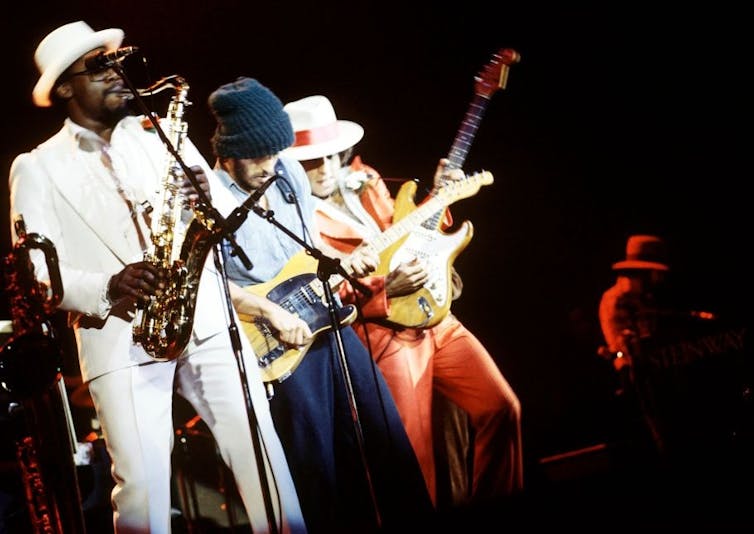
The album pulsates between hope and despair. Side 1 carries listeners from the elation of “Thunder Road” to the heartbreak of “Backstreets,” and Side 2 repeats the trajectory, from the exhilaration of “Born to Run” to the anguish of “Jungleland.” I felt I knew the characters in these songs – Mary and Wendy, Terry and Eddie – and I identified with the narrator’s struggles and dreams. They all wrestled with feeling stuck. They longed for something bigger and more exciting. But what was the price to pay for taking the leap – whether for love or the open road? These lyrical, operatic songs about freedom and fate, triumph and tragedy, still resonate, even though today’s music is more likely to emphasize beats, samples and software than extended guitar and saxophone solos. Springsteen continues to tour, and fans young and old fill arenas and stadiums to hear him because rock ’n’ roll still has something to say, still makes you shout, still makes you feel alive. “It’s embarrassing to want so much, and to expect so much from music,” Springsteen said in 2005, “except sometimes it happens – the Sun Sessions, Highway 61, Sgt. Peppers, the Band, Robert Johnson, Exile on Main Street, Born to Run – whoops, I meant to leave that one out.” In fall 1975, I played “Born to Run” over and over in my dorm room. I’d stare at Eric Meola’s cover photograph of a smiling Springsteen in leather jacket and torn T-shirt, his guitar pointing out and upward as he gazes toward his companion. Who wouldn’t want to join Springsteen and his legendary saxophonist, Clarence Clemons, on their journey? That October, I went on a first date with a girl. We’ve been married 44 years, and the stirring declaration from “Born to Run” has proven true time and again: “love is wild, love is real.”Saxophonist Clarence Clemons, Bruce Springsteen and guitarist Steven Van Zandt perform in the U.K. during the European leg of the ‘Born to Run’ tour.Andrew Putler/Redferns via Getty ImagesLouis P. Masur, Distinguished Professor of American Studies and History, Rutgers University This article is republished from The Conversation under a Creative Commons license. Read the original article.
The Building That Proved Los Angeles Could Go Vertical
Los Angeles once banned skyscrapers, yet City Hall broke the height limit and proved high-rise buildings could be engineered safely in an earthquake zone.
How City Hall Quietly Undermined LA’s Own Height Limits
The Knowledge Series | STM Daily News
For more than half a century, Los Angeles enforced one of the strictest building height limits in the United States. Beginning in 1905, most buildings were capped at 150 feet, shaping a city that grew outward rather than upward.
The goal was clear: avoid the congestion, shadows, and fire dangers associated with dense Eastern cities. Los Angeles sold itself as open, sunlit, and horizontal — a place where growth spread across land, not into the sky.
And yet, in 1928, Los Angeles City Hall rose to 454 feet, towering over the city like a contradiction in concrete.
It wasn’t built to spark a commercial skyscraper boom. But it ended up proving that Los Angeles could safely build one.
A Rule Designed to Prevent a Manhattan-Style City
The original height restriction was rooted in early 20th-century fears:
Limited firefighting capabilities
Concerns over blocked sunlight and airflow
Anxiety about congestion and overcrowding
A strong desire not to resemble New York or Chicago
Los Angeles wanted prosperity — just not vertical density.
The height cap reinforced a development model where:
Office districts stayed low-rise
Growth moved outward
Automobiles became essential
Downtown never consolidated into a dense core
This philosophy held firm even as other American cities raced upward.
How Los Angeles City Hall Proved Skyscrapers Could Be Built Safely
Why City Hall Was Never Meant to Change the Rules
City Hall was intentionally exempt from the height limit because the law applied primarily to private commercial buildings, not civic monuments.
But city leaders were explicit about one thing: City Hall was not a precedent.
It was designed to:
Serve as a symbolic seat of government
Stand alone as a civic landmark
Represent stability, authority, and modern governance
Avoid competing with private office buildings
In effect, Los Angeles wanted a skyline icon — without a skyline.
Innovation Hidden in Plain Sight
What made City Hall truly significant wasn’t just its height — it was how it was built.
Advertisement
At a time when seismic science was still developing, City Hall incorporated advanced structural ideas for its era:
A steel-frame skeleton designed for flexibility
Reinforced concrete shear walls for lateral strength
A tapered tower to reduce wind and seismic stress
Thick structural cores that distributed force instead of resisting it rigidly
These choices weren’t about aesthetics — they were about survival.
The Earthquake That Changed the Conversation
In 1933, the Long Beach earthquake struck Southern California, causing widespread damage and reshaping building codes statewide.
Los Angeles City Hall survived with minimal structural damage.
This moment quietly reshaped the debate:
A tall building had endured a major earthquake
Structural engineering had proven effective
Height alone was no longer the enemy — poor design was
City Hall didn’t just survive — it validated a new approach to vertical construction in seismic regions.
Proof Without Permission
Despite this success, Los Angeles did not rush to repeal its height limits.
Cultural resistance to density remained strong, and developers continued to build outward rather than upward. But the technical argument had already been settled.
City Hall stood as living proof that:
High-rise buildings could be engineered safely in Los Angeles
Earthquakes were a challenge, not a barrier
Fire, structural, and seismic risks could be managed
The height restriction was no longer about safety — it was about philosophy.
The Ironic Legacy
When Los Angeles finally lifted its height limit in 1957, the city did not suddenly erupt into skyscrapers. The habit of building outward was already deeply entrenched.
The result:
A skyline that arrived decades late
Uneven density across the region
Multiple business centers instead of one core
Housing and transit challenges baked into the city’s growth pattern
City Hall never triggered a skyscraper boom — but it quietly made one possible.
Why This Still Matters
Today, Los Angeles continues to wrestle with:
Advertisement
Housing shortages
Transit-oriented development debates
Height and zoning battles near rail corridors
Resistance to density in a growing city
These debates didn’t begin recently.
They trace back to a single contradiction: a city that banned tall buildings — while proving they could be built safely all along.
Los Angeles City Hall wasn’t just a monument. It was a test case — and it passed.
When TV Talks About Gentrification and Shopping Local — and Where It Gets It Right (and Wrong)
A closer look at how the TV show The Neighborhood tackles gentrification and shopping local—and where the reality of online sales and small business survival is more complex.
In our continuing look at how entertainment—television, movies, and streaming shows—grapples with real-world issues, this time we turn our attention to gentrification and the often-repeated call to “shop local.” Once again, we examine how popular culture frames these conversations, this time through the CBS sitcom The Neighborhood and the episode “Welcome Back to What Used to Be the Neighborhood.”
A Familiar Story: When the Neighborhood Changes
In the episode, Calvin’s favorite longtime restaurant closes its doors and is replaced by a flashy new pet spa. To Calvin, the change symbolizes something much bigger than a single business closing—it represents the slow erosion of the neighborhood he knows and loves. In response, he launches a campaign urging friends and neighbors to buy local in order to protect small businesses from disappearing.
Emotionally, the episode hits home. Many communities across the country have watched beloved neighborhood institutions vanish, replaced by businesses that feel disconnected from the area’s history and culture. In that sense, The Neighborhood gets something very right: gentrification often shows up one storefront at a time.
Where Television Simplifies a Complicated Reality
But, as is often the case with television, the episode also simplifies a much more complex economic reality.
The show frames “shopping local” as a direct alternative to shopping online, subtly suggesting that online platforms are inherently harmful to small businesses. In real life, however, the line between “local” and “online” is no longer so clear.
Many local and small businesses now survive precisely because they sell online—through their own websites, through Amazon, or through other platforms that support independent sellers. For some, online sales are not a threat to local commerce; they are a lifeline.
Why Brick-and-Mortar Isn’t Always Sustainable
Rising costs are a major factor driving these changes. Commercial leases, insurance premiums, utilities, staffing costs, and local fees have all increased dramatically in many cities. For small business owners, keeping a physical storefront open can become financially impossible—even when customer support remains strong.
As a result, some businesses choose to close their brick-and-mortar locations while continuing to operate online. Others scale back to pop-ups, shared spaces, or hybrid models. These businesses may no longer have a traditional storefront, but they are still local—employing local workers, paying local taxes, and serving their communities in new ways.
The Real Issue Behind “Shop Local”
Where The Neighborhood succeeds is in capturing the emotional truth of gentrification: the sense of loss, displacement, and cultural change that comes with rising rents and shifting demographics.
Where it misses the mark is in suggesting that consumer choices alone—simply avoiding online shopping—can solve the problem.
The real challenges facing local and small businesses go far beyond individual buying habits. They include zoning policies, commercial rent practices, corporate consolidation, and economic systems that increasingly favor scale over community presence.
A Conversation Worth Having—Even If TV Can’t Finish It
The Neighborhood deserves credit for bringing these issues into mainstream conversation. It sparks discussion, even if it wraps a complicated topic in a sitcom-friendly moral lesson.
The reality is messier. Supporting local businesses today often means rethinking what “local” looks like in a digital economy—and recognizing that survival sometimes requires adaptation, not nostalgia.
At STM Daily News, our Local and Small Business coverage continues to explore these real-world dynamics beyond the TV screen, highlighting the challenges, innovations, and resilience of the businesses that keep communities alive—whether their doors are on Main Street or their storefronts live online.
📍 Read more Local and Small Business coverage at:STM Daily News
Rod: A creative force, blending words, images, and flavors. Blogger, writer, filmmaker, and photographer. Cooking enthusiast with a sci-fi vision. Passionate about his upcoming series and dedicated to TNC Network. Partnered with Rebecca Washington for a shared journey of love and art. View all posts
Metro Board Advances Sepulveda Transit Corridor as C Line South Bay Extension Remains Under Review
The Los Angeles Metro Board meeting addressed progress on two key rail projects: the approved underground Sepulveda Transit Corridor, enhancing regional connectivity, and the debated extension of the Metro C Line into the South Bay, which remains undecided.
The future of Los Angeles transit was the focus of a recent Los Angeles County Metropolitan Transportation Authority (Metro) Board meeting, where directors considered progress on two major rail projects: the Sepulveda Transit Corridor and the long-planned extension of the Metro C Line into the South Bay.Image Credit: LA Metro
While the meeting resulted in a decisive vote on one project, the other continues to generate debate among Metro officials, local cities, and residents.
Sepulveda Transit Corridor: Underground Heavy Rail Moves Forward
The Metro Board unanimously approved the Locally Preferred Alternative (LPA) for the Sepulveda Transit Corridor, marking a major milestone for a project that has been discussed for decades.
The approved alternative calls for a fully underground heavy rail subway connecting the San Fernando Valley to the Westside, running from the Van Nuys Metrolink Station to the Metro E Line’s Expo/Sepulveda Station. The line would pass beneath the Sepulveda Pass, UCLA, and other high-demand travel areas.
Metro officials emphasized that the underground alignment offers the fastest travel times, highest passenger capacity, and the fewest surface-level impacts when compared with earlier aerial or monorail alternatives. The project is expected to significantly reduce congestion along the 405 Freeway corridor and improve regional connectivity.
With the LPA now selected, the Sepulveda Transit Corridor advances toward final environmental clearance, engineering, and eventual construction — a process that will continue over the coming years.
Metro C Line Extension: South Bay Alignment Debate Continues
The Board also discussed the Metro C Line extension into the South Bay, a project intended to extend light rail service approximately 4.5 miles from the current Redondo Beach station to the Torrance Transit Center.
Metro has released the project’s Final Environmental Impact Report (FEIR), which incorporates years of technical analysis and public input. However, unlike the Sepulveda project, the Board did not take final action to certify the FEIR or formally adopt a locally preferred alignment at this meeting.
Hawthorne Boulevard vs. Metro Right-of-Way
At the center of the C Line discussion is the question of alignment.
Metro staff has identified a “hybrid” alignment using an existing Metro-owned rail right-of-way as the preferred option. This route would largely follow the historic Harbor Subdivision corridor, minimizing new street disruptions while blending at-grade, elevated, and below-grade segments.
Some South Bay cities, however, continue to advocate for a Hawthorne Boulevard alignment, which would place rail tracks within the median of the busy commercial corridor. Supporters argue it offers better street-level access, while Metro has cited higher costs, longer construction timelines, and greater traffic impacts as key concerns.
Metro officials indicated that additional coordination with local jurisdictions and further Board action will be needed before a final decision is made.
Advertisement
What This Means for LA Transit
The contrast between the two projects was clear at the meeting: the Sepulveda Transit Corridor is now firmly on a defined path forward, while the C Line extension remains in a critical decision-making phase.
Together, the projects highlight both the ambition and complexity of expanding transit in Los Angeles County — balancing regional mobility goals, neighborhood impacts, and long-term funding realities.
STM Daily News will continue to follow both projects closely, providing updates as Metro moves toward final approvals, construction timelines, and funding decisions that will shape how Angelenos travel for decades to come.
For ongoing coverage of Metro projects, transportation policy, and infrastructure across Southern California, visit STM Daily News.