

Food and Beverage
Chili’s® Fires at Fast Food Again with Irresistible 3 For Lunch Combos

To highlight the incredible value and abundance of the latest expansion of the 3 For Me ® offering, Chili’s has challenged professional eater, Joey Chestnut, to take down a 3 For Lunch™ Combo – and if he doesn’t win, Chili’s guests do!
DALLAS /PRNewswire/ — Chili’s® Grill & Bar wants you to skip the drive-thru – and the sad fast food lunches – with the introduction of its new 3 For Lunch Combos. During the week (Monday-Friday) from 11 a.m. to 3 p.m. local time (at participating locations), guests can enjoy real value with 11 available options in the new 3 For Lunch Combos, featuring bottomless chips and salsa, choice of entrée and a bottomless non-alcoholic drink, all starting at just $10.99. 
Chili’s new 3 For Lunch Combos include elevated versions of America’s top lunch favorites, like burgers, chicken tenders, chicken sandwiches, and fries. Guests can continue to enjoy Chili’s 3 For Me favorites at lunch, like the Big Smasher Burger™ – with twice the beef of a Big Mac®* – or Chili’s Chicken Crispers®, made with hand-breaded chicken breasts in original or sauced flavors, a departure from the sad, misshapen nuggets you’ll find in the drive-thru.
In addition to those familiar favorites, guests can also enjoy the viral Triple Dipper® as an entrée option, giving them the chance to show off their cheese pulls during their lunch hour. Chili’s is also updating the Chipotle Chicken Fresh Mex Bowl, featuring grilled chicken with pico de gallo, greens, Mexican rice, corn salsa, house-made ranch and more, to now come with guacamole – for no extra charge. 

“We believe that our 3 For Lunch Combos are not only better quality but offer bigger portions and more variety than what you’ll find in fast food,” said Chili’s Chief Marketing Officer, George Felix. “This extension of our 3 For Me menu to lunch continues to deliver great value in every sense of the word. We compared our entrées against what’s available in fast food, and we believe that the Chili’s 3 For Lunch Combos stand out – from the quality we offer, to the abundance of food and the price point.”
To celebrate this new lunch menu and highlight the truly massive amount of food available with 3 For Lunch Combos, the grill & bar is challenging professional eating champion, Joey Chestnut, to find the bottom of one of Chili’s 3 For Lunch Combos – a seemingly impossible feat with the meal’s bottomless chips and salsa and non-alcoholic beverage. On Tuesday, October 1, 2024, the results of Joey’s epic showdown of man versus food will be unveiled. If he can defeat one of Chili’s 3 For Lunch Combos, he will win the 3 for Lunch Golden Basket Belt, which grants him bragging rights and lunch money for a year. And if Joey doesn’t win, you can. Chili’s will offer its guests the chance to win the 3 for Lunch Golden Basket Belt, including a year of free 3 For Lunch Combos, if Joey loses.
“I’ve competed in just about any eating contest you can think of, but the Chili’s 3 For Lunch Combo is no joke,” said Joey Chestnut. “This challenge isn’t about speed, it’s about endurance. I’ve pushed my boundaries to the limit this year, beating my personal bests, but Chili’s 3 For Lunch Combo with bottomless chips and salsa? That’s a whole different beast.”
Fans can watch Joey Chestnut take on a Chili’s 3 For Lunch Combo on X (@chilis) (formerly Twitter) on Tuesday, October 1 at 10am CST to see if he or one lucky guest will win the Chili’s 3 for Lunch Golden Basket Belt and free 3 For Lunch Combos for a year.
To learn more about Chili’s 3 For Lunch Combos and find your nearest location, visit chilis.com.
About Chili’s® Grill & Bar
Hi, welcome to Chili’s! We are a leader in the casual dining industry and the flagship brand of Dallas-based Brinker International, Inc. (NYSE: EAT). We are known for our Big Mouth Burgers ®, Chicken Crispers®, full-on sizzling fajitas, and hand-shaken margaritas. We take our food seriously – but not ourselves – because dining out should feel like a celebration even if there is nothing to celebrate. Our passion is making everyone feel special, and every day, our ChiliHeads make it their job to spread #ChilisLove across almost 1,600 restaurants in 27 countries and 2 territories. And Chili’s cares. We host local Give Back Events to support kids, education, and hunger and have raised more than $110 million benefiting St. Jude Children’s Research Hospital through generous Guest donations. Find more information about us at chilis.com, follow us on X or Instagram, like us on Facebook, or join us on TikTok.
*Big Mac® is a registered trademark of McDonald’s Corporation. The comparison is made based on the Big Mac’s pre-cooked patty weight of 3.2 oz (collectively).
SOURCE Chili’s Grill & Bar
Author


Last Updated on April 4, 2026 by Daily News Staff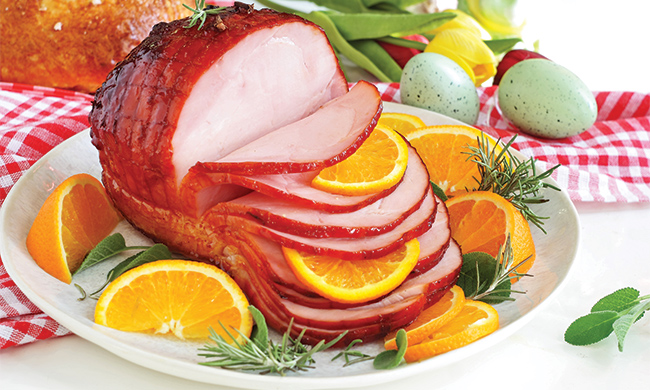
(Feature Impact) When your kitchen is full of colorful eggs, candy baskets, tempting sweets and all that comes with Easter, sometimes a holiday classic is just the answer for simplifying the season. Perfect for pairing with deviled eggs, potato salad and a traditional Sunday feast, this Maple-Glazed Easter Ham provides a hands-off approach to the main dish.
With an easily prepared glaze and your oven doing most of the work, you can keep your attention on time spent with loved ones. Visit Culinary.net to find more seasonal favorites, both classic and contemporary.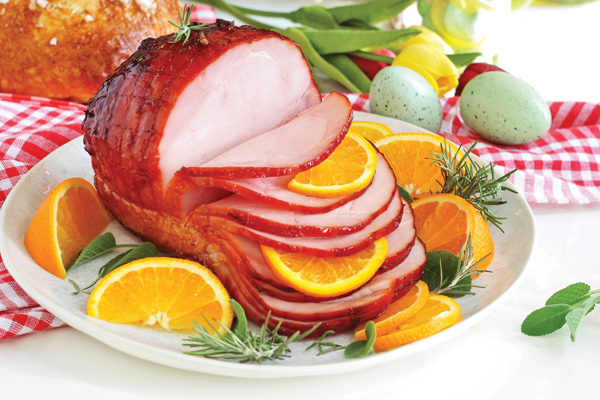
Maple-Glazed Easter Ham
Recipe adapted from Southern Living
Total time: 3 hours
Servings: 10
- 1 bone-in spiral-cut ham (8-9 pounds)
- 1 cup pure maple syrup
- 1/2 cup packed dark brown sugar
- 1/2 cup (4 ounces) bourbon
- 1/2 teaspoon grated fresh ginger
- 1/4 teaspoon ground cinnamon
- orange slices and wedges, for garnish
- fresh rosemary sprigs, for garnish
- Preheat oven to 350 F.
- Place ham in large roasting pan and fill with 1/2 inch of water. Cover pan with aluminum foil and bake about 2 hours, basting every 30 minutes with juices from pan, until meat registers 120 F at thickest portion.
- In medium saucepan over medium-high heat, stir maple syrup, brown sugar, bourbon, ginger and cinnamon; bring to boil. Cook, stirring occasionally, until thickened, 6-8 minutes. Remove from heat. Cover to keep warm and set aside.
- Remove ham from oven and discard foil. Increase oven temperature to 400 F. Using pastry brush, glaze ham with 1/3 cup maple-bourbon mixture.
- Bake ham about 30 minutes until top is lightly caramelized and meat registers 145 F at thickest portion, brushing with remaining glaze every 10 minutes.
- Remove from oven and transfer ham to serving platter. Let rest 15 minutes and garnish with orange slices, orange wedges and rosemary sprigs.
Photo courtesy of Shutterstock

SOURCE:
At our core, we at STM Daily News, strive to keep you informed and inspired with the freshest content on all things food and beverage. From mouthwatering recipes to intriguing articles, we’re here to satisfy your appetite for culinary knowledge.
Visit our Food & Drink section to get the latest on Foodie News and recipes, offering a delightful blend of culinary inspiration and gastronomic trends to elevate your dining experience. https://stmdailynews.com/food-and-drink/


If you needed a reason to celebrate your favorite wrapped meal, here it is.
National Burrito Day is observed every year on the first Thursday of April—a moving food holiday that always lands just in time to kick off spring cravings.
In 2026, National Burrito Day fell on April 2, giving burrito lovers across the U.S. the perfect midweek excuse to indulge.
A Quick Bite of History
While the burrito itself has deep roots in Mexican cuisine, the modern celebration of National Burrito Day is largely driven by restaurants and food brands that turned it into an annual event—complete with deals, giveaways, and social media buzz.
Today, it’s widely embraced by chains like Chipotle Mexican Grill and Qdoba Mexican Eats, along with local taquerías that join in the celebration.
Why It Matters (Beyond the Food)
National Burrito Day is more than just a marketing holiday—it reflects how a simple, portable dish became a staple of American food culture.
From classic bean-and-cheese to fully loaded carne asada burritos, the options are endless—and so are the reasons to celebrate.
External Related Reading
- National Day Calendar: National Burrito Day
- Smithsonian Magazine: A Brief History of the Burrito
- Chipotle Mexican Grill – Official Website
- Qdoba Mexican Eats – Official Website
Related Reading
recipes
Lighten Up: Fresh Spring Meals That Won’t Weigh You Down
Prepare your fresh spring menu with light, flavorful dishes like shrimp pearl couscous salad and chickpea couscous—perfect for easy, satisfying meals without the heaviness.
Lighten Up: Fresh Spring Meals That Won’t Weigh You Down
(Feature Impact) Put away the heavy coats and break out the rain jackets and rubber boots – spring is here, and with it comes more than just pop-up showers and sunshine. After months of comfort foods and curling up indoors, you may be ready for lighter meals that won’t weigh you down before splashing in the puddles.
Fresh produce may first come to mind, but spring bites can also mean swapping out ingredients like regular pasta for a solution such as pearl couscous. If you’re looking to complement greens, veggies, fish or meats with light yet filling flavor, consider Success Boil-in-Bag Pearl Couscous, a small, mediterranean-style pasta that always cooks right and is ready to eat in under 7 minutes once the water boils. The BPA-free boil-in-bag simplicity makes cooking easy and foolproof: no measure, no mess, no stress.
Made with high-quality semolina wheat, it features a slightly nutty flavor on its own while absorbing the flavors of salads while retaining its density and chewy texture. It’s distinguished from traditional Moroccan couscous by its slightly larger, rounder shape and less dense, firmer consistency.
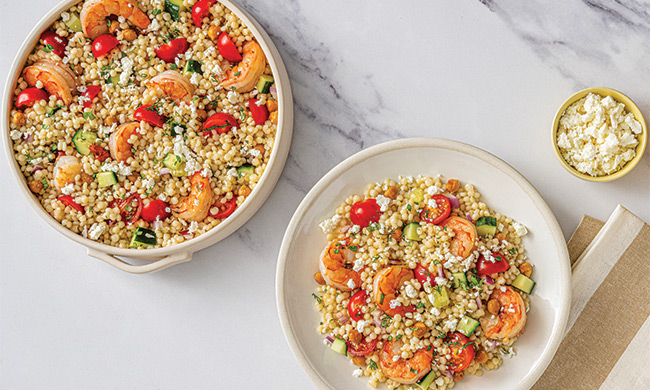
Try it with your next meal in this protein-forward Shrimp Pearl Couscous Salad, made using fresh herbs, citrus, seasoned shrimp and chickpeas for a jam-packed salad that screams spring. Never boring, the tender, seasoned couscous and shrimp, veggies and aromatic herbs can bring your family running to the kitchen after a day of play.
Or, for an even simpler dish that requires just 15 minutes in the kitchen, this Pearl Couscous and Chickpea Salad is light, bright and bursting with flavor. It brings together tender pearl couscous, crisp veggies and za’atar in every bite.
To find more light spring recipe ideas, visit SuccessRice.com.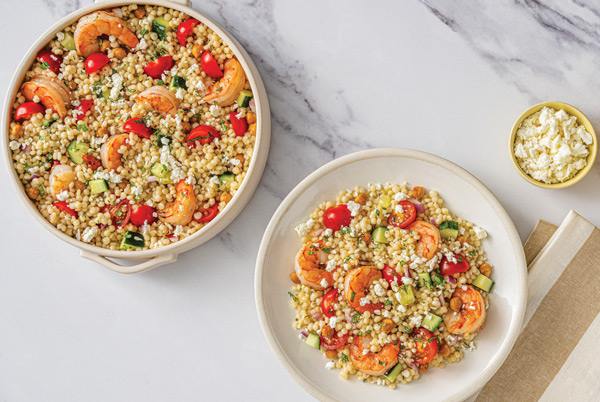
Shrimp Pearl Couscous Salad
Prep time: 10 minutes
Cook time: 15 minutes
Servings: 4
- 1 bag Success Pearl Couscous
- 1 pound large shrimp, peeled and deveined
- 1 tablespoon seasoned salt
- 4 tablespoons olive oil, divided
- 1 can (14 ounces) chickpeas, drained and rinsed
- 1/2 teaspoon garlic powder
- 1/2 teaspoon onion powder
- 1/2 teaspoon smoked paprika
- 1/4 teaspoon salt
- 1/2 English cucumber, diced
- 1 cup cherry tomatoes, halved
- 1/4 cup fresh basil, chopped
- 1/4 cup red onions, finely chopped
- 2 tablespoons fresh dill, chopped
- 1 tablespoon lemon juice
- 1/2 cup feta, crumbled
- Prepare pearl couscous according to package directions.
- In medium bowl, toss shrimp with seasoned salt.
- In large saucepan over medium-high heat, heat 1 tablespoon oil. Add shrimp and cook 5 minutes. If necessary, cook in batches to avoid overcrowding pan.
- In another large pan, heat 1 tablespoon oil over medium heat. Add chickpeas and cook 8 minutes until crispy and golden, tossing often. Add garlic powder, onion powder, paprika and salt. Toss to fully coat and cook 2 minutes.
- In large bowl, combine pearl couscous, shrimp, chickpeas, cucumbers, tomatoes, basil, red onion, dill, lemon juice and remaining olive oil. Toss to combine. Garnish with feta.
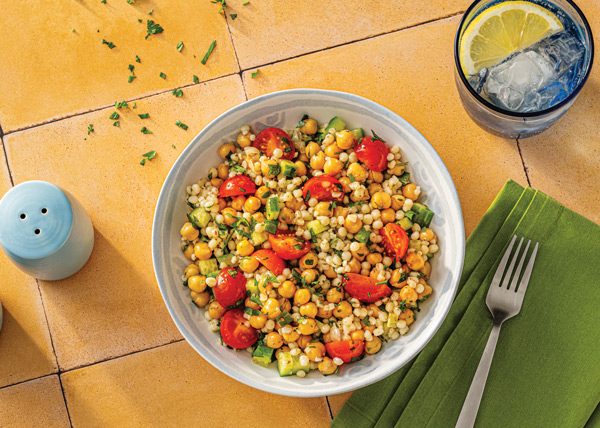
Pearl Couscous and Chickpea Salad
Prep time: 5 minutes
Cook time: 10 minutes
Servings: 4
- 1 bag Success Pearl Couscous
- 1 can (15 ounces) chickpeas, drained and rinsed
- 1 cup cherry tomatoes, halved
- 1/2 cup cucumber, diced
- 1/4 cup fresh parsley, chopped
- 1 tablespoon za’atar
- 2 tablespoons olive oil
- 1 tablespoon lemon juice, freshly squeezed
- 1/2 teaspoon salt
- 1/4 teaspoon pepper
- Prepare pearl couscous according to package directions.
- In large bowl, combine couscous, chickpeas, cherry tomatoes, cucumber, parsley and za’atar.
- Drizzle with olive oil and lemon juice. Season with salt and pepper. Toss until well combined.
- Serve warm or at room temperature.


SOURCE:
Hungry for what’s next? STM Daily News’ Food and Drink section dishes up the latest in restaurant news, beverage trends, seasonal recipes, culinary events, and food culture stories readers love to share.





