Connect with us

Blog

Deadly ‘Kissing Bug’ Disease in Arizona: What You Need to Know

Learn about Chagas disease in Arizona, where kissing bugs are found, symptoms to watch for, treatment options, and prevention tips to protect your home and family.

Published

on

Last Updated on September 8, 2025 by Daily News Staff
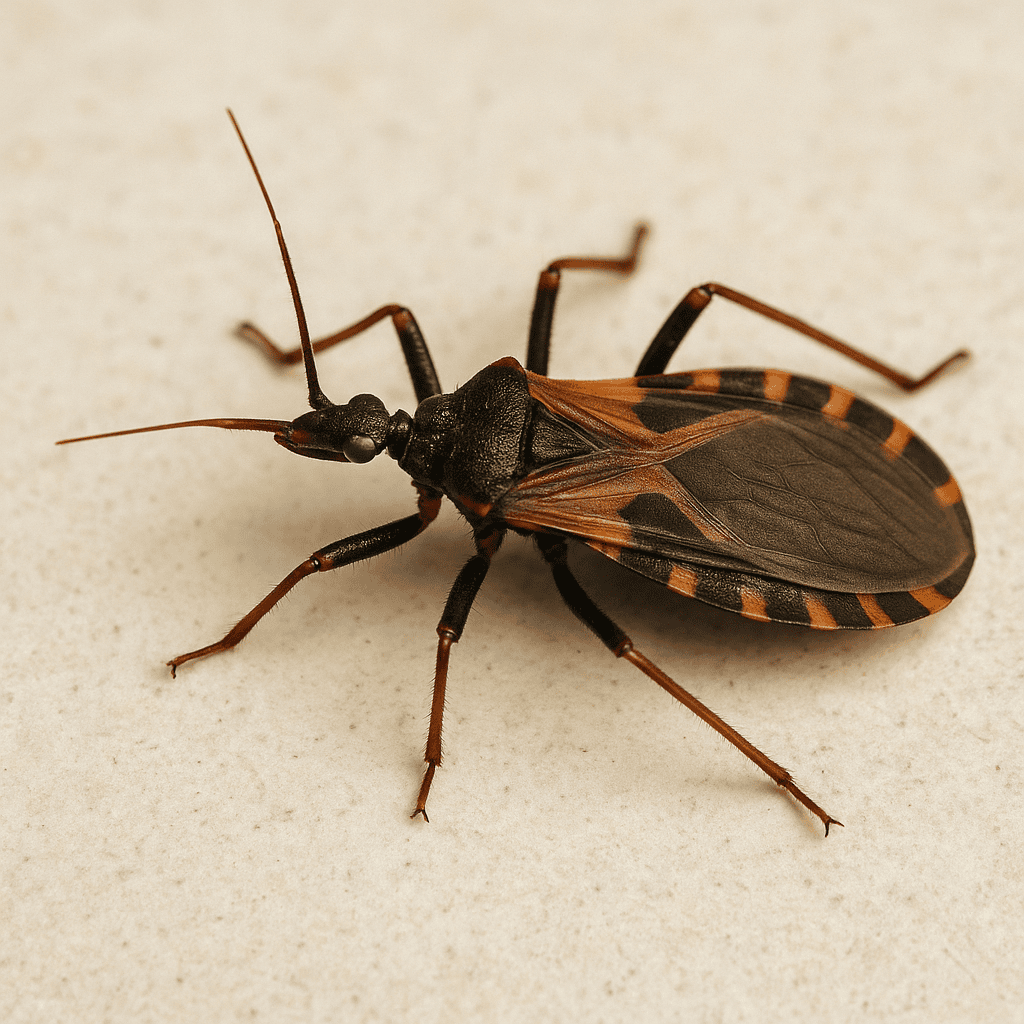
‘Kissing Bug’ Disease in Arizona

Chagas disease, often called the “kissing bug disease,” has been making headlines as it spreads in the United States. Arizona is one of the states where kissing bugs (Triatoma species) are common, particularly in the southern region. While confirmed human infections in Arizona have not been directly traced to bug bites, the insects are present, and many carry the parasite responsible for Chagas disease—making awareness and prevention critical.

Where Kissing Bugs Are Found in Arizona

Southern Arizona is a known hotspot for kissing bugs, with heavy activity in areas like:

Tucson and surrounding Pima County Cochise County Desert areas with packrat nests or outdoor animal enclosures

These insects are most active during late spring through early summer—from mid-May to mid-July—when they fly in search of food and shelter. Studies show that nearly half of the bugs collected in Arizona carry Trypanosoma cruzi, the parasite that causes Chagas disease.

How Kissing Bugs Spread Chagas Disease

Kissing bugs feed on the blood of humans and animals, often at night. Unlike mosquitoes, they don’t transmit the parasite through their bite itself. Instead, infection happens when:

The bug defecates near the bite wound and the parasite enters the skin through scratching. Contaminated bug droppings come into contact with the eyes, mouth, or open cuts.

Symptoms of Chagas Disease

Many people may not notice symptoms right away, but there are two phases of illness:

Acute Phase (weeks to months after infection)

Swelling or redness at the bite site Fever, fatigue, body aches Swollen eyelid (called Romana’s sign, a key indicator) Rash or loss of appetite

Chronic Phase (years later if untreated)

Advertisement
Get More From A Face Cleanser And Spa-like Massage

Heart problems (arrhythmias, enlarged heart, heart failure) Digestive issues (difficulty swallowing, severe constipation) Potentially life-threatening complications

If you suspect exposure, consult a doctor immediately. A blood test can confirm infection, and treatment is most effective when started early.

Treatment Options

Antiparasitic medications such as Benznidazole and Nifurtimox are available in the U.S. through the CDC. Treatment is most effective during the acute phase but may still help prevent complications in chronic cases. Doctors may also recommend heart or gastrointestinal monitoring for patients with chronic Chagas disease.

How to Prevent Kissing Bug Infestations

While human transmission in Arizona is rare, preventing bug exposure is the best protection.

Around Your Home

Seal cracks and gaps around doors, windows, roofs, and walls. Install and maintain window and door screens. Reduce outdoor lighting at night—bugs are drawn to light. Remove packrat nests, woodpiles, and debris near the home that can harbor kissing bugs. Keep pet sleeping areas clean and ideally indoors.

If You Find a Bug Indoors

Do not squash it with bare hands. Use a jar, plastic bag, or tissue to capture it safely. Freeze the bug or place it in rubbing alcohol for identification. Report findings to local health authorities or university research programs.

Key Takeaway

Southern Arizona—especially Tucson and surrounding counties—has a well-documented population of kissing bugs, many carrying the parasite that causes Chagas disease. While locally acquired human infections are rare, awareness and prevention are essential.

By sealing up your home, reducing nighttime exposure, and learning the signs of Chagas disease, you can greatly reduce your risk. If you notice unusual symptoms after possible exposure, don’t wait—get tested and treated early.

Related Links

CDC: Chagas Disease Information

Advertisement
Get More From A Face Cleanser And Spa-like Massage

University of Arizona Health Sciences:

Summertime Kissing Bug Season in Arizona

Texas A&M University: Kissing Bug Resource

National Library of Medicine: Chagas Disease in the United States

World Health Organization: Chagas Disease (American trypanosomiasis)

STM Daily News is a vibrant news blog dedicated to sharing the brighter side of human experiences. Emphasizing positive, uplifting stories, the site focuses on delivering inspiring, informative, and well-researched content. With a commitment to accurate, fair, and responsible journalism, STM Daily News aims to foster a community of readers passionate about positive change and engaged in meaningful conversations. Join the movement and explore stories that celebrate the positive impacts shaping our world.

https://stmdailynews.com/

Authors

  • Raphael

    Dolores Raphael is a dedicated writer and blogger focused on health, fitness, and everyday living. She shares practical tips and inspiring insights to help others lead a balanced and vibrant lifestyle. one of her passions is Pickleball. View all posts blogger/ writer

Want more stories 👋
“Your morning jolt of Inspiring & Interesting Stories!”

Sign up to receive awesome articles directly to your inbox.

STM Coffee Newsletter 1

We don’t spam! Read our privacy policy for more info.

Advertisement
Get More From A Face Cleanser And Spa-like Massage

Discover more from Daily News

Subscribe to get the latest posts sent to your email.

Dolores Raphael is a dedicated writer and blogger focused on health, fitness, and everyday living. She shares practical tips and inspiring insights to help others lead a balanced and vibrant lifestyle. one of her passions is Pickleball.

Continue Reading
Advertisement Tool Tickets

STM Blog

Why people trust influencers more than brands – and what that means for the future of marketing

Why people trust influencers? Discover why people trust influencers over traditional brands and what it means for marketing’s future. Learn about parasocial relationships, the 5 types of value influencers provide, and why microinfluencers often outperform mega-creators.

Published

on

Last Updated on December 16, 2025 by Daily News Staff

Why people trust influencers more than brands – and what that means for the future of marketing

Why people trust influencers more than brands – and what that means for the future of marketing

Kelley Cours Anderson, College of Charleston Not long ago, the idea of getting paid to share your morning routine online would have sounded absurd. Yet today, influencers are big business: The global market is expected to surpass US$32 billion by the end of 2025. Rooted in celebrity culture but driven by digital platforms, the influencer economy represents a powerful force in both commerce and culture. I’m an expert on digital consumer research, and I see the rise of influencers as an important evolution in the relationship between companies, consumers and creators. Historically, brands leaned on traditional celebrities like musicians, athletes and actors to endorse their products. However, by the late 2000s, social media platforms opened the door for everyday people to build audiences. Initially, influencers were viewed as a low-cost marketing tactic. Soon, however, they became a central part of marketing strategies. In the 2010s, influencer marketing matured into a global industry. Agencies and digital marketplaces emerged to professionalize influencer-brand matchmaking, and regulators like the Federal Trade Commission started paying more attention to sponsored content. The rise of video and short-form content like TikTok and Reels in the mid-2010s and 2020s added authenticity and emotional immediacy. These dynamics deepened influencer-follower relations in ways that brands couldn’t easily replicate. Influencers are now recognized as not only content creators, but also as entrepreneurs and cultural producers.

Why people trust influencers

Social media influencers often foster what researchers call “parasocial relationships” – one-sided bonds where followers feel as if they personally know the influencer. While the concept has roots in traditional celebrity culture, influencers amplify it through consistent, seemingly authentic content. This perceived intimacy helps explain why consumers often trust influencers more than brands. Though the parasocial relationship isn’t mutual, it feels real. That emotional closeness cultivates trust, a scarce but powerful currency in today’s economy. The goal for many influencers may be financial independence, but the path begins with social and cultural capital, acquired through community connection, relatability and niche expertise. As an influencer’s following grows, so does their perceived legitimacy. Brands, in turn, recognize and tap into that legitimacy. Although risks exist, like algorithmic incentives and commercial partnerships that undercut authenticity, many influencers successfully navigate this tension to preserve their community’s trust.

The many ways creators add value

Like any economy, the influencer economy revolves around value exchange. Followers spend their valuable resources – time and attention – in return for something meaningful. Researchers have identified several forms of value that influencers’ content can take:
  • Connection, or what researchers call “social value”: Influencers often build tight-knit communities around shared interests. Through live chats, comments and relatable storytelling, they offer a sense of belonging.
  • Fun, or “hedonic value”: Many influencers provide enjoyment using entertainment, humor and a touch of allure in their content. Think cat videos, TikTok dances and random acts of kindness that deliver joy and distraction from the day-to-day.
  • Knowledge, or “epistemic value”: Creators offer informational or educational content to feed consumer curiosity. This can be through tutorials, product reviews or deep dives into niche topics.
  • Usefulness, or “utilitarian value”: From life hacks to product roundups, like “Amazon must-haves,” influencers provide utilitarian or practical value to help simplify consumer decisions and solve everyday problems.
  • Money, or “financial value”: People love finding a bargain. Discounts, affiliate links and deal alerts offer direct economic benefit to followers. Some influencers even launch their own products or digital courses, delivering long-term value through entrepreneurial spinoffs.
These forms of value often overlap, reinforcing trust, and can pay off financially for influencers. In fact, consumers are significantly more likely to trust user-generated content like influencer posts over brand-generated advertising.

Lessons for brands

First, there’s evidence that smaller is often stronger. Marketing researchers categorize influencers based on how many followers they have, and nano- and microinfluencers – defined as those with fewer than 10,000 and 100,000 followers, respectively – often generate stronger engagement than mega-influencers with more than 1 million. Influencers with smaller followings can interact with their communities more closely, making their endorsements feel more credible. This has driven brands to focus on mid-tier and microinfluencers, where return on investment is often stronger. As a result, influencer agencies, brokers, platforms and trade associations have sprung up to facilitate these partnerships. Second, brands should remember that influencers’ role in the market comes with new challenges. As the field continues to become more professionalized, it’s also become more complex. Like other entrepreneurs, influencers must keep up with shifting regulations – namely, FTC sponsorship guidelines – which can lead to hefty fines if violated. Many struggle to identify how to best file their taxes when they receive freebies they are expected to build content around. It can also be a challenge for influencers to keep up with continued algorithm tweaks from the multiple social media platforms where they publish. Influencers manage more than content creation. Their role includes quickly responding to followers’ comments and managing communities, as well as handling trolls, all of which is stressful. Personal brand management adds another layer of pressure. As influencers gain more brand partnerships, they run the risk of being seen as “selling out.” Because parasocial trust depends on being viewed as authentic, aligning with the wrong brand or being too promotional can damage the very connection that built an influencer’s following. A single misstep can trigger public backlash. While growing a following can bring brand recognition and financial independence, some influencers even fear that they will lose their own identity. Influencers can struggle with work-life balance, as this is not a nine-to-five job. It requires being “always on” and the constant blurred lines. Their lives become their livelihoods, with little separation between personal and professional identity. In short, when engaging with influencers, strategic brands will recognize that they operate within an intense, high-pressure environment. Organizations such as the American Influencer Council offer support and advocacy, but industry-wide protections are lacking. Influencers have earned a central place in consumer culture not just by selling products, but by offering emotional proximity, cultural relevance and value. They’re not just marketers – they’re creators, community leaders and entrepreneurs. As the creator economy continues to grow, trust will remain its cornerstone. However, the next chapter will require thoughtful navigation of issues like regulation, platform ethics and creator well-being. Understanding influencers means recognizing both their creative work and the evolving market that now depends on them. Kelley Cours Anderson, Assistant Professor of Marketing, College of Charleston This article is republished from The Conversation under a Creative Commons license. Read the original article.

Dive into “The Knowledge,” where curiosity meets clarity. This playlist, in collaboration with STMDailyNews.com, is designed for viewers who value historical accuracy and insightful learning. Our short videos, ranging from 30 seconds to a minute and a half, make complex subjects easy to grasp in no time. Covering everything from historical events to contemporary processes and entertainment, “The Knowledge” bridges the past with the present. In a world where information is abundant yet often misused, our series aims to guide you through the noise, preserving vital knowledge and truths that shape our lives today. Perfect for curious minds eager to discover the ‘why’ and ‘how’ of everything around us. Subscribe and join in as we explore the facts that matter.  https://stmdailynews.com/the-knowledge/


Discover more from Daily News

Subscribe to get the latest posts sent to your email.

Continue Reading

Blog

Glad and Oscar the Grouch Team Up for a Trashy, Toe-Tapping Campaign

Glad teams up with Oscar the Grouch for a playful revival of the “Don’t Get Mad. Get Glad.” campaign, featuring a musical number, limited-edition Oscar-inspired trash bags, and a fresh take on making trash day fun for all ages.

Published

on

Oscar the Grouch and Glad trash bags featured in a colorful musical campaign, celebrating their playful collaboration with limited-edition green Oscar-inspired totes.

Glad revives its most popular, decades-long, star-studded ad campaign, “Don’t Get Mad. Get Glad.”

What happens when the world’s most iconic grouch meets the nation’s go-to name in trash bags? You get a campaign that’s equal parts nostalgia, Broadway-style fun, and a reminder that even trash can bring a little joy to your day.

A Classic Campaign Gets a Grouchy Remix

Glad has officially revived its legendary “Don’t Get Mad. Get Glad.” campaign, but this time, they’re ditching the usual celebrity faces for a true original: Oscar the Grouch. For the first time, the campaign’s star is none other than Sesame Street’s resident trash enthusiast himself, and he’s bringing his signature tune “I Love Trash” back with a contemporary twist.
The musical number, directed by the award-winning duo Will Speck and Josh Gordon, opens with Oscar in his element—surrounded by trash and a little bit of grumpiness. But the real magic happens when Oscar imagines a world where everyone else shares his passion for trash. The result? A joyful, Broadway-inspired remix that transforms everyday frustration into a celebration of Glad’s dependable trash solutions.

Why Oscar? Why Now?

According to Glad’s Marketing Director, Kellie Li, the choice was simple: “No one feels more strongly about trash than Oscar the Grouch.” The campaign aims to flip the script on how we think about trash—turning a dreaded chore into something a little more lighthearted. With Glad’s reliable bags, there’s less to get mad about, and maybe, just maybe, a little more to sing about.

Nostalgia Meets New Audiences

If “Don’t Get Mad. Get Glad.” sounds familiar, you’re not imagining things. The campaign has been a staple since 1987, featuring everyone from TV stars to athletes. But this new chapter, featuring Oscar and a cast of trash-loving co-stars, is designed to connect with both longtime fans and a new generation discovering Sesame Street on Netflix and PBS KIDS.

Limited-Edition Oscar Goodies and Where to Find Them

To celebrate the campaign, Glad is releasing limited-edition Oscar-inspired trash bag totes—complete with green fur, of course. Fans can snag these playful bags through a social media giveaway this December (follow @gladproducts on Instagram and TikTok for details). And if you miss out, don’t worry: special Oscar-branded Glad ForceFlex with Gain bags will hit Walmart shelves this April, just in time for spring cleaning.

Where to Watch

The campaign is rolling out across the U.S. and Canada, with full-length videos, bite-sized social teasers, and everything in between. Look for it on TikTok, Instagram, Facebook, and Reddit (for our friends up north). Featured products include Glad ForceFlex with Gain and Glad Cherry Blossom.

Bringing the Campaign Home: Phoenix Community Clean-Up

Here in Phoenix, we know the value of coming together to keep our neighborhoods clean and vibrant. Glad’s collaboration with Oscar the Grouch isn’t just a fun national campaign—it’s a reminder that tackling trash can be a community effort, too.
With spring cleaning right around the corner and special Oscar-branded Glad bags hitting Walmart shelves this April, it’s the perfect time for local groups, schools, and neighbors to organize clean-up events across the Valley. Whether you’re sprucing up a park, refreshing a neighborhood, or just making your own block a little brighter, every bag makes a difference.
Ready to join the movement? Rally your friends, family, or local organization and plan a Phoenix clean-up day this spring. Snap a photo of your crew with your Glad or Oscar-inspired trash bags and share it on social media using #GladToCleanPHX and #OscarLovesTrash. Let’s show how Phoenix turns trash day into a reason to celebrate!
  • “Phoenix, let’s get grouchy about litter and Glad about clean streets! Join our community clean-up and share your photos with #GladToCleanPHX.”
  • “Spotted: Oscar the Grouch in Phoenix! Grab your Glad bags, clean up your neighborhood, and tag #OscarLovesTrash for a chance to be featured.”
  • “Spring cleaning in Phoenix just got a lot more fun—thanks to Glad and Oscar! Who’s joining our next clean-up day? #GladToCleanPHX”

About the Brands

Glad, a member of The Clorox Company, has long been a leader in household waste solutions, while Sesame Workshop continues to inspire and educate families worldwide. This collaboration is a perfect blend of dependable products and beloved characters—reminding us all that even the messiest moments can spark a little joy.
The collaboration between Glad and Sesame Workshop for the “Don’t Get Mad. Get Glad.” campaign marks a creative partnership that blends household dependability with beloved children’s entertainment. By bringing Oscar the Grouch into the spotlight, Glad not only revives a classic campaign but also highlights the importance of making everyday chores more enjoyable for families. This partnership leverages Glad’s reputation as the nation’s leading provider of kitchen and outdoor trash bags and food protection products—trusted solutions designed to handle life’s messes with ease (Glad.com). Sesame Workshop, the nonprofit behind Sesame Street, has spent over 50 years enriching families worldwide through educational media and community outreach, helping children grow smarter, stronger, and kinder (Sesame.org). Together, their collaboration aims to inspire a new generation to see the positive side of cleaning up, all while celebrating the joy of community and play.
Sources:
High Demand Marks “Veggies for Veterans” Event Amid SNAP Delays

Discover more from Daily News

Subscribe to get the latest posts sent to your email.

Continue Reading

Artificial Intelligence

More than half of new articles on the internet are being written by AI – is human writing headed for extinction?

A new study finds over 50% of online articles are now AI-generated, raising questions about the future of human writing. Discover why formulaic content is most at risk, and why authentic, creative voices may become more valuable than ever.

Published

on

Is AI Replacing Human Writers? Why Over Half of Online Articles Are Now AI-Generated
Preserving the value of real human voices will likely depend on how people adapt to artificial intelligence and collaborate with it. BlackJack3D/E+ via Getty Images

More than half of new articles on the internet are being written by AI – is human writing headed for extinction?

Francesco Agnellini, Binghamton University, State University of New York The line between human and machine authorship is blurring, particularly as it’s become increasingly difficult to tell whether something was written by a person or AI. Now, in what may seem like a tipping point, the digital marketing firm Graphite recently published a study showing that more than 50% of articles on the web are being generated by artificial intelligence. As a scholar who explores how AI is built, how people are using it in their everyday lives, and how it’s affecting culture, I’ve thought a lot about what this technology can do and where it falls short. If you’re more likely to read something written by AI than by a human on the internet, is it only a matter of time before human writing becomes obsolete? Or is this simply another technological development that humans will adapt to?

It isn’t all or nothing

Thinking about these questions reminded me of Umberto Eco’s essay “Apocalyptic and Integrated,” which was originally written in the early 1960s. Parts of it were later included in an anthology titled “Apocalypse Postponed,” which I first read as a college student in Italy. In it, Eco draws a contrast between two attitudes toward mass media. There are the “apocalyptics” who fear cultural degradation and moral collapse. Then there are the “integrated” who champion new media technologies as a democratizing force for culture.
An older man with a beard, glasses and a suit poses while holding a cigarette.
Italian philosopher, cultural critic and novelist Umberto Eco cautioned against overreacting to the impact of new technologies. Leonardo Cendamo/Getty Images
Back then, Eco was writing about the proliferation of TV and radio. Today, you’ll often see similar reactions to AI. Yet Eco argued that both positions were too extreme. It isn’t helpful, he wrote, to see new media as either a dire threat or a miracle. Instead, he urged readers to look at how people and communities use these new tools, what risks and opportunities they create, and how they shape – and sometimes reinforce – power structures. While I was teaching a course on deepfakes during the 2024 election, Eco’s lesson also came back to me. Those were days when some scholars and media outlets were regularly warning of an imminent “deepfake apocalypse.” Would deepfakes be used to mimic major political figures and push targeted disinformation? What if, on the eve of an election, generative AI was used to mimic the voice of a candidate on a robocall telling voters to stay home? Those fears weren’t groundless: Research shows that people aren’t especially good at identifying deepfakes. At the same time, they consistently overestimate their ability to do so. In the end, though, the apocalypse was postponed. Post-election analyses found that deepfakes did seem to intensify some ongoing political trends, such as the erosion of trust and polarization, but there’s no evidence that they affected the final outcome of the election.

Listicles, news updates and how-to guides

Of course, the fears that AI raises for supporters of democracy are not the same as those it creates for writers and artists. For them, the core concerns are about authorship: How can one person compete with a system trained on millions of voices that can produce text at hyper-speed? And if this becomes the norm, what will it do to creative work, both as an occupation and as a source of meaning? It’s important to clarify what’s meant by “online content,” the phrase used in the Graphite study, which analyzed over 65,000 randomly selected articles of at least 100 words on the web. These can include anything from peer-reviewed research to promotional copy for miracle supplements. A closer reading of the Graphite study shows that the AI-generated articles consist largely of general-interest writing: news updates, how-to guides, lifestyle posts, reviews and product explainers. https://stmdailynews.com/wp-admin/post-new.php#visibility The primary economic purpose of this content is to persuade or inform, not to express originality or creativity. Put differently, AI appears to be most useful when the writing in question is low-stakes and formulaic: the weekend-in-Rome listicle, the standard cover letter, the text produced to market a business. A whole industry of writers – mostly freelance, including many translators – has relied on precisely this kind of work, producing blog posts, how-to material, search engine optimization text and social media copy. The rapid adoption of large language models has already displaced many of the gigs that once sustained them.

Collaborating with AI

The dramatic loss of this work points toward another issue raised by the Graphite study: the question of authenticity, not only in identifying who or what produced a text, but also in understanding the value that humans attach to creative activity. How can you distinguish a human-written article from a machine-generated one? And does that ability even matter? Over time, that distinction is likely to grow less significant, particularly as more writing emerges from interactions between humans and AI. A writer might draft a few lines, let an AI expand them and then reshape that output into the final text. This article is no exception. As a non-native English speaker, I often rely on AI to refine my language before sending drafts to an editor. At times the system attempts to reshape what I mean. But once its stylistic tendencies become familiar, it becomes possible to avoid them and maintain a personal tone. Also, artificial intelligence is not entirely artificial, since it is trained on human-made material. It’s worth noting that even before AI, human writing has never been entirely human, either. Every technology, from parchment and stylus paper to the typewriter and now AI, has shaped how people write and how readers make sense of it. Another important point: AI models are increasingly trained on datasets that include not only human writing but also AI-generated and human–AI co-produced text. This has raised concerns about their ability to continue improving over time. Some commentators have already described a sense of disillusionment following the release of newer large models, with companies struggling to deliver on their promises.

Human voices may matter even more

But what happens when people become overly reliant on AI in their writing? Some studies show that writers may feel more creative when they use artificial intelligence for brainstorming, yet the range of ideas often becomes narrower. This uniformity affects style as well: These systems tend to pull users toward similar patterns of wording, which reduces the differences that usually mark an individual voice. Researchers also note a shift toward Western – and especially English-speaking – norms in the writing of people from other cultures, raising concerns about a new form of AI colonialism. In this context, texts that display originality, voice and stylistic intention are likely to become even more meaningful within the media landscape, and they may play a crucial role in training the next generations of models. If you set aside the more apocalyptic scenarios and assume that AI will continue to advance – perhaps at a slower pace than in the recent past – it’s quite possible that thoughtful, original, human-generated writing will become even more valuable. Put another way: The work of writers, journalists and intellectuals will not become superfluous simply because much of the web is no longer written by humans. Francesco Agnellini, Lecturer in Digital and Data Studies, Binghamton University, State University of New York This article is republished from The Conversation under a Creative Commons license. Read the original article.
 

Dive into “The Knowledge,” where curiosity meets clarity. This playlist, in collaboration with STMDailyNews.com, is designed for viewers who value historical accuracy and insightful learning. Our short videos, ranging from 30 seconds to a minute and a half, make complex subjects easy to grasp in no time. Covering everything from historical events to contemporary processes and entertainment, “The Knowledge” bridges the past with the present. In a world where information is abundant yet often misused, our series aims to guide you through the noise, preserving vital knowledge and truths that shape our lives today. Perfect for curious minds eager to discover the ‘why’ and ‘how’ of everything around us. Subscribe and join in as we explore the facts that matter.  https://stmdailynews.com/the-knowledge/


Discover more from Daily News

Subscribe to get the latest posts sent to your email.

Continue Reading

Trending

