
Claudia Cooper, Queen Mary University of London
A new study has highlighted the complex emotions and ethical dilemmas of learning your future risk of Alzheimer’s disease. Among 274 healthy research participants from the US aged 65 and over, 40% declined to receive their personal risk estimates – despite having initially expressed an interest in doing so.
These risk estimates were based on demographic data, brain imaging and blood biomarkers, offering an 82 to 84% accuracy in predicting the likelihood of developing Alzheimer’s disease within five years. By comparison, age alone can predict this risk with 79% accuracy.
So the value of these tests is modest in people without any cognitive symptoms, and there are potential risks to disclosing them. People told they are at increased risk of dementia describe how this can feel like an illness in itself – or being in limbo between health and disease – and cause distress.
Participants who did not want to be tested cited the uncertainty of the result, the burden of knowing, and their negative experiences of witnessing Alzheimer’s disease in others. Those with a family history of Alzheimer’s were less likely to want to know their results – perhaps because of greater exposure to these negative experiences.
Get your news from actual experts, straight to your inbox. Sign up to our daily newsletter to receive all The Conversation UK’s latest coverage of news and research, from politics and business to the arts and sciences.
Black participants were less likely to want to know, too, which the researchers suggest could relate to greater experiences of stress, stigma and discrimination, making the prospect of a positive test result feel more threatening.
Perhaps the question here is not why more people didn’t want to know the result, but whether researchers should routinely offer them at all, given the lack of certainty of the results and the potential for distress.
Another issue is their limited usefulness for people without symptoms. Addressing lifestyle risk factors, such as eating a healthy diet and getting regular exercise, can reduce cognitive decline, a message the public is increasingly aware of. But knowing your risk doesn’t change the advice.
In contrast to areas like breast cancer, where people at high risk of the disease can be offered preventative measures, such as drugs, surgery or enhanced screening, there are no comparable interventions to reduce dementia risk in people without symptoms.
The authors of the new study explain that researchers used to be cautious about not sharing test results with participants in Alzheimer’s studies. But now there’s a growing expectation that people will be given their results. A proposed “bill of rights” for dementia research participants includes the right to get their results and have them clearly explained.
It’s hard to explain how uncertain these results can be. People often worry about getting dementia in general, not just Alzheimer’s, which makes up about two-thirds of all cases. Some people who are told they have a low risk of Alzheimer’s may still develop another form of dementia, such as vascular dementia.
The wider science that produced these future risk estimates has enabled the development of new diagnostic technologies unimaginable ten years ago. Similar blood tests can detect Alzheimer’s disease pathology in people with cognitive symptoms with over 90% accuracy, potentially enabling more accurate and timely dementia diagnoses.
Blood tests
Two major UK research programmes are piloting these blood tests in the NHS to support the more accurate diagnoses of some forms of dementia, including Alzheimer’s disease. Improved and earlier detection is needed: a third of people with dementia in England and Northern Ireland are never diagnosed.
The benefits of the first drugs to slow the progression of Alzheimer’s disease are modest. In the UK, the National Institute for Health and Care Excellence hasn’t yet been convinced that these drugs are worth the cost for the NHS.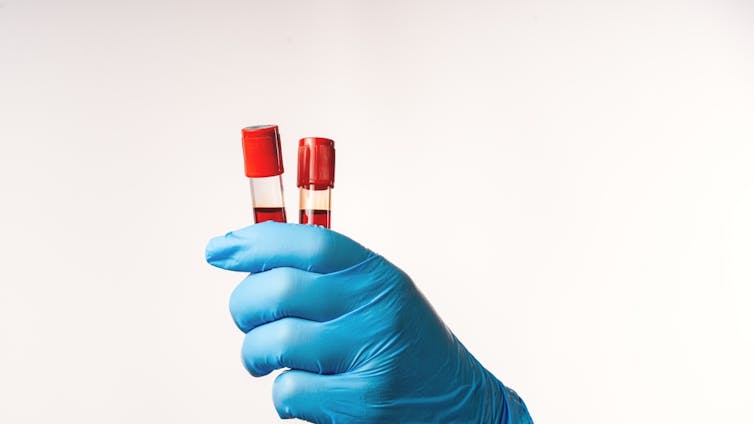
AntonSAN/Shutterstock.com
Some might question a focus on identifying future risks for dementia before we have good treatments. But developing better treatments depends on the new scientific discoveries that are helping us detect Alzheimer’s earlier. Finding a treatment for an illness requires a detailed understanding of how that illness develops.
We are closer to delivering accurate detection of Alzheimer’s disease than curative treatment. This presents a dilemma of how much to know about personal risk. Rights-based approaches situate this dilemma with the participant, to decide whether to know rather than researchers to decide whether to tell.
For researchers, disclosing results compassionately and clearly is difficult and for some, the knowledge will cause distress, however well it is conveyed. The option to receive results should come with warnings.
Claudia Cooper, Professor of Psychological Medicine, Queen Mary University of London
This article is republished from The Conversation under a Creative Commons license. Read the original article.