Connect with us

Food and Beverage

Don’t let food poisoning crash your Thanksgiving dinner

Safe thanksgiving dinner: Protect your Thanksgiving guests from foodborne illness with these expert food safety tips. Learn why you shouldn’t wash your turkey, how to avoid the danger zone, and essential prep strategies to prevent the 48 million annual cases of food poisoning in the U.S.

Published

on

Last Updated on November 26, 2025 by Daily News Staff

Don’t let food poisoning crash your Thanksgiving dinner
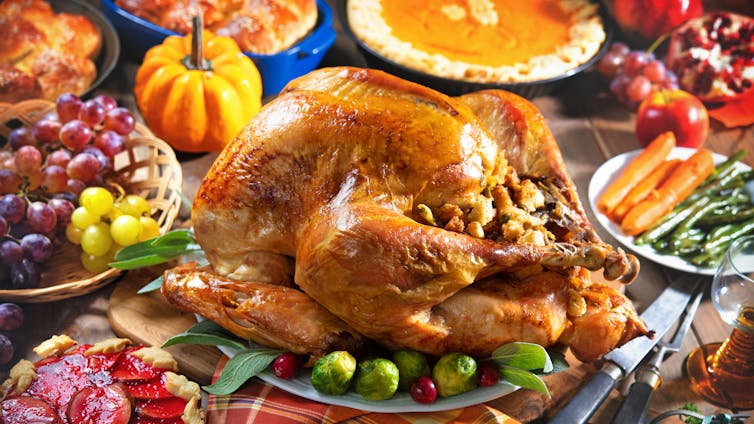
Undercooked turkey is a leading cause of foodborne illness on Thanksgiving.
AlexRaths/iStock via Getty Images Plus

Don’t let food poisoning crash your Thanksgiving dinner

Lisa Cuchara, Quinnipiac University

Thanksgiving is a time for family, friends and feasting. However, amid the joy of gathering and indulging in delicious food, it is essential to keep food safety in mind. Foodborne illnesses can quickly put a damper on your celebrations.

As an immunologist and infectious disease specialist, I study how germs spread – and how to prevent them from doing so. In my courses, I teach my students how to reduce microbial risks, including those tied to activities such as hosting a big Thanksgiving gathering, without becoming germophobes.

Foodborne illnesses sicken 48 million Americans – 1 in 6 people – each year. Holiday meals such as Thanksgiving pose special risks because these spreads often involve large quantities, long prep times, buffet-style serving and mingling guests. Such conditions create many opportunities for germs to spread.

This, in turn, invites a slew of microbial guests such as Salmonella
and Clostridium perfringens. Most people recover from infections with foodborne bacteria, but each year around 3,000 Americans die from the illnesses they cause. More routinely, these bugs can cause nausea, vomiting, stomach cramps and diarrhea within hours to a couple of days after being consumed – which are no fun at a holiday celebration.

Foods most likely to cause holiday illness

Most foodborne illnesses come from raw or undercooked food and foods left in the so-called danger zone of cooking temperature – 40 degrees to 140 degrees Fahrenheit – in which bacteria multiply rapidly. Large-batch cooking without proper reheating or storage as well as cross contamination of foods during preparation can also cause disease.

A turkey on a counter being stuffed by two sets of hands.
Put that bird right in the oven as soon as you’ve stuffed it to keep bacteria from multiplying inside.
kajakiki/E+ via Getty Images

Not all dishes pose the same risk. Turkey can harbor Salmonella, Campylobacter and Clostridium perfringens. Undercooked turkey remains a leading cause of Thanksgiving-related illness. Raw turkey drippings can also easily spread bacteria onto hands, utensils and counters. And don’t forget the stuffing inside the bird. While the turkey may reach a safe internal temperature, the stuffing often does not, making it a higher-risk dish.

Leftovers stored too long, reheated improperly or cooled slowly also bring hazards. If large pieces of roasted turkey aren’t divided and cooled quickly, any Clostridium perfringens they contain might have time to produce toxins. This increases the risk of getting sick from snacking on leftovers – even reheated leftovers, since these toxins are not killed by heat.

Indeed, each November and December outbreaks involving this bacterium spike, often due to encounters with turkey and roast beef leftovers.

Don’t wash the turkey!

Washing anything makes it cleaner and safer, right? Not necessarily.

Many people think washing their turkey will remove bacteria. However, it’s pretty much impossible to wash bacteria off a raw bird, and attempting to do so actually increases cross contamination and your risk of foodborne illness.

Advertisement
Get More From A Face Cleanser And Spa-like Massage

Since 2005, federal food safety agencies have advised against washing turkey or chicken. Despite this, a 2020 survey found that 78% of people still reported rinsing their turkey before cooking – often because older recipes or family habits encourage it.

When you rinse raw poultry, water can splash harmful bacteria around your kitchen, contaminating counter tops, utensils and nearby foods. If you do choose to wash turkey, it’s critical to immediately clean and disinfect the sink and surrounding area. A 2019 USDA study found that 60% of people who washed their poultry had bacteria in their sink afterward – and 14% had bacteria in the sink even after cleaning it.

Family enjoying Thanksgiving meal
A few food prep precautions can help keep the holiday free of gastrointestinal distress.
Drazen Zigic/iStock via Getty Images Plus

Food prep tips for a safe and healthy Thanksgiving

Wash your hands regularly. Before cooking and after touching raw meat, poultry or eggs, wash your hands thoroughly with soap and water for at least 20 seconds. Improper handwashing by people handling food is a major source of bacterial contamination with Staphylococcus aureus. This bacterium’s toxins are hard to break down, even after cooking or reheating.

Thaw turkey safely. The safest way to thaw a turkey is in the refrigerator. Allow 24 hours per 4-5 pounds. There’s also a faster method, which involves submerging the turkey in cold water and changing the water every 30 minutes – but it’s not as safe because it requires constant attention to ensure the water temperature stays below 40 F in order to prevent swift bacteria growth.

Stuff your turkey immediately before cooking it. Stuffing the turkey the night before is risky because it allows bacteria in the stuffing to multiply overnight. The toxins produced by those bacteria do not break down upon cooking, and the interior of the stuffing may not get hot enough to kill those bacteria. The USDA specifically warns against prestuffing. So cook stuffing separately, if possible, or if you prefer it inside the bird, stuff immediately before roasting, making sure it reaches 165 F.

Cook food to the right temperature. A thermometer is your best friend – use it to ensure turkey and stuffing both reach 165 F. Check casseroles and other dishes too. It’s best not to rely on an internal pop-up thermometer, since they can be inaccurate, imprecise and could even malfunction.

Avoid cross contamination. Use separate cutting boards for raw meat, vegetables and bread. Change utensils and plates after handling raw meat before using them for cooked foods.

Keep food at safe temperatures. Serve hot foods immediately, and make sure hot foods are served above 140 F and cold dishes below 40 F to keep them out of the microbial danger zone.

Be cautious with buffet-style serving. Limit food time on the table to two hours or less – longer than that, any bacteria present can double every 20 minutes. Provide dedicated serving utensils, and avoid letting guests serve with utensils they have eaten from.

Be mindful of expiration dates. Don’t forget to check dates on food items to make sure that what you are serving isn’t expired or left from last Thanksgiving.

Educate guests on food safety. Remind guests to wash their hands before preparing or serving food, and politely discourage double-dipping or tasting directly from communal dishes.

Advertisement
Get More From A Face Cleanser And Spa-like Massage

Thanksgiving should be a time of gratitude, not gastrointestinal distress. By following these simple food safety tips, you can help ensure a safe and healthy holiday.

Lisa Cuchara, Professor of Biomedical Sciences, Quinnipiac University

This article is republished from The Conversation under a Creative Commons license. Read the original article.

Our Lifestyle section on STM Daily News is a hub of inspiration and practical information, offering a range of articles that touch on various aspects of daily life. From tips on family finances to guides for maintaining health and wellness, we strive to empower our readers with knowledge and resources to enhance their lifestyles. Whether you’re seeking outdoor activity ideas, fashion trends, or travel recommendations, our lifestyle section has got you covered. Visit us today at https://stmdailynews.com/category/lifestyle/ and embark on a journey of discovery and self-improvement.

HUNGRY FOR MORE?

Discover a feast for your senses with our Food & Drink Blog, a tantalizing part of STM Daily News. Get the latest articles, recipes, and foodie news delivered straight to your inbox. Satisfaction guaranteed!

SIGN UP TO RECEIVE THE LATEST RECIPES & FOODIE NEWS, PLUS SOME EXCLUSIVE GOODIES!

We don’t spam! Read our privacy policy for more info.

Food and Drink

Discover more from Daily News

Subscribe to get the latest posts sent to your email.

Continue Reading
Advertisement Sports Research
Click to comment

Leave a Reply

Your email address will not be published. Required fields are marked *

Food and Beverage

Why eating cheap chocolate can feel embarrassing – even though no one else cares

Cheap Chocolates: The concept of “consumption stigma” describes how societal judgments influence individuals’ everyday consumption choices, leading to feelings of embarrassment and anxiety. People may alter their behaviors to avoid stigma, sometimes opting for more expensive products. Reclaiming the narrative around consumption can help reduce stigma, fostering a more accepting marketplace.

Published

on

Why eating cheap chocolate can feel embarrassing – even though no one else cares
How you feel about a treat can change based on the judgment of others. DeanDrobot/iStock via Getty Images Plus

Siti Nuraisyah Suwanda, West Virginia University; Emily Tanner, West Virginia University, and M. Paula Fitzgerald, West Virginia University

It’s February, and you grab a box of cheap Valentine’s chocolate from the grocery store on your lunch break. Later, you’re eating it at your office desk when you realize someone else is watching. Suddenly, you feel a flicker of embarrassment. You hide the box away, make a joke or quietly wish they hadn’t noticed – not because the chocolate tastes bad, but because you don’t want to be judged for choosing it.

If the scenario above feels familiar, you’re not alone. Many people experience subtle embarrassment or self-consciousness about everyday consumption choices, from eating cheap Valentine’s chocolate to accepting free lunch from a school food program or having visible tattoos.

We are social marketing researchers who study stigma in marketing. In our research, we coined the term “consumption stigma” to describe how people can be judged or looked down on by others, or by themselves, simply for using certain products – even when there’s nothing objectively wrong with them.

Living with consumption stigma

When people feel judged for what they consume, or choose not to consume, the effects can be mentally exhausting. Feeling stigmatized can quietly erode self-esteem, increase anxiety and change how people behave in everyday settings. What starts as a small moment of embarrassment can grow into a persistent concern about being seen the “wrong” way.

In reviewing 50 studies about stigma in marketing, we found that people respond to consumption stigma along a continuum. Some try to avoid stigma altogether by hiding their consumption or staying away from certain products. Others adjust their behavior to reduce the risk of being judged. At the far end of the spectrum, some people actively push back, helping to destigmatize certain forms of consumption for themselves and for others.

The research we reviewed found that to avoid stigma, people may deliberately consume more expensive or socially approved alternatives, even when those choices strain their finances. Imagine someone who switches to a premium chocolate brand at the office, not because she prefers the taste, but because she wants to avoid feeling embarrassed.

Over time, this kind of adjustment could pull people into spending patterns that are beyond their means, feeding a cycle of consumption driven more by social pressure than genuine need or enjoyment. We suggest that the ramifications can be even more stark in other contexts – for example, when a child skips a free school lunch to avoid being teased, or when a veteran turns down mental health support because they fear being judged by others.

From a business perspective, when consumers avoid or abandon products to escape stigma, companies may see declining demand that has little to do with quality or value. We suggest that if consumption stigma spreads at scale, the cumulative effect can translate into lost revenue and weakened brand value.

Understanding consumption stigma, then, isn’t just about consumer well-being; it’s also critical for businesses trying to understand why people buy, hide or walk away from certain products.

smiling woman in grocery aisle reaches for a candy
Openly choosing the one you like best can help break down stigmas. PixelsEffect/E+ via Getty Images

Take back the narrative

Stigma often feels powerful because it masquerades as reality. But at its core, consumption stigma is a social judgment, a shared story people tell about what certain choices supposedly say about someone. When that story goes unchallenged, stigma sticks. When it’s questioned, its power starts to fade.

One way people reduce stigma is by reclaiming the narrative around their consumption. Instead of hiding, explaining or compensating, they openly own their choices. This shift from avoidance to acceptance can strip stigma of its force.

Advertisement
Get More From A Face Cleanser And Spa-like Massage

Imagine a shopper who embraces buying cheaper store brands at the grocery store, seeing it not as a compromise but as a sign of being savvy to pay less for the same thing. When people wear their choices like armor, whether it’s cheap chocolate, secondhand clothing or specialized physical or mental health services, those choices lose their sting. When a behavior is no longer treated as something shameful, it becomes harder for others to use it as a basis for judging or looking down on people.

Of course, stigma doesn’t disappear overnight. But research shows that when enough people stop treating a behavior as something to hide, the social meaning around it begins to change. What feels embarrassing in one moment can become normalized in the next. For example, research on fashion consumption has shown how wearing a veil, once widely stigmatized in urban and secular settings, gradually became seen as ordinary and even fashionable as more women openly adopted it.

Enjoying cheap chocolate shouldn’t require justification. Cold water tastes just as good out of an unbranded travel mug as it does from a Stanley tumbler. A generic sweatshirt keeps you just as cozy as Aritzia. And yet, many people feel the need to explain, deflect or upgrade their choices to avoid being judged. Understanding consumption stigma helps explain why and underscores that these feelings aren’t personal failures, but social constructions.

Sometimes, the most effective response isn’t to consume differently, but to think differently. When people stop treating everyday choices as moral signals, they make room for a more humane – and hopefully honest – marketplace.

Siti Nuraisyah Suwanda, Doctoral Student and Graduate Researcher in Marketing, West Virginia University; Emily Tanner, Associate Professor of Marketing, West Virginia University, and M. Paula Fitzgerald, Professor of Business Administration, West Virginia University

This article is republished from The Conversation under a Creative Commons license. Read the original article.

Author


Discover more from Daily News

Subscribe to get the latest posts sent to your email.

Continue Reading

Local Business

Hawaiian Bros Opens First Glenwood, Illinois Location—Grand Opening Set for Feb. 16

Hawaiian Bros opens its first Glenwood, Illinois restaurant Feb. 16 with giveaways for the first 100 customers, VIP events Feb. 14, and island-inspired plate lunches.

Published

on

Hawaiian Bros opens its first Glenwood, Illinois restaurant Feb. 16 with giveaways for the first 100 customers, VIP events Feb. 14, and island-inspired plate lunches.

Hawaiian Bros Opens First Glenwood, Illinois Location With Grand Opening Giveaways

GLENWOOD, Ill. — Hawaiian Bros is officially expanding its Chicagoland footprint with its first Glenwood, Illinois location, opening Feb. 16 at 18851 S Halsted St (60425).

The island-inspired fast-casual brand is marking the launch with a grand opening celebration starting at 11 a.m. on Feb. 16. Hawaiian Bros says the first 100 customers in line will receive a free t-shirt and a gift card ranging from $25 to $500 (with purchase)—and one winner will be selected for Hawaiian Bros for a year.

Ahead of opening day, the company is also hosting VIP events on Feb. 14 from 11 a.m. to 2 p.m. and 5 p.m. to 8 p.m. Hawaiian Bros says first responders, medical personnel, academic staff, students, and local business employees will be treated to a free classic Plate Lunch.

Hawaiian Bros is known for its island-inspired plate lunch—typically chicken or pork with sweet, savory, or spicy sauces, served with macaroni salad and steamed white rice or vegetables. For dessert, the brand highlights its Dole Soft Serve®. The company also emphasizes that it doesn’t rely on freezers or microwaves, focusing instead on fresh, high-quality ingredients.

Hawaiian Bros currently operates 70+ restaurants across 14 states and has expanded franchise opportunities since 2023.

What to watch for

  • How early the line forms: The first 100 customers get the biggest perks, so timing could be everything.
  • Community turnout at VIP events (Feb. 14): Free plate lunches for local groups could drive strong early word-of-mouth.
  • Southland fast-casual competition: This opening adds another high-energy, limited-menu concept to the local mix—worth tracking for repeat traffic and reviews.

Learn more:https://hawaiianbros.com/

At our core, we at STM Daily News, strive to keep you informed and inspired with the freshest content on all things food and beverage. From mouthwatering recipes to intriguing articles, we’re here to satisfy your appetite for culinary knowledge.

Visit our Food & Drink section to get the latest on Foodie News and recipes, offering a delightful blend of culinary inspiration and gastronomic trends to elevate your dining experience. https://stmdailynews.com/food-and-drink/


Discover more from Daily News

Subscribe to get the latest posts sent to your email.

Continue Reading

recipes

A Medley of Garden Veggies

Published

on

Last Updated on February 15, 2026 by Daily News Staff

A Medley of Garden Veggies

A Medley of Garden Veggies

(Family Features) If your garden is overflowing, look no further than Thyme-Roasted Garden Veggies as a mouthwatering fall side dish. Zucchini, squash, tomato and carrot collide in this shareable dish that’s perfect for autumn get-togethers. Find main dishes to pair with these delicious roasted vegetables by visiting Culinary.net. 17701 RoastedVeggies detail embed  

Thyme-Roasted Garden Veggies

Recipe courtesy of “Cookin’ Savvy” Servings: 4-6
  • 2  zucchinis
  • 2 yellow squashes
  • 2 tomatoes
  • 2 carrots
  • avocado oil
  • 2 tablespoons thyme
  • 2 tablespoons minced garlic
  • salt, to taste
  • pepper, to taste
  • 1 cup shredded Parmesan cheese
  1. Heat oven or grill to 425 F.
  2. Cut zucchinis, squashes, tomatoes and carrots into bite-sized pieces. Place on lined baking sheet. Drizzle with avocado oil. Sprinkle with thyme and garlic then season with salt and pepper, to taste. Top with Parmesan cheese.
  3. Bake or grill 30 minutes until fork tender.
collect?v=1&tid=UA 482330 7&cid=1955551e 1975 5e52 0cdb 8516071094cd&sc=start&t=pageview&dl=http%3A%2F%2Ftrack.familyfeatures SOURCE: Culinary.net

At our core, we at STM Daily News, strive to keep you informed and inspired with the freshest content on all things food and beverage. From mouthwatering recipes to intriguing articles, we’re here to satisfy your appetite for culinary knowledge.

Visit our Food & Drink section to get the latest on Foodie News and recipes, offering a delightful blend of culinary inspiration and gastronomic trends to elevate your dining experience. https://stmdailynews.com/food-and-drink/


Discover more from Daily News

Subscribe to get the latest posts sent to your email.

Continue Reading

Trending