

STM Blog
Far fewer Americans support political violence than recent polls suggest

Last Updated on October 19, 2025 by Daily News Staff
Ryan Kennedy, The Ohio State University
A series of recent events has sparked alarm about rising levels of political violence in the U.S. These episodes include the assassination of political activist Charlie Kirk on Sept. 10, 2025; the murder of a Democratic Minnesota state legislator and her husband in June 2025; and two attempts to kill Donald Trump during the 2024 presidential campaign.
Some surveys have reported that a large number of Americans are willing to support the use of force for political ends, or they believe that political violence may sometimes be justified.
My research is in political science and data analytics. I have conducted surveys for almost 25 years. For the past three years, I have studied new techniques that leverage artificial intelligence to conduct and analyze interviews.
My own recent surveys, which use AI to ask people about why they give their answers, show that the surprisingly high level of support in response to these questions is likely the result of confusion about what these questions are asking, not actual support for political violence.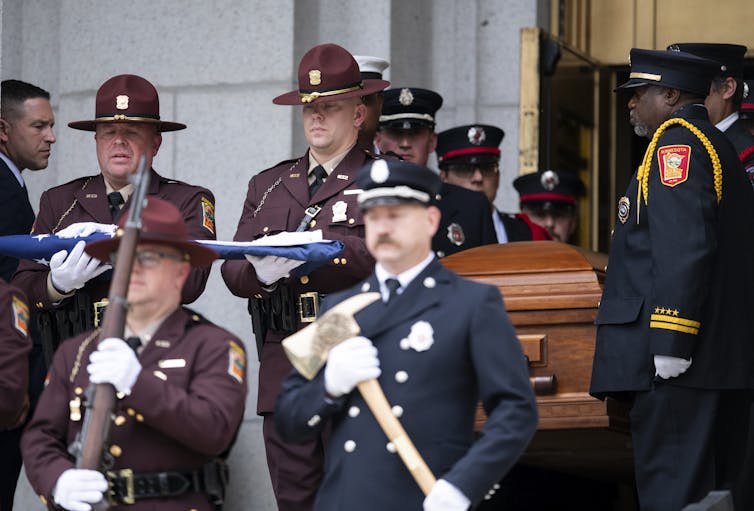
A failure to communicate
Why would multiple surveys get the answers to this important question wrong? I believe the cause is an issue called response error. It means that respondents don’t interpret a question in the way the researcher thinks they will.
As a result, the answers people provide don’t really reflect what the researcher thinks the answers show.
For example, asking whether someone would support the use of force to achieve a political goal raises the question of what the respondent thinks “use of force” means in this context. It could be interpreted as violence, but it could also be interpreted as using legal means to “force” someone to do something.
Such response errors have been a concern for pollsters ever since survey research began. They can affect even seemingly straightforward questions.
What did you mean by that?
To avoid this problem, I used an AI interviewing system developed by CloudResearch, a well-known survey research company, to ask respondents some of the same questions about political violence from previous surveys. Then I used it to ask what they were thinking when they answered those questions. This process is called cognitive interviewing.
I then used AI to go through these interviews and categorize them. Two short reports that summarize this process as applied to both polls are available online. These analyses have not been peer-reviewed, and the results should be considered very preliminary.
Nonetheless, the results clearly demonstrate that respondents interpret these questions in very different ways.
Nuance matters
For example, in my survey, about 33% of Democrats agreed with the statement that “use of force is justified to remove President Trump from office.” However, when asked why they agreed, more than 57% gave responses like this: “I was not thinking physically but more in the sense that he – the president – might need to be ‘fired’ or forced out of office due to rules or laws.” Still others were envisioning future scenarios where a president illegally seizes power in a coup.
Once you account for these different interpretations of the question, the AI only coded about 8% of Democrats as supporting use of force in violent terms under current conditions.
Even here, there was substantial ambiguity – for example, this type of response was not unusual: “The language ‘use of force’ was a bit too broad for me. I could not justify killing Trump, for example, but less extreme uses of force were valid in my eyes.”
Similarly, 29% of Republicans agreed that “use of the military is justified to stop protests against President Trump’s agenda.” However, almost all of the respondents who agreed with this statement envisioned the National Guard interceding nonviolently to stop violent protests and riots. Only about 2.6% of Republicans gave comments supporting use of the military against nonviolent protests.
Almost all those who agreed that use of the military was justified expressed thoughts like this: “I see the military coming and acting as a police force to stop or prevent the demonstrations that become violent. Peaceful protesters must be allowed to exercise their right to free speech.”
When is political violence justified?
Even questions that explicitly ask about political violence are open to wide interpretation. Take, for example, this question: “Do you think it is ever justified for citizens to resort to violence in order to achieve political goals?”
The lack of a specific scenario or location in this question invites respondents to engage in all kinds of philosophical and historical speculation.
In my survey, almost 15% of respondents said violence could sometimes be justified. When asked about the examples they were thinking of, respondents cited the American Revolution, the anti-Nazi French Resistance and many other incidents as a reason for their responses. Only about 3% of respondents said they were thinking about actions in the U.S. at the current time.
Moreover, almost all respondents stated that violence should be a last resort when all other peaceful and legal methods fail.
One respondent illustrated both problems with one sentence: “The (American) colonists tried petitions and negotiations first, but, when those efforts failed, they resorted to armed conflict to gain independence.”
A call for understanding
Even these numbers likely overestimate Americans’ support for political violence. I read the interviews, checking the AI system’s labeling, and concluded that, if anything, it was overestimating support for violence.
Other factors may also be distorting reports of public support for political violence. Many surveys are conducted primarily online. One study estimated that anywhere from 4% to 7% of respondents in online surveys are “bogus respondents” who are selecting arbitrary responses. Another study reported that such respondents dramatically increase positive responses on questions about political violence.
Respondents may also be willing to espouse attitudes anonymously online that they would never say or do in real life. Studies have suggested that “online disinhibition effects” or “survey trolling” can impact survey results.
In sum, my preliminary research suggests that response error is a substantial problem in surveys about political violence.
Americans almost universally condemn the recent political violence they have witnessed. The recent poll results showing otherwise more likely stem from confusion about what the questions are asking than actual support for political violence.
Ryan Kennedy, Timashev Chair of Data Analytics and Professor of Political Science, The Ohio State University
This article is republished from The Conversation under a Creative Commons license. Read the original article.
STM Daily News is a vibrant news blog dedicated to sharing the brighter side of human experiences. Emphasizing positive, uplifting stories, the site focuses on delivering inspiring, informative, and well-researched content. With a commitment to accurate, fair, and responsible journalism, STM Daily News aims to foster a community of readers passionate about positive change and engaged in meaningful conversations. Join the movement and explore stories that celebrate the positive impacts shaping our world.
Author


As the United States moves toward the 250th anniversary of its independence, a new public storytelling project is asking Americans to answer a big question: what does the American Dream mean today?
McCourt Entertainment has launched America-Dreams.com at SXSW as a digital platform designed to collect video submissions from people across the country. The goal is ambitious: gather one million voices reflecting on hope, opportunity, and what Americans want the future of the country to look like.
The initiative is tied to AMERIGO, an upcoming documentary presented by South Florida PBS and distributed by American Public Television. The film, which will be available to PBS stations nationwide beginning in June as part of 2026 programming tied to the nation’s 250th anniversary, explores the past, present, and future of the American Dream through conversations with people across the United States.
According to the project team, selected user-submitted videos may become part of the broader AMERIGOstorytelling effort, turning the campaign into more than a promotional rollout. Instead, it is being framed as a living archive of public voices gathered during a milestone moment in American history.
South Florida PBS President and CEO Dolores Fernandez Alonso said the goal is to make the anniversary feel inclusive and participatory.
“To celebrate the 250th anniversary of America’s independence, we wanted to do something truly remarkable and invite all Americans to share their hope for the American Dream at America-Dreams.com,” Alonso said. “We are extremely proud of the cross-section of voices from across our nation and we want to capture these stories, experiences and perspectives so that people feel included in this historic national conversation.”
Emmy Award-winning producer David McCourt said the project builds on the documentary team’s nationwide reporting.
“As the United States approaches its 250th anniversary, this project asks a simple but powerful question: ‘What is your hope for the American Dream?’” McCourt said. “We want to hear directly from people across the country.”
The campaign arrives at a moment when interactive documentary projects and audience participation are becoming a larger part of public media storytelling. With AMERIGO, the combination of a PBS documentary and a nationwide video submission initiative gives the project a broader cultural footprint than a traditional film release.
Submissions are now open at America-Dreams.com. A trailer for AMERIGO is also available on Vimeo.
For entertainment audiences, the project stands out less as a conventional documentary launch and more as a large-scale invitation to participate in a national media moment ahead of America’s semiquincentennial.
Catch the latest in movies, TV, music, pop culture, and live events in STM Daily News’ Entertainment section.
Related Links
Source Link
Authors


Last Updated on April 4, 2026 by Daily News Staff

Few transportation systems in the world are as instantly recognizable as the cable cars of San Francisco. Climbing steep hills with a steady hum and a nostalgic charm, these moving landmarks are more than just a tourist attraction—they’re a triumph of innovation born out of necessity.
🐎 A Problem on the Hills
In the mid-1800s, San Francisco was growing rapidly, but its geography posed a serious challenge. The city’s steep inclines made travel difficult, especially for horse-drawn streetcars, which were the primary form of public transportation at the time.
Horses often struggled to pull heavy loads uphill, and accidents were common. In some cases, animals collapsed under the strain. This dangerous and inefficient system needed a solution.
💡 The Vision of Andrew Hallidie
That solution came from Andrew Smith Hallidie, an engineer and entrepreneur who envisioned a safer, more reliable way to move people through the city.
Hallidie developed a system in which streetcars would be pulled by a continuously moving cable running beneath the street—eliminating the need for horses altogether.
⚙️ The First Cable Car Line
On August 2, 1873, Hallidie launched the world’s first cable car system: the Clay Street Hill Railroad.
This groundbreaking line proved that cable-powered transit could successfully navigate San Francisco’s steep terrain. Instead of relying on animal power, cars used a mechanical grip to latch onto a moving cable underground, allowing them to glide smoothly up and down hills.
The innovation quickly captured public attention—and demand.
🚀 A City Transformed
Following the success of the Clay Street line, cable car systems spread rapidly across San Francisco.
By the late 19th century:
- Dozens of routes crisscrossed the city
- Cable cars became the backbone of urban transportation
- The system helped shape the city’s growth and accessibility
For a time, San Francisco operated the largest and most advanced cable car network in the world.
⚡ The Rise of Electric Streetcars
Despite their success, cable cars faced competition from emerging electric streetcar systems in the early 20th century. Electric trolleys were cheaper to build and operate, and they didn’t require the complex underground cable infrastructure.
The turning point came after the devastating 1906 San Francisco earthquake, which destroyed much of the city—including large portions of the cable car network.
When rebuilding began, many lines were converted to electric systems instead of restoring the older cable technology.
San Francisco’s cable car system, first launched in 1873, remains the last manually operated system of its kind. According to the San Francisco Municipal Transportation Agency (SFMTA) , the system was designed to safely navigate the city’s steep terrain.
The cable cars are now designated as a National Historic Landmark, recognized for their cultural and engineering significance by the National Park Service .
Visitors can explore the history and mechanics of the system at the San Francisco Cable Car Museum , which preserves original equipment and archives.
🛑 Saving a Symbol
By the 1940s, cable cars were on the brink of extinction.
That’s when Friedel Klussmann stepped in. A passionate preservationist, Klussmann led a public campaign to protect the remaining lines from being dismantled.
Her efforts culminated in a successful 1947 voter referendum that ensured the survival of San Francisco’s cable cars—transforming them from everyday transit into a preserved cultural landmark.
🌉 Cable Cars Today
Today, San Francisco’s cable cars are:
- The last manually operated cable car system in the world
- A National Historic Landmark
- One of the most visited attractions in California
Three lines remain in operation:
- Powell–Hyde Line
- Powell–Mason Line
- California Street Line
While they still function as public transit, they now serve as a moving museum—connecting modern riders with the city’s past.
🎯 Why It Matters
San Francisco’s cable cars represent more than a mode of transportation. They tell a story of innovation, resilience, and community action.
From solving a practical problem to becoming a global icon, the cable car system reflects how cities adapt—and how people fight to preserve what makes them unique.
📌 “Now You Know”
San Francisco’s cable cars weren’t built for tourism—they were invented to solve a life-and-death problem on steep city streets. Today, they remain the last system of their kind anywhere in the world.
🔗 External Sources & Related Links
- SFMTA – Cable Cars Overview
- San Francisco Cable Car Museum
- National Park Service – Historic Landmark Info
- Britannica – Cable Car History
- History.com – Invention of Cable Cars
Explore the latest in innovation, AI, gadgets, startups, and digital trends in STM Daily News’ Techsection.
Last Updated on April 7, 2026 by Daily News Staff
🕒 [UPDATE] Artemis II Reaches the Moon
Orion has reached lunar proximity, giving astronauts a historic view of the Moon as the spacecraft performs its flyby maneuver.

Artemis II Successfully Launches
CAPE CANAVERAL, Fla. — NASA has successfully launched its Artemis II mission, marking the first crewed journey toward the Moon in more than 50 years.
The powerful Space Launch System (SLS) rocket lifted off from Kennedy Space Center on April 1, carrying four astronauts on a 10-day mission around the Moon and back.
On board are Commander Reid Wiseman, Pilot Victor Glover, Mission Specialist Christina Koch, and Canadian astronaut Jeremy Hansen. The mission is already being hailed as a major milestone in NASA’s effort to return humans to deep space.
Shortly after liftoff, the Orion spacecraft successfully reached orbit and deployed its solar arrays, beginning its journey that will eventually send the crew on a translunar trajectory toward the Moon. 
Artemis II is a lunar flyby mission, meaning astronauts will not land but will travel farther from Earth than any human mission in decades while testing critical systems needed for future landings.
The mission also marks several historic firsts, including the first woman and the first person of color—Victor Glover—to travel into lunar space.
NASA says the mission is a key step toward future lunar landings and long-term plans to establish a human presence on the Moon later this decade.
🛰️ Artemis II Mission Timeline
The 10-day Artemis II mission follows a carefully planned trajectory from Earth to the Moon and back:
- Day 1: Launch and Earth orbit
- Day 1–2: Translunar injection burn
- Days 2–4: Deep space travel
- Days 4–5: Lunar flyby
- Days 5–8: Return to Earth
- Days 9–10: Reentry and splashdown
For official updates and in-depth mission details, visit the following trusted sources:
- NASA: Artemis II Mission Overview
- NASA Artemis Program (Return to the Moon)
- Orion Spacecraft – Mission Details
- Space Launch System (SLS) Rocket Overview
- Kennedy Space Center – Launch Operations
- Watch NASA Live Coverage and Replays
🧾 Sources
- NASA official launch coverage and mission updates
- NASA Artemis II press materials and briefings
- NASA Kennedy Space Center launch operations updates
Stay with STM Daily News for live updates on Artemis II.





