Think of the preseason hurricane forecast as the 30,000-foot view: It can’t predict if or when a storm will hit a particular location, but it can offer insight into how many storms are likely to form throughout the entire Atlantic, and how active the season overall might be. These outlooks rely heavily on two large-scale climate factors. The first is the sea surface temperature in areas where tropical cyclones tend to form and grow. Hurricanes draw their energy from warm ocean water. So when the Atlantic is unusually warm, as it has been in recent years, it provides more fuel for storms to form and intensify.Once water temperatures are 79 degrees Fahrenheit (26 degrees Celsius), hurricanes can form. Most of the Gulf was above that by late May 2025.NOAA/NESDIS The second key ingredient that meteorologists have their eye on is the El Niño–Southern Oscillation, which forecasters refer to as ENSO. ENSO is a climate cycle that shifts every few years between three main phases: El Niño, La Niña, and a neutral space that lives somewhere in between. During El Niño, winds over the Atlantic high up in the troposphere – roughly 25,000 to 40,000 feet – strengthen and can disrupt storms and hurricanes. La Niña, on the other hand, tends to reduce these winds, making it easier for storms to form and grow. When you look over the historical hurricane record, La Niña years have tended to be busier than their El Niño counterparts, as we saw from 2020 through 2023. We’re in the neutral phase as the 2025 hurricane season begins, and probably will be for at least a few more months. That means upper-level winds aren’t particularly hostile to hurricanes, but they’re not exactly rolling out the red carpet either. At the same time, sea surface temperatures are running warmer than the 30-year average, but not quite at the record-breaking levels seen in some recent seasons. Taken together, these conditions point to a moderately above-average hurricane season. It’s important to emphasize that these factors merely load the dice, tilting the odds toward more or fewer storms, but not guaranteeing an outcome. A host of other variables influence whether a storm actually forms, how strong it becomes, and whether it ever threatens land.
The smaller influences forecasters can’t see yet
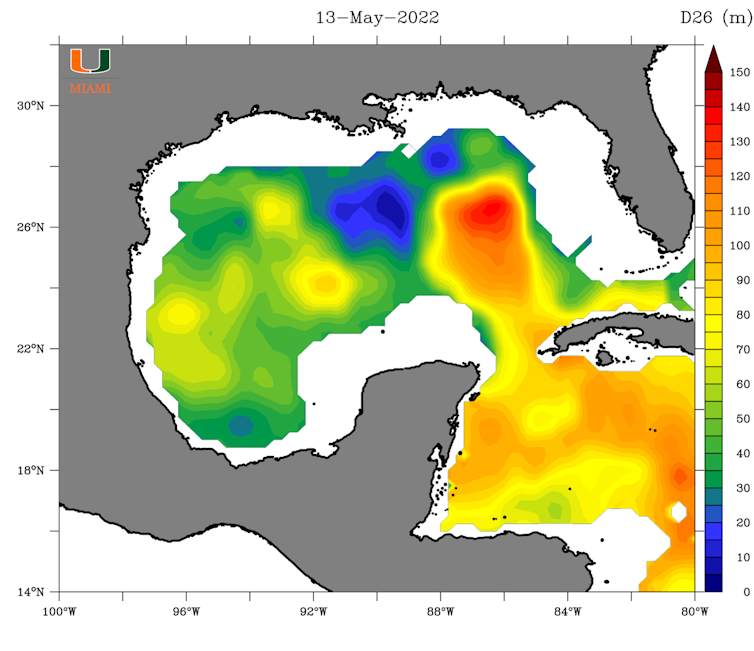
Once hurricane season is underway, forecasters start paying close attention to shorter-term influences. These subseasonal factors evolve quickly enough that they don’t shape the entire season. However, they can noticeably raise or lower the chances for storms developing in the coming two to four weeks. One factor is dust lofted from the Sahara Desert by strong winds and carried from east to west across the Atlantic. These dust plumes tend to suppress hurricanes by drying out the atmosphere and reducing sunlight that reaches the ocean surface. Dust outbreaks are next-to-impossible to predict months in advance, but satellite observations of growing plumes can give forecasters a heads-up a couple weeks before the dust reaches the primary hurricane development region off the coast of Africa.Dust blowing in from the Sahara Desert can tamp down hurricane activities by shading the ocean over the main development region for hurricanes and drying out the atmosphere, just off the African coast. This plume spread over 2,000 miles in June 2020.NASA Another key ingredient that doesn’t go into seasonal forecasts but becomes important during the season are African easterly waves. These “waves” are clusters of thunderstorms that roll off the West African coast, tracking from east to west across the ocean. Most major storms in the Atlantic basin, especially in the peak months of August and September, can trace their origins back to one of these waves. Forecasters monitor strong waves as they begin their westward journey across the Atlantic, knowing they can provide some insight about potential risks to U.S. interests one to two weeks in advance. Also in this subseasonal mix is the Madden–Julian Oscillation. The MJO is a wave-like pulse of atmospheric activity that moves slowly around the tropics every 30 to 60 days. When the MJO is active over the Atlantic, it enhances the formation of thunderstorms associated with hurricanes. In its suppressed phase, storm activity tends to die down. The MJO doesn’t guarantee storms – or a lack of them – but it turns up or down the odds. Its phase and position can be tracked two or three weeks in advance. Lastly, forecasters will talk about the Loop Current, a deep river of warm water that flows from the Caribbean into the Gulf of Mexico. When storms pass over the Loop Current or its warm eddies, they can rapidly intensify because they are drawing energy from not just the warm surface water but from warm water that’s tens of meters deep. The Loop Current has helped power several historic Gulf storms, including Hurricanes Katrina in 2005 and Ida in 2021.The Loop Current stretched well into the Gulf in May 2022. The scale, in meters, shows the maximum depth at which temperatures were 78 F (26 C) or greater.Nick Shay/University of Miami, CC BY-ND But the Loop Current is always shifting. Its strength and location in early summer may look very different by late August or September. Combined, these subseasonal signals help forecasters fine-tune their outlooks as the season unfolds.
Where hurricanes form shifts over the months
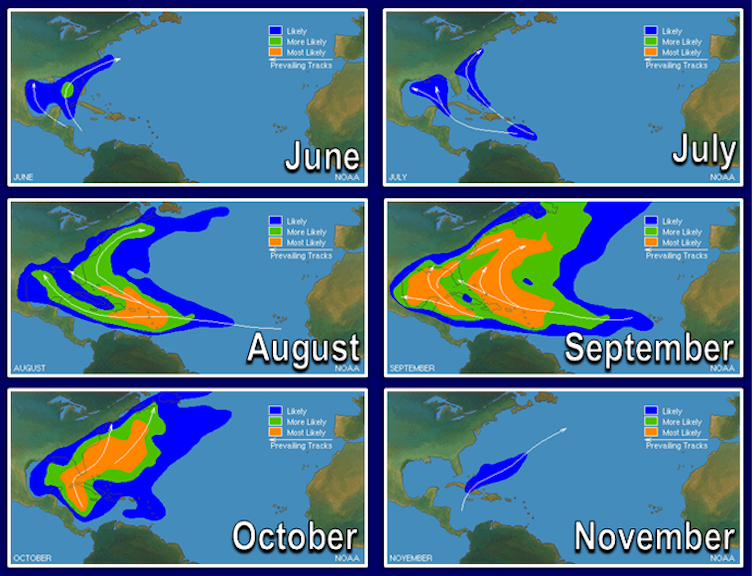
Where storms are most likely to form and make landfall also changes as the pages of the calendar turn. In early summer, the Gulf of Mexico warms up faster than the open Atlantic, making it a notable hotspot for early-season tropical storm development, especially in June and July. The Texas coast, Louisiana, and the Florida Panhandle often face a higher early-season risk than locations along the Eastern seaboard.These are generally the busiest areas during each month of hurricane season, but that doesn’t mean hurricanes won’t make landfall elsewhere.NOAA By August and September, the season reaches its peak. This is when those waves moving off the coast of Africa become a primary source of storm activity. These long-track storms are sometimes called “Cape Verde hurricanes” because they originate near the Cape Verde Islands off the African coast. While many stay over open water, others can gather steam and track toward the Caribbean, Florida or the Carolinas. Later in the hurricane season, storms are more likely to form in the western Atlantic or Caribbean, where waters are still warm and upper-level winds remain favorable. These late-season systems have a higher probability of following atypical paths, as Sandy did in 2012 when it struck the New York City region and Milton did in 2024 before making landfall in Florida. At the end of the day, the safest way to think about hurricane season is this: If you live along the coast, don’t let your guard down. Areas susceptible to hurricanes are never totally immune from hurricanes, and it only takes one to make it a dangerous – and unforgettable – season. Colin Zarzycki, Associate Professor of Meteorology and Climate Dynamics, Penn State This article is republished from The Conversation under a Creative Commons license. Read the original article.
Century City: From Hollywood Backlot to Business Hub
Century City, originally part of 20th Century Fox’s backlot, transformed into a prominent business district in Los Angeles during the 1950s amid the decline of cinema. Developer William Zeckendorf envisioned a mixed-use urban center, leading to iconic skyscrapers and establishing the area as a hub for law, finance, and media, blending Hollywood history with modern business.
Before Century City became one of Los Angeles’ premier business districts, it was part of 20th Century Fox’s sprawling backlot, used for filming movies and housing studio operations. By the 1950s, as television rose and movie attendance declined, 20th Century Fox faced financial challenges and decided to sell a portion of its land.Traffic On 405 Freeway In LA With Century City In The Background
Developer William Zeckendorf envisioned a “city within a city”—a modern, mixed-use urban center with office towers, hotels, and entertainment facilities. Branded Century City, the name paid homage to its studio roots while symbolizing LA’s vision for the future.
The first skyscrapers, including the Gateway West Building, set the tone for the district’s sleek, futuristic skyline. Architects like Welton Becket and Minoru Yamasaki helped shape Century City’s iconic look. Over time, it evolved from Hollywood’s backlot to a corporate and legal hub, attracting law firms, financial institutions, and media companies.
Today, Century City stands as a testament to Los Angeles’ postwar optimism, westward expansion, and multi-centered urban growth—a unique blend of Hollywood history and modern business.
Dive into “The Knowledge,” where curiosity meets clarity. This playlist, in collaboration with STMDailyNews.com, is designed for viewers who value historical accuracy and insightful learning. Our short videos, ranging from 30 seconds to a minute and a half, make complex subjects easy to grasp in no time. Covering everything from historical events to contemporary processes and entertainment, “The Knowledge” bridges the past with the present. In a world where information is abundant yet often misused, our series aims to guide you through the noise, preserving vital knowledge and truths that shape our lives today. Perfect for curious minds eager to discover the ‘why’ and ‘how’ of everything around us. Subscribe and join in as we explore the facts that matter. https://stmdailynews.com/the-knowledge/
Local governments provide proof that polarization is not inevitable
Local politics help mitigate national polarization by focusing on concrete issues like infrastructure and community needs rather than divisive symbolic debates. A survey indicates that local officials experience less partisanship, as interpersonal connections foster recognition of shared interests. This suggests that reducing polarization is possible through collaboration and changes in election laws.
Local officials get to participate in events such as ribbon cuttings, celebrating projects they may have helped make happen. NHLI/Eliot J. Schechter via Getty Images
But things are much less heated at the local level. A survey of more than 1,400 local officials by the Carnegie Corporation and CivicPulse found that local governments are “largely insulated from the harshest effects of polarization.” Communities with fewer than 50,000 residents proved especially resilient to partisan dysfunction.
Why this difference? As a political scientist, I believe that lessons from the local level not only open a window onto how polarization works but also the dynamics and tools that can help reduce it.
Problems are more concrete
Local governments deal with concrete issues – sometimes literally, when it comes to paving roads and fixing potholes. In general, cities and counties handle day-to-day functions, such as garbage pickup, running schools and enforcing zoning rules. Addressing tangible needs keeps local leaders’ attention fixed on specific problems that call out for specific solutions, not lengthy ideological debates.
By contrast, a lot of national political conflict in the U.S. involves symbolic issues, such as debates about identity and values on topics such as race, abortion and transgender rights. These battles are often divisive, even more so than purely ideological disagreements, because they can activate tribal differences and prove more resistant to compromise.When mayors come together, they often find they face common problems in their cities. Gathered here, from left, are Jerry Dyer of Fresno, Calif., John Ewing Jr. of Omaha, Neb., and David Holt of Oklahoma City. AP Photo/Kevin Wolf
Such arguments at the national level, or on social media, can lead to wildly inaccurate stereotypes about people with opposing views. Today’s partisans often perceive their opponents as far more extreme than they actually are, or they may stereotype them – imagining that all Republicans are wealthy, evangelical culture warriors, for instance, or conversely being convinced that all Democrats are radical urban activists. In terms of ideology, the median members of both parties, in fact, look similar.
These kinds of misperceptions can fuel hostility.
Local officials, however, live among the human beings they represent, whose complexity defies caricature. Living and interacting in the same communities leads to greater recognition of shared interests and values, according to the Carnegie/CivicPulse survey.
Meaningful interaction with others, including partisans of the opposing party, reduces prejudice about them. Local government provides a natural space where identities overlap.
People are complicated
In national U.S. politics today, large groups of individuals are divided not only by party but a variety of other factors, including race, religion, geography and social networks. When these differences align with ideology, political disagreement can feel like an existential threat.
Such differences are not always as pronounced at the local level. A neighbor who disagrees about property taxes could be the coach of your child’s soccer team. Your fellow school board member might share your concerns about curriculum but vote differently in presidential elections.
Advertisement
Mayors can find themselves caught up in national debates, as did Minneapolis Mayor Jacob Frey over the Trump administration’s immigration enforcement policies in his city. AP Photo/Kevin Wolf
These cross-cutting connections remind us that political opponents are not a monolithic enemy but complex individuals. When people discover they have commonalities outside of politics with others holding opposing views, polarization can decrease significantly.
Finally, most local elections are technically nonpartisan. Keeping party labels off ballots allows voters to judge candidates as individuals and not merely as Republicans or Democrats.
Nevertheless, the relative partisan calm of local governance suggests that polarization is not inevitable. It emerges from specific conditions that can be altered.
Polarization might be reduced by creating more opportunities for cross-partisan collaboration around concrete problems. Philanthropists and even states might invest in local journalism that covers pragmatic governance rather than partisan conflict. More cities and counties could adopt changes in election law that would de-emphasize party labels where they add little information for voters.
Aside from structural changes, individual Americans can strive to recognize that their neighbors are not the cardboard cutouts they might imagine when thinking about “the other side.” Instead, Americans can recognize that even political opponents are navigating similar landscapes of community, personal challenges and time constraints, with often similar desires to see their roads paved and their children well educated.
The conditions shaping our interactions matter enormously. If conditions change, perhaps less partisan rancor will be the result.
The Bridge is a section of the STM Daily News Blog meant for diversity, offering real news stories about bona fide community efforts to perpetuate a greater good. The purpose of The Bridge is to connect the divides that separate us, fostering understanding and empathy among different groups. By highlighting positive initiatives and inspirational actions, The Bridge aims to create a sense of unity and shared purpose. This section brings to light stories of individuals and organizations working tirelessly to promote inclusivity, equality, and mutual respect. Through these narratives, readers are encouraged to appreciate the richness of diverse perspectives and to participate actively in building stronger, more cohesive communities.
Why Christian clergy see risk as part of their moral calling
As clergy join protests against harsh immigration enforcement, a religious ethics scholar explains why many Christian Clergy view personal risk—arrest, backlash, even violence—as part of their vocation to protect vulnerable neighbors.
A large group of protesters, including clergy, gathered outside St. Paul International Airport in St. Paul, Minn., on Jan. 23, 2026, to demonstrate against the immigration crackdown. Elizabeth Flores/The Minnesota Star Tribune via Getty Image
As Christian clergy across the United States participate in ongoing protests against harsh immigration enforcement actions and further funding for U.S. Immigration and Customs Enforcement, many are still pondering the words of Rob Hirschfeld. On Jan. 18, 2026, Hirschfeld, Bishop of the Episcopal Diocese of New Hampshire, encouraged clergy in his diocese to “prepare for a new era of martyrdom” and put their wills and affairs in order.
He asserted that “it may be that now is no longer the time for statements, but for us with our bodies to stand between the powers of this world and the most vulnerable.”
Hirschfeld’s words attracted a lot of attention, with clergy generally responding positively, though at least one priest argued that he “did not sign up to be a martyr” and had a family and church relying on him.
Other clergy have willingly facedarrest for their advocacy on behalf of immigrants, seeing it as a moral calling. Rev. Karen Larson was arrested while protesting at the Minneapolis airport. She stated that when people are being separated from their families and taken to unknown detention centers, “this is our call” to protest on their behalf.
As a scholar of religious ethics, I am interested in how Christian clergy and thinkers consider personal risk when they feel called to engage in social action.
Most data on the risks that clergy face in their roles as religious leaders comes from studies of religious leaders in institutional settings, such as hospitals or prisons.
Questions about professional risks became particularly acute during the early years of the HIV/AIDS crisis, when researchers were uncertain exactly how the disease was spread and caregivers feared they might acquire HIV through their bedside work.
In her memoir about chaplaincy with HIV patients, Audrey Elisa Kerr notes that Riverside Church in New York continued to organize funerals, ministries and support groups for HIV/AIDS patients despite “terror” in the wider community about contagion.
As a chaplain herself, Kerr says this story of “radical hospitality” inspired her to set aside her own fears and embrace her professional role caring for people who were ill and dying.
Advertisement
Priests and nuns of the Catholic Church who cared for HIV/AIDS patients in the 1980s risked both the fear of contagion and the disapproval of their bishops and communities, since many of the people they cared for were men who had sex with men.
Some felt, however, that they must care for those at the margins as part of their role in the church or their monastic order. Sister Carol of the Hospital Sisters of Saint Francis felt that it was simply her moral duty as a sister to “go where she was needed,” despite potential risk.
Examination of the ethical obligations of chaplains and clergy ramped up during the COVID-19 pandemic when at least some priest, pastors and hospital chaplains felt an obligation to continue visiting patients for spiritual care.
Risks in other institutional settings are not such a matter of life and death. Because of their professional preaching function, however, clergy in church settings do accept the risk of alienating church members when they feel religiously called to speak about social issues. Rev. Teri McDowell Ott has written about taking risks when discussing LGBTQ+ inclusion and starting a prison ministry.
Risk-taking during social protest
For many clergy, religious and ethical obligations extend beyond their work in institutions like churches and hospitals and include their witness in public life.
Many feel an obligation to preach on issues of moral importance, even topics that are considered controversial and might elicit strong disagreement. It is common for priests and pastors in conservative churches to include messages against legalized abortion in their sermons.
Tom Ascol of the Center for Baptist Leadership urged Baptist pastors to preach about abortion in the lead-up to the 2024 presidential election.
Rev. Leah Schade, a Lutheran minister and scholar, has argued that since 2017, mainline pastors have preached more often on issues like racism, environmental justice or gun violence. Schade says pastors are inspired to speak more bluntly about social issues because of their religious concern for people who are at risk of harm from injustice or government policies.
Some clergy view their moral obligations as going beyond preaching and leading them to on-the-ground advocacy and protest. Rev. Brandy Daniels of the Disciples of Christ denomination examines these obligations in an article on her participation in a group of interfaith clergy in Portland, Oregon. The group was convened by a local rabbi and supported protesters for racial justice in Portland in 2017. In Daniels’ analysis, clergy took on the risk of staying in the middle of protests and facing a violent police response in order to “bear moral witness,” something they were both empowered and obligated to do as religious leaders.
Advertisement
Risking their lives
There are more extreme cases in which clergy who challenged government leaders or policies were killed for their words and actions of protest.The official portrait of Archbishop Oscar Romero, displayed in the Metropolitan Cathedral for a memorial service in San Salvador, El Salvador, on March 24, 2018. AP Photo/Salvador Melendez
In a well-known historical example, Bishop Oscar Romero, canonized as a martyred saint by the Roman Catholic Church in 2018, was assassinated in 1980 after speaking out against human rights violations against poor and Indigenous communities committed by the government of El Salvador. Romero viewed himself, in his priestly role, as a representative of God who was obliged to “give voice to the voiceless.”
During recent protests against ICE in Minneapolis and elsewhere, many clergy risked arrest and bodily harm. Rev. Kenny Callaghan, a Metropolitan Community Church pastor, who says that ICE agents in Minneapolis pointed a gun in his face and handcuffed him as he tried to help a woman they were questioning, said, “It’s in my DNA; I have to speak up for marginalized people.”
On Jan. 23, 2026, over 100 clergy were arrested at the Minneapolis-St. Paul airport as they protested and prayed against ICE actions. Rev. Mariah Furness Tollgaard said that she and others accepted being arrested as a way of demonstrating public support for migrants who are afraid to leave their homes.
In Chicago, ministers have been hit with projectiles and violently arrested. Presbyterian pastor David Black was shot in the head with a pepper spray projectile while protesting outside an immigration detention center in October 2025.
As I see it, for these and many Christian clergy and ethicists, the call to ministry includes an obligation to express their values of care for vulnerable neighbors precisely through a public willingness to accept personal risk.
STM Daily News is a vibrant news blog dedicated to sharing the brighter side of human experiences. Emphasizing positive, uplifting stories, the site focuses on delivering inspiring, informative, and well-researched content. With a commitment to accurate, fair, and responsible journalism, STM Daily News aims to foster a community of readers passionate about positive change and engaged in meaningful conversations. Join the movement and explore stories that celebrate the positive impacts shaping our world.