

Project Green
From Shirts to Insulators: Recycled Honda Uniforms Find New Utility in Vehicles

Last Updated on September 6, 2025 by Daily News Staff

From Shirts to Insulators: Recycled Honda Uniforms Find New Utility in Vehicles
August 10, 2023
— MARYSVILLE, Ohio
- Recycled Honda uniforms are shredded into fibers and repurposed for insulation in new Honda and Acura automobiles
- Uniform recycling program reduces waste to landfill from Honda manufacturing and R&D facilities in Alabama, Indiana, North Carolina and Ohio
- Honda’s “Triple Action to Zero” approach focuses on “resource circulation” to make new products from 100% sustainable materials by 2050
Honda associates put a lot into the products they make, now including the shirts right off their backs. Honda is advancing a recycling initiative that takes uniforms worn by associates at its U.S. manufacturing and R&D facilities and transforms them into sound-absorbing insulation for use in Honda and Acura automobiles. This program diverts approximately 45,000 pounds of uniforms from reaching landfills each month as Honda works toward its commitment to use 100% sustainable materials in its products in the future. Watch a video of the uniform recycling process at https://honda.us/UniformRecycling.
Honda has established a global “Triple Action to Zero” approach, with the goal of achieving carbon neutrality for all products and corporate activities, use of 100% clean energy and resource circulation (100% sustainable materials), by 2050. Achieving that goal – which targets zero environmental impact – will require innovative solutions, including how Honda sources materials for new products by recycling and reusing material from end-of-life vehicles and Honda operations.
“To achieve our Triple Zero goal of 100% sustainable material use, we need to take every possible opportunity to recycle materials at end of life for reuse in our products, thereby minimizing our utilization of virgin materials,” said Negar Gilsinger, manager of Resource Circulation for American Honda Motor Co., Inc. “By maximizing end-of-life material recycling, we are giving our uniforms a second life in Honda and Acura vehicles.”
The Honda uniform recycling program leverages cross-industry collaboration between Honda and its uniform suppliers Aramark and Cintas Corporation, as well as insulation supplier UGN Automotive and textile recycler Leigh Fibers. Uniforms from Honda production and R&D facilities in Alabama, Indiana, North Carolina and Ohio are recycled and reused in five different insulator parts on all nine Honda and four Acura models made in North America. In the future, Honda plans to expand the uniform recycling program to other facilities in North America.
“Collaborating with Honda suppliers in the uniform recycling program has brought great value to our supply chain sustainability efforts,” said Rob Long, senior procurement specialist with Honda North American Indirect Procurement. “As Honda works to advance sustainability, we appreciate our suppliers’ efforts to innovate their business operations to reduce waste and give new life to our Honda uniforms.”
More than 380,000 pounds of uniforms have been recycled since the program launched at the end of 2021. The uniforms Honda associates wear have always been an important part of the company’s culture and success, symbolizing Honda’s “One Team” approach, which promotes collaboration and the understanding that the ideas of all associates are valued.
Transforming Uniforms into Insulation
Honda associate uniforms that are cleaned by uniform suppliers – Aramark, at Honda Indiana and Ohio facilities, and Cintas Corporation, at Alabama and North Carolina facilities – are evaluated after washing. If the uniforms are undamaged, they are sent back to associates to wear. When uniforms are designated for reuse in Honda and Acura vehicles, they are baled and sent to Leigh Fibers, which specializes in reprocessing and custom-blending fiber-based materials.
At Leigh Fibers’ facility, the uniforms are shredded into material that meets the required fiber grade for use as vehicle insulators. Zippers and buttons from the uniforms are first extracted and collected so that no metal or plastic goes through the shredding process. Then the material gets blended into mixed fibers and tested to ensure the fiber material meets the fiber length requirements. The newly reprocessed fibers are then packaged and delivered to insulation supplier UGN.
UGN blends, consolidates and trims the fibers into material that is molded into insulation and returned to Honda auto manufacturing plants for new vehicle production. Typically, UGN creates insulation from post-industrial fibers, which are sourced from textile companies, and polyester sourced from recycled water bottles. The uniform recycling program marks the first time Honda and UGN are using post-consumer textile waste for sustainable insulation material.
“It is part of UGN’s history and culture to maximize recycled content in our parts, reduce landfill by recycling our own by-products, and promote circular, mono-material technologies that enable end-of-life vehicle recycling,” said Pranav Singh, director of Purchasing & Packaging for UGN Automotive. “Reusing Honda uniforms contributes to these efforts by increasing the amount of recycled materials available for insulators and opens the door to other post-consumer textile waste projects.”
Expanding Recycled Materials in Vehicles
The uniform recycling program builds on Honda’s longstanding commitment to reduce waste and incorporate higher recycled content in Honda and Acura vehicles. This includes working with suppliers to transform post-industrial textile scrap, such as fibers from denim, into vehicle insulation/absorption material. In collaboration with UGN, Honda annually reuses approximately 2,800 tons of recycled post-industrial textile waste – equivalent to 5.6 million pairs of jeans – and 3,000 tons of post-consumer PET (polyethylene terephthalate) bottles – equivalent to 6 million water bottles – for vehicle sound-absorbing insulation.
Other approaches to using sustainable materials in Honda and Acura vehicles have included soybean-based foam for vehicle headrests, recycled plastic water bottles and recycled Honda car bumpers for wheel liners, plant-based material for the seat fabric in the 2019 Acura RDX and Honda Clarity Plug-in Hybrid vehicle, and processed volcanic rocks for the roof liner in the 2003 Honda Element.
To learn more about Honda’s Triple Action to Zero approach and the concept of resource circulation, read Our Perspective, “We Have Set a Great Big Goal: Nothing.”
About Honda’s Commitment to the Environment
Honda is working toward its global goal of zero environmental impact by 2050 through its “Triple Action to Zero” approach, including achieving carbon neutrality for all products and corporate activities, 100% utilization of renewable energy, and resource circulation, utilizing 100% sustainable materials by reprocessing products back to raw materials and reusing those materials in the creation of new products. Toward this goal, Honda will strive to make battery-electric and fuel cell electric vehicles represent 100% of auto sales in the U.S. and globally by 2040.
About Honda’s Commitment to the Environment
Honda is working toward its global goal of zero environmental impact by 2050 through its “Triple Action to Zero” approach, including achieving carbon neutrality for all products and corporate activities, 100% utilization of renewable energy, and resource circulation, utilizing 100% sustainable materials by reprocessing products back to raw materials and reusing those materials in the creation of new products. Toward this goal, Honda will strive to make battery-electric and fuel cell electric vehicles represent 100% of auto sales in the U.S. and globally by 2040.
To reduce the environmental impact of its business operations, Honda also is offsetting CO2 emissions from its North American manufacturing operations through long-term virtual power purchase agreements (VPPAs) for renewable wind and solar power that seek to cover more than 60% of the electricity Honda uses in North America. Honda also promotes environmentally responsible business practices with its suppliers and retail dealer partners across North America.
Source: Honda


The Earth
Cement has a climate problem — here’s how geopolymers with add‑ins like cork could help fix it
Portland cement drives ~8% of global emissions. Learn how low-carbon geopolymers—enhanced with add-ins like cork—could cut concrete’s footprint.
Alcina Johnson Sudagar, Washington University in St. Louis
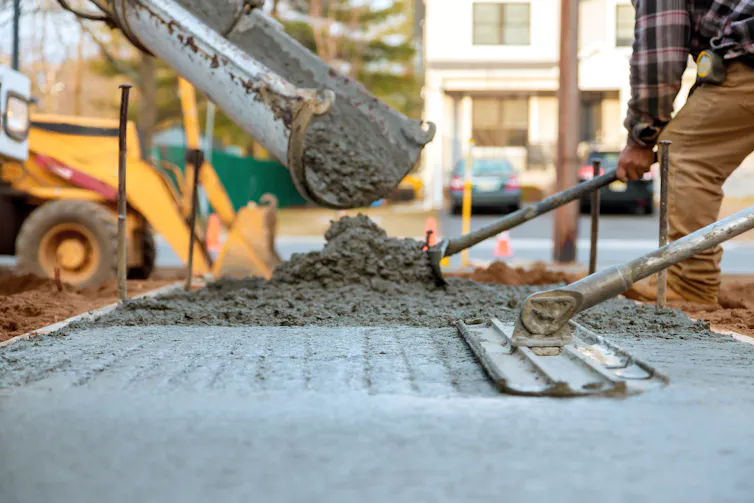
Concrete is all around you – in the foundation of your home, the bridges you drive over, the sidewalks and buildings of cities. It is often described as the second-most used material by volume on Earth after water.
But the way concrete is made today also makes it a major contributor to climate change.
Portland cement, the key component of concrete, is responsible for about 8% of global greenhouse gas emissions. That’s because it’s made by heating limestone to high temperatures, a process that burns a large amount of fossil fuels for energy and releases carbon dioxide from the limestone in the process.
The good news is that there are alternatives, and they are gaining attention.
Portland cement: A greenhouse gas problem
Cementlike substances have been used in construction for thousands of years. Architects have found evidence of their use in the pyramids of Egypt and the buildings and aqueducts of the Roman Empire.
The Portland cement commonly used in construction today was patented in 1824 by Joseph Aspdin, a British bricklayer.
Modern cement preparation starts with crushing the excavated raw materials limestone and clay and then heating them in a kiln at around 2,650 degrees Fahrenheit (about 1,450 degrees Celsius) to form clinker, a hard, rocklike residue. The clinker is then cooled and ground with gypsum into a fine powder, which is called cement.
About 40% of the carbon dioxide emissions from cement production come from burning fossil fuels to generate the high heat needed to run the kiln. The rest come as the heat converts limestone (calcium carbonate) to lime (calcium oxide), releasing carbon dioxide.
In all, between half a ton and 1 ton of greenhouse gas is released per ton of Portland cement. Cement is a binding agent that, mixed with water, holds aggregate together to create concrete. It makes up about 10% to 15% of the concrete mix by weight.
Alternative technologies can lower emissions
As populations, cities and the need for new infrastructure expand, the use of cement is growing, making it important to find alternatives with lower environmental costs.

Some techniques for reducing carbon dioxide emissions include substituting some of the clinker – the hard residue typically made from limestone – with supplementary materials such as clay, or fly ash and slag from industries. Other methods reduce the amount of cement by mixing in waste sawdust or recycled materials like plastics.
The long-term solution for reducing cement’s emissions, however, is to replace traditional cement completely with alternatives. One option is geopolymers made from earthen clay and industrial wastes.
Geopolymers: A more climate-friendly solution
Geopolymers can be made by mixing claylike materials that are rich in aluminum and silicon minerals with a chemical activator through a process called geopolymerization. The activator transforms the silicon and aluminum into a structure that will look like cement. All of this can happen at room temperature.
The major difference between cement and geopolymer is that cement is mainly made of calcium, whereas geopolymers are made of silicon and aluminum with some possible calcium in their structure.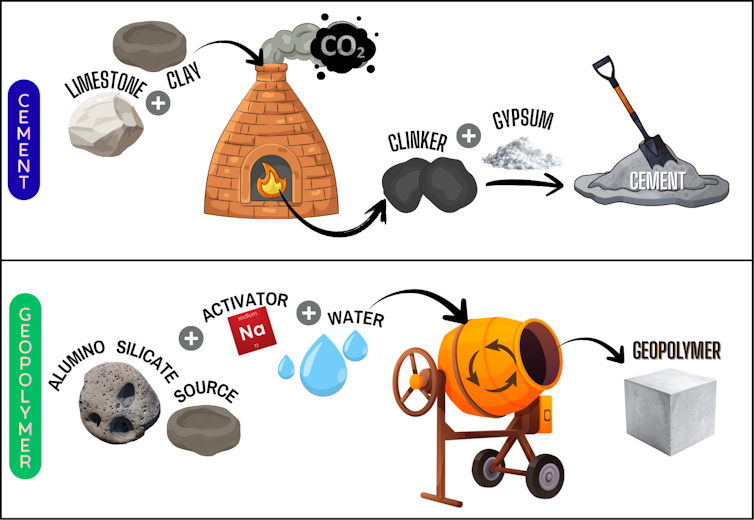
These geopolymers have been found to possess high strength and durability, including resilience in freeze-thaw cycles and resistance to heat and fire, which are important requirements in construction. Studies have found that some geopolymers can provide comparable if not better strength than traditional cement and, because they don’t require heat the way clinker does, they can be produced with significantly lower greenhouse gas emissions.
Geopolymers can also be produced from a variety of raw materials rich in aluminum and silicon, including earthen clays, fly ash, blast furnace slag, rice husk ash, iron ore wastes and recycled construction brick waste. Geopolymer technology can be adapted depending on the clay or industrial waste locally available in a region. https://www.youtube.com/embed/NOj3p6m9M7Q?wmode=transparent&start=0 A brief history of cement and geopolymers. Geopolymer International.
An added advantage of geopolymers is that changes to the mixture can produce a range of features.
For example, I and my co-researchers at the University of Aveiro in Portugal added a small amount of cork industry waste – the leftovers from creating bottle corks – to clay-based geopolymer and found it could improve the strength of the material by up to twofold. The cork particles filled the spaces in the geopolymer structure, making it denser, which increased the strength.
Similarly, additives such as sisal fibers from the agave plant, recycled plastic and steel fibers can change geopolymer properties. The additives do not participate in the geopolymerization process but act as fillers in the structure.
The structure of geopolymers can also be designed to act as adsorbents, attracting toxic metals in wastewater and capturing and storing radioactive wastes. Specifically, incorporating materials like zeolite that are natural adsorbents in the geopolymer structure can make them useful for such applications as well.
Where geopolymers are used now
Geopolymers have been used in many types of construction, including roads, coatings, 3D printing, coastal environmental protection, the steel and chemical industries, sewer rehabilitation and building radiation shielding and rocket launchpad and bunker infrastructure.
One of the earliest examples of a modern geopolymer concrete project was the Brisbane West Wellcamp airport in Australia.
It was built in 2014 with 70,000 metric tons of geopolymer concrete, which was estimated to have reduced the project’s carbon dioxide emissions by as much as 80%.
The geopolymer market is currently estimated to be between US$7 billion and $10 billion, with the largest growth in the Asia-Pacific region.
Analysts have estimated that the market could grow at a rate of 10% to 20% per year and reach about $62 billion by 2033.
In several countries, greenhouse gas regulations and green-building certifications are expected to support the continued growth of geopolymers in the construction industry.
Expanding the use of cement alternatives
The advantage of using industrial wastes in geopolymers is a double-edged sword, however. The composition of industrial wastes varies, so it can be difficult to standardize the processing methods. The geopolymer components need to be mixed in particular ratios to achieve desired properties.
Producing the activator for the geopolymer, typically done in chemical facilities, can raise the cost and contribute to the carbon footprint. And the long-term data about these materials’ stability is only now being developed given their newness. Also, these geopolymers can take longer to set than cement, though the setting time can be sped up by using raw materials that react quickly.
Developing cheaper, naturally available activators like agricultural waste rice husk with sustainable supply chains could help lower the costs and environmental impact. Also, printing the recipe on the raw material packaging could help simplify the job of determining the mixing ratio so geopolymers can be more widely used with confidence.
Even though geopolymer technology has some drawbacks, these low-carbon alternatives have great potential for reducing emissions from the construction sector.
Alcina Johnson Sudagar, Research Scientist in Chemistry, Washington University in St. Louis
This article is republished from The Conversation under a Creative Commons license. Read the original article.
📰 Enjoying STM Daily News? Join the conversation!
💬 Leave a comment, share your thoughts, and subscribe to our newsletter for the latest stories, updates, and “News You Can Use This Moment!” delivered to your inbox.
Stay connected with STM Daily News!
Automotive
The Road to Cleaner Water: How to Prevent Roads from Polluting Waterways
Everyone loves driving on clean highways and spotless local roads. Few people, however, realize the benefits of clean roads go well beyond mere aesthetics. Cleaner roads also mean cleaner and healthier local rivers, lakes and beaches. Follow these simple year-round tips to help make the waters as fun and healthy as possible this summer.

(Feature Impact) Everyone loves driving on clean highways and spotless local roads. Few people, however, realize the benefits of clean roads go well beyond mere aesthetics. Cleaner roads also mean cleaner and healthier local rivers, lakes and beaches.
That’s because harmful pollutants in local waters often run off untreated from highways and roads during strong storms. Those rains sweep trash, dripped oil, harmful chemicals and even dangerous bacteria from pet waste into local waters via stormways and sewers. This untreated runoff can affect people’s health, make water unsafe for swimming and harm aquatic life. Every year, such man-made “stormwater pollution” even closes portions of recreational rivers and beaches.
It’s up to everyone to help prevent human-caused stormwater pollution. Don’t wait for rain in the forecast to get started. Instead, follow these simple year-round tips from the experts at the California Department of Transportation to help make the cooling waters in California and beyond as fun and healthy as possible this summer.
Trash-Free Trips and Responsible Car Care
Summer can mean more road time traveling to your next adventure. Loose items in truck beds and on roof carriers or trash tossed from car windows can quickly become the next wave of stormwater pollution flowing into local waters. To reduce:
- Secure Your Load: Always securely tarp and tie down anything in a truck bed or on a roof rack. Items falling off vehicles are both a safety hazard and can become roadside debris.
- Keep a Car Trash Catcher: Designate a bag or container in your car for food wrappers, coffee cups and other small trash until you can dispose of it properly.
- Wash Smart: Commercial car washes that recycle water are superior for preventing road dirt and chemicals accumulated on your car from entering storm drains compared to washing in a driveway. If washing at home, do it on your lawn or a permeable surface where the water naturally filters into the ground and not street gutters.

Outdoor Adventures That Leave Only Footprints
Whether you’re hiking a mountain trail, picnicking at the park or relaxing on the beach, remember the outdoor golden rule: pack out everything you pack in. Food wrappers, plastic bottles and even seemingly small items like bottle caps and cigarette butts are some of the most common litter found in parks, waterways and along coastlines. When left behind, they’re not just eyesores; they’re prime candidates for being washed into waterways.
- Pro Tip: Choose reusable water bottles that clip onto bags to reduce pollution from discarded plastic bottles.
At Home and In Your Neighborhood
Even close to home, your actions can make a difference.
- Garden Care: When tidying up your garden or front lawn, sweep leaves and grass clippings into your green bin instead of hosing them down the driveway. Hosing yard waste into road gutters can clog storm drains and cause flooding.
- Pesticide Prevention: To protect waterways from harmful chemical runoff, opt for organic or eco-friendly alternatives for pest and weed control whenever possible.
- Scoop the Poop: Pet waste contains harmful bacteria that can contaminate waterways. In fact, the EPA estimates that just two days’ worth of waste from 100 dogs can produce enough bacteria to close a beach. Always pick up after your pets, especially when walking in your neighborhood or parks, and dispose of it in a trash bin.
Pollution in waterways doesn’t just look bad; it creates real problems, from harming wildlife and ecosystems to causing potential health issues for humans and pets who encounter contaminated water. The cleaner roads and surrounding areas are, the healthier rivers, lakes and beaches become. For more tips and resources, visit CleanWaterCA.com to ensure a clean, healthy summer for everyone.
Photos courtesy of Shutterstock

SOURCE:
California Department of Transportation
STM Daily News is a vibrant news blog dedicated to sharing the brighter side of human experiences. Emphasizing positive, uplifting stories, the site focuses on delivering inspiring, informative, and well-researched content. With a commitment to accurate, fair, and responsible journalism, STM Daily News aims to foster a community of readers passionate about positive change and engaged in meaningful conversations. Join the movement and explore stories that celebrate the positive impacts shaping our world.
home improvement
Simple Ways to Make At-Home Recycling More Effective
To create a more eco-friendly household, consider these practical tips to help you reduce waste, stay organized and make at-home recycling part of your everyday routine.
Last Updated on May 12, 2026 by Daily News Staff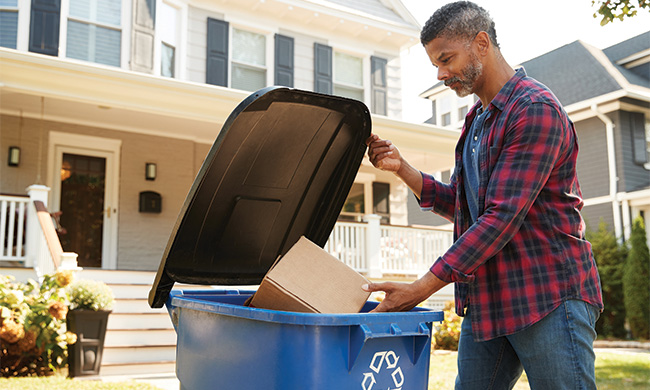
Simple Ways to Make At-Home Recycling More Effective
(Feature Impact) Recycling is a simple way households can reduce waste and help protect natural resources. While many communities offer curbside recycling programs, some people still wonder if they’re doing it correctly or if they’re missing opportunities to recycle more.
To create a more eco-friendly household, consider these practical tips to help you reduce waste, stay organized and make recycling part of your everyday routine.
Know What Your Local Program Accepts
Recycling rules vary depending on your city or waste management provider. Most curbside programs include items like cardboard, paper, aluminum cans and plastics, but others – such as glass – may require drop-off recycling. Review your community guidelines so recyclables don’t accidentally end up in the regular trash.
Create a Simple Sorting System
Set up clearly labeled bins – separated for paper, plastics and metals – in a high-traffic area like the kitchen, garage or laundry room.
Rinse Before You Recycle
Food residue can contaminate other recyclables and may cause entire batches of materials to be rejected during the recycling process. Quickly rinsing yogurt cups, jars or soup cans of leftover residue helps keep recycling streams clean and more likely to be processed properly.
Break Down Boxes
Cardboard boxes are among the most commonly recycled household materials. Flattening boxes before placing them in the recycling bin saves space and allows collection trucks to hold more.
Compost Food Scraps
Not everything belongs in the recycling bin, particularly food waste. Composting fruit peels, vegetable scraps, coffee grounds and eggshells is an easy way to reduce the amount of trash your household produces. Finished compost can be used in gardens, flower beds or houseplants, turning kitchen waste into a valuable resource.
Find more ideas for making recycling a natural part of your household routine at eLivingtoday.com.
Photo courtesy of Shutterstock


SOURCE:
Welcome to the Consumer Corner section of STM Daily News, your ultimate destination for savvy shopping and informed decision-making! Dive into a treasure trove of insights and reviews covering everything from the hottest toys that spark joy in your little ones to the latest electronic gadgets that simplify your life. Explore our comprehensive guides on stylish home furnishings, discover smart tips for buying a home or enhancing your living space with creative improvement ideas, and get the lowdown on the best cars through our detailed auto reviews. Whether you’re making a major purchase or simply seeking inspiration, the Consumer Corner is here to empower you every step of the way—unlock the keys to becoming a smarter consumer today!




