Connect with us

STM Blog

How Americans came to embrace meditation, and with it, Hinduism

Published

on

Last Updated on September 16, 2025 by Rod Washington

Hinduism
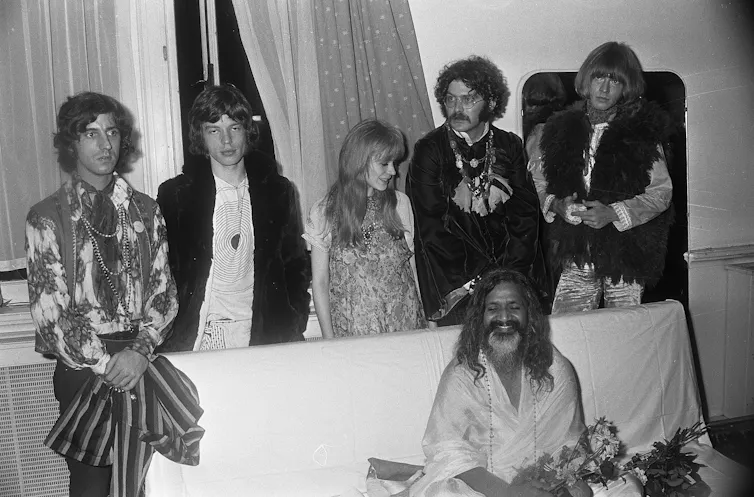
Mahesh Yogi (seated in front) who gained a following in the United States with musicians and artists. Ben Merk/ANEFO, Nationaal Archief, NL, CC BY-SA
Vasudha Narayanan, University of Florida This week marks the death anniversary of Mahesh Yogi, the Indian guru who brought transcendental meditation to the West in the sixties and became a spiritual teacher to The Beatles, comedian Jerry Seinfeld and countless other celebrities. Today, the legacy of the Maharashi, as he was popularly known, is evident in the widespread appreciation of meditation: Over 6 million people worldwide practice the technique the Maharishi introduced – transcendental meditation. An even larger number practice other forms. Health professionals and practitioners extol its many benefits, which range from anger management, lowered blood pressure and cardiovascular disease, reduced post-traumatic stress and simply a healthier lifestyle. In the 1960s many Americans may have only known Hinduism through meditation, but the story of this country’s relationship with Hinduism is much longer and more complex.

Early embrace of Hinduism

The first time the American public formally learned about Hinduism was through the World’s Parliament of Religions, a gathering of practitioners of different faith traditions, which took place in Chicago in 1893. It was at that time when the American public first saw and heard people from “Eastern” religions, including Hindus and Buddhists, on their own soil. At the time European and American scholars were becoming more accepting of other major religions in the world. Not considered as good as Christianity, they were nonetheless being included in the roster of an emerging group of “world religions.” Unfortunately, no representative of any Native American traditions or indigenous religions was invited.
file 20180202 19952 1vxrwxr.jpg?ixlib=rb 4.1
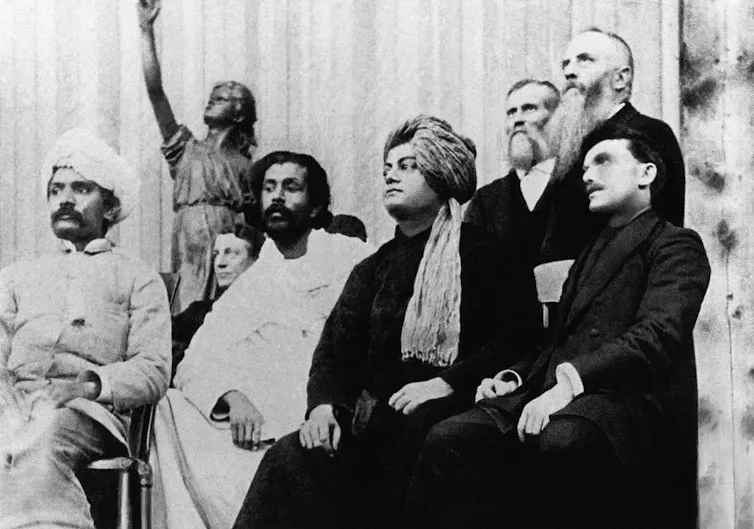
Swami Vivekananda at Parliament of Religions. Parliament of Religion, 1893
Vivekananda, a young monk representing Hinduism famously began his speech hailing his hosts as “brothers and sisters of America.” It was most unusual for an Indian monk to embrace the audience as a single family, at a time when societies were segregated and racial superiority was an accepted part of life. Vivekananda received a standing ovation. The appreciation continued as he journeyed through America after the talk. One journalist wrote:
Vivekananda’s address before the parliament was broad as the heavens above us, embracing the best in all religions, as the ultimate universal religion—charity to all mankind, good works for the love of God.”
Vivekananda spoke extensively about the spiritual benefits of yoga and meditation, explaining how they were common resources for all human beings, and not just for Hindus.
“Think of a space in your heart and in the midst of that space think that a flame is burning. Think of that flame as your own soul and inside the flame is another effulgent light, and that is the Soul of your soul, God. Meditate upon that in the heart.”
In fact, long before the World’s Parliament of Religions, American transcendentalists, Ralph Waldo Emerson and Henry Thoreau, showcased their fascination with Hindu texts in their poems and essays. Emerson copied long passages from Hindu texts in his journals and called the Bhagavad Gita, a Hindu text composed approximately 2,000 years ago, a “trans-national book.” Emerson’s poems, “Brahma” and “Hamatreya,” modeled on passages from Hindu texts speak about the impermanence of life and the immortality of the human soul. Indeed, their adulation has assured the presence of the Bhagavad Gita in most large libraries in the United States.

Hinduism in popular culture

Since the 1960s, two kinds of Hinduism have made their home in the U.S. One is a continuation of the popularization of meditation started by Vivekananda and Mahesh Yogi. Many other gurus came from India during the sixties and taught self-transformation through yoga and meditation. This acquired such popularity that Life magazine called 1968 the “year of the guru.” In more recent years, Deepak Chopra, who was once a disciple of Maharishi, brought the meditation-body-mind healing to American consciousness. This work has made Chopra a popular author, public speaker and advocate for complementary healing in America today. Some, though not all, of these movements underplay or distance their connections with the word “Hindu” and some use labels such “spiritual” to emphasize their “universal” content. In other words, though the teachers were Hindu and their teachings had Hindu origins, they were presented not as Hindu or as “religious,” but in a generic form as “spiritual” and as applicable to all human beings. Meditation advocated by these gurus became distanced from its religious roots. In India, meditation, especially on a mantra (a syllable, sound, word, or phrase), is only one part of the larger Hindu culture. Conservative estimates by the National Institute of Health show that over 18 million Americans meditate and approximately 21 million adults and 1.7 million children practiced yoga regularly. Interestingly, although some Americans may associate meditation with Hinduism, another set of data shows that more than half the Hindus in America never practice it. Movies too have embraced Hindu ideas. For example, “the Force” in “Star Wars,” has parallels with Hindu philosophical ideas such as “Brahman,” the Supreme, the ultimate principle of the universe, as does the illusory overlay in “The Matrix,” with “Maya,” the wondrous illusory power. It’s no accident that the creator of Star Wars, George Lucas, learned from Joseph Campbell, who was a student of Hindu-Vedanta philosophy.

Hinduism today

file 20180202 19961 ydxqyy.JPG?ixlib=rb 4.1
A Hindu and Jain temple in Nevada. Vasudha Narayanan, CC BY
The second kind of Hinduism that has grown in America since the 1960s is what I would call “temple-Hinduism,” brought by immigrants from India and the Caribbean. In 1900, seven years after Vivekananda set foot in America, there were only about 1,700 Hindus. Today, there are about 2.4 million Hindus who have made America their home today. Many of the current immigrants came following a new immigration law enacted in 1965 that abolished a quota system. The new immigrants wanted to practice of their faith centered on rituals done in temples at specific days and times with processions, dances and music. Meditation was only one part of it.
Thoreau could have hardly imagined that within 150 years of his meditations, the waters of the Ganges in India would be mingled with waters of Walden to consecrate the temple of the Goddess Lakshmi in Ashland, Massachusetts, in 1989, and hundreds of temples across America.The Conversation Vasudha Narayanan, Professor of Religion, University of Florida This article is republished from The Conversation under a Creative Commons license. Read the original article.   Nourishing Our Heroes: Eight Years of Impact at Phoenix VA’s Veggies for Veterans
Nourishing Our Heroes: Eight Years of Impact at Phoenix VA’s Veggies for Veterans

Discover more from Daily News

Subscribe to get the latest posts sent to your email.

Continue Reading
Advertisement Tool Tickets

opinion

STM Daily News Pop-Culture Fact Check: Do electric cars have fuses?

Do electric cars have fuses? In a 2023 episode of The Neighborhood, Marty claims electric cars don’t have fuses — but that’s technically incorrect and out of character for an engineer. STM Daily News breaks down why EVs absolutely have fuses and why the sitcom got it wrong.

Published

on

Last Updated on December 8, 2025 by Daily News Staff

Do electric cars have fuses?

EV charging station for electric car in concept of green energy and eco power produced from sustainable source to supply to charger station in order to reduce CO2 emission .

Do electric cars have fuses?

Did The Neighborhood Get EV Fuses Wrong? Yes — And Marty Should’ve Known Better

In a memorable moment from The Neighborhood, Season 5 (2023), Episode 20 (“Welcome to the Other Neighborhood”), Calvin Butler excitedly unveils a new business idea: an electric vehicle repair shop he and Marty plan to call The Fuse Box. During a lively family dinner, Marty’s new girlfriend raises a simple but important question:

“Do electric cars have fuses?”

Unexpectedly, Marty — the character known for his intelligence, engineering degree, and technical precision — responds with an emphatic: “No!”

For long-time fans, this answer sparked a double-take. Why? Because electric vehicles don’t just have fuses — they rely on multiple types of them to operate safely. Marty, of all people, should know this. While the line serves as a quick punchline, it contradicts the very foundation of his character: a calm, highly educated engineer who rarely makes basic technical mistakes.

Dreambreaker: A Pickleball Story — A Closer Look at the Documentary and Its Uncredited Voice

Where the Scene Goes Wrong

The joke lands, but at the cost of technical accuracy and character consistency. Marty is typically the voice of reason and knowledge in the Butler household — especially when it comes to anything mechanical or technological. The idea that he’d misunderstand something as fundamental as an EV fuse system feels out of step with the show’s established internal logic.

Realistically, this is a line that should’ve come from Calvin, whose old-school, hands-on approach to mechanics leaves plenty of room for misunderstandings about modern electric vehicles. Marty would normally be the one who corrects him — not the other way around.

Fact Check: Yes, Electric Cars Have Fuses

Electric cars contain multiple fuse systems, each designed to protect different components and ensure safe operation:

  • High-Voltage Fuses: Protect the battery pack, inverter, DC-DC converter, and onboard charger.
  • 12-Volt Fuses: Handle accessories like interior lighting, infotainment, power windows, door locks, and safety electronics.
  • Pyro-Fuses: Specialized safety fuses that instantly disconnect the battery during a crash.

This makes Marty’s confident “No!” not just incorrect but mechanically impossible. EVs rely on fuses in the same way traditional vehicles do — just at higher voltages and sometimes in more sophisticated configurations.

Why the Writers Made This Choice

Like many sitcoms, The Neighborhood occasionally sacrifices technical accuracy for quick comedic timing. The joke required a snappy, surprising answer — and Marty’s overconfident reply delivered that punch. The trade-off is that it momentarily breaks character for a laugh.

For viewers who pay attention to both pop culture and automotive technology, the moment stood out as one of the most transparent technical slips in the series.

What Marty Should Have Said

A more accurate and in-character response could’ve been:

Advertisement
Get More From A Face Cleanser And Spa-like Massage

“Yes — and EVs actually use high-voltage fuses, which is why our shop is called The Fuse Box.”

Or the scene could’ve played out with Calvin giving the wrong answer first, and Marty correcting him, keeping both accuracy and humor intact. Either way, the writers opted for the faster laugh, even if it meant bending Marty’s character logic.


Dive into “The Knowledge,” where curiosity meets clarity. This playlist, in collaboration with STMDailyNews.com, is designed for viewers who value historical accuracy and insightful learning. Our short videos, ranging from 30 seconds to a minute and a half, make complex subjects easy to grasp in no time. Covering everything from historical events to contemporary processes and entertainment, “The Knowledge” bridges the past with the present. In a world where information is abundant yet often misused, our series aims to guide you through the noise, preserving vital knowledge and truths that shape our lives today. Perfect for curious minds eager to discover the ‘why’ and ‘how’ of everything around us. Subscribe and join in as we explore the facts that matter.  https://stmdailynews.com/the-knowledge/

View recent photos

Unlock fun facts & lost history—get The Knowledge in your inbox!

We don’t spam! Read our privacy policy for more info.


Discover more from Daily News

Subscribe to get the latest posts sent to your email.

Continue Reading

Blog

The Wild, Wacky Legacy of Pasadena’s Doo Dah Parade

Discover the bizarre and beloved history of Pasadena’s Doo Dah Parade — the irreverent, comedic, anything-goes counter-parade that became a Southern California cultural icon.

Published

on

The Wild, Wacky Legacy of Pasadena’s Doo Dah Parade: Inside California’s Most Unusual Celebration

The Wild, Wacky Legacy of Pasadena’s Doo Dah Parade

For nearly four decades, Pasadena’s Doo Dah Parade turned the idea of a “traditional” parade on its head — then stomped on it with lawn-chair drill teams, absurd costumes, and satire that could lampoon anything from politics to pop culture to the Rose Parade itself. What began as a joke in a Pasadena bar became one of Southern California’s most iconic community celebrations of imagination, humor, and glorious weirdness.

From Barroom Idea to Cultural Phenomenon

The Doo Dah Parade began in 1978, dreamed up by a group of local artists and musicians at Chromo’s Bar. Tired of the strict formality of the Tournament of Roses Parade, they envisioned a counter-culture alternative — a parade where anyone could join, creativity reigned supreme, and the rules were… nonexistent.

What started with a few dozen eccentrics quickly exploded into a regional sensation. Over the years, it attracted national attention from outlets like TIME, USA Today, and multiple TV programs. Its success even inspired copycat Doo Dah parades in other cities.

A Parade with No Rules — And That’s the Point

The Doo Dah Parade embraces chaos by design. Participants often show up moments before marching — or don’t march at all. Many ride bikes, push shopping carts, drag absurd props, or simply strut in homemade costumes that defy explanation.

  • Synchronized “swimmers” performing on dry pavement
  • Flying baby-doll battalions
  • The Bicycle Ballet troupe
  • Unicycling men in Viking helmets
  • Marching bands that proudly do not play in tune
  • Political parody floats roasting current events
  • The famously unconventional “Queen of Doo Dah”

More Than a Parade: A Celebration of Free Expression

At its heart, the Doo Dah Parade represents something deeper than comedy. It became a platform for artists, eccentrics, activists, and everyday people who simply wanted to express themselves without restraint. In a world where everything is curated, polished, and filtered, Doo Dah stood proudly as a parade of pure authenticity.

envato labs image edit 3

The Pause — and the Legacy

The last official Pasadena Doo Dah Parade was held in 2019 before the pandemic reshaped public events. While its future is uncertain, its cultural impact remains alive through the creative spirit it championed.

According to Wikipedia, in 2025, the Light Bringer Project (the non-profit organization behind the event) postponed Pasadena’s Doo Dah Parade until 2026, due to the thousands of locals displaced by the Eaton wildfires and unsteady funding.

Fun Facts About the Doo Dah Parade

  • Born in a Bar: The parade started as a late-night idea at Chromo’s Bar in Old Town Pasadena.
  • Unpredictable Royalty: Past “Queens of Doo Dah” include belly dancers, drag queens, and performance artists.
  • National Attention: Featured on The Tonight Show, CNN, and in major magazines.
  • No Rules: The only real rule is that anyone weird, funny, or creative is welcome.
  • Countrywide Influence: Inspired similar parades in cities like Columbus and Ocean City.

Related Links:

STM Daily News is a vibrant news blog dedicated to sharing the brighter side of human experiences. Emphasizing positive, uplifting stories, the site focuses on delivering inspiring, informative, and well-researched content. With a commitment to accurate, fair, and responsible journalism, STM Daily News aims to foster a community of readers passionate about positive change and engaged in meaningful conversations. Join the movement and explore stories that celebrate the positive impacts shaping our world.

https://stmdailynews.com/

STM Daily News is a multifaceted podcast that explores a wide range of topics, from life and consumer issues to the latest in food and beverage trends. Our discussions dive into the realms of science, covering everything from space and Earth to nature, artificial intelligence, and astronomy. We also celebrate the amateur sports scene, highlighting local athletes and events, including our special segment on senior Pickleball, where we report on the latest happenings in this exciting community. With our diverse content, STM Daily News aims to inform, entertain, and engage listeners, providing a comprehensive look at the issues that matter most in our daily lives. https://stories-this-moment.castos.com/


Discover more from Daily News

Subscribe to get the latest posts sent to your email.

Continue Reading

Blog

The Substitute Teacher Who Wanted Blueprints of Our House

A fifth-grade assignment took a strange turn when a substitute teacher asked students to draw schematics of their homes. What followed — a wildly fictional floor plan and a priceless reaction from my mom — turned into one of my funniest childhood memories.

Published

on

Last Updated on December 8, 2025 by Daily News Staff

Comedic illustration of a 1970s–1980s elementary school classroom with a substitute teacher holding a blueprint while confused fifth graders draw exaggerated house schematics, including a two-story doghouse.  

The Substitute Teacher Who Wanted Blueprints of Our House

Elementary school memories tend to blend together — cafeteria pizza, playground arguments, the eternal struggle of times tables — but every once in a while, something happens that sticks with you for life. For me, that moment came in the fifth grade during a week when our regular teacher was out, and we cycled through substitute teachers like we were testing models for durability. By midweek, in walked a substitute with a mysterious, slightly intense energy — the kind of vibe that suggested he either meditated at dawn or worked a graveyard shift doing something he couldn’t talk about. We settled into our seats, expecting worksheets or quiet reading time. But nope. He had other plans. “Today,” he announced, “we’re going to draw schematics of our houses.” Schematics. Not drawings. Not little houses with smoke coming out of the chimney. Actual blueprint-style schematics. He wanted the layout of our bedrooms, our parents’ rooms, and where the pets slept. Every detail. Now, to be fair, Highlights Magazine did have a feature that month teaching kids how to draw floor plans. So maybe he was just a bit overenthusiastic about cross-curricular learning. Or maybe — and this is my completely rhetorical adult theory — he worked the graveyard shift as a cat burglar gathering intel between heists. Just moonlighting between blueprints. While the rest of the class tried their best to recreate their actual homes, my imagination sprinted in a totally different direction. The house I drew had:
  • A massive master bedroom with an oversized bathroom for my parents
  • Separate bedrooms for us kids on the opposite side of the house
  • A kitchen placed right in the center like a command center
  • And the dog — the true VIP — had a luxurious two-story doghouse
I had basically created a dream home designed by a 10-year-old watching too much Fantasy Homes by the Yard. A young African American boy shows his mother an exaggerated, hand-drawn house schematic with unrealistic room layouts and a two-story doghouse, while she reacts with a mix of concern, confusion, and relief in a cozy 1970s–1980s living room. Later that day, my mom asked the usual question: “So, what did you guys do today?” “We drew schematics of our house,” I said casually. The look on her face was instant and intense. She wasn’t panicked, but there was definitely a “Why does a substitute teacher need to know the exact layout of my home?” expression happening. Parental instincts activated. But then I showed her my diagram. She stared at it. Blinked. Then sighed with massive relief. “This isn’t our house,” she said. “Nope! I made it up,” I replied proudly. Her shoulders relaxed so much she probably lost five pounds of tension in one instant. If the substitute was secretly planning a heist, my masterpiece of misinformation would have sent him to the wrong house entirely. Looking back, the whole moment feels like a sitcom setup — a mysterious substitute collecting “house schematics,” me creating a completely fictional piece of architecture, and my mom going on a full emotional journey in under 30 seconds. Maybe he was just excited about the Highlights Magazine floor-plan activity. Or maybe — just maybe — he moonlighted in cat burglary. We’ll never know. But if he was, I like to think I threw him completely off the scent.

Enjoy this story?

Check out more nostalgic and humorous stories on STM Daily News and be sure to sign up for our newsletter!

Our Lifestyle section on STM Daily News is a hub of inspiration and practical information, offering a range of articles that touch on various aspects of daily life. From tips on family finances to guides for maintaining health and wellness, we strive to empower our readers with knowledge and resources to enhance their lifestyles. Whether you’re seeking outdoor activity ideas, fashion trends, or travel recommendations, our lifestyle section has got you covered. Visit us today at https://stmdailynews.com/category/lifestyle/ and embark on a journey of discovery and self-improvement.


Discover more from Daily News

Subscribe to get the latest posts sent to your email.

Continue Reading

Trending

