How constitutional guardrails have always contained presidential ambitions
The article discusses concerns regarding Trump’s second term and potential threats to American democracy, highlighting historical presidential power expansions and emphasizing the resilience of democratic institutions against authoritarianism in the U.S.
Authoritarianism erodes property rights and the rule of law, so financial markets typically respond with alarm to political unrest. If major investors and corporations really believed the United States was on the brink of dictatorship, there would be large-scale capital flight, equity sell-offs, spikes in U.S. credit default swaps or rising bond yields unexplained by typical macroeconomic factors such as inflation forecasts.
Instead, there have been no systematic signs of such market reactions, nor an investor exodus from American markets. Quite the contrary.
This absence of alarm is not conclusive proof that democracy is safe forever, nor that Trump cannot damage American democracy at all. But it does suggest that credible institutions and investors who literally bet on political outcomes for a living do not view an American autocracy as imminent or even likely.
This is probably because the mechanics of upending American democracy would entail surmounting a thick tangle of constitutional, bureaucratic, legal and political obstacles. As a political economist who has written widely about the constitutional foundations of modern democracies, I submit it’s far more complicated than one man issuing brash executive orders.The first reading of the Emancipation Proclamation to the Cabinet marked a moment of a president seizing significant power. VCG Wilson/Corbis via Getty Images
Presidents have long seized more power
Throughout American history, presidents have achieved far greater expansions of executive power than Trump did in his first term.
Abraham Lincoln suspended habeas corpus during the Civil War, allowing detention without trial. He bypassed Congress through sweeping executive actions, most notably the Emancipation Proclamation, which declared freedom for enslaved people in Confederate states.
Woodrow Wilson created administrative agencies and imposed draconian censorship during World War I via the Espionage Act of 1917 and the Sedition Act of 1918.
These historical examples should not be conflated with an actual ability to impose one-man rule, though. The United States, whatever its imperfections, has a deeply layered system of checks and balances that has repeatedly stymied presidents of both parties when they tried to govern by decree.
Trump’s openly combative style was in many ways less adept at entrenching presidential power than many of his predecessors. During his first term, he broadcast his intentions so transparently that it galvanized numerous institutional forces – judges, bureaucrats, state officials, inspectors general – to resist his attempts. While Trump’s rhetoric was more incendiary, other presidents achieved deeper expansions of the executive branch more discreetly.Then-Vice President Mike Pence presides over the certification of the results of the 2020 presidential election on Jan. 6, 2021. Saul Loeb/POOL/AFP via Getty Images
Trump’s Jan. 6 plan was never realistic
Trump’s failure to impose his will became particularly evident on Jan. 6, 2021, when claims that an “auto-coup” was afoot never translated into the real-world mechanics that would have kept him in office beyond the end of his term.
Even before the Electoral Count Reform Act made the process clearer in 2022, scholars agreed that under the 12th Amendment the vice president’s role in certifying the election is purely ministerial, giving him no constitutional basis to replace or discard certified electoral votes. Similarly, state laws mandate that certification is a mandatory, ministerial duty, preventing officials from arbitrarily refusing to certify election results.
Had Pence refused to certify the Electoral College vote count, it is more likely than not that courts would have swiftly ordered Congress to proceed. Moreover, the 20th Amendment fixed noon on Jan. 20 as the end of the outgoing president’s term, making it impossible for Trump to remain in power just by creating delay or confusion.
The idea that Pence’s refusal to certify could erase state-certified votes, or coerce Congress into accepting alternate slates, had no firm grounding in law or precedent. After Jan. 20, the outgoing president would simply cease to hold office. Thus, the chain of events needed for an auto-coup to occur in 2021 would have fallen apart under the weight of well-established procedures.
A massive bureaucracy
Potential avenues of power consolidation during Trump’s impending second term are equally narrow. The federal bureaucracy makes it exceedingly difficult for a president to rule by fiat.
The Department of Justice alone comprises roughly 115,000 employees, including over 10,000 attorneys and 13,000 FBI agents, most of them career civil servants protected by the Civil Service Reform Act and whistleblower laws. They have their own professional standards and can challenge or reveal political interference. If an administration tries to remove them en masse, it runs into protracted appeals processes, legal constraints, the need to conduct a bevy of lengthy background checks and a crippling loss of institutional knowledge.
Independent regulatory agencies also resist being dominated by the president. Many are designed so that no more than three out of five commissioners can belong to the same political party, ensuring some measure of bipartisan representation. Minority commissioners can deploy a host of procedural tools – delaying votes, demanding comprehensive studies, calling for hearings – that slow down or block controversial proposals. This makes it harder for a single leader to unilaterally impose policy. Those minority commissioners can also alert the media and Congress to questionable moves, inviting investigations or public scrutiny.
In addition, a 2024 Supreme Court ruling shifted the power to interpret federal laws, as passed by Congress, away from executive branch government agencies. Now, federal judges play a more active role in determining what Congress’ words mean. This requires agencies to operate within narrower bounds and to produce stronger evidence to justify their decisions. In practical terms, an administration now has less leeway to stretch statutes for partisan or authoritarian ends without encountering judicial pushback.
Advertisement
Federal judges have more power to interpret Congress’ intention than in recent years. U.S. Supreme Court
Layers of defenses
American democracy has vulnerabilities, and other democracies have collapsed under powerful executives before. But in my view, it’s not reasonable to draw definitive lessons from a tiny number of extreme outliers, such as Hitler in 1933 or the handful of elected leaders who staged more recent auto-coups in fragile or developing democracies such as Argentina, Peru, Turkey and even Hungary.
The United States stands out for having a complex federal system, entrenched legal practices and multiple layers of institutional friction. Those protections have historically proven adept at limiting presidential overreach – whether subtle or bombastic.
In addition, state-level politicians, including attorneys general and governors, have repeatedly demonstrated their willingness to challenge federal overreach through litigation and noncooperation.
The military’s professional culture of civilian control and constitutional fidelity, consistently upheld by the courts, provides another safeguard. For instance, in 1952 the Supreme Court ruling in Youngstown Sheet and Tube Co. v. Sawyer reversed President Harry Truman’s order that the military seize privately owned steel mills to ensure supply during the Korean War.
All those institutional checks are further buttressed by a robust civil society that can mobilize legal challenges, advocacy campaigns and grassroots resistance. Corporations can wield economic influence through public statements, campaign funding decisions and policy stances – as many did in the aftermath of Jan. 6.
Taken together, these overlapping layers of resistance make the path to autocracy far more challenging than many casual observers might assume. These protections also may explain why most Americans are resigned to Trump’s second term: Many may have come to realize that the nation’s democratic experiment is not at stake – and probably never was.
Harkins Theatres Announces Rob Reiner Tribute Screening of The American President
Harkins Theatres has announced a special one-day tribute screening honoring acclaimed filmmaker Rob Reiner, celebrating his life’s work and cinematic legacy.
On December 17, select Harkins locations will screen Reiner’s 1995 political romance The American President, with all proceeds benefiting the Human Rights Campaign. Tickets are priced at $5, making the event both an accessible film experience and a charitable fundraiser.
The tribute was announced via Harkins’ official, verified social media accounts and is positioned as a legacy celebration, not a memorial.
🎥 Why The American President?
Released in 1995 and written by Aaron Sorkin, The American President stars Michael Douglas and Annette Bening and remains one of Rob Reiner’s most politically resonant films. The movie blends romance, idealism, and civic responsibility — themes that have consistently appeared throughout Reiner’s career.
The film later served as a creative blueprint for The West Wing, cementing its place in modern political storytelling.
Rob Reiner’s career spans more than five decades, including landmark films such as:
This Is Spinal Tap
Stand By Me
The Princess Bride
When Harry Met Sally…
Misery
A Few Good Men
His work is often praised for balancing entertainment, empathy, and social conscience, making tribute events like this especially meaningful to longtime audiences.
Hollywood Legend Rob Reiner and Wife Found Dead; Son in Custody
Renowned filmmaker Rob Reiner and his wife, Michele Singer Reiner, were found dead in their Los Angeles home in a reported homicide. Police have arrested their son in connection with the case, and tributes are pouring in.
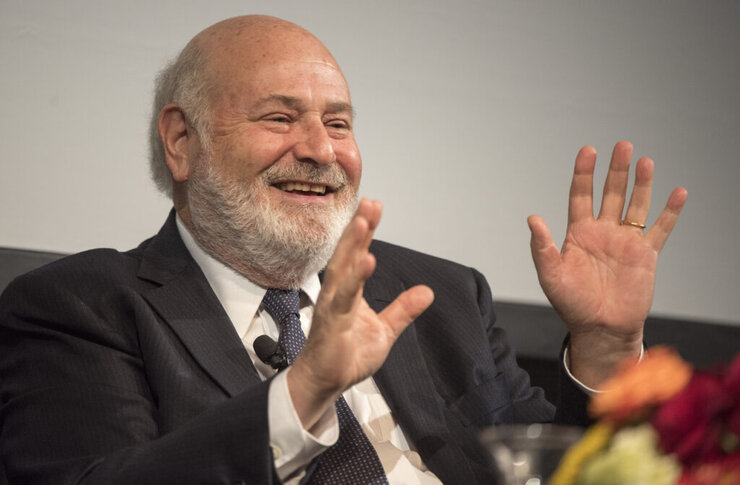
Director Rob Reiner participates in a discussion following a screening of the film LBJ at the LBJ Presidential Library in Austin, Texas on Saturday October 22, 2016 On Saturday evening October 22, 2016, the LBJ Presidential Library held a sneak peek of Rob Reiner’s new filmÊLBJ, starring Woody Harrelson as the 36th president. The film, which premiered at the Toronto International Film Festival in September, chronicles the life and times of Lyndon Johnson who would inherit the presidency at one of the most fraught moments in American history. Following the screening, director Rob Reiner, actor Woody Harrelson, and writer Joey Hartstone joined LBJ Library Director Mark Updegrove on stage for a conversation about the film. LBJ Library photo by Jay Godwin 10/22/2016
Hollywood Legend Rob Reiner and Wife Found Dead; Son in Custody
December 15, 2025
Renowned filmmaker and actor Rob Reiner, 78, and his wife Michele Singer Reiner, 68, were found dead in their Brentwood, Los Angeles home on Sunday, authorities say. Emergency responders were called to the residence Sunday afternoon, where both were discovered with fatal wounds consistent with a stabbing. Police are treating the case as a double homicide.
Los Angeles police arrested the couple’s 32-year-old son, Nick Reiner, in connection with the deaths. He is being held in custody as investigators continue to piece together the circumstances surrounding the incident.
2016 SAMHSA Voice Awards
Reiner was one of Hollywood’s most influential figures, known for his work as a director, producer and actor. His career spanned decades, from early television fame to directing beloved films that shaped American cinema.
Friends, colleagues and public figures have begun sharing tributes and reactions to the news as the investigation is ongoing.
More details will be updated as they become available.
FDA’s COVID-19 Vaccine Safety Claims Lack Solid Evidence—Why Overreaction Could Harm Public Health
COVID-19 vaccine safety: The FDA’s claims about COVID-19 vaccine deaths in children lack strong evidence and could restrict vaccine access. Learn why experts say VAERS reports aren’t proof, and how overreacting may harm public health and trust in vaccines.
The death of children due to an unsafe vaccine is a serious allegation. I am a pediatric cardiologist who has studied the link between COVID-19 vaccines and heart-related side effects such as myocarditis in children. To my knowledge, studies to date have shown such side effects are rare, and severe outcomes even more so. However, I am open to new evidence that could change my mind. But without sufficient justification and solid evidence, restricting access to an approved vaccine and changing well-established procedures for testing vaccines would carry serious consequences. These moves would limit access for patients, create roadblocks for companies and worsen distrust in vaccines and public health. In my view, it’s important for people reading about these FDA actions to understand how the evidence on a vaccine’s safety is generally assessed.
Determining cause of death
The FDA memo claims that the deaths of these children were directly related to receiving a COVID-19 immunization. From my perspective as a clinician, it is awful that any child should die from a routine vaccination. However, health professionals like me owe it to the public to uphold the highest possible standards in investigating why these deaths occurred. If the FDA has evidence demonstrating something that national health agencies worldwide have missed – widespread child deaths due to myocarditis caused by the COVID-19 vaccine – I don’t doubt that even the most pro-vaccine physician will listen. So far, however, no such evidence has been presented. While a death logged in VAERS is a starting point, on its own it is insufficient to conclude whether a vaccine caused the death or other medical causes were to blame. To demonstrate a causal link, FDA staff and physicians must align the VAERS report with physicians’ assessments of the patient, as well as data from other sources for monitoring vaccine safety. These include PRISM, which logs insurance claims data, and the Vaccine Safety Datalink, which tracks safety signals in electronic medical records. It’s known that most deaths logged only in VAERS of children who recently received vaccines have been incorrectly attributed to the vaccines – either by accident or in some cases on purpose by anti-vaccine activists.
Heart-related side effects of COVID-19 vaccines
In his Substack and Twitter accounts, Prasad has said that he believes the rate of severe cardiac side effects after COVID-19 vaccination is severely underestimated and that the vaccines should be restricted far more than they currently are. In a July 2025 presentation, Prasad quoted a risk of 27 cases per million of myocarditis in young men who received the COVID-19 vaccine. A 2024 review suggested that number was a bit lower – about 20 cases out of 1 million people. But that same study found that unvaccinated people had greater risk of heart problems after a COVID-19 infection than vaccinated people. In a different study, people who got myocarditis after a COVID-19 vaccination developed fewer complications than people who got myocarditis after a COVID-19 infection. Existing vaccine safety infrastructure in the U.S. successfully identifies dangers posed by vaccines – and did so during the COVID-19 pandemic. Today, most COVID-19 vaccines in the U.S. rely on mRNA technology. But as vaccines were first emerging during the COVID-19 pandemic, two pharmaceutical companies, Janssen and AstraZeneca, rolled out a vaccine that used a different technology, called a viral vector. This type of vaccine had a very rare but genuine safety problem that was detected.A report in VAERS is at most a first step to determining whether a vaccine caused harm. VAERS, the Vaccine Safety Datalink, clinical investigators in the U.S. and their European counterparts detected that these vaccines did turn out to cause blood clotting. In April 2021, the FDA formally recommended pausing their use, and they were later pulled from the market. Death due to myocarditis from COVID-19 vaccination is exceedingly rare. Demonstrating that it occurred requires proof that the person had myocarditis, evidence that no other reasonable cause of death was present, and the absence of any additional cause of myocarditis. These factors cannot be determined from VAERS data, however – and to date, the FDA has presented no other relevant data.
A problematic vision for future vaccine approvals
Currently, vaccines are tested both by seeing how well they prevent disease and by how well they generate antibodies, which are the molecules that help your body fight viruses and bacteria. Some vaccines, such as the COVID-19 vaccine and the influenza vaccine, need to be updated based on new strains. The FDA generally approves these updates based on how well the new versions generate antibodies. Since the previous generation of vaccines was already shown to prevent infection, if the new version can generate antibodies like the previous one, researchers assume its ability to prevent infection is comparable too. Later studies can then test how well the vaccines prevent severe disease and hospitalization. The FDA memo says this approach is insufficient and instead argues for replacing such studies with many more placebo-controlled trials – not just for COVID-19 vaccines but also for widely used influenza and pneumonia vaccines. That may seem reasonable theoretically. In practice, however, it is not realistic. Today’s influenza vaccines must be changed every season to reflect mutations to the virus. If the FDA were to require new placebo-controlled trials every year, the vaccine being tested would become obsolete by the time it is approved. This would be a massive waste of time and resources.Influenza vaccines must be updated for every flu season.Jacob Wackerhausen/iStock via Getty Images Plus Also, detecting vaccine-related myocarditis at the low rate at which it occurs would have required clinical trials many times larger than the ones that were done to approve COVID-19 mRNA vaccines. This would have cost at least millions of dollars more, and the delay in rolling out vaccines would have also cost lives. Placebo-controlled trials would require comparing people who receive the updated vaccine with people who remain unvaccinated. When an older version of the vaccine is already available, this means purposefully asking people to forgo that vaccine and risk infection for the sake of the trial, a practice that is widely considered unethical. Current scientific practice is that only a brand-new vaccine may be compared against placebo. While suspected vaccine deaths should absolutely be investigated, stopping a vaccine for insufficient reasons can lead to a significant drop in public confidence. That’s why it’s essential to thoroughly and transparently investigate any claims that a vaccine causes harm.